
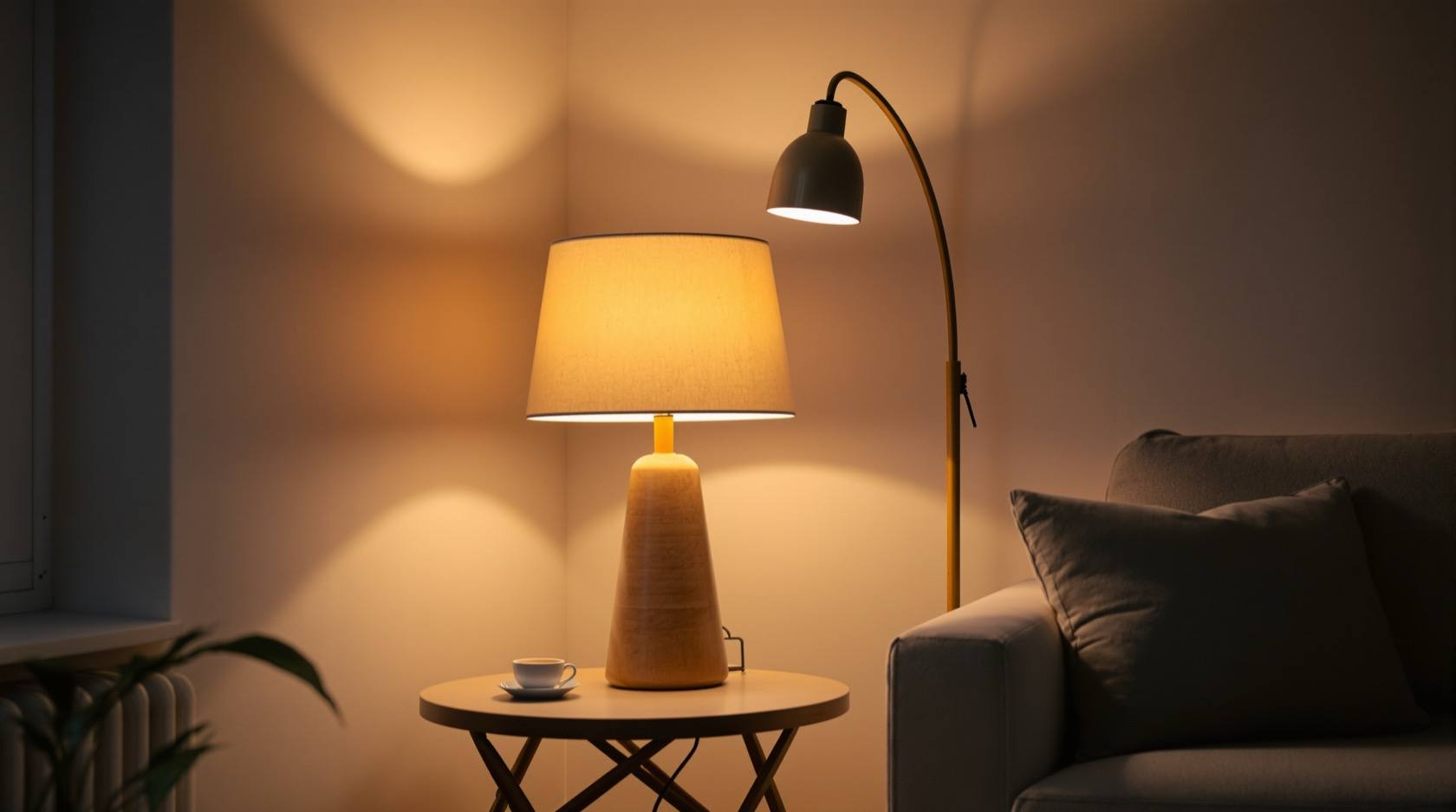
Table Lamps, Floor Lamps & Portable Lighting: The Easy Layer (2026)
The design guide to plug-and-play lighting — table lamps, floor lamps, reading and desk lamps, and rechargeable cordless lamps — the one lighting layer you can add to any Indian home, rented or owned, with no electrician and no wiring.
Every other lighting layer asks you to open a wall. Recessed downlights, cove strips, wall sconces, pendants — they all mean an electrician, a chase cut into the plaster, a circuit, and a landlord's permission you may never get. Portable lamps are the exception. A table lamp or floor lamp arrives in a box, plugs into a socket you already have, and switches on. That single fact — no wiring, no electrician, fully movable — makes portable lighting the most useful layer in the Indian home, and the most under-used. Countless living rooms and bedrooms here still run on one harsh tube or ceiling light and nothing else, when a lamp or two would transform the room in an afternoon.
This is the design guide to that easy layer: what the lamp types are and what each one is for, the handful of height and placement numbers that separate a lamp that flatters a room from one that glares, and how to build a whole layered scheme out of lamps alone. It sits inside the complete guide to lighting in India and is the plug-and-play cousin of the hard-wired wall lights and sconces.
Scope & how to read this. This is a design and specification guide, not a wiring manual. Lamps are plug-and-play by nature, so the safety notes here are about cords, heat, sockets and stable bases — but if you ever want a lamp hard-wired, a switched wall socket added, or a dimmer built into the wall, that is electrical work for a licensed electrician, and it is safety-critical. Colour-temperature and CRI depth lives in the Electrical hub; automation lives in the Smart Home hub. All heights, wattages and cost bands are indicative planning aids — get local quotes.
Why portable lamps matter more than you think
A ceiling light fills a room from a single high point. It is efficient and it is flat — everything gets the same wash from above, corners fall dark, and faces sit under a hard top-down glare. Lamps do the opposite, and that is exactly why a room needs them.
- Instant layering. Lamps put light at table and floor level, not just the ceiling — the second and third layers of a proper scheme. This is the fastest way to get the effect described in layered lighting without touching a wire.
- Warmth at a low level. Light low in the room, glowing through a shade, reads as calm and intimate. The same lumens from the ceiling read as clinical. Lamps are how you get the pooled, restful evening light Indian homes so often lack.
- They fill the corners the ceiling misses. A central light leaves the edges of a room dim; a lamp in a corner or on a console pushes light into exactly the dead zones a downlight cannot reach.
- Renter-friendly and reversible. No holes, no landlord conversation, nothing left behind. You unplug them and they move to the next home.
- Flexible and re-arrangeable. Rearrange the furniture, move the lamp. Change the mood, swap the bulb. Nothing else in your lighting scheme is this forgiving.
The result is that lamps are the accent and ambient layer most Indian homes are missing — the difference between "the lights are on" and a room that actually feels good after dark. For the theory of why a room needs several sources at different heights, see functional vs ambient vs accent lighting; one of the most common failures in lighting mistakes is relying on a single ceiling source and skipping this layer entirely.
The portable lamp family
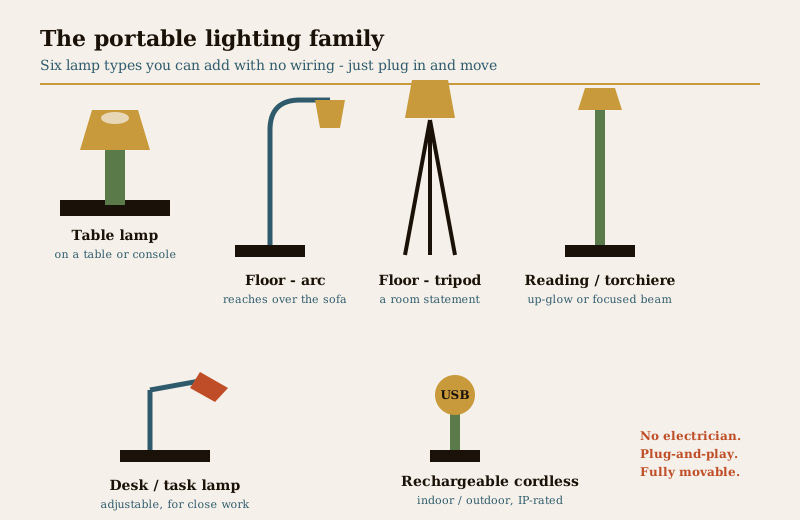
"Lamp" covers a surprising range. Knowing what each type is actually good at is half the design decision.
| Lamp type | What it does | Best used for |
|---|---|---|
| Table lamp | Mid-level pool of soft light through a shade | Bedsides, consoles, side tables, sideboards — the everyday warm glow |
| Floor lamp — arc | Curves out and over, dropping light where a table cannot reach | Reading light over a sofa or bed without a side table under it |
| Floor lamp — tripod | A sculptural, freestanding source and a room statement | Living-room corners, filling a bare vertical gap beside seating |
| Reading / torchiere floor lamp | Either a focused down-beam for reading, or an up-glow (torchiere) that bounces off the ceiling for soft ambient light | A reading chair (down-beam) or a dim corner needing gentle fill (torchiere) |
| Desk / task lamp | Adjustable arm delivering focused light onto a work surface | Study desks, work-from-home stations, dressing tables, homework |
| Rechargeable cordless lamp | Battery-powered, no cord at all; many are IP-rated for outdoors | Dining tables, balconies, terraces, pooja corners, festive and power-cut light |
The rechargeable cordless lamp deserves a special mention for Indian homes. Because it carries its own battery, it goes where no socket exists — the centre of a dining table, a balcony ledge, a terrace dinner — and if it is IP44 or IP65 rated per IS/IEC 60529, it survives a splash or a monsoon-damp balcony. During a power cut it keeps glowing. It is the one lamp that is genuinely wireless.
The design numbers that actually matter
Lamps go wrong in two ways: wrong height, so you stare into a bare bulb, and wrong position, so they cast shadows or glare. A few numbers fix both.
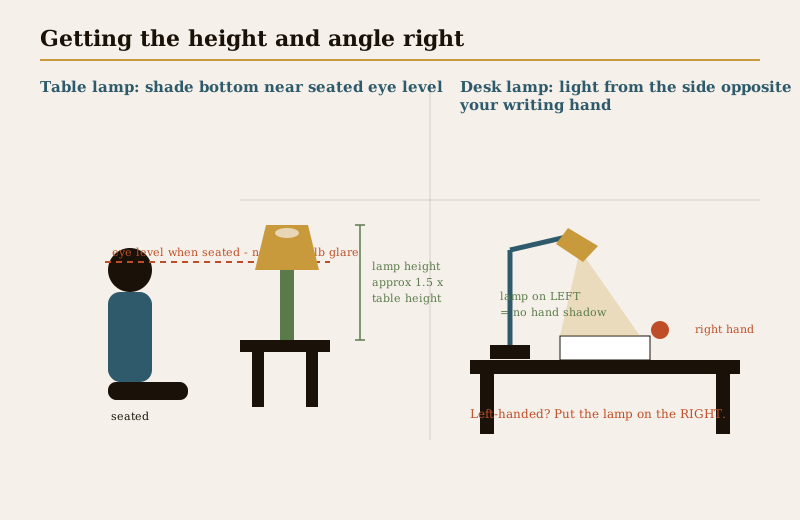
Table-lamp height
The rule that fixes almost everything: the bottom of the shade should sit at roughly eye level when you are seated beside it. Sit on the sofa or in bed, and your eye should meet the lower edge of the shade — so the shade hides the bulb and you see glow, not filament. Too tall and the lit bulb blazes into your eyes; too short and it only lights the table.
As a starting proportion, a table lamp is usually about 1.5 times the height of the table it stands on — a taller side table wants a shorter lamp, a low one a taller lamp. On a bedside table, the switch should fall to hand from the pillow. Pick the lamp to suit the seat, then confirm by sitting down and checking the bulb is out of sight.
Floor-lamp placement
A floor lamp earns its place beside something you sit in. Put it just behind or to the side of a sofa or reading chair, roughly at shoulder height when seated, so light falls over your shoulder onto a book or the seat — not into the eyes of the person opposite. In a bare corner, a tripod or torchiere lifts the darkness and adds a vertical accent where furniture leaves a gap. An arc lamp is the trick for a sofa that has no side table: the base sits to one side and the head reaches out over the seat.
Desk-lamp position
For a task lamp, the one rule is about shadows: place the light on the side opposite your writing hand. Right-handed, the lamp goes on the left; left-handed, on the right. Otherwise your own hand throws a shadow across exactly what you are writing. Set it so the shade shields the bulb from your eyes and the pool lands on the work, and keep task light within the lux levels that reading and close work need — a topic the technical home lighting design guide covers in depth.
Shades, diffusion and the quality of the glow
Two lamps with the same bulb can feel completely different because of the shade. The shade is the design.
- Opaque shade (fabric, metal, dark). Blocks light sideways and pushes it up and down — you get two bright pools, above and below, and a crisp, contained puddle of light. Good over a reading chair or to graze a wall. Directional, dramatic, low ambient spill.
- Translucent shade (light linen, paper, frosted glass). Lets the bulb glow through the whole surface, so the shade itself becomes a soft, warm object filling the room with gentle ambient light. This is the "lantern" effect — the shade glows, not just the space under it.
For most living rooms and bedrooms, a translucent or light-coloured shade gives the warmer, more flattering result. Reserve opaque shades for task and accent spots where you want the light aimed, not spread. A dark shade with a low-wattage warm bulb is a beautiful accent; the same shade as your only light source leaves the room gloomy.
Bulbs, colour temperature and dimming
A lamp is only as good as the bulb in it — and here the plug-and-play story gets even better, because you swap bulbs freely.
- Go warm. For living rooms and bedrooms, choose warm white, around 2700K, sometimes down to 2400K for a candle-like evening glow. Cool daylight bulbs in a lamp kill the intimacy that is the whole point. Match colour temperatures across your lamps so the room reads as one warm scene — the reasoning is in colour temperature and CRI.
- Choose good colour rendering. A high-CRI LED (look for a high Ra on the box, and a BEE star rating for efficiency) makes skin, wood and fabric look right rather than washed-out. Cheap low-CRI bulbs make a warm room look sickly.
- Make it dimmable. This is the single upgrade that turns a lamp from a light into a mood tool. A dimmable warm smart bulb — screwed into an ordinary lamp, controlled from your phone or voice — lets one lamp go from bright reading light to a dim evening glow with no dimmer switch and no wiring. It is the easiest, most reversible smart-lighting move a renter can make. Explore the options in the smart lighting guide.
Because the bulb sits in a plug-in lamp, you get dimming, colour-tuning and scheduling entirely wirelessly. A room full of smart-bulb lamps is a fully dimmable, scene-controllable scheme that touched no wall.
Composing with lamps: pairs, heights and depth
Lamps are as much about arrangement as about the lamps themselves.
- Pair for symmetry. Matching lamps flanking a bed, a sofa, or a console give a calm, balanced, deliberately styled look — the classic pair of bedside lamps, or two lamps bookending a sideboard. Symmetry reads as considered.
- Mix heights for depth. In a whole room, vary the level of your light sources: a low table lamp, a mid-height lamp on a console, a tall floor lamp in a corner. Several pools at different heights give a room dimension and softness that one flat ceiling wash never will. This staged, layered feel is what makes a room look designed — see how it plays out across a home in the apartment lighting planning guide and the bedroom design ideas.
- Balance warm and cool spots by purpose. Warm lamps for lounging and reading; a cooler, brighter desk lamp for the work corner — different jobs, different light, in the same room.
Lamps are also the friendliest way to add decorative lighting: a sculptural tripod, a coloured-glass table lamp or a paper-shade floor lamp is furniture and light at once.
The renter's whole-room scheme — no wiring at all
Here is the most powerful idea in this guide: you can build a complete, layered, mood-controlled lighting scheme using nothing but portable lamps and smart bulbs — no electrician, nothing drilled, everything reversible.
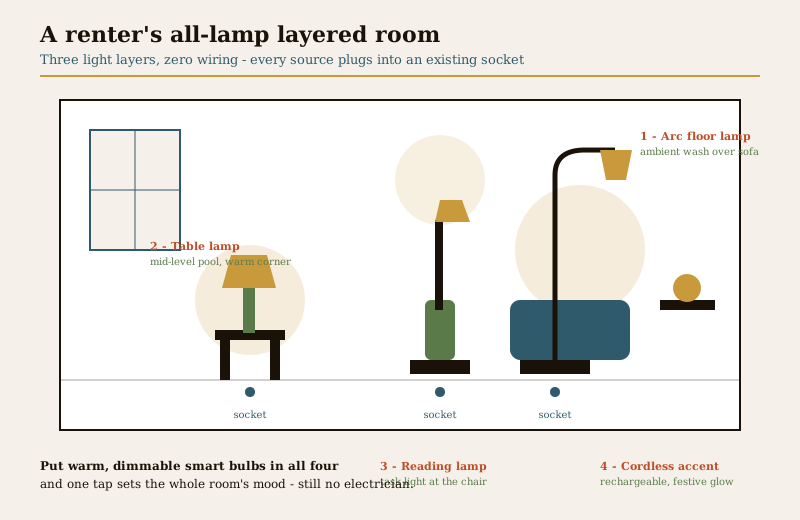
A three-layer scheme, entirely plug-in:
1. Ambient layer — an arc or torchiere floor lamp washing a wall or ceiling, giving the whole room a soft base glow instead of the flat tube overhead.
2. Task layer — a reading floor lamp beside the chair and a desk lamp at the work spot, each delivering focused light where you actually need it.
3. Accent layer — a table lamp glowing on a console and a rechargeable cordless lamp on a shelf or in a corner, adding warmth and highlighting the room's nicer things.
Put warm, dimmable smart bulbs in all of them, and one tap on your phone sets the whole room from "bright" to "movie night." You never touched a wall. When you move, it all comes with you. For renters — and for anyone who does not want the disruption and cost of rewiring — this is the entire lighting scheme, delivered from a few sockets.
India context: the under-used layer, and the festive glow
Indian homes have historically leaned on strong overhead light and skipped lamps — a hangover from an era when a bright room signalled a well-kept one. But a single bright tube is exactly the light that makes an evening room feel like an office. Bedside lamps in particular are missing from most homes: a warm, dimmable bedside lamp is the difference between a bedroom you switch off harshly and one you wind down in.
Lamps also shine in the Indian festive calendar. A cluster of warm table lamps and a rechargeable cordless glow turn a corner into a Diwali or festival setting far more gracefully than a hard ceiling light — a soft, low, golden light that flatters faces, rangoli and the pooja corner alike. A cordless lamp on the dining table or balcony extends that glow to where no socket reaches, and rides out the power cut that so often arrives mid-celebration.
Safety and practical notes
Portable does not mean careless. A few habits keep lamps safe.
- Manage the cords. Route cables along walls and behind furniture, never across a walkway where someone trips or a child tugs. Do not run cords under rugs (heat) or through doorways.
- Give heat room. LEDs run cool, but keep any shade clear of the bulb and never drape fabric over a warm lamp. Use LED bulbs within the lamp's stated wattage.
- Choose a stable, weighted base — especially a floor lamp in a home with children or pets, where a top-heavy lamp is a tipping hazard. Position tall lamps out of the main traffic path.
- Match the socket load. A lamp draws little, but do not chain it through an overloaded multi-plug board. If you find yourself wanting a switched socket, an extra point, or a wall dimmer, that is the moment to call a licensed electrician — cords and adapters are your job, wiring is theirs.
- Outdoors, check the IP rating. Only use a lamp rated for damp or wet locations (IP44 or higher per IS/IEC 60529) on a balcony or terrace.
How it connects
- Start from the complete guide to lighting in India, then see where lamps fit in the layered lighting guide and the difference between the functional, ambient and accent roles a lamp can play.
- For the hard-wired cousin of a portable lamp, read wall lights and sconces; to avoid the single-source trap lamps solve, see common lighting mistakes.
- Turn any lamp into a mood tool with the smart lighting guide, and get the bulb right with colour temperature and CRI.
- Treat a lamp as an object as well as a light in decorative lighting, plan it across a home with the apartment lighting planning guide, and see lamps in context in the bedroom design ideas.
- Size task light with the lux level calculator.
Key takeaways
- Portable lamps are the one lighting layer that needs no electrician — plug-and-play, movable, reversible, and perfect for renters and anyone avoiding rewiring.
- They add the low-level, warm, corner-filling light a ceiling fixture cannot, which is why most Indian homes feel under-lit at night without them.
- Get two numbers right: a table lamp's shade bottom at seated eye level (about 1.5x the table height), and a desk lamp on the side opposite your writing hand.
- Translucent shades spread ambient glow; opaque shades aim the light — choose by the job.
- A warm, dimmable smart bulb turns any lamp into a mood tool with no wiring — the easiest smart-lighting move there is.
- You can build a complete three-layer scheme from lamps and smart bulbs alone — ambient, task and accent — touching no wall.
- All heights, wattages and cost bands are indicative — confirm against IS 3646, NBC (SP 7:2026) and product ratings, get local quotes, and leave any actual wiring to a licensed electrician.
References
- National Building Code of India, NBC (SP 7:2026), Bureau of Indian Standards — general illumination and lighting provisions (named generally).
- IS 3646 — code of practice for interior illumination and recommended lux levels for living, reading and work areas (named generally).
- IS 10322 / IEC 60598 and IS 16107 — luminaire safety and LED luminaire performance for lamps and portable fittings (named generally).
- IS / IEC 60529 — IP rating classification (e.g. IP20 dry, IP44 splash, IP65 outdoor) for cordless and outdoor-rated lamps.
- BEE star rating for LED lamps and bulbs — energy efficiency guidance (named generally).
All lamp heights, proportions, wattages, colour-temperature values and cost bands here are indicative design aids only; confirm the governing figures against IS 3646, NBC (SP 7:2026) and product ratings, get local quotes, and engage a licensed electrician for any wiring, switched-socket, dimmer or hard-wired work — electrical work is safety-critical.
Export this guide
Related Guides — Deep-dive reading
Lighting Controls & Dimming Design: Zones, Scenes & Switches (2026)
How to plan lighting control so an Indian home's light is flexible — split each room's layers onto separate switches, choose dimmers that actually work with LEDs, add two-way switching where you need it, and layer scenes on top. The design decisions you must settle before the electrician wires.
LightingLighting Design Principles: The Rules Good Schemes Follow (2026)
The design rules that separate a room that feels considered from one that feels like a floodlit hall — layering on separate controls, glare control, colour-temperature discipline, direction and shadow, lighting at different heights, and washing the walls — written for the Indian home.
LightingLiving Room Lighting Design for Indian Homes (2026)
The design guide to lighting the most-used, most-layered room in the house - how to build a flexible, dimmable, multi-scene living room scheme with ambient, task, accent and decorative layers, warm evening light, a comfortable TV wall and open-plan zoning.
LightingRelated Tools — Try Free
Apartment Furniture Size Chart
Standard furniture dimensions for Indian apartments — sofas, beds, tables, dining, storage.
Reference ChartApartment Interior Planning Checklist
51-item checklist across structural, ceiling, lighting, furniture, storage, electrical, kitchen, bathroom.
ChecklistCross-Ventilation Analyzer
Estimate airflow and air changes per hour (ACH) from room size, window areas, layout, and local wind — with NBC 2016 Part 8 compliance check.
Ventilation Calculator