
Bathroom Lighting Design: Mirror, Ambient & IP Zones (2026)
How to light an Indian bathroom so the mirror is shadow-free and the wet zones are safe — the vanity task light that makes or breaks grooming, the ambient and accent layers, colour temperature and CRI for true skin tones, and the IP-rating wet-zone rules a licensed electrician must wire.
The bathroom is the one room where you put your face a foot from a mirror in artificial light every single morning — and it is the room most people light with a single downlight dropped in the ceiling as an afterthought. That one fitting is the reason you look tired, patchy or half-shaved when you leave the house, and it is why makeup done at the basin can look completely wrong once you step into daylight. Bathroom lighting is really two problems wearing one coat: getting the light on your face right, and keeping electricity and water safely apart.
This is the room-by-room bathroom guide for the Studio Matrx Lighting hub. It shows you how to layer the scheme, where the vanity light must sit, what colour and brightness flatter skin, and — the part that is genuinely life-safety — which fixtures are allowed in which wet zone. For the underlying theory of the three layers, read functional vs ambient vs accent lighting; for skin-accurate colour, colour temperature and CRI.
Scope & how to read this. This is a design and specification guide — it helps you plan the layers, choose fixtures and set the mood so you can brief an electrician and shop with confidence. Every lux, kelvin and rupee figure is indicative for planning, not a firm spec — confirm against IS 3646, NBC (SP 7:2026) and product datasheets. Water and electricity together are life-safety. Every fixture, its IP rating, low-voltage supply and RCD/earth-leakage protection must be selected and wired by a licensed electrician to the electrical safety rules. Do not treat any wiring, zoning or fitting choice here as DIY guidance — get it inspected and certified.
The mirror mistake — and the fix
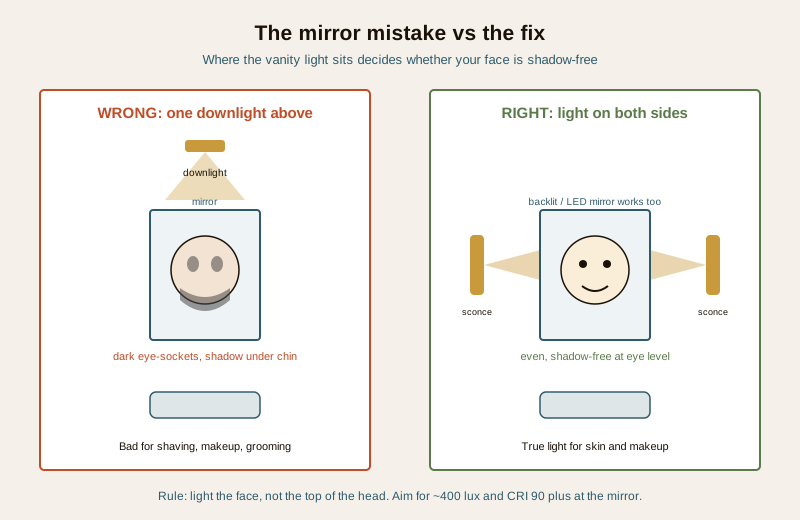
Almost every badly lit bathroom makes the same error: a single recessed downlight in the ceiling, sometimes directly above the mirror. Because the light comes from straight overhead, it drops your brow bone into shadow, hollows out the eye sockets, and throws a hard shadow under the nose and chin. You are lighting the top of your head, not your face. Shaving, plucking, makeup and skincare all suffer — you are working blind exactly where you need to see.
The fix is a principle, not a product: light the face from the sides, at roughly eye level. Any of these deliver it:
- A pair of vertical sconces or wall lights, one on each side of the mirror, mounted at about face height. This is the gold standard — light arrives from left and right and cancels shadows. See wall lights and sconces for fixture choices.
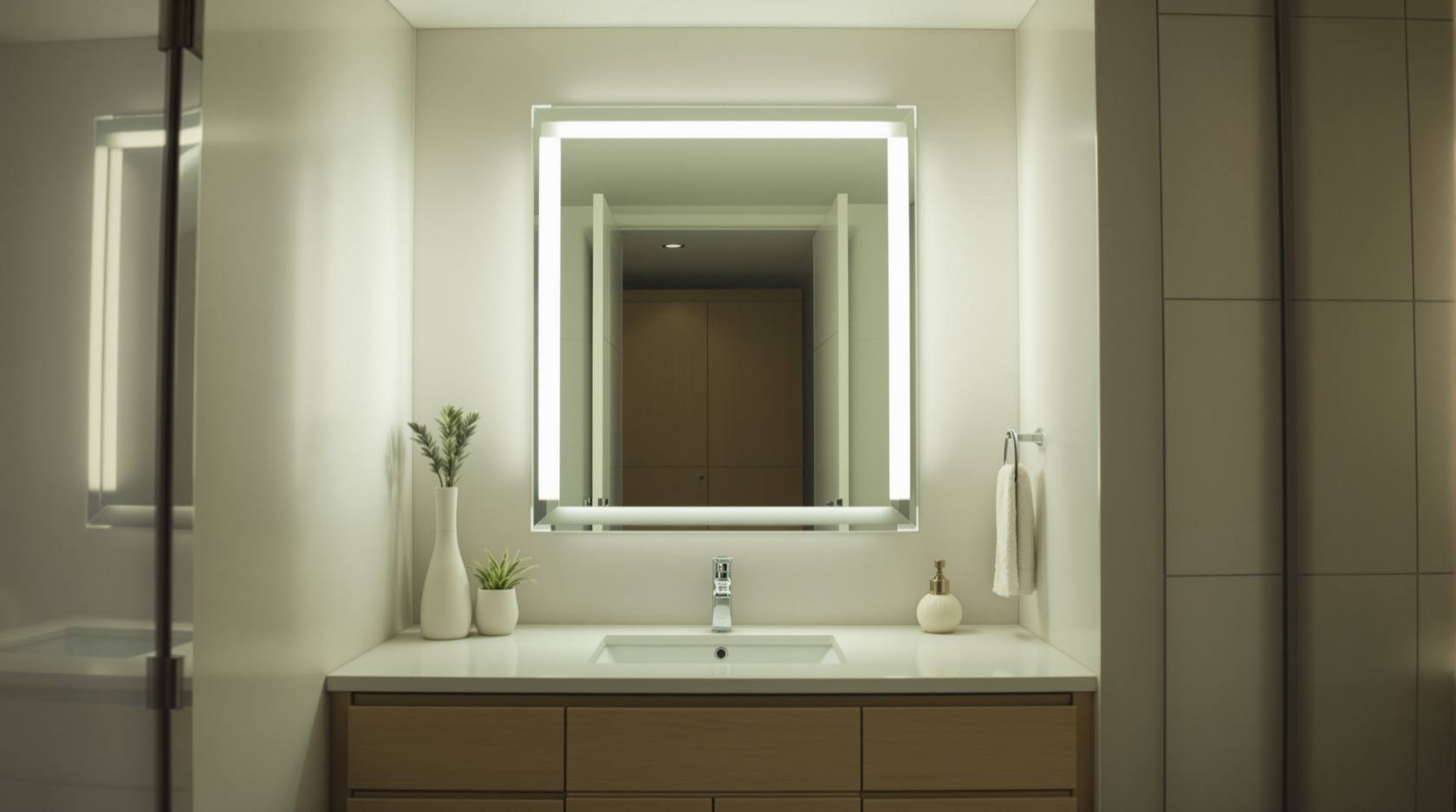
- A backlit or LED-edge mirror, where the glow rings the whole mirror and wraps the face evenly. Clean, modern, and space-saving in small Indian bathrooms.
- A good horizontal vanity bar with a diffused lens mounted above the mirror — the budget compromise. It is better than a bare downlight because the diffuse spread reaches down the face, but true side lighting still wins.
What to avoid: a single spotlight above, a bright light behind you casting your own shadow onto the mirror, and any fitting so glary it dazzles you at the basin. If you can only change one thing in your bathroom, move the light to the sides of the mirror.
The three layers of a bathroom
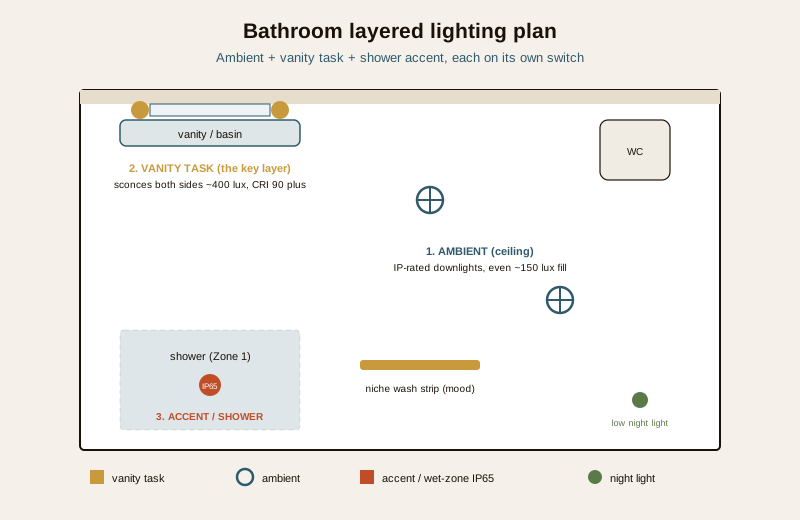
A well-lit bathroom, like any room, works in layers — but here the task layer at the mirror carries far more weight than usual, and one layer (accent, in wet zones) has hard safety limits.
- Ambient (ceiling). The general fill that lets you see the whole room safely — moving around, cleaning, finding things. Usually IP-rated recessed downlights or a flush ceiling fixture, spread evenly so there are no dark corners around the WC or behind the door.
- Vanity task (the key one). Focused, shadow-free light at the mirror for grooming. This is the layer that decides whether the bathroom "works". Get it wrong and no amount of ambient light rescues you.
- Accent (mood, niche, shower wash). The optional layer that lifts the room from functional to hotel-like — a warm strip light washing a shower niche or under the vanity, a downlight grazing a feature-tile wall, a soft glow for an evening soak. In wet zones this must be wet-rated and low-voltage.
Put each layer on its own switch. You want to flood the room for cleaning, but only the mirror on at 6 am, and only a low glow at night. One switch for everything is the second most common bathroom mistake after the mirror. The layered lighting guide explains the discipline in full.
Colour temperature & CRI — so your face tells the truth
This matters more in the bathroom than anywhere else, because the bathroom is where you judge your skin, hair and makeup — and then walk out into the world under different light.
- Colour temperature (kelvin). Aim for neutral white, roughly 3000K to 4000K. Around 3000K is warm and flattering; 4000K is crisper and reads cleaner and more "awake" for the morning routine. Below 2700K everything goes yellow and you cannot judge colour; above 5000K the room feels clinical and cold. Many prefer 3500K to 4000K at the mirror and a warmer 3000K for the ambient and evening layers. A tunable fitting, or the colour temperature selector, lets you dial it in.
- CRI (colour rendering index). This is the one people ignore and regret. Insist on high CRI — 90 or above — at the mirror. A low-CRI bulb (many cheap LEDs sit at 70 to 80) distorts reds and skin tones, so makeup applied under it looks natural in the bathroom and wrong in daylight or office light. High CRI means the colours you see are the real ones. Read the deep colour temperature and CRI guide before you buy.
A practical Indian tip: match your mirror light to the daylight your face will actually be seen in most of the day. If you leave for a naturally lit office, aim for cool-neutral, high-CRI light so there are no nasty surprises at 10 am.
Brightness — how much light, and where
Bathrooms are small, so the numbers are modest, but they are not uniform — the mirror needs far more than the floor. These are indicative planning figures; confirm task levels against IS 3646.
| Area / task | Indicative level | Notes |
|---|---|---|
| General ambient (whole room) | ~100 to 150 lux | Even fill, no dark corners; higher for large or dark-tiled bathrooms |
| Mirror / vanity (grooming) | ~350 to 500 lux on the face | The key layer; from the sides, high CRI |
| Shower enclosure | ~150 to 200 lux | Wet-rated fitting; enough to see clearly and safely |
| WC / general moving-about | ~100 lux | Comfortable, not glary |
| Night / low use | ~5 to 20 lux | Warm, low, motion or separate switch — no dazzle at 2 am |
Dark tiles, stone and deep colours drink light — a charcoal-tiled bathroom can need nearly double the lumens of a white one to reach the same brightness. Layer up and use dimmers or a separate low-night circuit so you are never forced to choose between "blinding" and "off".
Vanity lighting at a glance
The vanity is where the design lives or dies. This table compares the realistic ways to light it.
| Vanity option | Shadow control | Best for | Watch-outs |
|---|---|---|---|
| Sconces both sides at face level | Excellent — light cancels shadows | The definitive grooming setup | Needs wall space beside the mirror; wire before tiling |
| Backlit / LED-edge mirror | Very good — even wrap of light | Small or narrow bathrooms; modern look | Buy a good one; check CRI and that it is bathroom-rated |
| Vanity bar above the mirror (diffused) | Fair — better than a downlight | Budget upgrades, retrofits | A bar alone still slightly shadows the lower face |
| Single downlight above mirror | Poor — casts face shadows | Nothing; this is the mistake | Avoid; add side light if you are stuck with it |
| Ceiling light only, no vanity light | Very poor | Storerooms, not bathrooms | The default builder setup — always add a mirror layer |
Add a mirror demister pad behind a good LED mirror if your bathroom steams up — it keeps the glass clear without a separate fan blast, which matters in humid coastal and monsoon conditions. And plan for a low night light: a warm, dim, separately switched (or motion-sensor) fitting so a 2 am visit does not mean flooding the room and jolting yourself awake. Model your basin and room quickly with the bathroom lighting calculator.
IP ratings & wet zones — the safety section
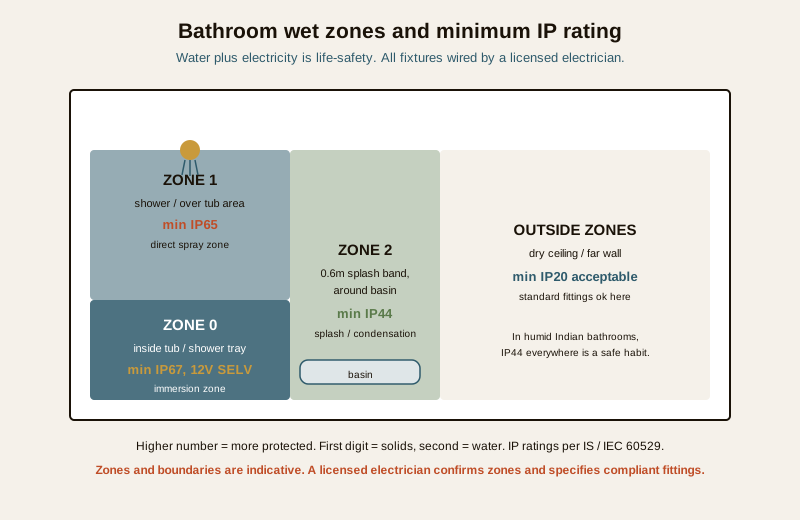
This is the part to take seriously. A bathroom mixes standing water, spray, steam and bare skin with mains electricity — a combination that is life-threatening if a fitting is not sealed and protected. Fixtures are graded by an IP rating (Ingress Protection, per IS / IEC 60529): the first digit is protection against solids, the second against water. Higher is more protected. The bathroom is divided into zones by how much water reaches them, and each zone has a minimum IP rating.
| Zone | Where it is | Minimum IP | Example fitting |
|---|---|---|---|
| Zone 0 | Inside the tub or shower tray (immersion) | IP67, 12V SELV low-voltage | Sealed low-voltage recessed floor/tray light |
| Zone 1 | Directly above the tub/in the shower, up to ~2.25m | IP65 | Sealed IP65 downlight or shower light |
| Zone 2 | ~0.6m band around Zone 1, and around the basin | IP44 | Splash-proof downlight, IP44 wall light |
| Outside zones | Dry ceiling / far wall | IP20 (standard) | Ordinary indoor fitting |
Read the whole zone map here, then hand it to your electrician:
Non-negotiables, all of which are your electrician's job, not yours:
- Right IP for the zone. Never put an unrated indoor fitting in a shower or over a tub. In India's humid climate, defaulting to IP44 or better across the whole bathroom is a sensible, safe habit even outside the strict zones.
- Low voltage where required. Zone 0 (and often Zone 1) needs extra-low-voltage (SELV, typically 12V) supply via a transformer sited outside the wet zone.
- RCD / earth-leakage protection. The whole bathroom circuit must be on a residual-current device so a fault trips in milliseconds. This is a wiring requirement — confirm it exists.
- Correct switching. Pull-cord or outside-the-room switches for wet zones as required; no reachable-from-the-bath switches or sockets.
- Licensed, certified work. All of the above is designed, installed and certified by a licensed electrician to the electrical safety code. Water plus electricity leaves no room for "the local guy will manage" — this is the one section where cutting corners can kill.
Ventilation-light combo units (an exhaust fan with an integral light, often with a heater) are popular and useful in windowless or monsoon-damp bathrooms — buy a bathroom-rated unit and have it wired and vented properly; it is still electrical work in a wet room.
Small & windowless bathrooms
Most Indian apartment bathrooms are small, and many internal ones have no window at all — so artificial light does the whole job, all day.
- Layer even harder. With no daylight, ambient plus a strong vanity layer plus a little accent is what stops the room feeling like a cupboard. Do not rely on one central fitting.
- Light-coloured surfaces multiply light. Pale tiles, a large mirror and light grout bounce your lumens around; dark schemes need noticeably more output to feel bright.
- A backlit mirror earns its place — it adds light exactly where you need it without eating ceiling space or casting shadows.
- Pair light with ventilation. A windowless bathroom needs a good exhaust anyway; a vent-light combo tackles both, and clearing steam keeps the mirror and fittings usable.
- Warm, low night light matters most here, where there is no ambient glow from a window to navigate by.
For the wider planning picture in compact homes, see apartment lighting planning and the residential lighting design guide.
How it connects
- Start at the complete guide to lighting — the pillar — and the residential lighting design guide for the whole-home view.
- Nail the theory behind this room: functional vs ambient vs accent lighting and colour temperature and CRI for skin-true light.
- Choose the mirror and accent fittings via wall lights and sconces and strip and profile lighting for niche washes.
- Avoid the classic errors in common lighting mistakes — the single-downlight mirror is the headline one.
- Hand all wiring, IP zoning, low-voltage supply and RCD protection to the electrical hub and a licensed electrician — non-negotiable in a wet room.
- Size it with the bathroom lighting calculator and dial in the mood with the colour temperature selector.
Key takeaways
- The mirror is everything. Light the face from both sides at eye level (twin sconces, a backlit mirror, or a diffused vanity bar) — never a single downlight above, which shadows the eyes and chin.
- Layer it and switch it separately — ambient ceiling fill, the crucial vanity task light, and optional accent/mood — so you can run the mirror alone at dawn and a low glow at night.
- Colour matters for your face: aim for 3000K to 4000K and insist on high CRI (90+) at the mirror, or makeup that looks right at the basin looks wrong in daylight.
- Brightness is uneven: ~100 to 150 lux ambient, ~350 to 500 lux on the face at the mirror; dark tiles need far more.
- Water plus electricity is life-safety. Match every fitting to its IP zone (IP65 in the shower/over the tub, IP44 near the basin, IP20 dry), use low-voltage where required, and have it all wired and certified by a licensed electrician on an RCD-protected circuit.
- In small or windowless bathrooms, layer harder, use pale surfaces and a backlit mirror, pair light with ventilation, and add a warm night light.
- Every figure here is indicative — confirm against IS 3646, NBC (SP 7:2026) and product datasheets, and get the electrical work inspected.
References
- IS 3646 — code of practice for interior illumination; recommended lux levels for bathrooms, vanities and general areas (named generally).
- National Building Code of India, NBC (SP 7:2026), Bureau of Indian Standards — general lighting and services provisions.
- IS / IEC 60529 — degrees of protection provided by enclosures (the IP rating system for wet-zone fixtures).
- IS 10322 / IEC 60598 — luminaire safety, including fittings for damp and wet locations (named generally).
- IS 16107 and BEE star rating — LED luminaire performance and energy efficiency.
- Licensed electrician and the National Electrical Code / local wiring rules — bathroom zoning, low-voltage supply, RCD/earth-leakage protection and certification.
All lux, kelvin, IP and cost figures here are indicative planning aids only; confirm the governing values against IS 3646, IS / IEC 60529, NBC (SP 7:2026) and product datasheets, get local quotes for cost, and have a licensed electrician design, install and certify every bathroom fixture, its wet-zone IP rating, low-voltage supply and earth-leakage protection.
Export this guide
Related Guides — Deep-dive reading
Bathroom Mirror Lighting India: Shadow-Free Vanity Light, Colour Temp, CRI & Cost (2026)
Why a single ceiling downlight throws ugly shadows on your face, how vertical sconces either side of the mirror beat a light bar above, when a backlit mirror is glow not task light, plus the colour temperature, CRI, mounting height, IP rating and 2026 rupee costs that actually get make-up and shaving right.
BathroomsBathroom Lighting India: The Complete Guide to Layers, Lux, Colour Temperature & IP Safety Zones (2026)
How to light an Indian bathroom properly — the three layers of ambient, task and accent light, the right lux levels and a neutral ~4000K colour temperature for grooming, the IP safety zones near water that decide which fitting goes where, waterproof fixtures, dimming and scenes, mirror lighting done right, motion sensors and energy.
BathroomsLED Bathroom Mirror India: Backlit vs Front-Lit, Colour Temperature, Cost & The Point Behind the Glass
A practical India-first guide to LED and backlit bathroom mirrors — integrated shadow-free face lighting, 2700K-6500K colour temperature and tunable white, halo backlight versus sandblasted front strips, plus the concealed electrical point, IP rating, demister and driver access you must plan behind the mirror before you tile.
BathroomsRelated Tools — Try Free
Cross-Ventilation Analyzer
Estimate airflow and air changes per hour (ACH) from room size, window areas, layout, and local wind — with NBC 2016 Part 8 compliance check.
Ventilation CalculatorBathroom Lighting Calculator
A lux-based bathroom lighting plan — total lumens, number of LED downlights, mirror task lighting and indicative wattage.
Bathroom CalculatorRoom Lighting Calculator
Estimate the target lux, total lumens and number of LED fixtures a room needs, from its type and size — a general-illumination planning guide.
Lighting