
Senior Citizen Safety Features in Home Elevators (India)
The cabin and control features that make a home lift genuinely safe and easy for an older person — automatic doors, level entry, handrail, fold-down seat, reachable contrasting controls, ARD and an alarm pendant.
A home lift can be the single feature that lets a parent or grandparent stay in their own multi-storey home for years longer. But a lift is only senior-friendly if its features match how an older body actually moves: less grip strength, slower balance reflexes, dimmer vision, harder hearing. A modern home lift is already very safe — door interlocks, an overspeed governor and safety gear, and battery rescue all work in the background. This guide is about the layer on top of that: the specific cabin and control features that make a lift genuinely easy and reassuring for a senior to use, every day, alone.
This is the safety-features lens. If you are still deciding whether and where to put a lift for ageing-in-place — lift versus stairlift, location near the bedroom, single-phase power — read the companion Lift planning for senior-friendly homes first. For the formal accessibility numbers behind these features, see Accessibility standards for residential lifts and the homeowner execution view in Accessible home design in India.
A useful test for every feature below: could my 78-year-old mother use it confidently, on a dim evening, with arthritic hands, while a little unsteady? If the answer is no, change the feature, not the person.
The senior-safety features at a glance
Each of these targets a specific age-related change. Treat the millimetre figures as indicative — confirm exact dimensions and options with your vendor and a licensed lift technician, ideally against the CPWD Harmonised Guidelines.
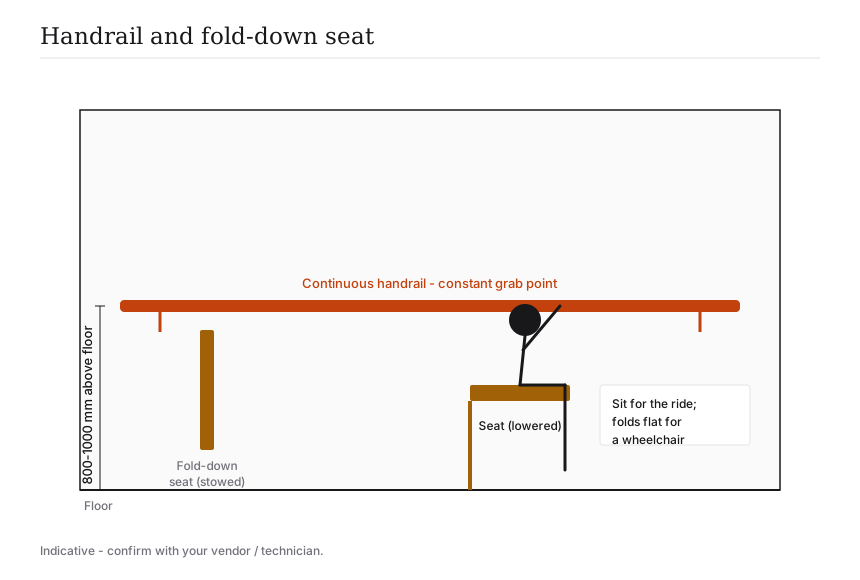
| Feature | Why it helps an older person |
|---|---|
| Automatic sliding/telescopic doors | No heavy manual swing door to pull or hold against; the car waits with doors open. Removes a real fall and strain risk. |
| Level, flush car entry (no step, no gap) | Eliminates the trip hazard between landing and car — the commonest cause of a stumble at the threshold. |
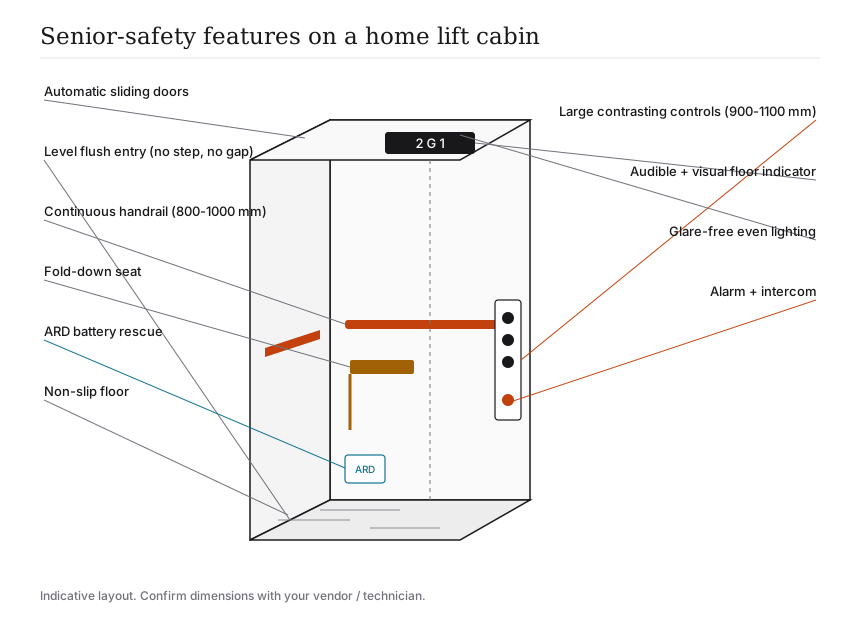
| Generous car (≈1100 × 1400 mm) | Room to turn, to bring a walker or wheelchair, and for an attendant to stand alongside without crowding. |
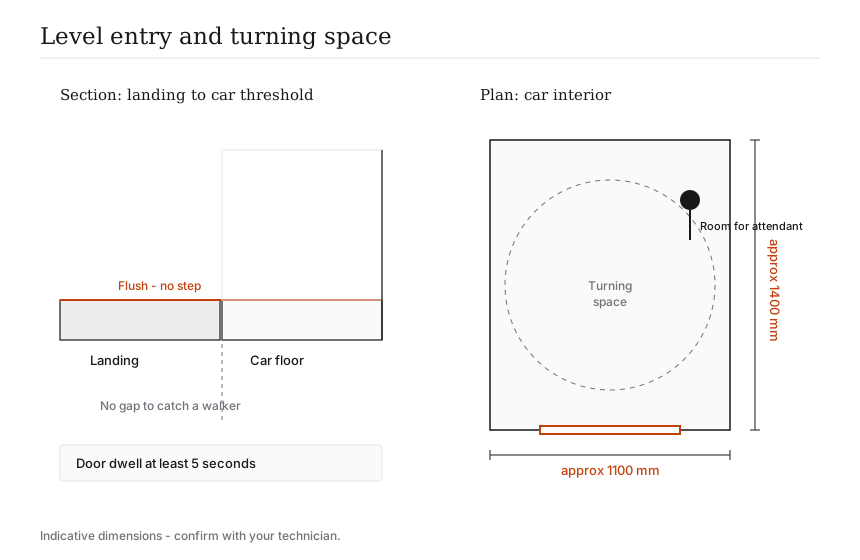
| Continuous handrail | A constant point of support to steady balance on entry, the short ride, and exit — at ≈800–1000 mm above the floor. |
| Fold-down seat | Lets a frail user sit for the ride; vital for someone who cannot stand long or who tires or gets dizzy. |
| Large, low, high-contrast call/control buttons within seated reach (≈900–1100 mm) | Easy to see and press for weaker hands and poorer vision — and reachable while seated or from a wheelchair. |
| Non-slip cabin floor | Reduces slip risk, especially on monsoon days when shoes are wet. |
| Bright, glare-free, even lighting | Older eyes need more light and struggle with glare and shadows; even lighting prevents misjudged steps. |
| Audible and visual floor indicators | Serves both fading hearing and fading vision — the person always knows the car has arrived and where it is. |
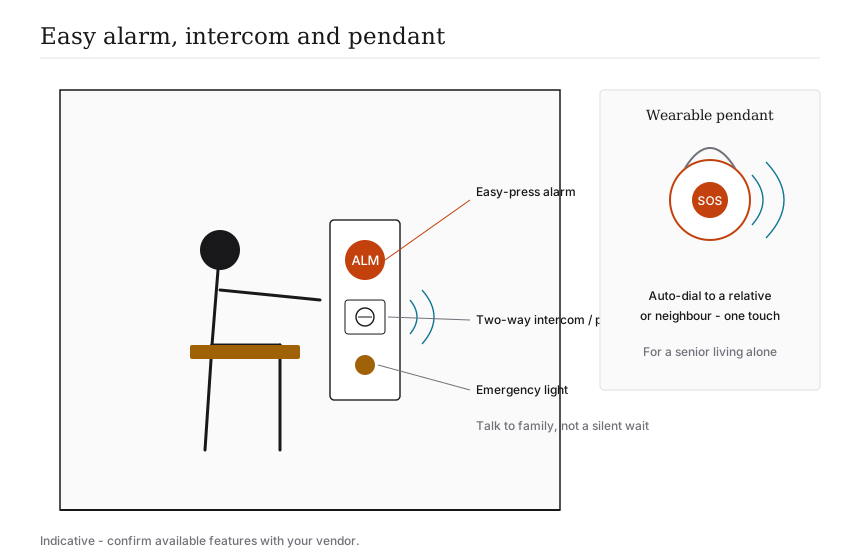
| Easy-to-reach alarm and two-way intercom | One clearly marked, easy-press control summons help; the intercom lets a trapped or unwell senior talk to family. |
| ARD (Automatic Rescue Device) | On a power cut the battery takes the car to the nearest floor and opens the doors — a senior is never stranded. |
| Phone/pendant or auto-dial alarm | For a senior living alone: a one-touch or wearable link to a relative or neighbour if anything goes wrong. |
Getting in and out without strain or stumble
The riskiest moments of any lift trip are the few seconds of entering and leaving. Three features carry most of the load here.
Automatic doors, not a heavy manual door
A manual swing door is the quiet enemy of an older user. It has to be pulled open, held while you step in, and it can swing back. For someone with reduced grip or balance, that is a genuine fall risk — and it is one of the common buyer mistakes made to save a little money. Automatic telescopic or sliding doors open by themselves, wait, and reverse instantly if anything is in the way (the infrared light curtain — part of the core safety components). Specify a generous door dwell time of at least 5 seconds so a slow walker is never rushed.
A level, flush entry — no step, no gap
The car floor must come level with the landing, with no lip to step over and no gap to catch a stick, a walker wheel or a toe. A flush threshold is the difference between a confident step and a stumble. Ask your vendor specifically about levelling accuracy and threshold detail; this is also exactly what makes the lift wheelchair-usable.
Room to move inside
A cramped car forces awkward turns. A car of around 1100 × 1400 mm lets a senior turn comfortably, brings a walking frame or wheelchair, and lets a family member or carer ride alongside. The same dimension underpins the accessibility standard, so it future-proofs the home too.
Support and comfort for the ride: handrail and seat
Even a short, slow ride (home lifts run at a gentle 0.15–0.5 m/s) is easier with something to hold and, when needed, somewhere to sit.
A continuous handrail runs along the cabin wall at roughly 800–1000 mm above the floor — the height the CPWD guidelines specify near the control panel — giving a constant grab point through entry, ride and exit. It steadies balance the moment a foot is unsure.
A fold-down seat transforms the lift for a frail user. Someone who cannot stand for long, who tires easily, or who feels dizzy can sit for the ride and fold the seat flat when not needed so a wheelchair user still has room. For a senior recovering from surgery or living with low stamina, the seat is often the feature that decides whether they use the lift confidently or avoid it.
Controls a senior can actually see and reach
Buttons defeat more older users than any mechanical fault. The fix is geometry and contrast.
- Mount controls low and within seated reach — a call/control band roughly 900–1100 mm above the floor so the buttons are usable standing, seated on the fold-down seat, or from a wheelchair. A tall panel is unreachable from a chair.
- Big buttons with a clear raised edge are far easier for arthritic or trembling hands than small flush ones.
- High contrast — light buttons on a dark panel or vice-versa — so failing vision can find them. Add Braille / tactile markings so they can be read by touch.
- Audible feedback — a tone or voice confirming the press — reassures a user who cannot see clearly that the lift has registered the command.
Pair this with bright, glare-free, even lighting and a non-slip floor. Older eyes need more light but are easily dazzled, so avoid bare bulbs and harsh reflections; even, diffuse light prevents the shadows that cause a misjudged step. The non-slip floor matters most in the monsoon, when wet footwear meets a hard cabin floor.
Floor indicators should be both audible and visual — a chime and a clear lit number — so the senior knows the car has arrived and which floor it is at, whichever sense is fading.
Calling for help: alarm, intercom and a pendant
For peace of mind — especially for a senior living alone — the help features matter as much as the comfort ones.
Every cabin should have a clearly marked, easy-to-press alarm and a two-way intercom or phone that connects to the rest of the house or to the maintenance line. If a senior feels unwell or the lift stops, one press summons help and they can talk to someone — which is far calmer than a silent wait. Keep the cabin's emergency light maintained so a stop in darkness is never frightening.
The single most important background feature in India is the ARD (Automatic Rescue Device). Power cuts are frequent, and a senior must never be left sitting in a stalled car. With ARD, a power failure simply means the battery glides the car to the nearest floor and opens the doors within seconds — self-rescue without a phone call. Do not buy a home lift without it. For the device detail and the household what-to-do, see Power-failure safety for elevators and the Lift emergency procedures playbook; the rescue hardware itself is covered in Emergency rescue systems for home lifts.
For a senior who lives alone, add a phone or wearable pendant / auto-dial alarm: a one-touch or worn button that calls a relative or neighbour. It need not be wired into the lift — many are standalone personal-alarm devices — but positioned near or carried into the lift, it closes the gap between "something is wrong" and "someone is coming".
What stays the technician's job
These features make the lift easy to use. The systems that make it safe — the door interlock, overspeed governor and safety gear, brakes, buffers, the ARD battery and controller — live inside the shaft and machinery and are a licensed lift technician's responsibility. As a household:
- Do safe use and simple visual checks only: doors close cleanly, lighting works, the alarm and intercom answer, the floor is dry and clear.
- Never defeat a safety device or prop a door, and never enter the shaft.
- Keep a sound AMC (annual maintenance contract) so the door sensors, levelling and ARD battery are tested on schedule — these are exactly the features a senior relies on.
- Keep the technician's emergency number by the lift and saved in every household phone.
For the wider household safe-use rules and a full feature audit, see the Home lift safety guide for India, and to write all of this into a purchase, the Lift specification checklist.
References
- IS 14665 (Electric Traction Lifts) — Part 1 Outline dimensions: https://law.resource.org/pub/in/bis/S05/is.14665.1.2000.pdf
- IS 14665 — Part 2 Code of practice for installation, operation and maintenance: https://law.resource.org/pub/in/bis/S05/is.14665.2.1-2.2000.pdf
- National Building Code of India 2016 (BIS), Part 8 Section 5 — Installation of Lifts: https://www.bis.gov.in/standards/technical-department/national-building-code/
- BIS — Guide for Using NBC 2016: https://www.bis.gov.in/wp-content/uploads/2022/08/Booklet-Guide-for-Using-NBC-2016.pdf
- Rights of Persons with Disabilities (RPwD) Act 2016 — Sections 40, 44, 45: https://ssepd.odisha.gov.in/sites/default/files/2024-01/RPWD%20ACT.pdf
- Department of Empowerment of Persons with Disabilities (DEPwD): https://depwd.gov.in/en/faqs-4/
- CPWD / MoHUA Harmonised Guidelines and Space Standards for a Barrier-Free Built Environment: https://www.cpwd.gov.in/Publication/Harmonisedguidelinesdreleasedon23rdMarch2016.pdf
- Home elevator safety features (Nibav): https://www.nibavlifts.us/blog/home-elevator-safety-features/
- How safe are home elevators — safety features (Inclinator): https://inclinator.com/blog/how-safe-home-elevators/
Standards and figures here are indicative and best-practice benchmarks; private homes are not legally bound by RPwD accessibility rules, but they are the right standard to design to. Confirm every dimension and feature option with the CPWD Harmonised Guidelines, your vendor, and a licensed lift contractor.
Export this guide
Related Guides — Deep-dive reading
Lift Planning for Senior-Friendly Homes (India): Ageing in Place, with the Lift at the Centre
When stairs become a barrier with age, the home lift is the heart of an ageing-in-place plan. How to choose it over a stairlift, specify it for an older user, place it for daily use, and plan for a parent moving in.
Home Lifts & AccessibilityDesigning Adaptable & Universal-Design Homes
Accessibility, Aging-in-Place, and the Multi-Stage Family — Code, Anthropometrics, and Plan-Stage Discipline for Indian Residential Architects
Room PlanningThe Accessible Home (India): Step-Free, Mobility-Friendly Design for Every Age
Practical, room-by-room accessibility that quietly works for ageing parents, recovery, pregnancy and kids alike.
Home Lifts & AccessibilityRelated Tools — Try Free
Lift Safety Audit Checklist
Interactive checklist that scores your home lift on safety devices, compliance and upkeep.
ChecklistAccessibility Compliance Calculator
Check a planned lift against the CPWD and RPwD accessible-lift benchmarks for a score.
Lift CheckerHome Accessibility Planner
Integrate lift, ramp, stairlift and wheelchair circulation into one accessibility plan.
Planner