
Lift Door Types Explained (India): Manual, Telescopic, Centre-Opening and Glass
A technical reference to how lift doors actually work — swing, collapsible, automatic telescopic, centre-opening and glass — plus the door operator, light curtain and the all-important door interlock.
The door is the part of a lift you touch every single day, and it is also the part that decides whether the lift is safe to ride. A lift can have a perfect motor and a strong shaft, but if a landing door can open while the car is somewhere else, you have an open hole in your house. This is why door design in lifts is not really about looks at all — it is about a chain of mechanical and electrical interlocks that physically prevent the lift from moving unless every door is shut and locked.
This guide is the technical reference on lift door TYPES and how they work: the swing door, the collapsible shutter, automatic telescopic and centre-opening doors, full automatic glass, plus the components that make them safe — the door operator, the safety edge / light curtain, and the all-important door interlock. If instead you want to choose a door for style (finishes, vision panels, designer looks), read our companion design guide, Designer Elevator Doors in India. This page explains the machinery; that one helps you pick the look.
Indicative figures throughout — door behaviour, clear widths and code triggers vary by model, state bye-laws and vendor. Always confirm with a licensed lift contractor.
Two doors, not one: car door and landing door
Every lift opening is actually two doors working together:
- The landing door (or "hoistway door") sits in the wall at each floor. It is the door you see when you press the call button and wait.
- The car door (or "cabin door") travels up and down with the lift car.
When the car arrives perfectly level at a floor, the car door's mechanism engages the landing door at that floor and drives both open at the same time. They close together too. At every other floor the landing door stays shut and locked, because there is no car there to unlock it. Manual swing-door lifts are the exception — there the landing doors are hinged and hand-operated, while the car opening may have a simple collapsible gate.
Understanding this pairing is the key to everything below: the type of lift door is really a description of how these two leaves are shaped, how they move, and how they lock.
The lift door types at a glance
| Door type | How it works | Opening | Accessibility | Cost (relative) |
|---|---|---|---|---|
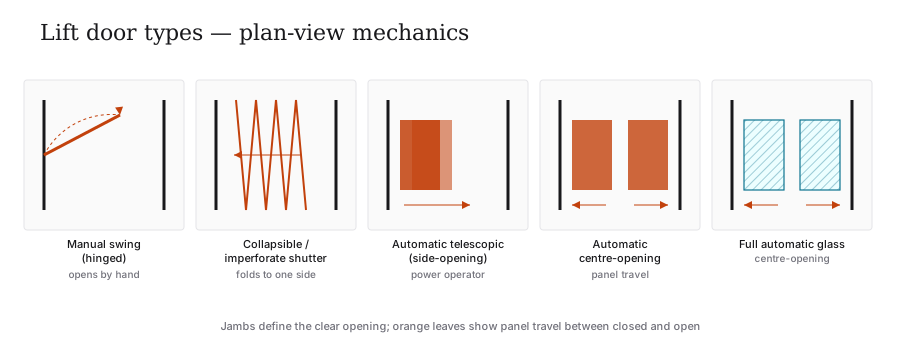
| Manual swing (hinged) | Hand-operated hinged landing door, like a room door; car has a collapsible gate | Single hinged leaf | Poor — you must pull it open, blocks a wheelchair, needs swing space | Lowest |
| Collapsible / imperforate shutter | Concertina metal gate (collapsible) or solid rolling shutter (imperforate), pulled by hand | Folds/rolls to one side | Poor — manual, pinch points, not wheelchair-friendly | Low |
| Automatic telescopic (2–4 panel) | Power operator slides panels of unequal width that "telescope" behind each other to one side | Side-opening, 2 / 3 / 4 panel | Good — automatic, gives wide clear width from a narrow shaft | Mid |
| Automatic centre-opening | Operator splits panels and drives them out from the centre to both sides | Centre, parts both ways | Best — fast, even, generous clear width, smooth flow | Higher |
| Full automatic glass | Automatic door (telescopic or centre-opening) with laminated/tempered glass leaves | Side or centre | Good — automatic; see-through aids orientation | Highest |
Cost is shown only as relative ranking because real prices depend on the whole lift package. For rupee figures see Home Lift Cost in India 2026, and tick off door choices on the Lift Specification Checklist.
Manual doors: swing and shutter
Manual swing (hinged) door
This is the cheapest door and the one most people picture in an older Indian building: a hinged landing door at each floor, opened and closed by hand, paired with a collapsible metal gate on the car. It is mechanically simple and inexpensive, which is its only real advantage.
The drawbacks are serious for a modern home:
- It is not wheelchair-friendly. A person in a wheelchair cannot easily pull a hinged door open while manoeuvring, then hold it while moving in.
- It needs landing swing space — the door arcs out into the lobby, so you must keep that area clear.
- It depends on the user to close it; a door left ajar can stall the lift or, without a correct interlock, become a hazard.
A swing door can still be perfectly safe if it carries a proper landing-door lock and electrical interlock (described below). But for any home where future-proofing or accessibility matters, it is the wrong starting point.
Collapsible and imperforate shutters
The collapsible gate is the familiar concertina (criss-cross) metal gate that folds to one side. The imperforate shutter is a solid version with no gaps — "imperforate" simply means it has no openings you could put a hand through, which is safer than an open lattice. Both are older, manual styles.
They are robust and cheap, but they share the swing door's problems: manual operation, pinch points at the folding leaves, and no real accessibility. In new homes they survive mainly as a car-side gate behind a more modern landing arrangement, or in goods/service lifts.
Automatic doors: telescopic and centre-opening
Automatic doors are the modern default for a comfortable home lift. A door operator — a small motor and linkage mounted on top of the car — drives the panels open and shut, syncs the car and landing doors, and reverses them instantly if something is in the way. Two layouts dominate.
Automatic telescopic (side-opening, 2–4 panel)
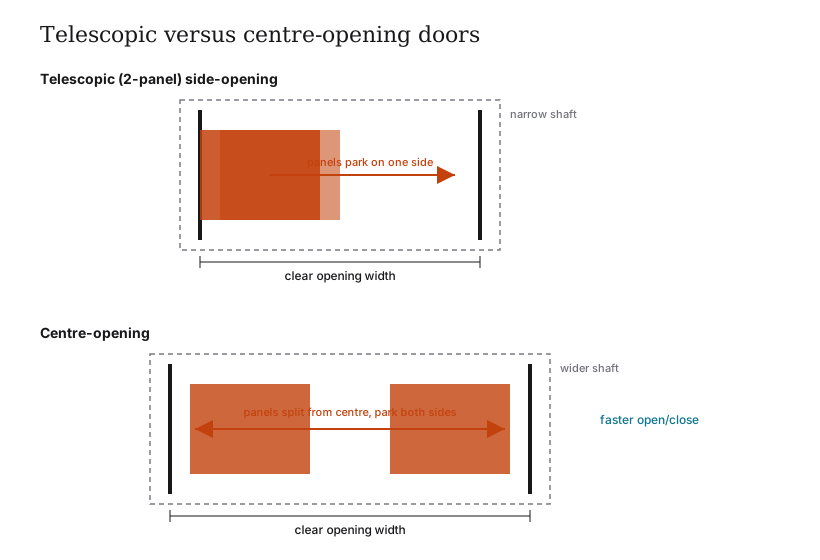
In a telescopic door the panels all slide to one side, with each panel sliding behind the next like the sections of a telescope — hence the name. A 2-panel door has two leaves of unequal width; 3-panel and 4-panel versions stack more leaves to open wider.
The big advantage is geometry: telescopic doors give a wide clear opening from a relatively narrow shaft, because the panels park stacked rather than needing wall space on both sides. That makes them ideal for tight retrofit shafts and homes where every centimetre of the hoistway counts.
Automatic centre-opening
A centre-opening door splits in the middle and drives the panels out to both sides simultaneously. Because each side only has to travel half the opening width, the door opens and closes faster and feels balanced and premium. It is the smoothest, quickest passenger experience and the usual choice where the shaft is wide enough to allow panels to park on both jambs.
The trade-off versus telescopic is shaft width: centre-opening needs wall space on both sides for the parked panels, so a narrow shaft may force you to telescopic instead.
Full automatic glass doors
A glass automatic door is simply a telescopic or centre-opening door whose leaves are laminated and/or tempered safety glass instead of steel. The mechanism is identical; only the panel material changes. Glass leaves let light through, help riders orient themselves, and suit panoramic and feature lifts. The glass must be true safety glass — laminated (a tough interlayer holds the shards) or tempered (breaks into blunt granules) — never ordinary plate glass. For the deeper glass story see Glass Elevator Technologies in India and the design-led Glass Elevator Design.
The door operator and the safety edge / light curtain
Two components make an automatic door both work and behave safely.
The door operator is the powered mechanism on the car roof that opens and closes the doors. It controls how the door moves — gentle acceleration, a smooth slow-down near the end of travel, and the timed pause (dwell) the door holds open. The operator also links the car door to the landing door so the two move as one.
The safety edge and light curtain stop the doors from closing on a person:
- A safety edge is a pressure-sensitive strip on the door's leading edge — if it touches an obstruction while closing, the doors reopen.
- A light curtain is the better, non-contact version: an invisible grid of infrared beams across the doorway. Break any beam — a hand, a foot, a stick, a pet — and the doors reverse before they touch you. Most modern home lifts use a light curtain, often alongside an edge sensor.
These door-edge protections are part of the lift's safety system catalogued in Elevator Safety Components in India.
The door interlock: the single most important door safety device
If you remember one thing from this guide, make it this. Every landing door is both mechanically locked and electrically interlocked. Together these mean the lift cannot move unless every door is fully closed and locked, and no landing door can be opened unless the car is actually present at that floor.
Here is the chain:
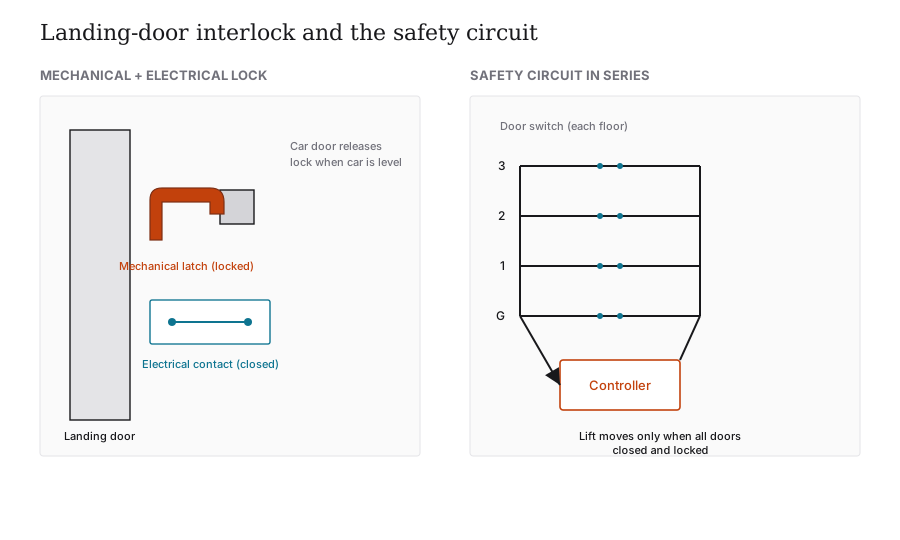
1. Mechanical lock. When the car leaves a floor, a latch on that landing door physically engages and holds the door shut. A person standing in the lobby cannot pull the door open into an empty shaft, because the latch is locked and nothing is there to release it.
2. Electrical interlock. Each door also carries a switch wired into a safety circuit. Only when all the door switches confirm "closed and locked" is the circuit complete and the controller permitted to drive the motor. If any single door — at any floor — is open or unlatched, the circuit breaks and the lift will not move.
3. Engagement at the floor. When the car arrives level at a floor, the car door's mechanism reaches across and releases that one landing door's lock, so the two can open together. Move away from that floor and the lock re-engages.
This interlock is a mandatory safety device, not an optional extra. It is the reason a properly built lift cannot run with a door open and cannot drop someone into an open shaft. Door interlocks are specified under IS 14665 Part 4 (lift components) and aligned with IS 17900 / EN 81-20/50 safety concepts.
A worn, bypassed or jumpered door interlock is one of the most dangerous faults a lift can have. Never let a technician "temporarily" defeat an interlock to keep a lift running. If the doors are misbehaving, the safe answer is to stop the lift until the interlock is repaired.
Doors and accessibility: clear width, automatic, 5-second dwell
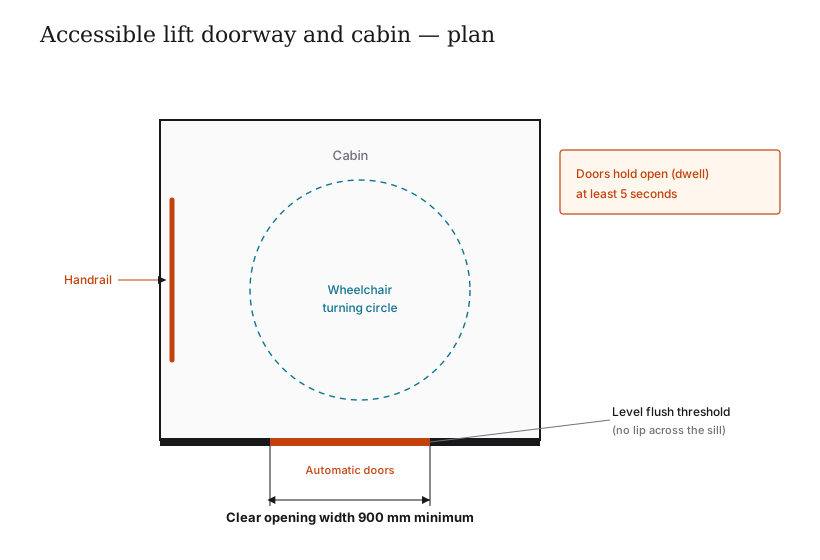
Door choice is where most homes either pass or fail on accessibility. The benchmark in India comes from the CPWD / MoHUA Harmonised Guidelines (the standards the RPwD Act 2016 points to for accessible buildings). For a lift door the essentials are:
- Automatic doors, not manual — a wheelchair user cannot operate a hinged or collapsible door unaided.
- Clear opening width at least 900 mm, so a wheelchair and, ideally, an attendant can pass through comfortably.
- Automatic door-closing time of at least 5 seconds of dwell, giving a slower mover or a wheelchair user time to cross the threshold before the doors begin to close.
- A level threshold flush with the landing, so wheels and walking aids are not caught by a lip (the floor and threshold detail sits with Lift Flooring Materials in India).
Centre-opening and telescopic automatic doors both meet these criteria when sized correctly; manual swing and collapsible doors do not. For the wider accessibility picture see the Residential Elevator Buyer's Guide.
Fire-rated landing doors and vision panels
In taller buildings the landing doors do a second job: they form part of the building's fire compartmentation. A fire-rated landing door is designed to resist the spread of fire and smoke from a floor into the shaft (and vice versa) for a rated period. Where local bye-laws and NBC 2016 Part 8 Section 5 require it — typically in taller installations and for a fireman's lift — the landing doors must carry the appropriate fire rating, and any vision panel (the small window in the door) must be fire-rated glazing rather than ordinary glass.
Vision panels also serve everyday safety: they let someone in the lobby see whether the car is actually at the floor, and they let a trapped rider be seen. For the rescue side of things — what happens during a power cut or entrapment — see Emergency Rescue Systems for Home Lifts in India, and note that an ARD (Automatic Rescue Device) brings the car to the nearest floor and opens the doors on a power failure.
How door type fits the rest of the lift
Your door choice ripples through the whole installation. A narrow retrofit shaft may push you to a telescopic door; a wider purpose-built one lets you enjoy a fast centre-opening door. Glass doors interact with the shaft type — see Lift Shaft Construction Materials in India. The door operator is driven by the lift's controller and motor, covered in Lift Controller Systems in India, Lift Motor Technologies in India and the overview How Home Lifts Work in India. And the cabin behind the door is its own materials question, in Lift Cabin Materials Guide for India and the design-led Lift Cabin Material Selection.
Quick decision summary
- Budget-only, old-building feel: manual swing or collapsible — but accept the accessibility and convenience penalty.
- Tight or retrofit shaft, want automatic: automatic telescopic (2–4 panel) for maximum clear width from minimum shaft.
- Wide shaft, premium feel: automatic centre-opening for the fastest, smoothest experience.
- Panoramic / feature lift: full automatic glass on a telescopic or centre-opening frame, in safety glass.
- Always, regardless of type: a working door interlock, a light curtain or safety edge, and — for accessibility — automatic doors with at least 900 mm clear width and at least a 5-second dwell.
References
Standards and sources used in this guide (figures indicative — confirm with your vendor and local bye-laws):
- IS 14665 — Electric Traction Lifts (BIS, committee ETD 25; aligned to EN 81). Part 1 covers outline dimensions including door types; Part 4 covers lift components including door interlocks; Part 3 covers safety rules.
- IS 14665 Part 2: https://law.resource.org/pub/in/bis/S05/is.14665.2.1-2.2000.pdf
- IS 15259 — Hydraulic Lifts (companion installation code, by name).
- IS 17900 + EN 81-20/50 — the current safety concept for lift components, interlocks and door-edge protection.
- NBC 2016, Part 8 (Building Services), Section 5 — Installation of Lifts, Escalators and Moving Walks (fire-rated landing doors, fireman's lift triggers):
- BIS Guide for Using NBC 2016: https://www.bis.gov.in/wp-content/uploads/2022/08/Booklet-Guide-for-Using-NBC-2016.pdf
- RPwD Act 2016 (accessibility duty for buildings):
- DEPwD: https://depwd.gov.in/en/faqs-4/
- CPWD / MoHUA Harmonised Guidelines and Space Standards for a Barrier-Free Built Environment (clear width, automatic doors, 5-second dwell):
- Elevator World — elevator safety components: https://elevatorworld.com/article/elevator-safety-components/
Export this guide
Related Guides — Deep-dive reading
Designer Elevator Doors (India): Types, Finishes and Style
Manual swing, automatic telescopic and panoramic glass doors — how to match the door to the cabin, the wall and the people who use it
Home Lifts & AccessibilityHome Lift Safety Guide (India): How Safe Home Lifts Are and How to Use One Safely
Why modern home lifts cannot free-fall or open onto an empty shaft, the safety features explained, and how to use one safely every day — for children, seniors and emergencies.
Home Lifts & AccessibilityUniversal Design Doors for Indian Homes: Inclusive Doors That Work for Everyone (2026)
How to design and specify doors that serve children, the elderly, pregnant women, the injured and wheelchair users by default - generous width, lever handles, near-flush thresholds, low-force closing, contrast and good lighting - without your home ever looking medical.
Home Doors & EntrancesRelated Tools — Try Free
Cross-Ventilation Analyzer
Estimate airflow and air changes per hour (ACH) from room size, window areas, layout, and local wind — with NBC 2016 Part 8 compliance check.
Ventilation CalculatorLift Safety Audit Checklist
Interactive checklist that scores your home lift on safety devices, compliance and upkeep.
ChecklistAccessibility Compliance Calculator
Check a planned lift against the CPWD and RPwD accessible-lift benchmarks for a score.
Lift Checker