
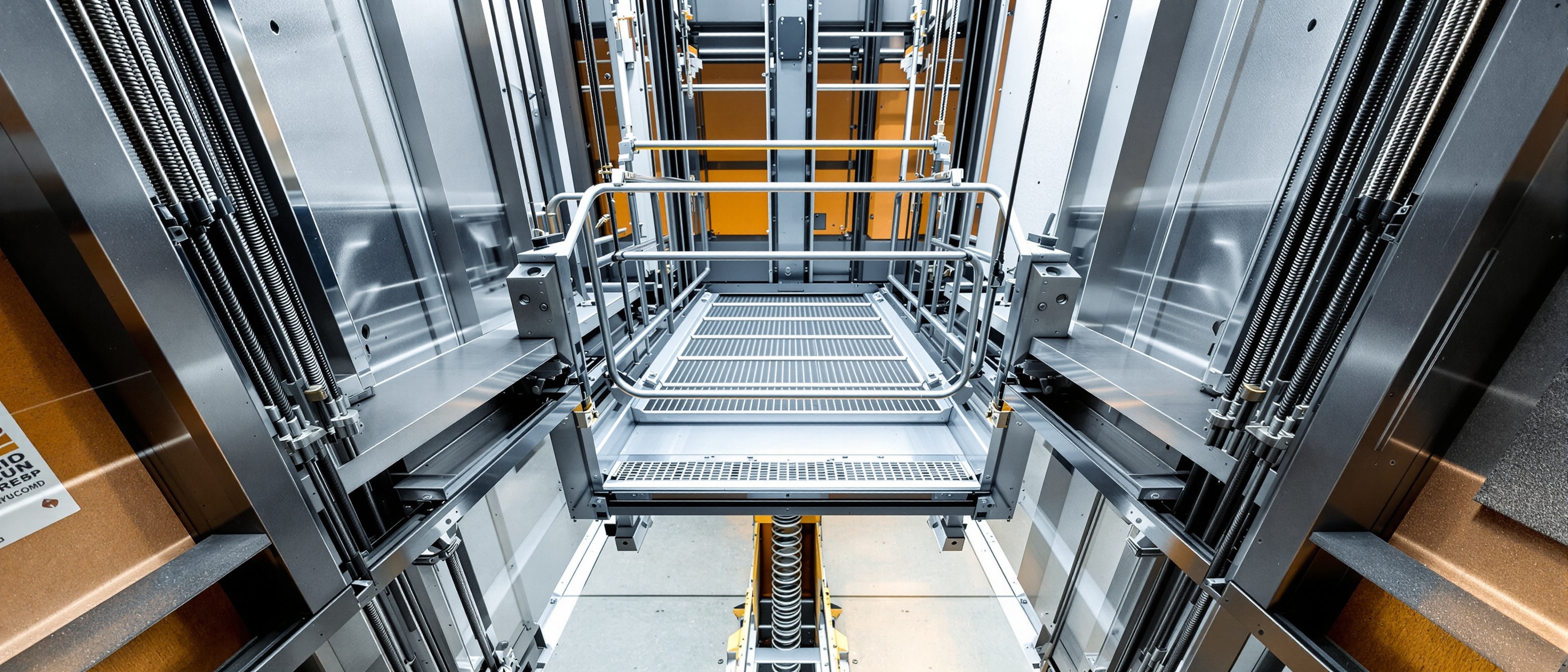
Elevator Safety Components Guide (India): Governor, Safety Gear, Buffers and Interlocks
A plain-language catalogue of the layered safety devices that keep a home lift safe — the overspeed governor and safety gear, buffers, door interlocks, limit switches and more — referenced to IS 14665 Part 4 and IS 17900 / EN 81-20/50.
A home lift does not rely on a single part to keep you safe. It is a layered system: several independent devices, each designed to catch a different failure, and most of them work whether or not there is power, software or even a person paying attention. This guide is a plain-language catalogue of those safety components — what each one is, what it does, and why it matters — referenced to the Indian and European standards that define them.
This is the component reference. If you want to know what actually happens during a power cut or a trapped-passenger situation — the step-by-step rescue procedure — read our companion guide on emergency rescue systems for home lifts in India. Here we stay on the hardware: the overspeed governor, the safety gear, buffers, door interlocks and the rest of the safety chain.
All figures are indicative and vary by model, capacity and vendor. Treat every number here as a starting point and confirm the exact safety specification with your lift contractor and the certificate of compliance.
The first thing to understand: a home lift cannot free-fall
The single most common fear — that a cable snaps and the car drops like a stone — does not match how a lift is built.
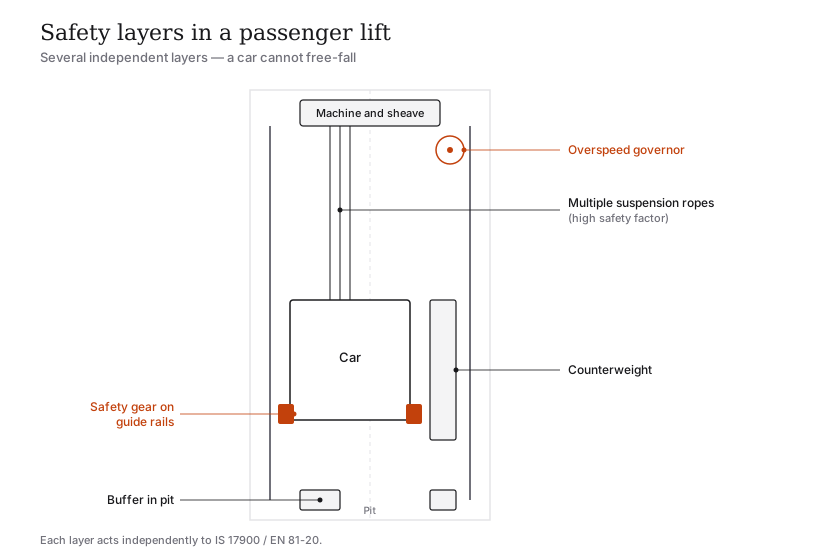
- A traction lift is suspended by multiple steel ropes (typically several in parallel), and each rope on its own is engineered to carry far more than the full loaded car. Standards require a safety factor well above the actual load, so even if one rope were damaged the rest hold the car comfortably.
- Independently of the ropes, the overspeed governor and safety gear stand ready to clamp the car to its guide rails the moment it moves too fast in the down direction.
- Below everything, buffers in the pit are the last cushion.
So a real "free-fall" requires multiple independent systems to fail at once — ropes, governor, safety gear and buffers — which is why it effectively does not happen on a properly installed and maintained lift. Pneumatic vacuum, screw and hydraulic lifts use different physics (air pressure, a threaded screw column, an oil column) but each has its own descent-control safety, so the same principle holds: no single failure drops the car.
The safety components at a glance
The table below is the quick reference. Each component is explained in detail afterwards.
| Safety component | What it does | Why it matters |
|---|---|---|
| Overspeed governor | Continuously senses the car's speed; trips at about 115 percent of rated speed | The "trigger" of the fall-protection system — it decides when to act |
| Safety gear (safety brake) | When tripped, grips the guide rails to stop and hold the car | The "muscle" — physically arrests the car so it cannot descend |
| Buffers (pit) | Spring or oil cushions at the bottom of the shaft | Absorb the impact if the car or counterweight overruns the lowest point |
| Door interlocks | Lock each landing door shut and prove it electrically | The lift cannot move unless every door is closed and locked |
| Final limit switches and terminal slowdown | Force the car to slow near the ends of travel and cut power if it goes past | Stop the car before it can run into the pit or overhead |
| Slack-rope and broken-rope sensing | Detect a slack or failed suspension rope | Catches rope problems early and can trip the safety system |
| Ascending-car overspeed protection (UCMP) | Detects the car moving up too fast or moving with doors open | Guards the "going up" and "unintended movement" cases the down-only governor does not |
| Over- and under-load sensing | Weighs the load in the car | Stops an overloaded car from starting; prevents unsafe operation |
| Light curtain / safety edge | Infrared beams (or a pressure edge) across the doorway | Reopens closing doors if a person, child or object is in the way |
| Emergency / electromechanical brake | Holds the car stationary at a floor when stopped | Prevents drift and stops the car if control is lost |
| Automatic Rescue Device (ARD) | Battery brings the car to the nearest floor on a power cut and opens the doors | Prevents entrapment during India's frequent outages |
| Emergency alarm and intercom | Battery-backed call button and two-way voice | Lets a trapped person summon help even with no power |
Together these are the safety chain: if any link reports a fault, the controller will not allow the lift to run.
The core fall-protection system: governor and safety gear
This is the pairing every buyer should understand, because it is the device that makes a lift fundamentally safe.
How the governor and safety gear work together
The overspeed governor is a mechanical device, usually mounted at the top of the shaft, with its own thin governor rope looped down to the car. As the car moves, the governor spins at a speed proportional to the car's speed. Inside it, weighted flyballs or a centrifugal mechanism are held in by a spring.
If the car ever travels too fast downward — by convention the trip point is around 115 percent of the rated speed — centrifugal force overcomes the spring, the flyweights fly out, and the governor mechanically grabs its rope. The now-stationary governor rope pulls a linkage on the car that lifts the safety gear into action.
The safety gear (also called the safety brake) is mounted on the car frame and straddles the steel guide rails that run the height of the shaft. When triggered, wedges or rollers in the safety gear are driven against the guide rails, gripping them and bringing the car to a controlled, firm stop — then holding it there. Two broad types exist:
- Instantaneous safety gear — grips almost immediately; used on slower lifts (most home lifts qualify).
- Progressive safety gear — applies the braking force more gradually for a smoother, lower-deceleration stop; used on faster or larger lifts.
At the same moment, an electrical contact on the governor (and on the safety gear) opens the safety chain, so the controller cuts power to the motor and brake. The result: the car stops on the rails and stays put, independent of ropes, motor or software.
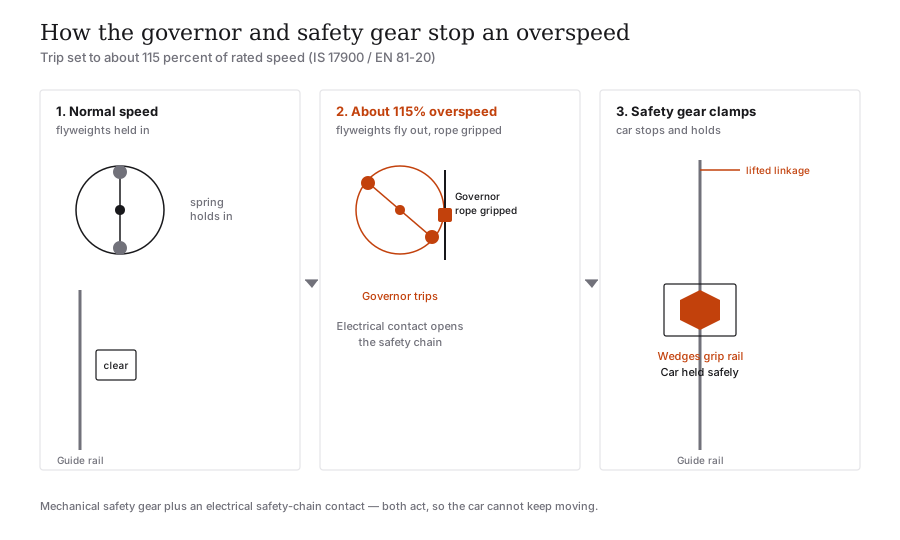
The governor is the sensor and trigger; the safety gear is the muscle. Both are mechanical and self-contained — they will act even if the lift's electronics and power are dead. This pairing is defined in IS 14665 Part 4 (components) and harmonised with EN 81-20/50 via IS 17900.
Buffers: the last cushion in the pit
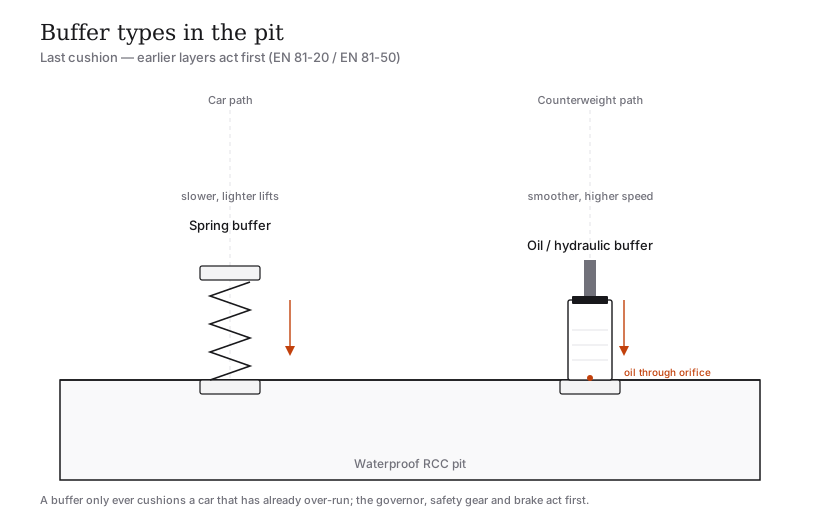
At the very bottom of the shaft sit the buffers — one set under the car's path and, on traction lifts, one under the counterweight. They are the final layer if a car somehow travels below the lowest floor.
- Spring buffers — coiled steel springs that compress to absorb energy. Simple, maintenance-light; used on slower, lighter home lifts.
- Oil (hydraulic) buffers — a piston pushes oil through an orifice to dissipate energy smoothly over a longer stroke. Used where speeds are higher; they give a gentler deceleration than springs.
Buffers are a backstop, not a routine stopping device — by the time a car reaches them, several earlier layers (terminal slowdown, final limit switches, safety gear) should already have acted. Their pit location is why the pit must be a waterproof RCC box; standing water can corrode buffers and other pit safety gear.
Door interlocks: the lift cannot move with a door open
Most lift incidents historically involve doors, which is why door interlocks are a core safety device, not a convenience feature.
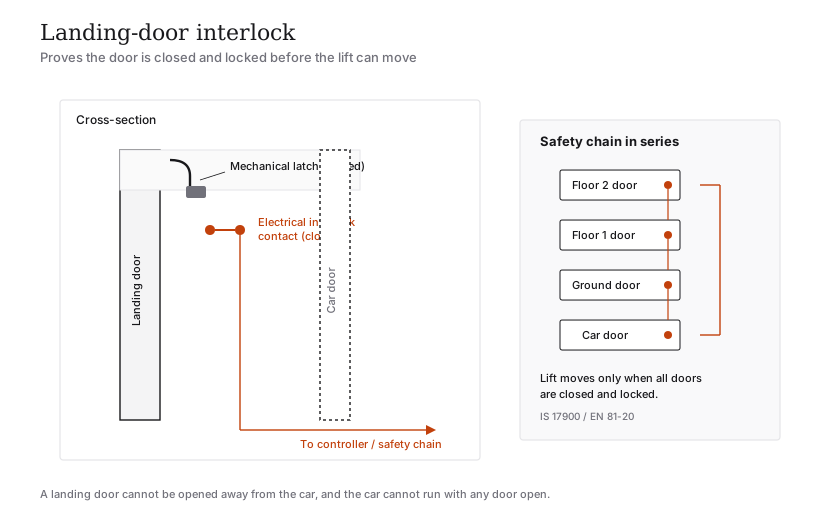
Each landing door (the door at every floor) has two linked functions:
1. Mechanical lock — the door is physically latched shut so it cannot be pulled open from the landing while the car is away.
2. Electrical interlock — a switch proves to the controller that the door is both closed and locked.
Only when every landing door and the car door report closed-and-locked does the controller complete the safety chain and allow the car to move. If any door is open, ajar or unlatched, the lift simply will not run. On automatic doors this works alongside the door operator and the light curtain / safety edge described below.
For the mechanics and types of doors themselves (manual swing, telescopic, centre-opening, full glass) and how interlocks differ between them, see our lift door types reference for India; for the aesthetic side, see designer elevator doors.
Travel-limit safety: terminal slowdown and final limit switches
Two devices guard the ends of the shaft:
- Terminal slowdown switches force the car to decelerate as it approaches the top or bottom floor, so it arrives at normal levelling speed.
- Final limit switches sit just beyond the normal travel limits. If the car ever passes the last floor, these cut power directly, stopping the car before it can strike the overhead or descend into the pit.
These are deliberately independent of the normal floor-stopping logic, so a controller or levelling fault still cannot drive the car off the ends of its travel.
Rope and movement sensors
- Slack-rope and broken-rope sensing — monitors the suspension ropes. If a rope goes slack or fails, the device stops the lift and, on many systems, can set the safety gear. Combined with the multiple-rope, high-safety-factor design, this is why a snapped rope does not lead to a fall.
- Ascending-car overspeed protection (UCMP — Unintended Car Movement Protection) — the classic governor only watches downward overspeed. UCMP adds protection for the car moving upward too fast and, critically, for unintended movement (for example, the car drifting away from a floor with its doors open). This is a key requirement in the EN 81-20/50 safety concept that IS 17900 adopts.
- Over- and under-load sensing — a load-weighing device under the car platform. An overloaded car will not start (and usually sounds an alarm), protecting the ropes, motor and safety gear from being asked to do more than they are rated for.
Door-edge protection: light curtain and safety edge
On automatic doors, a light curtain projects a grid of infrared beams across the doorway. If anything — a hand, a child, a walking stick, a pet — breaks a beam while the doors are closing, they immediately reopen. Older or simpler installations use a mechanical safety edge, a pressure-sensitive strip that reverses the doors on contact. Either way, the doors will not close on a person.
This matters most in homes with children and elderly residents, and it is one of the features to confirm is present rather than assume.
Holding and rescue: emergency brake and ARD
- Emergency / electromechanical brake — when the car stops at a floor, a spring-applied brake on the machine clamps and holds it. The brake is fail-safe: it is held open by power, so any loss of power makes it grip. It also acts if the controller detects loss of control.
- Automatic Rescue Device (ARD) — a battery unit that, on a mains power cut, automatically drives the car at slow speed to the nearest floor and opens the doors, then powers down. In India's outage-prone reality, an ARD is the difference between a brief inconvenience and being trapped in the dark. Do not buy a home lift without one.
- Emergency alarm and intercom — a battery-backed alarm button and two-way voice link, so a trapped person can always call for help.
The ARD and intercom are where this guide hands over to procedure. For exactly how a power-cut rescue and a manual rescue unfold — and what you as a homeowner should and should not do — read emergency rescue systems for home lifts in India.
How these components relate to the rest of the lift
The safety devices do not work in isolation — they are wired into and watched over by other systems:
- The controller is the brain that holds the safety chain, reads every safety device, runs continuous self-diagnostics and refuses to move the lift if any link is open. See lift controller systems in India.
- The motor and drive (especially a VVVF drive) deliver the smooth acceleration and accurate levelling that keep the lift inside its normal envelope, reducing how often the safety devices are ever called upon. See lift motor technologies in India and the overview how home lifts work in India.
- The guide rails that the safety gear grips, and the pit that houses the buffers, are part of the shaft. See lift shaft construction materials in India, lift shaft design guide and home lift structural design.
- For glass and panoramic cabins, the safety glass (laminated and tempered) is itself a safety component — see glass elevator technologies in India.
What to confirm before you buy and after installation
A short checklist drawn from the must-have safety set:
- Overspeed governor and safety gear fitted and certified (the non-negotiable core).
- ARD battery backup — essential in India.
- Door interlocks on every landing, plus a light curtain or safety edge on automatic doors.
- Overload sensing, emergency alarm and intercom, and manual lowering / emergency brake.
- On taller homes, a fireman's switch.
- A certificate of compliance referencing IS 14665 (and IS 15259 for hydraulic, or IS 17900 / EN 81-20/50 for safety) — and, in the roughly ten states that regulate lifts, the required installation and operation licence and periodic inspection by the government lift inspectorate.
For the full procurement picture, use the lift specification checklist for India and the residential elevator buyer's guide. Costs for safety options sit inside overall pricing — see home lift cost in India 2026. We deliberately do not quote per-component prices here; safety features are bundled into the lift and AMC, so confirm them as part of the package with your vendor.
Safety devices are only as good as their upkeep. Insist your Annual Maintenance Contract explicitly covers testing of the governor, safety gear, interlocks, buffers and ARD — and read the fine print, since some contracts exclude exactly these major components.
References
Standards and codes that define the components in this guide:
- IS 14665 — Electric Traction Lifts (BIS, committee ETD 25; aligned to EN 81). Part 4 — Components specifies buffers, guide rails and shoes, the carframe/car/counterweight/suspension, and safety gears and governors (the core of this guide). Part 3 covers safety rules; Part 1 covers outline dimensions.
- IS 14665 Part 2 (BIS): https://law.resource.org/pub/in/bis/S05/is.14665.2.1-2.2000.pdf
- IS 15259 — Hydraulic lifts (companion code for hydraulic installations).
- IS 17900 / EN 81-20 and EN 81-50 — the current safety concept for lift design and the testing of safety components (governors, safety gear, buffers, interlocks, UCMP). IS 17900 aligns Indian home-lift safety with EN 81-20/50.
- NBC 2016, Part 8 (Building Services), Section 5 — Installation of Lifts, Escalators and Moving Walks.
- BIS Guide for Using NBC 2016: https://www.bis.gov.in/wp-content/uploads/2022/08/Booklet-Guide-for-Using-NBC-2016.pdf
Further technical references on safety components and overspeed governors:
- Elevator World — elevator safety components: https://elevatorworld.com/article/elevator-safety-components/
- Wittur — overspeed governors: https://www.wittur.com/en/elevator-components/mechanical-packages/overspeed-governors.aspx
- MAS Industries — elevator overspeed governor: https://masind.net/blog/elevator-overspeed-governor/
- 99acres — lift regulations in India: https://www.99acres.com/articles/know-all-about-the-lift-regulations-in-india.html
All technical figures here are indicative and standards evolve — confirm the exact safety specification and certification of your lift with a licensed lift contractor and your state lift inspectorate.
Export this guide
Related Guides — Deep-dive reading
How Home Lifts Work (India): Hydraulic, Traction, Screw and Vacuum Explained
A plain-language look inside the four drive types that lift a home elevator, plus the core components and safety systems every homeowner should be able to name.
Home Lifts & AccessibilityHome Lift Safety Guide (India): How Safe Home Lifts Are and How to Use One Safely
Why modern home lifts cannot free-fall or open onto an empty shaft, the safety features explained, and how to use one safely every day — for children, seniors and emergencies.
Home Lifts & AccessibilityLift Safety Standards Every Homeowner Should Know (India)
The plain-language homeowner digest of what IS 17900, mandatory since 22 December 2025, actually requires on your new home lift, and the four pieces of compliance proof you can verify or ask your vendor for.
Home Lifts & AccessibilityRelated Tools — Try Free
Home Lift Comparison Tool
Compare hydraulic, traction, pneumatic vacuum and screw lifts side by side for your home.
Lift ComparisonHome Lift Cost Calculator
All-in home lift cost by floors, type, capacity and city — equipment, civil, GST and AMC, with a drive-type comparison.
Lift CalculatorLift Safety Audit Checklist
Interactive checklist that scores your home lift on safety devices, compliance and upkeep.
Checklist