

Home Lift Safety Guide (India): How Safe Home Lifts Are and How to Use One Safely
Why modern home lifts cannot free-fall or open onto an empty shaft, the safety features explained, and how to use one safely every day — for children, seniors and emergencies.
A home lift can feel like a big, unfamiliar machine the first time it is installed in your house. It is natural to wonder: is it safe for my children, for my parents, for me? The reassuring, honest answer is that a modern home lift built to standard and maintained on a contract is one of the safest machines you will ever own. It does not move with a door open, it cannot let you step into an empty shaft, and it physically cannot free-fall. Those are not marketing claims; they are engineered behaviours built from several independent safety systems, each of which would have to fail together for harm to occur.
This guide is the calm overview of home-lift safety for Indian homes. It explains the safety features in plain language, how to use a lift safely every day, how to keep children and seniors safe, and what happens in an emergency or a hazard such as a power cut, an earthquake or a fire. It is the hub of our safety cluster: each section links to a deeper guide where you can go further. Throughout, one rule holds: safe everyday use and simple routine checks are yours; anything inside the shaft, the controller or the brake is a licensed technician's job, and you must never defeat or disable a safety device.
Figures in this guide are indicative. Exact specifications vary by model, capacity and vendor — always confirm the safety features on your specific lift with your installer and your Annual Maintenance Contract (AMC) technician.
How safe is a home lift, really?
Lift safety does not rest on one clever device. It rests on layers — several independent systems, any one of which can stop an accident on its own. For something to go badly wrong, multiple unrelated systems would all have to fail at the same instant, which is why lifts have one of the best safety records of any everyday machine.
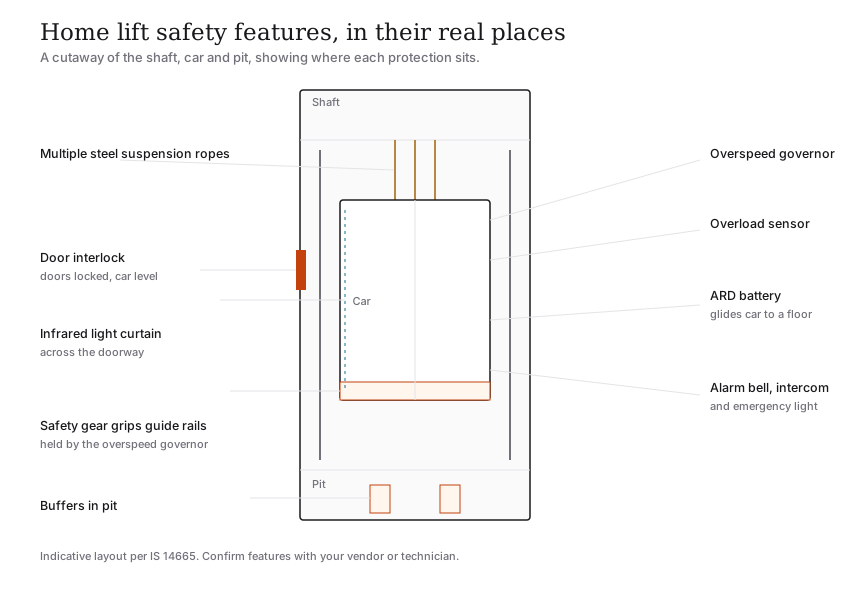
The two questions people ask most are "Can the car fall?" and "Can I step into an empty shaft?" The answer to both is no, by design. A car hangs on multiple steel ropes, each rated with a large safety factor, so the rope system alone carries many times the car's loaded weight. Even in the imaginary case that every rope failed, an overspeed governor would sense the car moving too fast and trip the safety gear, a set of wedges that grip the guide rails and clamp the car to a stop. And you cannot open a landing door onto a shaft without the car there, because of the door interlock. These are separate systems with separate failure modes — that independence is the whole point.
The safety features, in plain language
Here is what each system does and why it matters in an Indian home. For the device-level detail — ratings, how a governor trips, how safety gear is set — see our companion catalogue, Elevator safety components explained.
- Door interlock. The single most important safety device. The car cannot move unless it is level at a landing and every door is closed and locked, and a landing door cannot be opened unless the car is there. This is what makes it impossible to step into an empty shaft, and impossible for the car to move with a door open.
- Door sensors / infrared light curtain. An invisible grid across the doorway. If a person, a pet, a school bag or a walking stick is in the way, the doors stop and re-open instead of closing on them.
- Overspeed governor and safety gear. If the car ever moves faster than about 115 percent of its rated speed, the governor trips the safety gear, which grips the guide rails and holds the car mechanically. This is the "cannot free-fall" guarantee.
- Buffers in the pit. Spring or oil cushions at the bottom of the shaft — a final shock absorber that is almost never reached because of all the layers above it.
- Final limit switches and emergency brake. Independent switches and a brake that stop the car if it travels beyond its normal top or bottom landing.
- Overload sensor. If too many people or too much weight enters the car, it will not start and usually sounds a tone — so the lift is never asked to carry more than it is rated for.
- ARD (Automatic Rescue Device). A battery that, on a power cut, gently takes the car to the nearest floor and opens the doors. Given how common outages are in India, this is essentially non-negotiable — see Power-failure safety for elevators and our battery-backup systems guide.
- Alarm bell, two-way intercom and emergency light. So anyone inside can call for help and is never in the dark. The detail of self-rescue and trapped-passenger devices is in Emergency rescue systems for home lifts.
Safety features at a glance
| Safety feature | What it protects against | What it does | Owner action |
|---|---|---|---|
| Door interlock | Stepping into an empty shaft; car moving with a door open | Locks doors; car will not move unless level and all doors closed | Never wedge or hold a door; report any door that does not lock |
| Door sensors / light curtain | Doors closing on a person or object | Stops and re-opens the doors | Keep the sensor edges clean; do not test it on purpose |
| Overspeed governor + safety gear | The car descending too fast | Grips the guide rails and holds the car | Leave fully alone — technician-set, inside the shaft |
| Multiple ropes + safety factor | A single rope failing | Each rope carries many times the load; redundancy | Part of annual inspection — technician |
| Buffers (pit) | Over-travel at the bottom | Cushion the car as a last resort | Keep the pit dry; report any flooding |
| Overload sensor | Carrying more than rated | Lift will not start; sounds a tone | Do not overcrowd; remove a person if it beeps |
| ARD (battery) | Being stranded in a power cut | Moves car to nearest floor, opens doors | Keep mains/charger on; replace battery per AMC |
| Alarm + intercom + emergency light | Being unable to call for help | Calls out; keeps the cabin lit | Test monthly; keep the helpline number by the lift |
Using your home lift safely every day
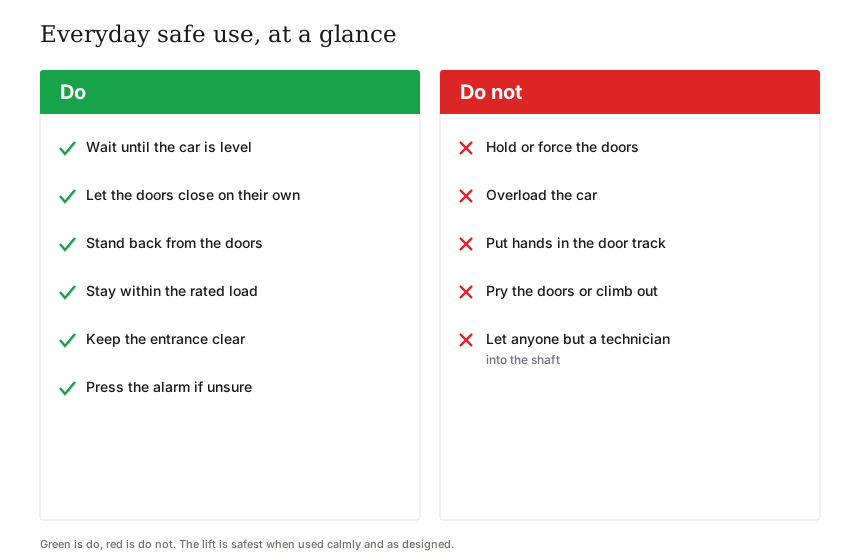
Most of safety is simple habit. A lift built to IS 14665 does the heavy lifting; you just need to use it sensibly.
| Do | Don't |
|---|---|
| Wait for the car to be level with the floor before stepping in or out | Do not jump in the car or rock it |
| Let the doors close on their own | Do not hold, block or force the doors |
| Stand back from the doors while they move | Do not put hands, feet or objects in the door track |
| Stay within the rated number of people and weight | Do not overload; if it beeps, step out |
| Keep the lift entrance and pit area clear and dry | Do not store items in the car or lean things against doors |
| Press the alarm and use the intercom if anything feels wrong | Do not try to pry the doors or climb out |
| Keep the cabin and door tracks clean | Do not let anyone work inside the shaft except a licensed technician |
A few minutes a month of routine owner checks keep the lift dependable: confirm the cabin light and emergency light work, test the alarm and intercom, listen for any new noise or jerk, and make sure the doors close smoothly and the light curtain re-opens them when you wave a hand across (without leaning in). Anything beyond that — and certainly anything requiring the shaft, the controller or the brake to be opened — is for your AMC technician. Never defeat a safety device to "save time" or work around a fault; a door that will not lock or a lift that does not level is telling you to call for service, not to override it.
Keeping children safe
Children are curious, and a lift is fascinating to them. The engineered protections are real — the light curtain re-opens doors, the interlock keeps the shaft sealed — but the true safeguard is supervision and a simple rule: a lift is not a toy.
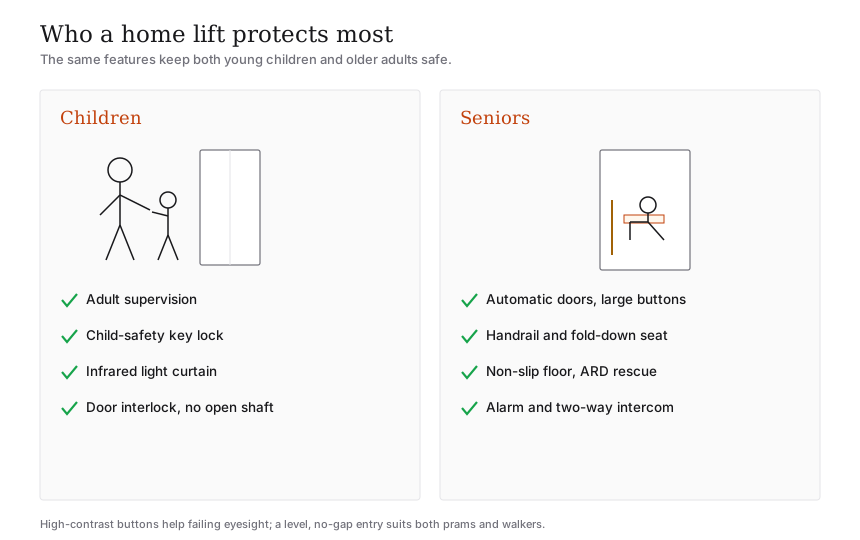
Teach children not to play in, on or around the lift, not to press every button, not to block the doors, and never to try to pry doors open. In homes with toddlers, a child-safety key lock can disable the lift so it cannot be called or operated unsupervised — a simple, strong measure. Keep small fingers clear of doors, and do not let kids "test" the sensor by darting in and out. The full playbook, including the key lock, age-appropriate rules and supervision, is in Child safety with home elevators.
Keeping seniors safe
For older family members, a home lift is often the feature that lets them stay in the home they love. Several safety features matter especially for seniors: automatic doors (no heavy manual door to wrestle), a level-entry car with a non-slip floor, a continuous handrail, an optional fold-down seat, large, high-contrast call buttons within seated reach, glare-free lighting, clear audible and visual floor indicators, an easy-to-reach alarm and intercom, and ARD so a power cut never strands someone. For a senior living alone, a phone pendant or auto-dial alarm adds real reassurance.
This is the safety-feature view; for room-by-room planning and choosing a senior-friendly lift, see Senior-citizen safety with home elevators and the planning companion, Planning a senior-friendly home.
Emergencies: what to do if someone is in the lift
Emergencies in a properly maintained home lift are rare and almost always end calmly. The single most important thing to know: if you are ever stopped between floors, you are safe. The car is held by the brakes and safety systems, it is ventilated, and help is one button away.
If you are stopped or trapped: stay calm. Press the alarm, use the intercom to call for help, and wait. Do not try to force the doors or climb out — that is the only way to turn a safe stop into a dangerous one.
With an ARD fitted, a power cut self-rescues to the nearest floor in seconds. If someone inside is unwell, use the intercom, keep them calm and call for medical help. Keep your AMC and technician emergency number physically by the lift and saved in every household phone, and make sure everyone knows how the alarm and intercom work. For the full household playbook — the steps, who does what, and how rescue devices work — see Lift emergency procedures and the device-level Emergency rescue systems.
Hazards: power cuts, earthquakes and fire
Three hazards deserve their own simple rules. Each has a dedicated guide; here is the overview.
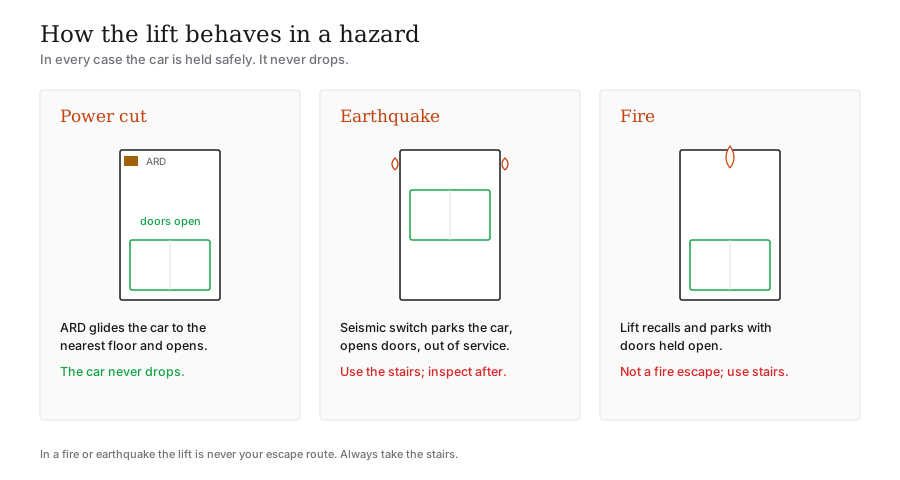
- Power cut. A power failure does not drop the car — the brakes hold it. With ARD it goes to the nearest floor and opens the doors; without ARD it simply stops safely and waits, and you use the alarm and intercom. Protect the controller from voltage surges with a stabiliser or surge-protection device, and coordinate any inverter or generator changeover so the lift restarts cleanly. Full detail in Power-failure safety for elevators.
- Earthquake. In a quake, do not use the lift — use the stairs. If you are inside when shaking starts, press every floor button and get out at the first floor the car stops at. A seismic switch (fitted in seismic areas and on larger installations) detects shaking, parks the car at the nearest floor, opens the doors and takes the lift out of service until it is checked. India is zoned II to V for seismicity under IS 1893 and NBC 2016; the shaft is an RCC element designed with the building. After any significant quake, have the lift inspected before reuse. See Earthquake safety for residential lifts.
- Fire. A normal home lift is not a fire escape — use the stairs. On a fire alarm the lift should recall to a designated floor and park with its doors open, out of service. Keep smoke detectors working, and build your household fire plan around the assumption that the lift is unavailable. A fireman's lift (taller buildings only) is a different, certified system. See Fire safety for home lifts and the design lens, Lift fire-safety planning.
Standards, inspection and accessibility
Your confidence ultimately rests on standards and inspection. In India, home lifts are built to IS 14665 (which aligns with the European EN 81 family), installed under NBC 2016 Part 8 Section 5, and — in roughly ten states with a Lift Act — licensed and inspected by the government lift inspectorate, not a private company. Buying from a reputable vendor, insisting on the full safety feature set, and keeping a live AMC with monthly preventive visits is what keeps all of the above working year after year. See the residential elevator buyer's guide and the lift specification checklist.
Accessibility is the other half of safe use. The RPwD Act 2016 legally binds public buildings; private homes are not compelled, but the CPWD / MoHUA Harmonised Guidelines are the right benchmark — a clear door width of at least 900 mm, a car large enough for a wheelchair and attendant, a handrail, an automatic door dwell of at least 5 seconds, Braille and tactile buttons, and audible plus visual indicators. The standards reference is Accessibility standards for residential lifts; the homeowner execution lens is Accessible home design.
The bottom line
A modern home lift is safe because it is built from independent layers that each fail safe: it will not move with a door open, it will not let you into an empty shaft, it cannot free-fall, it will not overload, and it brings you to a floor when the power dies. Your job is the easy part — use it sensibly, supervise children, set up the small senior-friendly comforts, keep the helpline by the lift, follow the simple hazard rules, and keep a live maintenance contract. Do that, and the machine quietly does the rest.
References
- Bureau of Indian Standards — IS 14665 Part 1 (Electric Traction Lifts, outline dimensions): https://law.resource.org/pub/in/bis/S05/is.14665.1.2000.pdf
- Bureau of Indian Standards — IS 14665 Part 2 (installation, operation and maintenance): https://law.resource.org/pub/in/bis/S05/is.14665.2.1-2.2000.pdf
- Bureau of Indian Standards — National Building Code of India 2016 (Part 8, Section 5 — Installation of Lifts): https://www.bis.gov.in/standards/technical-department/national-building-code/
- BIS — Guide for Using NBC 2016: https://www.bis.gov.in/wp-content/uploads/2022/08/Booklet-Guide-for-Using-NBC-2016.pdf
- Rights of Persons with Disabilities Act, 2016 (full text): https://ssepd.odisha.gov.in/sites/default/files/2024-01/RPWD%20ACT.pdf
- CPWD / MoHUA — Harmonised Guidelines and Space Standards for a Barrier-Free Built Environment: https://www.cpwd.gov.in/Publication/Harmonisedguidelinesdreleasedon23rdMarch2016.pdf
- IS 1893 / NBC 2016 — seismic zoning of India (Part 6, Structural Design): https://www.bis.gov.in/standards/technical-department/national-building-code/
- 99acres — lift regulations and state Lift Acts in India: https://www.99acres.com/articles/know-all-about-the-lift-regulations-in-india.html
- National Government Services Portal — Maharashtra licence to operate a lift: https://services.india.gov.in/service/detail/maharashtra-license-to-operate-lift
- Inclinator — how safe are home elevators (safety features overview): https://inclinator.com/blog/how-safe-home-elevators/
- Nibav — home elevator safety features: https://www.nibavlifts.us/blog/home-elevator-safety-features/
Export this guide
Related Guides — Deep-dive reading
Power Failure Safety in Elevators (India): What Happens and What to Do
A power cut does not drop the car. Here is exactly what happens, why an ARD is non-negotiable in India, and how to protect the controller so your lift restarts safely.
Home Lifts & AccessibilitySenior Citizen Safety Features in Home Elevators (India)
The cabin and control features that make a home lift genuinely safe and easy for an older person — automatic doors, level entry, handrail, fold-down seat, reachable contrasting controls, ARD and an alarm pendant.
Home Lifts & AccessibilityElevator Safety Components Guide (India): Governor, Safety Gear, Buffers and Interlocks
A plain-language catalogue of the layered safety devices that keep a home lift safe — the overspeed governor and safety gear, buffers, door interlocks, limit switches and more — referenced to IS 14665 Part 4 and IS 17900 / EN 81-20/50.
Home Lifts & AccessibilityRelated Tools — Try Free
Accessibility Compliance Calculator
Check a planned lift against the CPWD and RPwD accessible-lift benchmarks for a score.
Lift CheckerLift Annual Maintenance Cost Calculator
AMC cost for a home lift — comprehensive vs non-comprehensive, with a 5-year projection.
Lift CalculatorLift Safety Audit Checklist
Interactive checklist that scores your home lift on safety devices, compliance and upkeep.
Checklist