
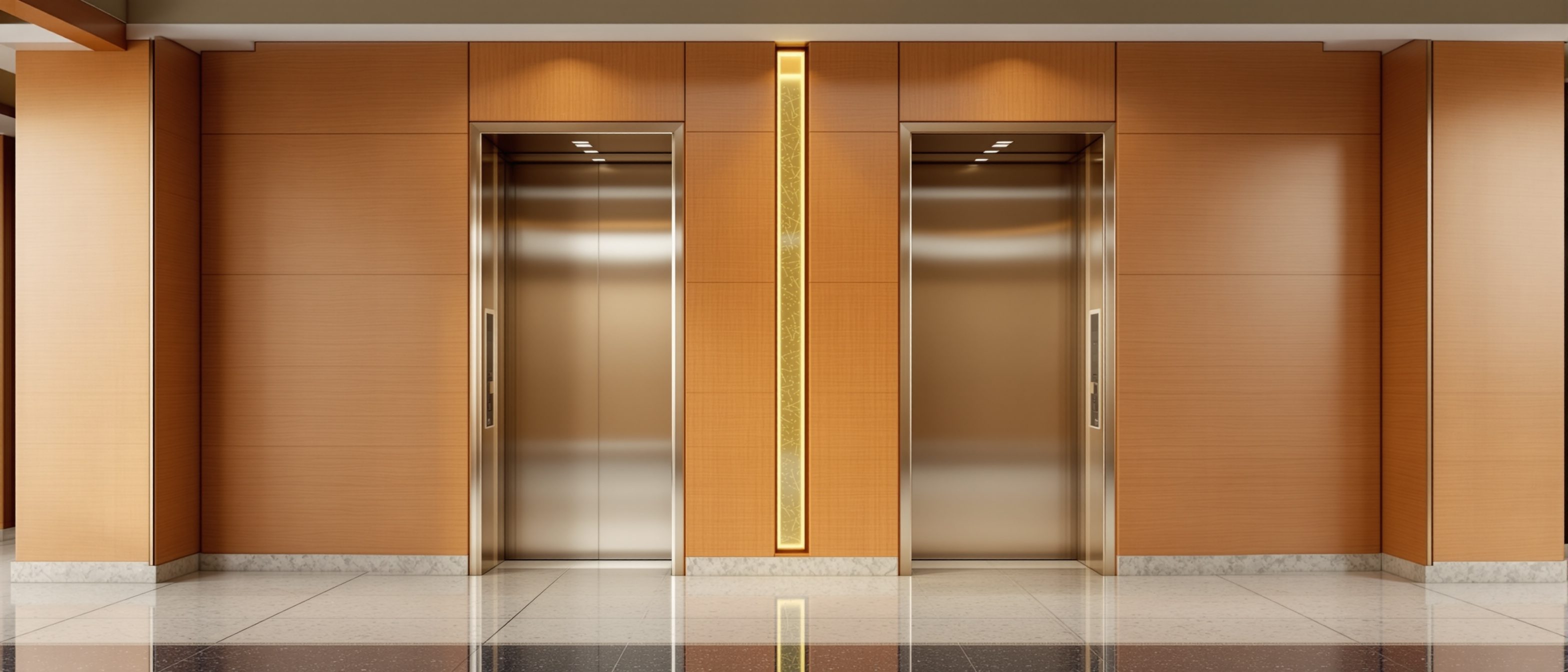
Designer Elevator Doors (India): Types, Finishes and Style
Manual swing, automatic telescopic and panoramic glass doors — how to match the door to the cabin, the wall and the people who use it
The cabin gets all the attention, but on every floor the part of the lift your family actually touches is the door. It is the first thing a guest sees in the lobby and the last surface your hand meets before the ride. A designer elevator door does two jobs at once: it has to open the right way for the people who use it, and it has to belong to the wall it sits in. Get both right and the lift reads as architecture. Get either wrong and even a beautiful cabin feels like a service hatch bolted to the corridor.
This guide treats the door as a design element and a function. We will walk through the three door families homeowners actually choose between in India, the finishes that make them sing, the small details (vision panels, handles, frames) that separate a builder-grade door from a designed one, and the one accessibility rule that quietly decides which door you are allowed to pick if anyone in the home uses a wheelchair.
The door is the only part of your lift that lives in two rooms at once — inside the cabin and out on the landing. Design it from both sides.
For where the lift sits in the home and how it becomes a statement, see Lift Design for Luxury Residences. For the full buying picture start at the Residential Elevator Buyer's Guide.
The three door families
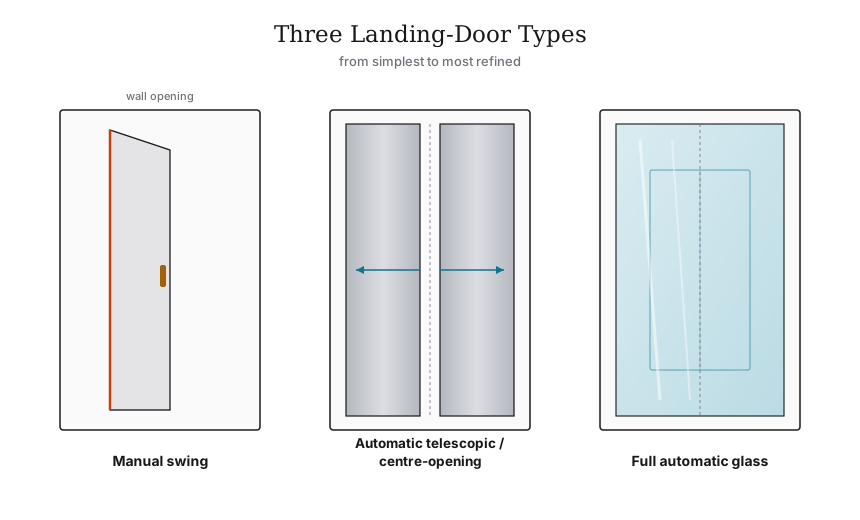
Almost every home-lift door in India is one of three things. They differ less in looks than in how they move — and how they move decides cost, smoothness, and whether a wheelchair can get through.
Manual swing doors — the budget honest-choice
A hinged door (sometimes a collapsible grille on older installs) that you pull open by a handle, step in, and pull shut behind you. It is the cheapest landing-door arrangement and you will still see it on plenty of compact G+1 and G+2 home lifts.
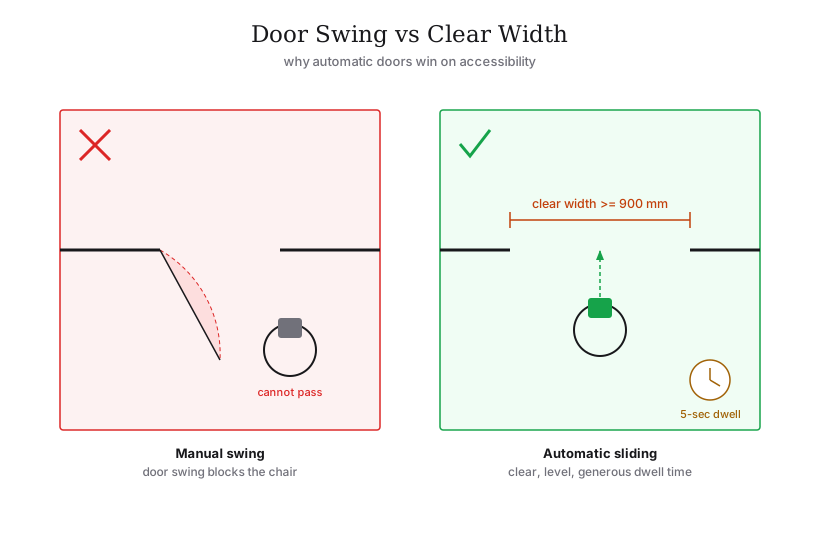
The trade-off is real and worth saying plainly: a manual swing door is not wheelchair-friendly. A person in a chair cannot reach, pull, hold, and reverse through a hinged door without help, and the swing itself eats floor space on the landing. It is fine for an able-bodied household watching the budget; it is the wrong choice the moment accessibility or future-proofing is on the table.
Even at this price point you can design it well — a clean powder-coated frame, a slim vision panel, a good handle — but no finish fixes the swing.
Automatic telescopic / centre-opening doors — the sensible default
Powered doors that slide sideways into the wall pocket. Telescopic panels nest and slide to one side (good where the wall is short on one flank); centre-opening panels part from the middle and meet again (the smooth, symmetrical "real lift" feel). They open as the car arrives and close on a timer, with a light curtain or sensor that re-opens if anything breaks the beam.
This is the family most new Indian home lifts land on, and for good reason: it is smooth, it is hands-free, it photographs beautifully flush in the wall, and — crucially — it is wheelchair-accessible when the clear opening is wide enough. It costs more than a swing door but it is the door that lets the lift behave like a lift.
Full automatic glass doors — the panoramic statement
Automatic sliding doors in laminated/tempered safety glass, usually paired with a glass or panoramic cabin so the whole assembly reads as one transparent shaft. This is the showpiece door — it makes a stairwell void feel like a sunlit atrium and turns the ride into a view. It is the natural partner to a glass elevator or a pneumatic-vacuum cabin.
Glass automatic doors keep the accessibility benefit of powered opening while adding light and a sense of space. The costs to weigh are privacy (people see in and out), cleaning (every fingerprint shows), and a higher price than a steel-skinned door. Used in the right double-height void, none of that matters next to the effect.
Door-type comparison
Indicative — confirm exact widths, mechanisms and pricing with your vendor. Costs sit on top of the base lift; for ranges see Home Lift Cost in India 2026.
| Door type | The look | Accessibility | Relative cost | Best for |
|---|---|---|---|---|
| Manual swing | Traditional, framed, a handle to grip; can look smart but reads as a "door", not a lift | Not wheelchair-friendly — needs pulling/holding; swing eats landing space | ₹ (lowest) | Budget G+1/G+2 homes, able-bodied households, tight projects |
| Automatic telescopic / centre-opening | Flush, hands-free, slides into the wall; the clean contemporary default | Accessible with clear width ≥ 900 mm and a 5-second dwell | ₹₹ | Most new home lifts; any home wanting smooth, future-proof access |
| Full automatic glass | Transparent, light, panoramic; the showpiece | Accessible (powered) — same width/dwell rule applies | ₹₹₹ (highest) | Glass/panoramic cabins, atriums, double-height voids, statement homes |
The accessibility rule that picks your door for you
If anyone in the household uses a wheelchair now — or might in the years the lift will serve — this single rule outranks every finish decision:
- The door must be automatic (powered open/close), so no one has to pull and hold it.
- The clear opening width must be at least 900 mm so a wheelchair passes through comfortably.
- The door should stay open for at least 5 seconds (the dwell time) so there is no rush to clear the threshold.
These come from India's barrier-free benchmarks — the CPWD / MoHUA Harmonised Guidelines for a barrier-free built environment, the standard most architects design to, sitting under the RPwD Act 2016. Private homes are not legally forced to comply, but these are the right numbers to build to. Pair the door with the rest of the accessible-cabin kit — a rear-wall mirror to reverse the chair out, a side handrail, tactile/Braille buttons — and read Accessible Home Design in India and the Lift Specification Checklist before you sign off.
If a wheelchair will ever use this lift, the door choice is already made: automatic, ≥ 900 mm clear, 5-second dwell. Everything after that is finish.
One more safety note that touches design: glass doors and glass vision panels must be laminated or tempered safety glass (the same family of glass IS 14665 expects around lifts), and the landing threshold should sit flush with the floor so there is no lip to trip a toe or a castor.
Finishes — making the door belong to the wall
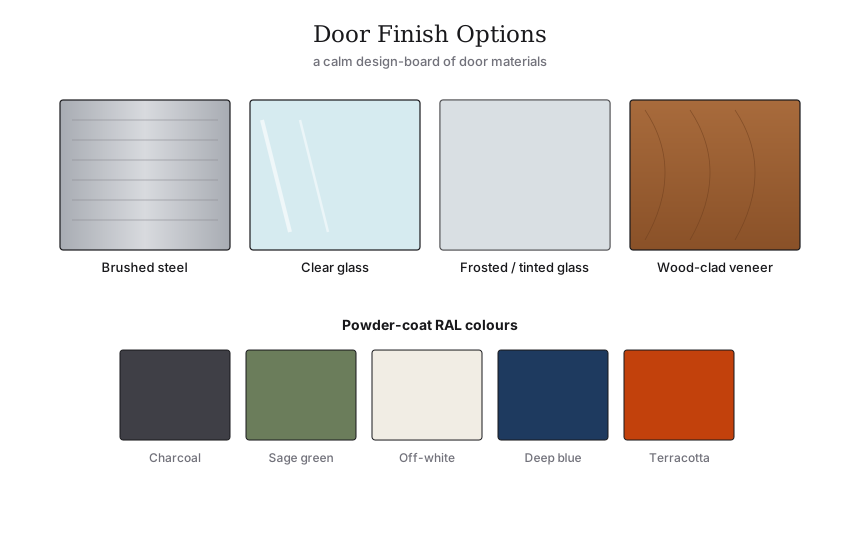
Once the door type is settled, the finish is what carries the design. The goal is almost never to make the door stand out — it is to make it sit so naturally in the landing wall that it looks intentional. The same finish logic applies to the cabin skin; see Lift Cabin Material Selection and the stainless-steel-vs-glass comparison.
| Finish | Character | Watch-outs |
|---|---|---|
| Brushed / hairline stainless steel | The clean contemporary default; restrained, neutral, fingerprint-resistant, low-maintenance | Mirror-polish shows every smudge — brushed/matte ages far better in a home |
| Glass (clear / tinted / frosted) | Light, open, makes compact landings feel larger; the panoramic look | Privacy and cleaning; must be safety glass; frosted/tinted buys back privacy |
| Wood-clad veneer / laminate | Warmth; blends the door into wood floors and joinery; the Japandi-calm choice | Veneer is premium; laminate is cost-effective and comes in many textures |
| Powder-coat / RAL colour | Full colour customisation to match the wall — some brands offer 16+ RAL shades | Pick a finish (matte) and a colour that reads with the corridor, not against it |
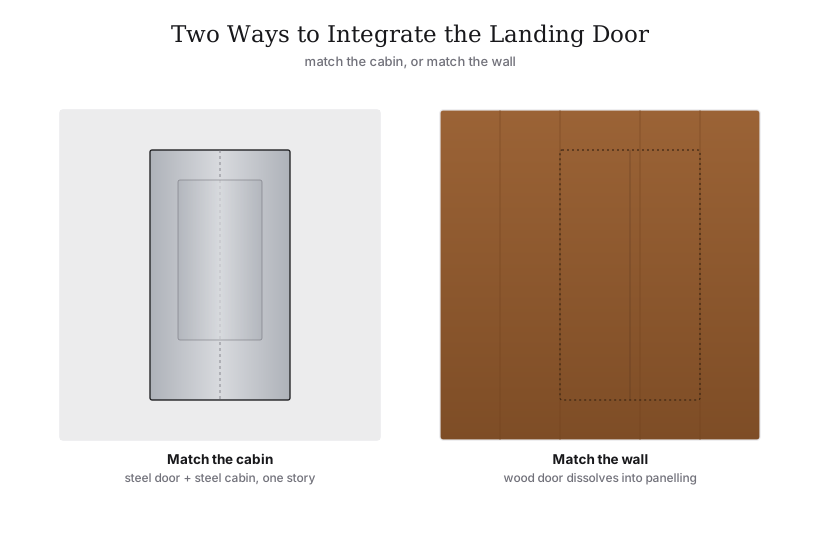
A useful design habit: choose the door finish to either match the cabin (door and interior read as one material story) or match the landing wall (the door disappears into the architecture and the lift surprises you when it opens). Both are valid; what you avoid is a door that matches neither.
The details that separate designer from builder-grade
Door type and finish get you most of the way. These small things finish the job:
- Vision panels. A slim glass strip — narrow vertical slot, a small round porthole, or a wide letterbox — lets you see the car coming and adds a safety check before you step in. On glass doors the whole panel is the vision panel. Keep its proportion deliberate; a vision panel is a design move, not just a peephole.
- Handles (where there is one). Only manual doors need a handle, and it is the one piece of the lift you grip every day — so make it good. A slim tubular pull, a flush recessed grip, or a designer lever in a finish that picks up the door's metal. The 2026 trend on automatic doors is the opposite: handle-less, flush panels with no hardware at all.
- Frames and reveals. A slim, well-finished frame (or a frameless flush detail) is what makes the door read as architecture. A clunky oversized frame is the tell of a builder-grade install.
- Threshold and floor line. Flush, anti-slip, and continuous with the landing floor — no lip. This is both a finish detail and the accessibility detail from the section above.
- A consistent door story across floors. The door repeats on every landing. Decide its language once — finish, frame, vision panel, hardware — and hold it on all floors so the lift feels designed top to bottom.
For how the door's metals and glass tie into a high-end scheme — brass/champagne trims, fluted glass, integrated lighting — see Luxury Home Elevator Interiors, Premium Lift Finishes, and the wider Luxury Interiors treatment. For the lit cabin behind the door, Home Lift Lighting Design; for where the category is heading, Contemporary Elevator Design Trends and Smart Home Lift Design.
Choosing your door in four moves
1. Start with access, not looks. Will a wheelchair ever use this lift? If yes, you are choosing an automatic door, ≥ 900 mm clear, 5-second dwell — full stop. If no, a swing door is a legitimate budget choice.
2. Pick the family. Manual swing (budget), automatic telescopic/centre-opening (the sensible default), or full automatic glass (the statement). Match it to the cabin — a glass cabin wants glass doors.
3. Choose the finish to match the cabin or the wall. Brushed steel for clean-contemporary, wood-clad for warmth, glass for light, RAL for a colour-matched wall. Never neither.
4. Resolve the details. Vision panel proportion, handle (or handle-less), a slim frame, a flush anti-slip threshold — and the same language on every floor.
A door done this way costs more than the builder default, but it is the cheapest possible way to make a lift feel custom — and the one that decides, quietly, whether everyone in the home can actually use it.
References
- CPWD — Harmonised Guidelines and Space Standards for a Barrier-Free Built Environment (door clear width, automatic-door dwell, accessible-lift essentials): https://www.cpwd.gov.in/Publication/Harmonisedguidelinesdreleasedon23rdMarch2016.pdf
- RPwD Act 2016 (Rights of Persons with Disabilities — accessibility basis): https://ssepd.odisha.gov.in/sites/default/files/2024-01/RPWD%20ACT.pdf
- IS 14665 Part 1 (BIS — lift outline dimensions and door types): https://law.resource.org/pub/in/bis/S05/is.14665.1.2000.pdf
- BIS — National Building Code 2016 (Part 8, Section 5 — Installation of Lifts): https://www.bis.gov.in/standards/technical-department/national-building-code/
- Elite Elevators — classic home elevator styles for Indian homes: https://www.eliteelevators.com/blog/top-classic-home-elevator-styles-for-indian-homes/
- Brio Elevators — custom elevator cabins: materials, finishes and lighting: https://brioelevators.com/blog/custom-elevator-cabins-materials,-finishes-lighting
- Nibav — best home elevators in India 2026 (panoramic glass home lifts): https://www.nibavlifts.com/blog/best-10-home-elevators-in-india/
Export this guide
Related Guides — Deep-dive reading
Lift Cabin Material Selection Guide (India): Steel, Glass, Wood, Laminate and Stone
A practical decision framework for choosing your home lift cabin material — compared on look, durability, maintenance, weight, cost and best-fit home style.
Home Lifts & AccessibilityUniversal Design Doors for Indian Homes: Inclusive Doors That Work for Everyone (2026)
How to design and specify doors that serve children, the elderly, pregnant women, the injured and wheelchair users by default - generous width, lever handles, near-flush thresholds, low-force closing, contrast and good lighting - without your home ever looking medical.
Home Doors & EntrancesWheelchair Accessible Doors for Indian Homes: Clear Width, Thresholds & Hardware (2026)
The exact specs that make a door usable from a wheelchair - clear opening width, near-flush threshold, lever hardware, approach clearance and low-force or auto operation, mapped to the RPwD Harmonised Guidelines 2021.
Home Doors & EntrancesRelated Tools — Try Free
Accessibility Compliance Calculator
Check a planned lift against the CPWD and RPwD accessible-lift benchmarks for a score.
Lift CheckerLift Safety Audit Checklist
Interactive checklist that scores your home lift on safety devices, compliance and upkeep.
ChecklistHome Lift Budget Planner
Full line-item budget for a home lift — equipment, finishes, civil, GST, AMC and contingency.
Lift Planner