
Ponding Water on a Flat Roof: Why It Happens and Why It Matters
Standing water that will not drain off a flat roof or terrace within about 48 hours is one of the slow killers of Indian flat roofs. What ponding is, why it is so damaging, what causes it, how to spot it safely from terrace level, and the real fix — re-establishing a proper fall of about 1 in 100 — which is a design correction, not a mop-up.
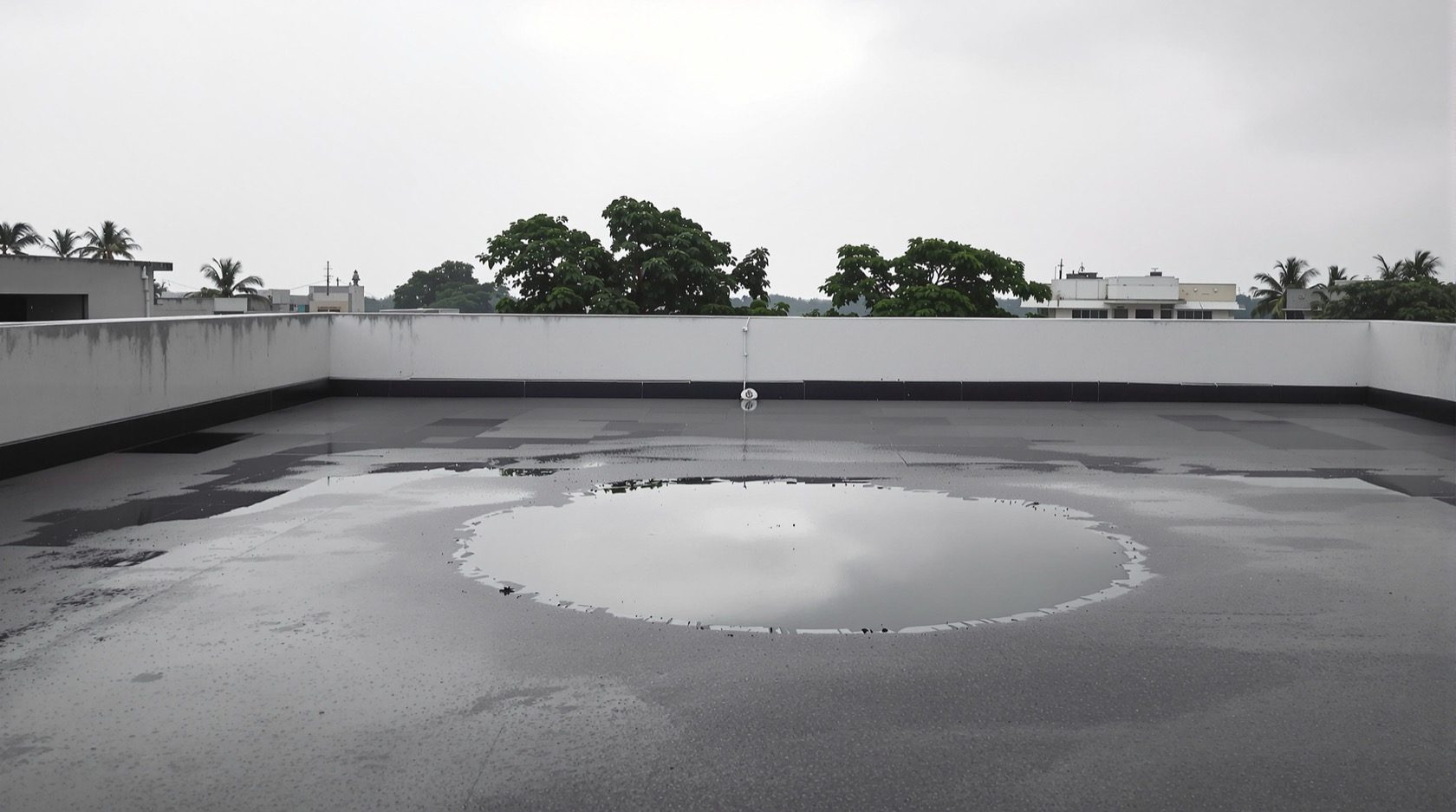
Walk onto almost any old Indian terrace a few days after heavy rain and you will find it: a wide, shallow sheet of water sitting exactly where it always sits, greening at the edges, long after the rest of the roof has dried. That standing water has a name — ponding — and it is one of the quietest, most underrated killers of flat roofs in India. It does not announce itself with a dramatic collapse. It works slowly, sitting on the same weak spots season after season, until one monsoon the ceiling below finally starts to weep.
This is a defects and diagnosis guide in the Roofing Knowledge Hub, a companion to The Ultimate Guide to Roofing Systems. Its job is narrow and useful: help you understand what ponding is, judge how serious your ponding is, spot it safely without ever putting yourself in danger, describe it accurately to a contractor, and know exactly who fixes it and roughly what it costs. The single most important idea — and the one most homeowners get wrong — is this: ponding is a drainage and fall problem, so the real cure is a design fix (re-establishing the slope), not another coat of waterproofing over water that will never leave.
Scope & safety. You can safely diagnose ponding from terrace level — watching where water sits after rain, chalk-marking the puddles, and checking a drain from a safe, dry, level standing spot. That is homeowner work. Everything that fixes it — re-screeding to a fall, laying tapered insulation or brickbat coba, re-waterproofing, and above all any assessment of a sagging slab — is qualified professional work for a licensed waterproofing contractor and, where deflection is suspected, a structural engineer. Never step onto a wet, sloping, mossy, or fragile roof to inspect or fix anything. Work at height is dangerous; a wet roof doubly so.
What ponding actually is — and the 48-hour rule
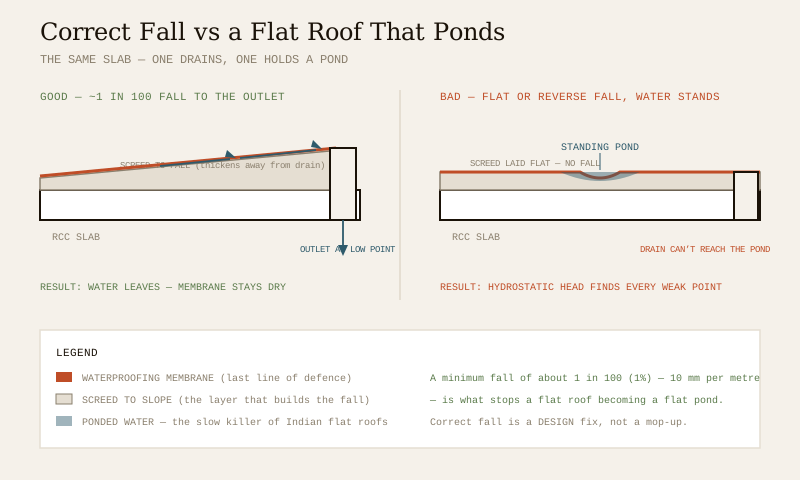
No flat roof is ever truly flat. Even the flattest-looking RCC terrace is built with a deliberate, gentle tilt — the fall — so that rain runs off toward the outlets instead of sitting still. Ponding is what happens when that fall fails: water collects in low areas and does not drain away, staying put long after the rain has stopped.
How long is too long? The widely used rule of thumb in the roofing world is the 48-hour rule: water that is still standing on a flat roof roughly 48 hours after rain has stopped (in dry, draining weather) is considered ponding — a genuine defect, not just a passing puddle. Two days is generous; it allows for the last of a heavy downpour to clear and for a little evaporation. If water is still there after that, gravity has been defeated somewhere, and the roof is telling you its drainage or its fall is not doing its job.
The tell-tale that survives even the dry season is the ghost ring: a stain, a rim of dried silt, or a patch of algae and moss that marks where a pond repeatedly forms and dries. When you can read the map of old puddles on a dry terrace, you are looking at a drainage fault that has been quietly at work for a long time.
Why ponding matters — the slow damage
A puddle looks harmless. It is not. A waterproofing membrane is designed to shed water that touches it briefly and runs away — it was never designed to sit submerged under a standing pond for days at a time, season after season. Here is the damage ponding does, roughly in order of how it kills a roof:
- Constant hydrostatic head finds every weakness. Standing water presses down under the slow, patient pressure of its own depth. That pressure works into the tiniest pinhole, lap, or crack in the waterproofing and pushes water through — precisely where a brief shower never would. Ponding turns a harmless flaw into an active leak.
- It accelerates membrane and coating breakdown. Permanent wetness, combined with UV and the daily heat-and-wet cycling of a shallow warm pond, ages bitumen, acrylic, and cementitious coatings far faster than a roof that dries between showers. The coating you paid for wears out years early under a pond.
- It breeds algae, moss, and mosquitoes. A warm, still, shallow pond is an ideal nursery. Algae and moss make the surface slippery (a fall hazard) and hold yet more moisture against the membrane; standing water is a textbook mosquito breeding site — a public-health nuisance, not just a roofing one.
- It adds dead load the slab never planned for. Water is heavy: every 100 mm of depth is roughly one kilonewton per square metre of extra weight. A small pond is a nuisance; a large one on a slab whose drains have blocked is a genuine structural concern.
- It masks — and often signals — slope and structural faults. A pond that sits dead-centre of a span, not near an edge, can be the visible symptom of a sagging slab (see roof sagging & deflection signs). The water is pointing at a low spot that should not exist.
- In cold regions, freeze-thaw prises it apart. In the high Himalaya and other cold zones, a pond that freezes expands into every crack and lifts the surface as it thaws — a slow mechanical wrecking of both screed and membrane.
None of this is fast. That is exactly why ponding is dangerous: by the time the ceiling below shows a stain, the pond has usually been working for seasons. Understanding this is the whole reason to catch it early — which the roof leakage diagnosis guide picks up once a leak has actually started.
The causes — why the water sits
Ponding is almost never bad luck. It has causes, and knowing them tells you which fix you actually need. There are five common ones, and most old roofs have more than one at once.
1. Inadequate fall, designed or lost. The commonest cause of all. Either the roof was built with too little slope (or none) to begin with, or the fall was fine at first and has since been lost — buried under later work. A fall of less than about 1 in 100 leaves the roof at the mercy of every small imperfection.
2. Sagging or deflection creating low spots. Over years, an RCC slab under load can deflect — sag slightly in the middle of its span. That gentle dish becomes a permanent low spot that collects water even if the original fall was correct. This is the cause that can point at a structural problem.
3. Blocked or wrongly placed rain outlets. A drain choked with leaves, silt, or a plastic bag stops water leaving; a drain placed at a high point rather than the true low point means water has to climb to reach it — and so it never does. Either way the water strands.
4. Screed or overlay laid flat. The layer that is supposed to build the fall — the screed to slope — is sometimes laid dead level by a careless contractor, or a later overlay (a fresh coat, a new screed, a repair patch) is troweled flat and cancels whatever fall existed.
5. Added terrace flooring that kills the slope. A very Indian cause: tiles, pavers, or a new china-mosaic finish are later laid on the terrace — often dead flat for looks — burying the original fall and turning a draining roof into a flat tray. (See terrace flooring systems for doing this without killing the drainage.)
| Cause of ponding | The fix | Who does it |
|---|---|---|
| Inadequate fall (built flat or too gentle) | Lay a screed to slope / tapered insulation / brickbat coba to re-establish fall of ~1 in 100 or better | Waterproofing / roofing contractor |
| Sagging or deflection (low spot mid-span) | Assess deflection first; then correct fall over the dished area | Structural engineer, then contractor |
| Blocked or wrongly placed outlet | Clear the drain; if wrongly located, re-cut a new outlet at the true low point | Contractor / plumber (homeowner may safely clear a reachable grating) |
| Screed / overlay laid flat | Re-screed to a proper fall before re-waterproofing | Waterproofing contractor |
| Added terrace flooring killing the fall | Re-lay the finish over a sloping bed, keeping the drainage path | Contractor / tiler working to a fall |
How to spot ponding safely — from terrace level only
You do not need to climb, crawl, or walk a roof to diagnose ponding. In fact you must not. The best diagnosis is done from a safe, dry, level standing spot — usually the terrace floor itself once it has drained, a doorway, or a staircase headroom — and it is genuinely useful homeowner work.
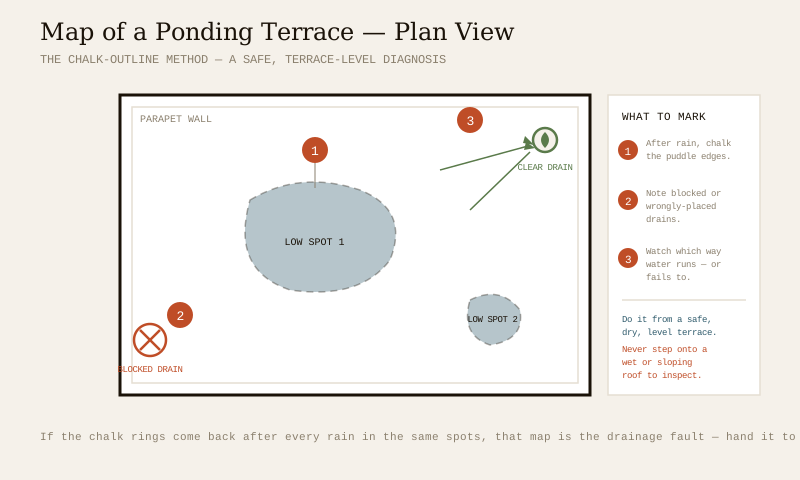
- Watch where water sits. During and just after rain, note from a safe vantage where the sheets of water linger and which way (if at all) they move. The last places to dry are your low spots.
- The chalk-outline method. After the rain stops, and once the terrace surface is safe and dry enough to stand on at floor level, mark the outline of each remaining puddle with chalk. Come back at 24 and 48 hours. Puddles still inside their chalk lines after 48 hours are confirmed ponding. Repeat over a couple of rains and you will have a reliable map of the roof’s low spots.
- Check the drains from a safe spot. Look at each rainwater outlet and its grating from where you can safely see it. Is it clear or choked? Is it sitting at a low point (water reaching it) or a high one (water pooling away from it)? A reachable grating on a dry, level terrace can be cleared by hand or with a stick — but do not lean over a parapet, climb, or venture onto anything wet or sloping to reach one.
- Read the dry-season ghosts. Even with no rain, algae rings, silt rims, and stains map exactly where ponds form. Photograph them.
Photograph everything and note the timings. That photo set and chalk-map is precisely what lets a contractor quote the right fix without guessing — and it is the safe half of the job that is entirely yours to do.
How serious is it? A ponding triage table
Not every puddle is an emergency, and not every pond is cosmetic. Use how long the water sits, and where, to judge urgency — and to decide who to call.
| How long water sits / where | What it means | What to do |
|---|---|---|
| Clears within a few hours of rain | Normal — the roof is draining as designed | Nothing; keep drains clear as routine |
| Gone within ~24–48 hours | Marginal fall or a slightly slow drain | Watch it; clear/keep-clear the outlets; plan a fall check at next re-coat |
| Still standing after 48 hours, shallow, near an edge/corner | Confirmed ponding — local low spot or slow outlet | Get a contractor to clear/re-set the drain and correct the local fall |
| Still standing after 48 hours, wide pond mid-roof | Ponding over a possible sag — drainage AND maybe structure | Contractor to re-slope; if it is mid-span, a structural engineer checks deflection first |
| Pond deepening over successive rains, drain clearly blocked | Water accumulating with nowhere to go — added dead load | Clear/unblock urgently (safely); if it will not clear, treat as a load concern — keep off the roof |
| Ponding plus ceiling stain / damp below | The pond has already found a leak path | Diagnose the leak (leak diagnosis guide) and re-slope + re-waterproof, not just re-coat |
When to call a professional — the red flags
Most ponding is a drainage-and-fall job for a good waterproofing contractor. But some patterns mean structure, and those go to a structural engineer first, before anyone paints or screeds over them. Treat these as engineer-now signals:
- The pond sits in the middle of a span, not near an edge — a classic marker of a sagging slab. Cross-check with the roof sagging & deflection signs guide.
- You can see a visible dish, dip, or sag in the ceiling or terrace surface, or doors/cracks that suggest the slab is deflecting.
- The pond is large and deepening and a drain cannot be cleared — the trapped water is now a real load on the slab.
- Ponding comes with structural cracks on the underside, spalling concrete, or rust-staining exposed steel (roof cracks guide).
- The roof itself is old, fragile, or you cannot inspect it without going onto a wet or sloping surface — then the inspection is professional work too. See the roof safety guide.
If in doubt, keep people off the roof and get the slab looked at before spending a rupee on coatings. Waterproofing over a structural sag is money poured onto a moving target.
The fix — correct the fall, then waterproof
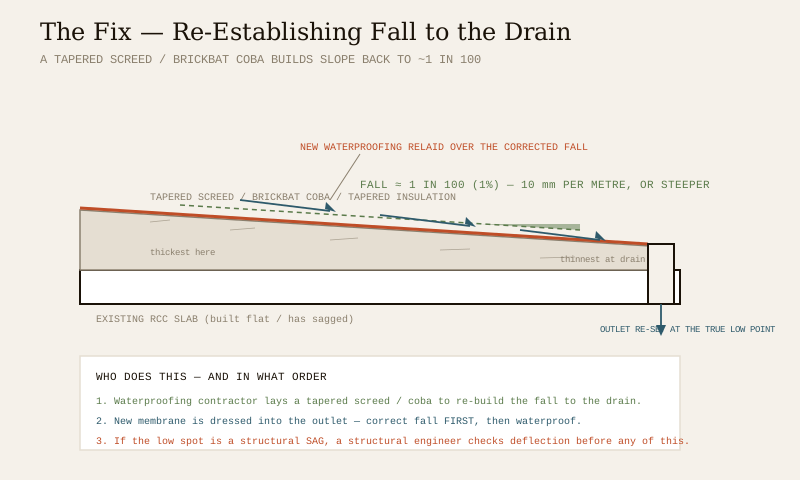
Here is the heart of it, and the point most often missed: you do not cure ponding by painting over it. Re-coating water that has nowhere to go simply buries the problem under a fresh, expensive layer that the same pond will kill again. The real fix restores the fall so the water leaves — a design correction — and only then re-waterproofs.
The professional sequence, roughly:
1. Clear and, if needed, re-position the drains. Sometimes a choked or badly placed outlet is the whole story; clearing it or re-cutting one at the true low point solves the pond.
2. Re-establish the fall. Where the slope is genuinely gone, the contractor builds it back: a sloping screed laid to thicken away from the drain, tapered (slope-cut) insulation boards, or the traditional Indian brickbat coba — broken-brick-and-mortar laid to a slope — all aimed at a fall of about 1 in 100 (1%, or 10 mm per metre) or better, running cleanly to the outlets.
3. Re-waterproof over the corrected fall. With the water now guaranteed to run off, a fresh membrane (dressed properly into the outlets) has a fair, dry job to do and will last. See flat roof waterproofing and the broader roof waterproofing guide.
4. In bad cases, an engineer checks deflection first. If the low spot is a structural sag, none of the above happens until a structural engineer has assessed the slab.
To picture the flow of a job and to size the drainage side, the roof drainage guide and roof gutters & downpipes guide go deeper, and the roof drain calculator and roof area calculator help you and your contractor scope outlet capacity for your roof.
Indicative costs — 2026 ranges, get local quotes
Costs vary enormously with city, roof area, access, the finish on top, and how bad the fall problem is. Treat the table below as indicative 2026 ranges only — always get two or three local quotes for your actual roof. Prices assume normal residential access.
| Job | Indicative 2026 range | Notes |
|---|---|---|
| Clearing / unblocking outlets and gratings | ₹500–3,000 per visit | Often part of routine roof maintenance; cheapest and first thing to try |
| Re-cutting / re-positioning a rainwater outlet | ₹3,000–12,000 per outlet | Depends on slab, downpipe re-routing, and making good |
| Re-sloping screed / brickbat coba to restore fall | ₹60–150 per sq ft | The core cure; heavier where a thick fall must be built up |
| Tapered insulation to build fall (over-deck) | ₹90–220 per sq ft | Also improves roof insulation; premium boards cost more |
| Full re-waterproofing over corrected fall | ₹80–250 per sq ft | System-dependent; see the flat roof waterproofing guide |
| Structural engineer deflection assessment | ₹5,000–25,000+ | For suspected sag; a fraction of the cost of getting the fix wrong |
The economics are simple: a ₹500 drain-clearing or a one-time re-slope is far cheaper than re-coating a ponding roof every few years and eventually repairing the water-damaged ceilings below. Fix the fall once, properly.
A homeowner-safe ponding checklist
Everything here is doable from safe, dry, level ground — no climbing, no wet or sloping surfaces:
- After heavy rain, note from a safe spot where water lingers and the last areas to dry.
- Once the terrace floor is safe and dry, chalk-outline the remaining puddles; re-check at 24 and 48 hours.
- Apply the 48-hour rule: water still standing after ~two days of draining weather is ponding.
- Photograph puddles, chalk maps, ghost rings, algae patches, and each drain grating.
- Check reachable outlets for blockage; clear an easily reachable grating only from a safe, level position — never lean over a parapet or step onto anything wet or sloping.
- Note whether the worst pond is near an edge (likely drainage/fall) or mid-span (possible sag → engineer).
- Watch for warning signs below: fresh ceiling stains, damp patches, efflorescence (ceiling damp & efflorescence guide).
- Fold a ponding check into every pre-monsoon roof inspection.
- Hand your photos and chalk map to a licensed contractor — and insist the fix corrects the fall, not just re-coats.
The one-line answer
Flat roof ponding is water that still stands on a terrace roughly 48 hours after rain has stopped — a genuine defect, because the constant hydrostatic head finds every waterproofing weakness, ages the membrane, breeds algae and mosquitoes, adds dead load, and often masks a sagging slab. It is caused by too little (or lost) fall, sagging, blocked or wrongly placed drains, screed laid flat, or terrace flooring added dead-level. You can diagnose it safely from terrace level with the chalk-outline method; the real cure is a design fix — re-establishing a fall of about 1 in 100 with a sloping screed, tapered insulation, or brickbat coba, and only then re-waterproofing — done by a waterproofing contractor, with a structural engineer checking deflection first if the low spot sits mid-span. Correct fall, not another coat of paint, is what actually stops the pond.
Where to go next
- The whole subject in one map: The Ultimate Guide to Roofing Systems.
- Get the water moving and off: Roof Drainage Guide · Roof Gutters & Downpipes Guide.
- The membranes a corrected fall protects: Flat Roof Waterproofing Guide · Roof Waterproofing Guide.
- Where ponding starts and how it is designed: Flat Roof Design Guide.
- The wider fault-finding family: Roof Defects Guide · Roof Leakage Diagnosis & Repair · Roof Sagging & Deflection Signs.
- Keep it from coming back: Roof Maintenance Guide.
- Scope the drainage: Roof Drain Calculator · Roof Area Calculator.
- The whole library: Roofing Knowledge Hub.
References
- National Building Code of India (SP 7), Bureau of Indian Standards — Part 9 (Plumbing Services, including roof and surface-water drainage and the falls that move water to outlets); verify the current edition via the BIS catalogue.
- IS 3067: Code of Practice for General Design Details and Preparatory Work for Damp-Proofing and Waterproofing of Buildings (falls, drainage and outlet detailing in relation to waterproofing) — verify current status via the BIS catalogue.
- IS 456: Plain and Reinforced Concrete — Code of Practice (the RCC slab, deflection limits, cover and durability behind mid-span sag) — Bureau of Indian Standards.
- Minimum roof fall guidance is commonly taken as about 1 in 100 (1%), with steeper falls preferred in heavy-rainfall regions; confirm the value required for your design and location with your engineer and the current code editions.
- Confirm any standard’s current status via the BIS catalogue: https://www.services.bis.gov.in/
This is an educational overview. Diagnosing ponding from safe, level ground is homeowner work; re-establishing falls, laying screeds or tapered insulation, re-waterproofing, any assessment of a sagging slab, and all work at height are qualified professional work — engage a licensed waterproofing contractor and a structural engineer for your project, and verify any standard’s current status via the BIS catalogue before relying on it.
Export this guide
Related Guides — Deep-dive reading
Roof Defects: A Homeowner's Field Guide (India)
The diagnostic catalog that anchors the whole subject — every common roof defect on Indian homes, pictured and named: cracks, damp and efflorescence, ponding, waterproofing blisters, sagging, spalling and rusting rebar, corrosion, algae and moss, parapet and drain-junction failures, slipped tiles and perished fasteners. For each: what it looks like, what it usually means, how serious it is, and exactly who to call.
RoofingRoof Leak Diagnosis & Repair
The homeowner's most common roofing crisis, calmly explained — how to read the signs (stains, damp, efflorescence, peeling paint, drips, a musty smell), why the leak is almost never right above the stain, where roofs actually leak, how leaks are traced, and the honest line between what you can safely check yourself and what needs a professional. India-grounded, monsoon-tested.
RoofingBathroom Waterproofing Failure in India: Causes, Diagnosis & Fixes (2026)
Why bathroom waterproofing fails in Indian homes — poor surface prep, thin coats, missed junctions, no membrane turn-up, damage during tiling — how to read the symptoms, and whether a surface fix or a full redo is the right remedy.
BathroomsRelated Tools — Try Free
Monsoon-Readiness Checklist
Pre-rain home audit across 9 categories — terrace, drains, waterproofing, electrical, HVAC, pest, vehicles, documents.
Seasonal AuditRoof Drain Calculator
Find how many rainwater downpipes a roof needs from roof area, rainfall intensity and downpipe size.
Plumbing CalculatorPlumbing Pressure-Test & Leak Checklist
Pre-closure pressure and leak test — 9 categories, 60+ checkpoints across water supply, drainage, fixtures, waterproofing, hot water, tanks.
Pre-Closure Test