
Cracks in Your Roof & Slab: What They Mean and When to Worry
Not every crack is a crisis, and not every crack is harmless. A calm, India-grounded field guide to reading cracks on RCC roofs, terraces, parapets and ceiling plaster — hairline vs map vs structural, what each type means for leaks and for the structure, the safe homeowner job of observe-photograph-measure-monitor, and the exact patterns that mean call a structural engineer today.
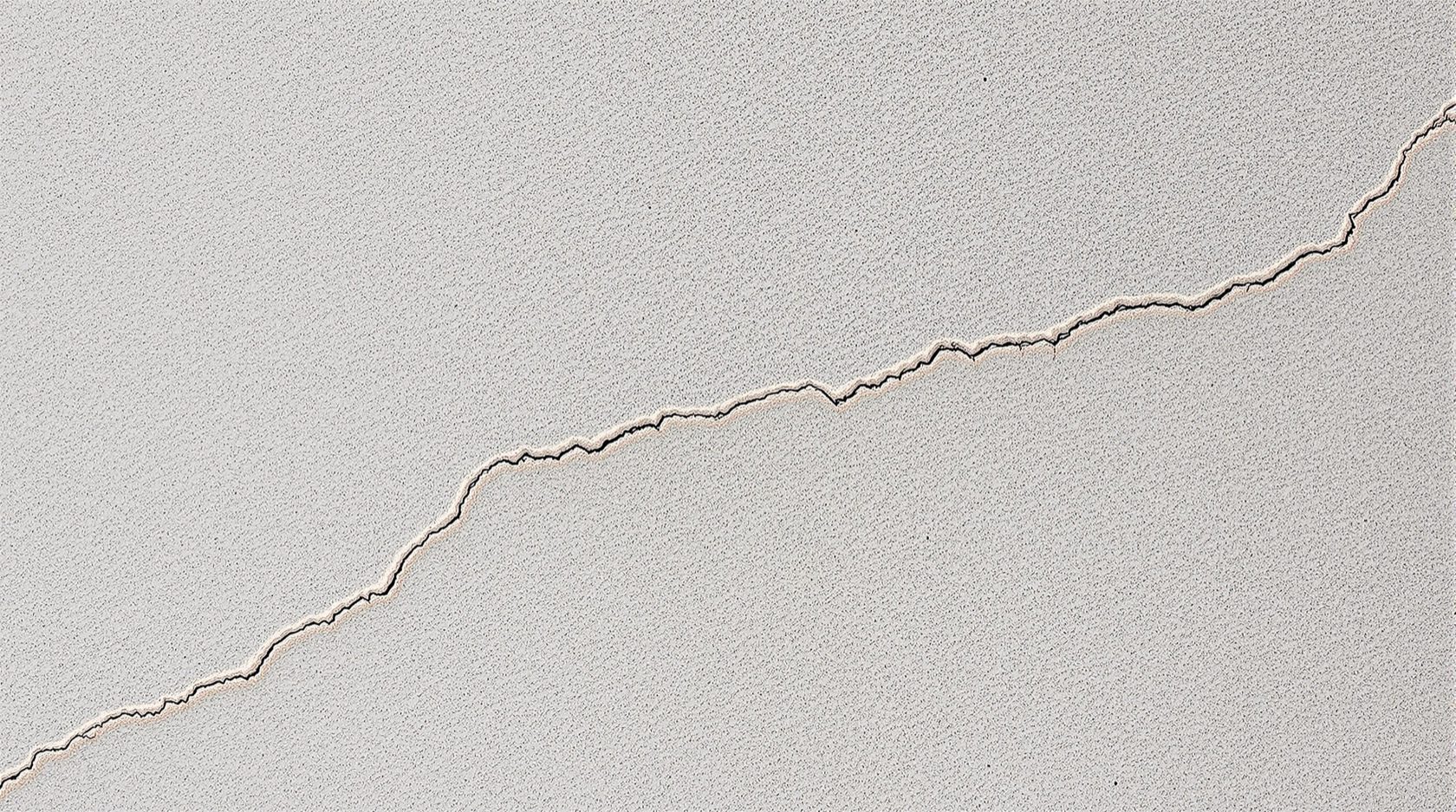
Sooner or later you will see a crack. A thread-thin line across the ceiling plaster, a spider-web of fine cracks on the terrace, a hairline running out from a corner, or — the one that stops your heart — a diagonal crack over a doorway with a rust stain weeping out of it. The first question every homeowner asks is the right one: is this serious? The honest answer is that it depends entirely on the type of crack, and most cracks you will ever see are cosmetic. But a small minority are the structure talking to you, and telling those apart is a skill worth having.
This is the crack-reading spoke of the Roofing Knowledge Hub, and a companion to The Ultimate Guide to Roofing Systems. It sits alongside the broader roof defects guide and the roof leak diagnosis guide, because a crack is where a great many Indian roof leaks begin. Here we stay with one question and answer it thoroughly: what does this crack mean, and what do I do about it? We will sort cracks by how they look and what caused them, judge each one for two separate threats — does it let water in, and does it threaten the structure — and mark clearly the line between what you can safely do and what must go to a professional.
Scope & safety. Your safe job with a crack is to observe, photograph, measure its width from a safe reachable spot, mark its ends with the date, and monitor whether it grows. That is genuinely useful work and it is all you should do. Do NOT grind, chase, inject, fill or coat a crack yourself, and never climb onto or walk a roof to investigate one. Crack injection, structural repair and any work at height are qualified work for a licensed waterproofing/roofing contractor and, where the structure is involved, a structural engineer. Most Indian terraces have a low parapet or none; falls from roofs are among the commonest serious home-repair injuries. Nothing here replaces an on-site professional assessment.
What's actually going on — cracks come from movement
Concrete is strong in compression and weak in tension. It cracks whenever something pulls it apart faster than it can stretch — and concrete barely stretches at all. So a crack is almost always a record of movement: the concrete shrank as it dried, the slab baked in the sun and expanded, a support settled, or steel inside rusted and swelled. Reading a crack is really reading which movement caused it.
That matters because the cause decides the danger. A crack from harmless drying shrinkage is a cosmetic and waterproofing issue — annoying, sometimes leaky, but not a threat to the building. A crack from overload, settlement or corroding steel is the structure under stress, and that is a different conversation. Two cracks can look almost identical to a worried eye; the pattern, the location and the behaviour over time are what separate them.
The Indian context sharpens one cause in particular. On a flat RCC roof, the slab is a large, exposed, horizontal sheet of concrete that bakes under a fierce sun all day and cools sharply at night. It expands and contracts every single day, and unless it is well insulated, well jointed and well cured, that relentless daily movement cracks it. Thermal movement is the single biggest source of non-structural cracking on Indian flat roofs, and we give it its own section below.
The crack-type field guide
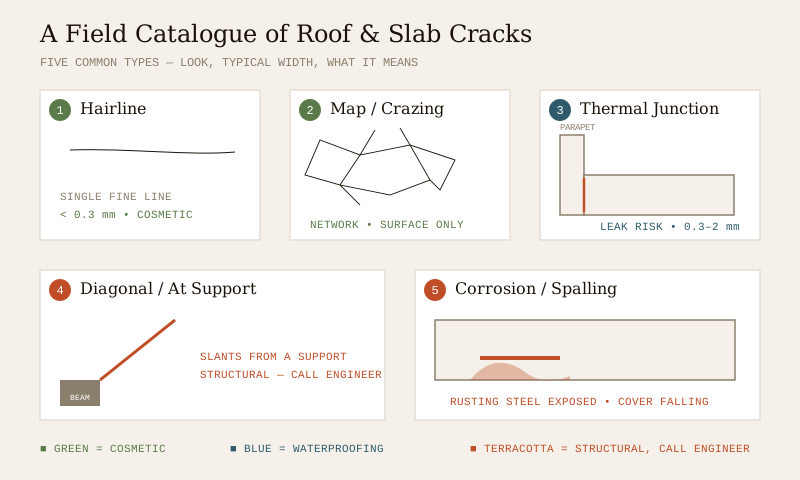
This is the heart of the guide. Read the table with the crack in front of you, and note the two separate threat columns: water (does it leak) and structure (does it endanger the building). A crack can threaten one, both or neither.
| Crack type | What it looks like | Typical width | Usual cause | Threatens waterproofing? | Threatens structure? | Who acts |
|---|---|---|---|---|---|---|
| Hairline | A single fine line, barely a pencil mark, often in plaster | < 0.3 mm | Plastic/drying shrinkage, minor thermal | Rarely on its own; can wick water over time on a terrace | No | Monitor; waterproofer if on a wet terrace |
| Map / crazing | A shallow web or network of fine cracks, like dried mud or crazed glaze | Each < 0.5 mm | Surface shrinkage of screed/plaster, over-troweled or fast-dried finish | Yes — a network gives water many small paths on a terrace | No | Waterproofing contractor (surface treatment) |
| Thermal (junction) | A straighter crack, often along a parapet-to-slab junction or where materials meet | 0.3–2 mm, can open/close with heat | Daily expansion & contraction of the baking flat slab | Yes — junction cracks are classic leak entries | Usually no, but watch if widening | Waterproofer; engineer if wide/growing |
| Wide / straight | A clearly open crack you can lay a coin edge into | > 2 mm | Overload, settlement, or long-neglected movement | Yes | Possibly — get it assessed | Structural engineer |
| Diagonal / at supports | A slanting crack near a beam, column, corner or slab support | Any width | Settlement, overload, structural distress | Yes | Yes — treat as structural | Structural engineer NOW |
| Corrosion / spalling | Cracks along a line, concrete flaking off, rusty steel showing | Widening; cover falling away | Rebar rusting and expanding, splitting the cover | Yes | Yes — section is losing strength | Structural engineer NOW |
| Through-slab | Same crack visible top of terrace AND on ceiling below, often leaking | Any | Serious movement through full depth | Yes | Yes | Structural engineer NOW |
Three of these — hairline, map/crazing and most junction thermal cracks — are the everyday, non-structural majority. They are a waterproofing and cosmetic story, covered by the roof waterproofing guide. The other three — diagonal/at-support, corrosion/spalling and through-slab — are the ones that put "call an engineer" in bold, and we return to them in the red-flags section.
Non-structural cracks — the common, mostly harmless majority
Plastic-shrinkage and drying-shrinkage cracks
Fresh concrete loses water as it sets and again as it dries over weeks. As it loses that water it shrinks, and because the slab is restrained by walls, beams and its own reinforcement, the shrinkage shows up as fine cracks. Plastic-shrinkage cracks form within hours of the pour, on the top surface, while the concrete is still soft — usually from too little curing or a hot, windy pour drying the top too fast. Drying-shrinkage cracks appear over the following weeks and months. Both are typically fine, shallow, and stable once the concrete has fully dried and stopped moving. IS 456 addresses shrinkage and thermal effects directly, which is why proper curing (keeping the slab wet for the specified period) is one of the cheapest defences a homeowner can insist on at construction time. See how this connects to the slab itself in the RCC roof guide.
Map cracks (crazing)
Crazing is that fine, interconnected web — like the surface of an old glazed pot or dried river mud — on the top of a plaster or a cement screed. It is a surface-layer phenomenon: a rich, over-troweled or too-quickly-dried finish shrinks over a stabler base and cracks into a network. Crazing does not threaten the structure at all. Its real cost is on a terrace, where the network of tiny cracks gives rainwater dozens of small paths to sit in, wick down and eventually find the waterproofing below. That is why a crazed terrace is a waterproofing job, not a demolition job.
Thermal-movement cracks — the big one on Indian flat roofs
Picture your flat terrace at 2 pm in May. The exposed concrete surface can reach 60–70°C while the shaded slab soffit below stays far cooler. The top expands more than the bottom; the slab tries to grow and bow, and it is held back by the parapets and walls it is tied to. At night it all reverses and contracts. Do this every day for years and something has to give — usually a crack, and very often right at the junction where the flat slab meets the vertical parapet, because that is where two elements moving at different rates tear apart.
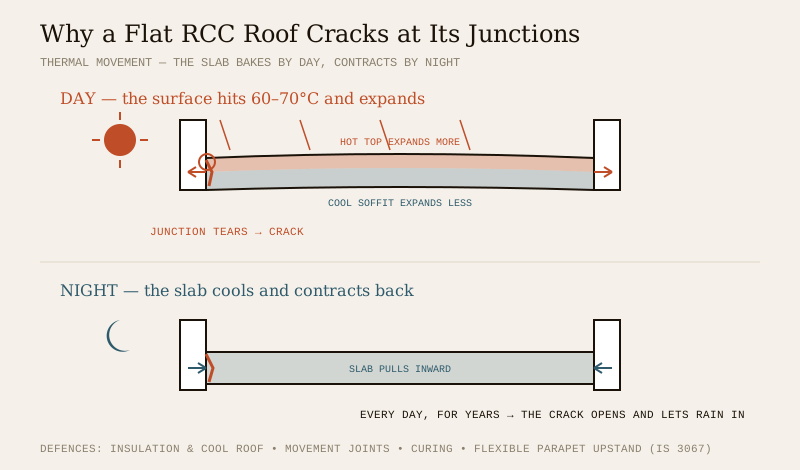
This is why thermal cracks are so common in India and why they cluster at junctions and edges. They are usually not a structural threat — but they are a leading cause of terrace leaks, because a junction crack that opens in the heat is an open door for the next downpour. The defences are the ones a good roof already uses: insulation and a cool-roof surface to cut the temperature swing (see the cool roof guide and roof insulation guide), proper movement joints, good curing, and a waterproofing system with a flexible, well-detailed parapet upstand as IS 3067 describes for junctions. When a thermal junction crack widens year on year, though, it graduates to something a professional should look at.
Structural-suspect cracks — the minority that matter
A small number of cracks are the structure under genuine stress, and these deserve respect. You do not diagnose them yourself — that is an engineer's job — but you recognise the warning patterns so you know to call one. The tell is rarely width alone; it is pattern, location and behaviour.
- Diagonal cracks, especially near a beam, column, corner or the support of a slab, suggest the structure is shearing or a support is moving. Slanting cracks are more worrying than straight horizontal or vertical ones.
- Cracks at supports — where the slab sits on a beam or wall — are where structural forces concentrate.
- Through-slab cracks you can see on both the top of the terrace and the ceiling below, often with water coming through, mean movement through the full depth.
- Cracks with sagging or a visible dip in the slab combine two red flags — see the roof sagging and deflection guide.
- Wide cracks (over ~2 mm) that are growing. A stable 1 mm crack is very different from one opening a little each season.
- Corrosion cracks with exposed, rusting steel and spalling — see below; this is both a durability and a strength problem.
Corrosion-induced cracking and spalling — a special case
This one earns its own note because it is progressive and it destroys the slab from inside. Reinforcement steel is protected by the "cover" — the depth of concrete over it — and by concrete's natural alkalinity. When water, carbon dioxide and (near the coast) salt reach the steel, it rusts. Rust occupies several times the volume of the steel it came from, so as the bar corrodes it swells and splits the cover off in cracks running along the line of the bar, then flakes it away entirely — this flaking is spalling, and once the brown steel is showing, the section has already lost cover, protection and some strength. It is common on older or coastal roofs and on soffits below leaking terraces. IS 456 sets cover and durability requirements precisely to slow this down; too little cover is a root cause. Exposed rusting rebar is never a "monitor and see" crack — it is a call-an-engineer crack, and on the coast the coastal roofing guide explains why the clock runs faster.
How wide is too wide? A reference
Width is not the whole story — a thin diagonal crack at a support can matter more than a wider harmless shrinkage crack — but for a given, non-structural crack, width is a useful gauge of the waterproofing risk and of how urgently to act. Measure with an inexpensive crack-width gauge (a printed card with graded lines) or by comparison against a known object from a safe, reachable spot. As a rough field reference:
| Measured width | Rough sense of it | For a shrinkage/thermal crack | If diagonal, at a support, or with rust/sag |
|---|---|---|---|
| Under 0.3 mm | Finer than a human hair mark | Cosmetic; monitor; seal if on a wet terrace | Still show an engineer if the pattern is structural |
| 0.3–1 mm | About a fingernail edge | Waterproofing attention on a terrace; monitor | Get an engineer's opinion |
| 1–2 mm | A thin coin edge fits | Route-and-seal by a pro; monitor closely | Engineer |
| Over 2 mm | Clearly open | Professional repair; find the cause | Engineer now |
| Any width, growing | Widening over months | Cause is still active — investigate | Engineer now |
The single most useful number is not the width today but whether it is changing. A crack that has been the same for years is telling you the movement that made it has stopped. A crack that widens each summer, or after each rainy season, is telling you the cause is still at work — and that is worth a professional's eyes regardless of type.
Your safe job: observe, measure, monitor
Here is the good news: the most valuable thing anyone can do in the first weeks of noticing a crack is exactly the thing that is completely safe. You become the person who gathers the evidence an engineer or contractor needs to judge it well. Do all of this from a safe, reachable, ground- or floor-level position — never at height, never on the roof.
- Photograph the crack in good light, including a wide shot showing where it is and a close shot of the crack itself. Put a coin or a ruler beside it for scale.
- Measure the width with a crack-width gauge card, or compare against a coin edge or the ruler in your photo, from a spot you can safely reach.
- Mark the ends. With a pencil, draw a small line across each end of the crack and write today's date beside it. If the crack later grows past your marks, you have proof it is active. This is a genuine engineering technique and it costs nothing.
- Note the pattern and place — is it near a corner, a beam, a parapet junction, a doorway? Straight or diagonal? On the ceiling, or on the terrace above, or both?
- Note the behaviour — does it appear or open after rain, in peak summer, or all the time? Is water coming through?
- Re-check on a schedule — photograph against your dated marks every few weeks and after the monsoon, and keep the images together.
That dossier — dated photos, a width, a location, a behaviour — lets a professional make a fast, accurate call and often saves you an unnecessary repair. It is the crack equivalent of the safe diagnostic work in the pre-monsoon roof inspection guide and the roof maintenance guide.
What you must never do: grind or chase the crack open, inject it with anything, fill it with putty or mortar to "hide" it, coat over a structural crack, or climb onto the roof to reach it. Hiding a crack destroys the very evidence a professional needs, and a filled crack that reappears has simply wasted your money. Filling and injection are pro jobs done after the cause is understood.
How cracks get repaired — an indicative guide (all done by pros)
You will not do any of this yourself, but knowing the ladder of repairs helps you understand a quote and judge whether it matches the crack. Costs are indicative 2026 ranges and vary widely with access, height, extent and city — always get local quotes.
| Approach | For which cracks | What it involves | Indicative range | Who does it |
|---|---|---|---|---|
| Surface seal / re-coat | Hairline & map/crazing on a terrace | Clean, prime, apply a flexible waterproof coating or crack-bridging membrane over the area | ₹40–120 per sq ft of area | Waterproofing contractor |
| Rout & seal | Single defined non-structural cracks | Cut a small V-groove along the crack, fill with a flexible polyurethane/polysulphide sealant, then over-band | ₹150–500 per running metre | Waterproofing contractor |
| Crack injection | Cracks needing to be re-bonded/sealed in depth | Inject epoxy (structural bond) or polyurethane (flexible/water-stopping) under pressure through ports | ₹500–2,000+ per running metre | Specialist applicator |
| Structural repair | Corrosion/spalling, diagonal, at-support, through-slab | Engineer's assessment first; expose & treat rebar, patch with repair mortar/micro-concrete, sometimes jacketing, fibre-wrap or added support | Project-specific — quote after assessment | Structural engineer + specialist contractor |
Two honest points. First, the cause must be fixed, not just the crack — a thermal junction crack that is sealed but not insulated will simply crack again next summer, and corroded steel that is patched without stopping the water will keep rusting. Second, injection is over-sold. Reputable contractors reach for the simplest approach that solves the actual problem; be wary of anyone who prescribes expensive injection for a cosmetic hairline, or who offers to inject a crack no one has yet worked out the cause of. When in doubt, an engineer's assessment first is money well spent — and a good roofing contractor will tell you when a crack is above their pay grade.
When to call a professional — the red flags
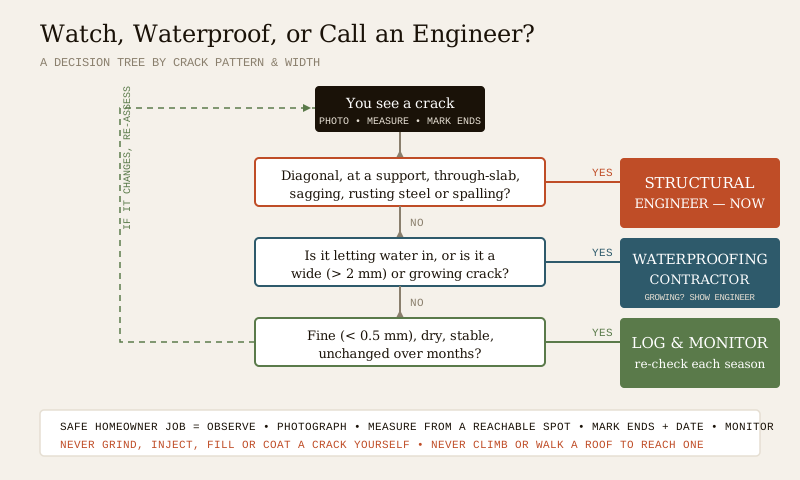
Stop monitoring and call a structural engineer promptly if a crack shows any of these:
- It is diagonal, or sits near a beam, column, corner or a slab support.
- It runs through the full slab — visible on the terrace above and the ceiling below.
- It is wide (over ~2 mm) or visibly growing past your dated marks.
- The slab or ceiling around it is sagging, dipping or bulging.
- There is rust staining, exposed rusting steel, or concrete spalling/flaking away.
- Several cracks appear suddenly together, or after any event (nearby construction, an earthquake, a change of use adding heavy load on the roof).
Call a licensed waterproofing/roofing contractor (not necessarily an engineer) when the crack is clearly the common non-structural kind — hairline, crazing, a stable junction crack — but it is letting water in on a terrace or showing up as a ceiling leak. That is a waterproofing repair, and it pairs naturally with the roof leak diagnosis guide.
And call no one, for now, when a fine crack is stable, dry, cosmetic and unchanging over months — just keep it in your monitoring log. Not every crack needs a rupee spent on it. The skill is knowing which is which, and this guide has given you the patterns.
A safe homeowner crack-watch checklist
- Photograph every new crack — wide shot for location, close shot with a coin for scale.
- Measure the width with a gauge card or coin comparison, from a safe reachable spot.
- Pencil a dated mark across each end so you can see if it grows.
- Note pattern (straight/diagonal), place (corner/junction/support), and behaviour (after rain/in summer/leaking).
- Re-check against your marks every few weeks and after the monsoon.
- Keep drains and terrace clear so water is not standing over a crack — see the roof drainage guide.
- Never grind, fill, inject or coat a crack yourself; never climb onto the roof to reach one.
- Match the crack to the red-flag list: any structural flag → structural engineer; leaking non-structural → waterproofing contractor; stable and cosmetic → log and monitor.
The one-line answer
Most roof cracks you will ever see — hairline shrinkage lines, map crazing, and the thermal junction cracks that a baking Indian flat slab produces — are cosmetic or a waterproofing issue, not a danger to the building. The minority that matter — diagonal cracks, cracks at supports, through-slab cracks, wide or growing cracks, and any crack with sagging or rusting, spalling steel — are the structure under stress and belong to a structural engineer. Your job is the safe and genuinely useful one: observe, photograph, measure the width, mark the ends with a date and monitor — and then call the right person. Never grind, inject or climb to reach a crack. Get the cause fixed, not just the crack hidden, and when in doubt, an engineer's assessment first is the cheapest insurance you can buy.
Where to go next
- The overview of everything that goes wrong up top: Roof Defects Guide.
- Where many cracks turn into leaks: Roof Leak Diagnosis & Repair.
- The slab itself: The RCC Roof Guide · the layer that keeps water out: Roof Waterproofing Guide.
- When a crack comes with a dip: Roof Sagging & Deflection Signs.
- Cutting the thermal swing that cracks flat roofs: Cool Roof Guide · Roof Insulation Guide.
- Finding the right person: Roofing Contractor Guide.
- The whole library: Roofing Knowledge Hub · the master map: The Ultimate Guide to Roofing Systems.
References
- IS 456: Plain and Reinforced Concrete — Code of Practice (cracking, cover, durability and control of shrinkage and thermal effects in RCC) — Bureau of Indian Standards; verify current status via the BIS catalogue: https://www.services.bis.gov.in/
- IS 3067: Code of Practice for General Design Details and Preparatory Work for Damp-Proofing and Waterproofing of Buildings (junction, upstand and crack detailing) — Bureau of Indian Standards.
- IS 13182 / IS 1346 / IS 2645: Waterproofing materials and practice — Bureau of Indian Standards; verify current editions via the BIS catalogue.
- National Building Code of India (SP 7), Bureau of Indian Standards — structural design and serviceability provisions; verify the current edition via the BIS catalogue.
This is an educational overview to help you recognise, judge and describe roof and slab cracks, not a repair manual. Diagnosing a structural crack, working at height, and all crack injection, waterproofing application and structural repair are qualified professional work — engage a licensed waterproofing/roofing contractor and, where the structure is involved, a structural engineer, and verify any standard's current status via the BIS catalogue before relying on it.
Export this guide
Related Guides — Deep-dive reading
Roof Defects: A Homeowner's Field Guide (India)
The diagnostic catalog that anchors the whole subject — every common roof defect on Indian homes, pictured and named: cracks, damp and efflorescence, ponding, waterproofing blisters, sagging, spalling and rusting rebar, corrosion, algae and moss, parapet and drain-junction failures, slipped tiles and perished fasteners. For each: what it looks like, what it usually means, how serious it is, and exactly who to call.
RoofingRoof Leak Diagnosis & Repair
The homeowner's most common roofing crisis, calmly explained — how to read the signs (stains, damp, efflorescence, peeling paint, drips, a musty smell), why the leak is almost never right above the stain, where roofs actually leak, how leaks are traced, and the honest line between what you can safely check yourself and what needs a professional. India-grounded, monsoon-tested.
RoofingWaterproofing Failures Explained: Why Systems Fail and How to Spot It
Why waterproofing so often leaks again within a year or two — the weak links in the system, the junctions that really fail, the flood test everyone skips, and how to tell a real repair from a cosmetic patch.
Structural SafetyRelated Tools — Try Free
Monsoon-Readiness Checklist
Pre-rain home audit across 9 categories — terrace, drains, waterproofing, electrical, HVAC, pest, vehicles, documents.
Seasonal AuditMaterial Schedule Generator
Generate a room-wise finish schedule — walls, floors, ceilings, trim, and joinery by location.
Material ScheduleInterior Red Flag Checklist — Before Signing
54 red flags across 8 categories with a live risk score and personalised PDF.
Red Flag Checklist