
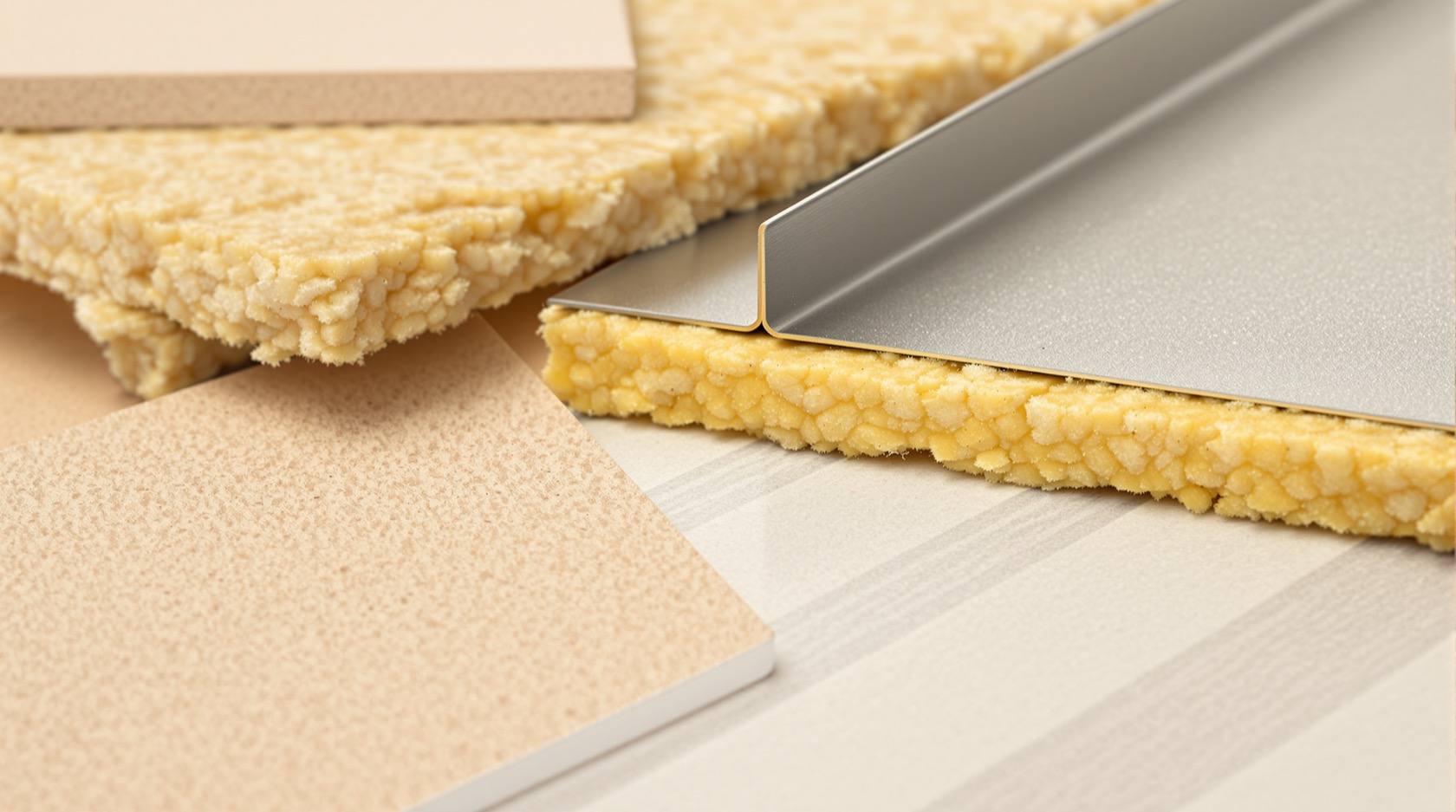
Fire-Resistant Building Materials in India: A Specify-and-Select Guide (2026)
The difference between how a material reacts to fire and how long a rated assembly resists it, then the materials that deliver passive fire protection - non-combustible structure, mineral wool, fire-rated boards, intumescent coatings, spray fireproofing and fire-stopping - with a material-to-role selection table.
A fire does not care what a brochure says. It tests every wall, floor, door and column in a building for one thing: how long each one keeps doing its job while it burns. That time - measured in half-hours, one, two or four hours - is what buys people the chance to get out and gives the fire service time to arrive. Getting it right starts with choosing the right materials, and choosing them for the right reason.
This guide helps you understand and specify fire-resistant building materials. It untangles two ideas that get muddled constantly - how a material "reacts" to fire versus how long an "assembly" resists it - and then walks the actual materials: the inherently non-combustible structure, the mineral wools and fire-rated boards, the coatings and sprays that protect steel, and the fire-stopping that seals the gaps. It will help you pick the right material for each role. It will not turn you into a fire-safety engineer, because that is a separate, licensed job.
Scope and safety: This is a selection guide. Fire ratings, thicknesses, coverage and prices here are indicative only and move with brand, build-up and region - always get local quotes and the manufacturer's tested data. Fire-safety strategy, compartment design, means of escape, rated-assembly detailing, fireproofing application and statutory compliance are the work of a qualified fire-safety consultant, architect or structural engineer, signed off by the authority having jurisdiction. Nothing here replaces the National Building Code, the relevant IS standards, a tested-system report or a licensed professional. This guide helps you choose materials - it does not certify a building.
Reaction to fire vs fire resistance - two different questions
Almost every mistake in this topic comes from blurring two separate questions.
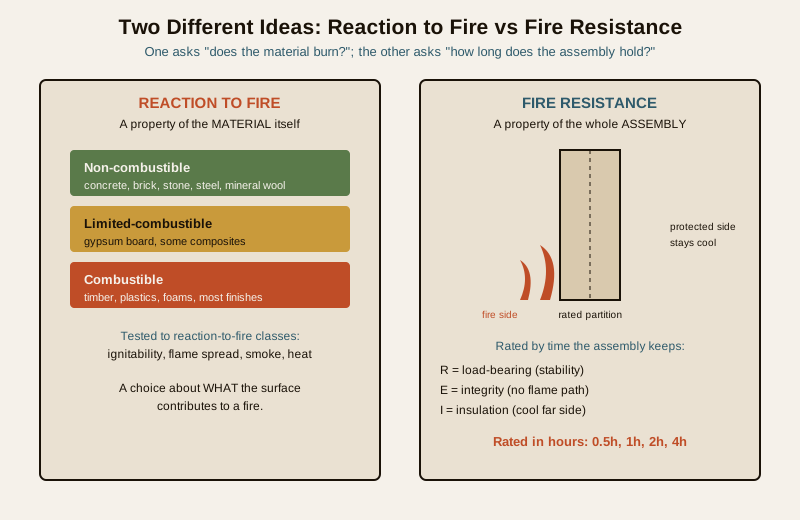
Reaction to fire is a property of the material on its own. It asks: does this material ignite, does it spread flame across its surface, how much heat and smoke does it give off? Materials are graded into broad families:
- Non-combustible - it does not burn and adds no fuel: concrete, brick, stone, steel, mineral wool, calcium silicate.
- Limited-combustible - it burns only marginally and contributes little: some gypsum-based and composite products.
- Combustible - it burns and feeds the fire: timber, most plastics, foams and many finishes.
Fire resistance is a completely different property, and it belongs to a whole assembly, not a single material. It asks: for how long does this built element - a wall, a floor, a door, a boxed-in column - keep performing under a standard fire? Performance is judged on three criteria, usually written as R, E and I:
- R - load-bearing capacity (stability): the element keeps carrying its load.
- E - integrity: no cracks or gaps let flame and hot gas pass through.
- I - insulation: the far (unexposed) side stays cool enough not to ignite what touches it.
The result is a fire-resistance rating in hours - 0.5h, 1h, 2h, 4h - such as a "two-hour rated partition". The single most important sentence in this whole guide follows from that: the rating belongs to the tested assembly, not to any one material in it. A superb board fixed the wrong way, with the wrong screws, no cavity insulation or an unsealed penetration beside it, does not give you the rating on the box.
Passive fire protection - the built-in defence
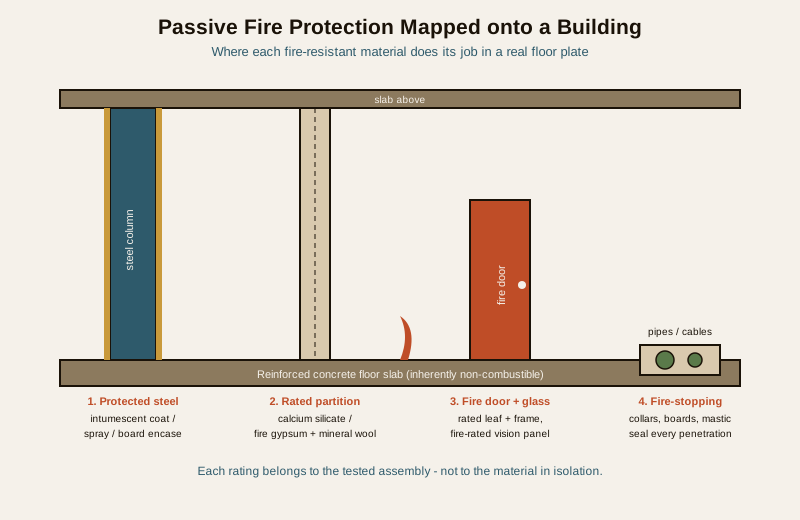
The materials in this guide deliver passive fire protection (PFP): protection built into the fabric that works with no power, no trigger and no human action. It is the counterpart to active protection - detectors, alarms, sprinklers, hydrants - which act during a fire. Passive protection does three jobs at once: it compartments the building (so fire is contained in the room or floor where it starts), it protects the structure (so the frame survives long enough), and it keeps escape routes (stairs, lobbies, corridors) tenable. Every material below serves one of those three jobs.
The inherently non-combustible structure
The bones of most Indian buildings are already non-combustible, which is a strong starting point.
- Concrete is the workhorse of passive protection. It does not burn, insulates well and holds structural fire resistance for long periods, provided the steel reinforcement inside has enough cover. Its behaviour under load and heat is engineering territory - see understanding concrete strength and why reinforcement steel matters.
- Fired clay brick and natural stone are non-combustible and give masonry walls useful inherent fire resistance; thickness and mortar matter.
- AAC blocks are non-combustible and, because they are lightweight and full of trapped air, they insulate well against heat - a genuine fire advantage over many alternatives. Weigh them against clay brick in AAC blocks vs red bricks and fly ash bricks vs clay bricks.
- Steel is the exception that catches people out. Steel does not burn, but it loses strength dramatically as it heats - by around 500 to 600 deg C an unprotected structural section can soften to the point of collapse. So a steel frame is non-combustible yet not fire-resistant on its own: it must be protected to earn a rating. Steel fundamentals are in the TMT steel complete guide and structural safety hub.
That steel caveat is the reason half the materials below exist: to keep steel cool long enough to survive.
Protecting steel - coatings, sprays and boards
There are three common ways to give structural steel a fire rating, and you specify by build type and finish:
- Intumescent coatings. A paint-like coating that looks ordinary at room temperature, then swells (intumesces) many times its thickness when heated, forming an insulating char that shields the steel. It is the go-to where the steel is exposed and a clean, painted appearance is wanted - atria, feature columns, exposed frames. Film thickness is engineered to the section and the required rating.
- Cementitious spray fireproofing. A sprayed-on cement- or gypsum-based coating that builds an insulating layer over the steel. It is cheaper per square metre and fast to apply, but it is textured and usually hidden - above ceilings, on decks and concealed beams.
- Board encasement (boxing-in). Wrapping the section in calcium silicate or fire-rated gypsum board to box the steel inside a rated case. It gives a clean, finishable, robust result and is common where the steel is visible or needs a hard surface.
- Vermiculite and perlite plasters. Plasters using lightweight, heat-stable vermiculite or perlite aggregate provide a sprayed or trowelled insulating coat - a traditional, robust route to protecting steel and soffits.
Which one is right, and how thick, depends on the section, the rating and exposure - that is the fire engineer's calculation, and the application belongs to a specialist applicator.
Mineral wool - the non-combustible core
Mineral wool (the family that includes rock wool / stone wool) is the insulation you reach for when fire matters. Spun from molten rock, it is non-combustible, withstands very high temperatures without melting, and does double duty as thermal and acoustic insulation. Packed into the cavity of a stud partition, it is what lets that partition hold its insulation (I) rating; it also serves as a fire-safe core in cladding and as a firestop backing. For the full picture see rock wool insulation, and compare the wider insulation family in the building insulation materials guide. A caution worth stating: not all insulation is fire-safe - many foam insulants are combustible, so in a fire-critical location mineral wool is the deliberate choice.
Fire-rated boards - the lining that makes the rating
Flat boards are how most partitions, shafts and ceilings earn their rating:
- Fire-rated gypsum board. Special-grade plasterboard with additives (and glass-fibre reinforcement) that hold together in a fire far longer than ordinary board. It is the everyday lining for rated drywall partitions and protected ceilings. See the gypsum boards guide and, for plaster context, gypsum plaster vs cement plaster.
- Calcium silicate board. A non-combustible, damp-tolerant mineral board that reaches the highest board fire ratings with a clean finish - the board of choice for high-rating partitions, shafts, steel encasement and public-building ceilings. Full detail in calcium silicate boards.
- Fibre-cement / cement board. Non-combustible, tough and moisture-tolerant, used where a rugged rated board is wanted, including tile backing and semi-exposed areas - see cement boards and fibre-cement.
The board earns the rating only as part of the tested system - correct studs, spacing, layers, screws and joints. Change the build-up and the rating is void.
Fire-stopping - sealing the holes you cannot see
A perfectly rated wall is useless if a pipe, cable tray or duct passes through it and leaves an unsealed gap - fire and smoke pour straight through. Fire-stopping reinstates the rating at every penetration, joint and gap, using purpose-tested products:
- Fire collars clamp around plastic pipes; in a fire the collar's intumescent lining crushes the melting pipe shut.
- Fire-rated boards, batts and coated mineral wool seal larger openings and cable-tray routes.
- Intumescent and fire-rated mastics/sealants close linear gaps, joints and small penetrations - the fire-rated members of the wider sealants guide family.
Fire-stopping is unforgiving detail work tied to tested systems and is a specialist trade. It is also the item most often skipped on site, and the one that most often fails an inspection - so it is worth naming explicitly in a specification.
Fire-rated glass and fire doors - the openings
Openings are the weak points of any fire barrier, and both have their own rated products.
- Fire-rated glass is engineered to keep integrity (and, in insulating grades, to limit heat transfer) for a rated period - very different from ordinary toughened or laminated glass, which fails fast in a fire. Use it only where its rating is documented; for the wider glass family see the glass and glazing hub and, for facade fire behaviour, facade fire safety and cladding.
- Fire doors are complete rated assemblies - leaf, frame, intumescent seals, hinges, closer and hardware - certified together. Swapping any component can void the rating. The dedicated guide is fire-rated doors.
Material-to-role selection table
Match the material to the job it does in the fire strategy, not to a headline claim.
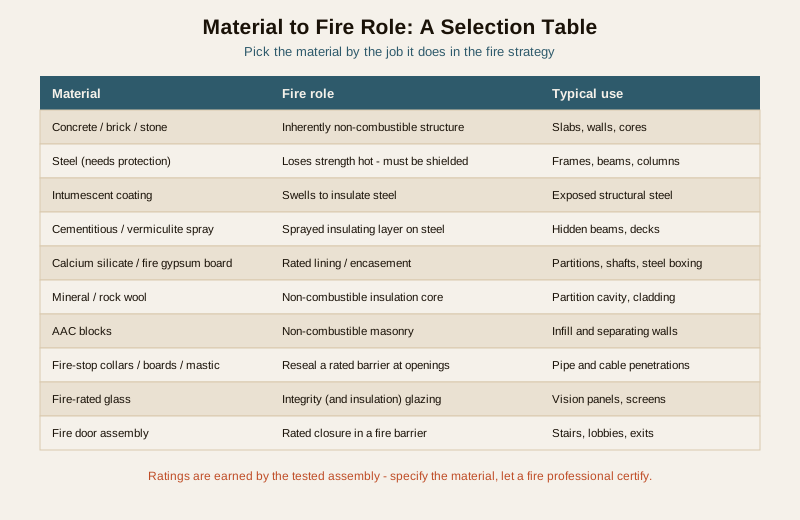
| Material | Fire role | Typical use in a building |
|---|---|---|
| Concrete | Inherently non-combustible structure | Slabs, cores, columns, walls |
| Brick / stone | Non-combustible masonry | Load-bearing and separating walls |
| AAC blocks | Non-combustible, insulating masonry | Infill and separating walls |
| Steel (protected) | Frame that must be shielded | Beams, columns, trusses |
| Intumescent coating | Swells to insulate exposed steel | Feature columns, exposed frames |
| Cementitious / vermiculite spray | Sprayed insulating layer on steel | Concealed beams, decks, soffits |
| Calcium silicate board | Highest-rating lining and encasement | Rated partitions, shafts, steel boxing |
| Fire-rated gypsum board | Everyday rated lining | Drywall partitions, protected ceilings |
| Fibre-cement board | Tough, damp-tolerant rated board | Wet-area and semi-exposed linings |
| Mineral / rock wool | Non-combustible insulating core | Partition cavity, cladding, firestop batt |
| Fire-stop collar / board / mastic | Reseals a barrier at openings | Pipe, cable and duct penetrations |
| Fire-rated glass | Rated integrity (and insulation) glazing | Vision panels, screens, borrowed lights |
| Fire door assembly | Rated closure in a barrier | Stairs, lobbies, exit routes |
Where this lands in a home
Most of the heavy machinery above is for larger and taller buildings, but several items matter in ordinary homes and apartments:
- The party wall / separating wall to the next flat or unit should be genuinely fire-resistant - masonry, AAC or a rated board partition.
- Around the kitchen and near electrical risers, favour non-combustible surfaces and keep combustible finishes back from heat sources - broader indoor-safety context is in healthy homes.
- Service shafts and the flat entrance door in apartments are common places a fire door and fire-stopping are specified.
- False ceilings in kitchens and near escape routes benefit from non-combustible boards - see the false ceiling guide.
If you are renovating, the right move is to keep existing fire separation intact - do not knock through a rated wall or leave a penetration unsealed - and to ask your architect where ratings apply.
Standards - named generally
Fire and life-safety in India is governed primarily by the National Building Code of India (SP 7:2026), Part 4 - Fire and Life Safety, which sets out compartmentation, structural fire protection, escape and rating requirements. Fire-resistance ratings of building elements are established by standard fire-resistance tests (the relevant Bureau of Indian Standards test methods, such as those in the IS 3809 family for fire-resistance testing, named generally here - confirm the current editions). Individual materials carry their own BIS product specifications and reaction-to-fire classifications, and every rating you rely on should come from a tested-system report for that exact build-up. Green-building frameworks - GRIHA, IGBC and LEED - may reward non-combustibility and low-smoke, low-toxicity materials. Standards and editions are revised periodically; verify against the current code, the test report and the manufacturer's data sheet rather than memory, and let the fire-safety professional map the requirement to your building.
Key takeaways
- Reaction to fire is about the material (non-combustible, limited-combustible, combustible); fire resistance is about the assembly and is rated in hours for stability (R), integrity (E) and insulation (I).
- The rating belongs to the tested assembly, not to a single material - wrong build-up, wrong fixings or an unsealed penetration voids it.
- Concrete, brick, stone and AAC are inherently non-combustible; steel is non-combustible but loses strength in a fire, so it must be protected by intumescent coating, spray, board encasement or vermiculite/perlite plaster.
- Mineral / rock wool is the non-combustible insulation core; fire-rated gypsum, calcium silicate and fibre-cement boards form rated linings; fire-stopping reseals every penetration; fire-rated glass and fire doors protect the openings.
- Use this guide to choose and specify materials - hand fire strategy, rated-assembly design, application and statutory sign-off to a qualified fire-safety consultant, architect or structural engineer.
References
- National Building Code of India (SP 7:2026), Part 4 - Fire and Life Safety - the governing provisions for compartmentation, structural fire protection, escape and element ratings.
- Bureau of Indian Standards - fire-resistance test methods (including the IS 3809 family) and product specifications and reaction-to-fire classifications for boards, insulation and coatings; consult the current editions.
- Manufacturer technical data sheets and tested-system / assembly reports - the authoritative source for the fire rating of a specific build-up, coating thickness or firestop detail.
- GRIHA, IGBC and LEED - green-building frameworks that may recognise non-combustible, low-smoke and low-toxicity materials.
- Studio Matrx guides: calcium silicate boards, cement boards and fibre-cement, gypsum boards, rock wool insulation, facade fire safety and cladding, fire-rated doors, AAC blocks vs red bricks and the complete building materials guide.
Export this guide
Related Guides — Deep-dive reading
Fire Rated Walls in India (2026): Compartmentation, Ratings & Keeping the Barrier Intact
How fire-rated walls divide a building into fire compartments so a fire in one part cannot spread to the rest - what makes a wall rated, and why one un-sealed penetration defeats the whole barrier.
SecurityRock Wool Insulation in India: Fire-Rated Thermal & Acoustic Insulation Guide (2026)
What rock wool (stone mineral wool) is, why it beats most insulants on fire and sound, the forms and densities it comes in, where it wins over glass wool and foams, indicative cost and safe fibre handling - a specify-and-select guide.
Building MaterialsCalcium Silicate Boards in India: Fire-Rated Partition, Ceiling & Cladding Guide (2026)
What a calcium silicate board is, why it leads on fire resistance and damp tolerance, where it beats gypsum and cement boards, how to tell it apart from fibre-cement, plus indicative cost and safe cutting - a specify-and-select guide.
Building MaterialsRelated Tools — Try Free
Acoustic Privacy (STC) Visualizer
Indian healthcare acoustic visualizer — compare wall assemblies and noise sources, see received SPL after STC attenuation, and check FGI 2018 / IS 1950 / NABH speech-privacy compliance with live dual-canvas waveform.
Acoustic ToolElectrical Safety & Load Audit
Home electrical audit — 10 categories, 65+ checkpoints across earthing, RCCB, MCB, wiring, switchboards, appliance circuits, DG/inverter backup.
Safety AuditFalse Ceiling Cost Estimator
Live ₹/sqft across 8 ceiling types — POP, gypsum, designer, metal, PVC, wooden — with cove and spot lighting for 20 Indian cities.
Cost Calculator