
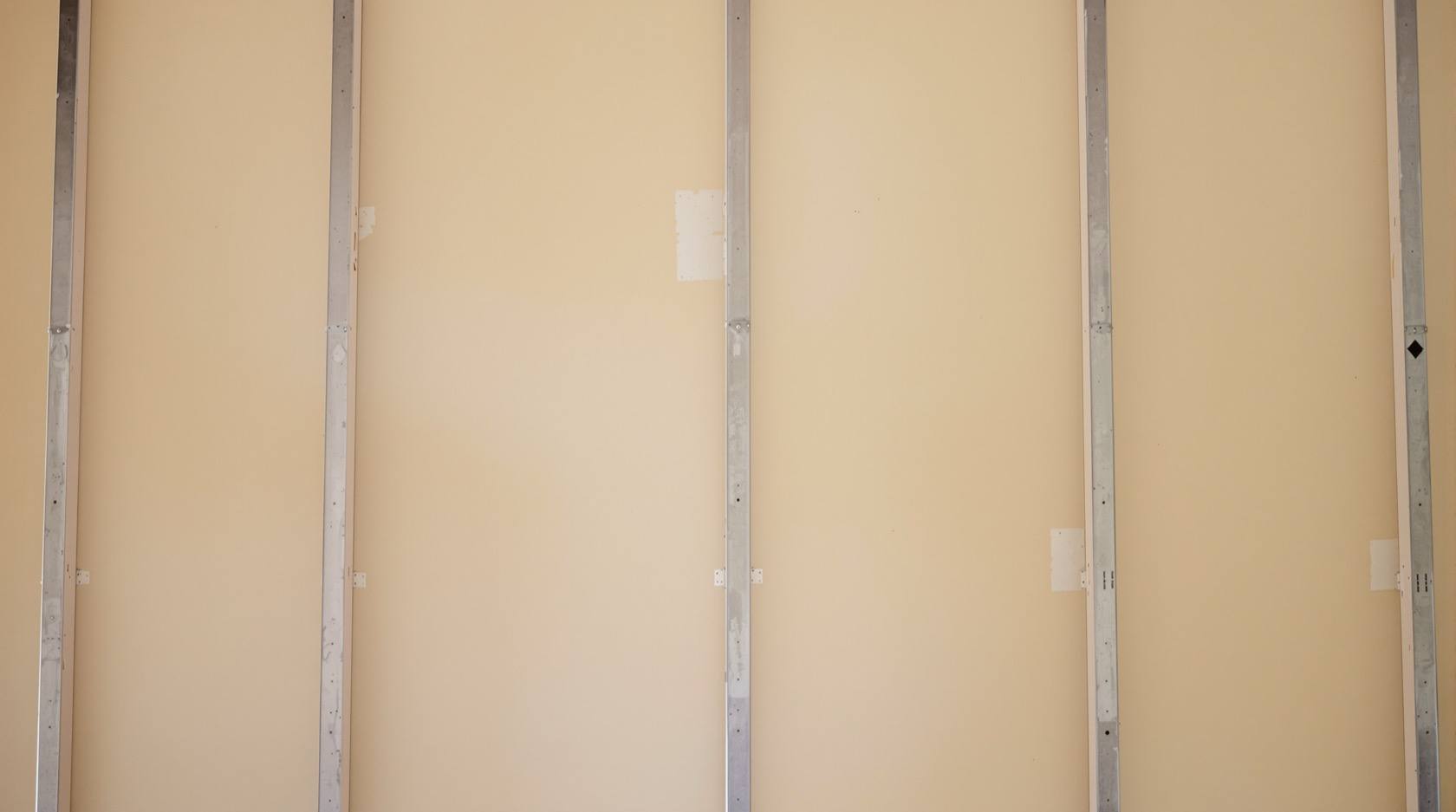
Gypsum Board (Drywall / Plasterboard) Guide for India: Types, Systems & Selection (2026)
What gypsum board is, why it dominates Indian false ceilings and drywall partitions, the grades - regular, moisture-resistant, fire-resistant, acoustic - the metal-framed drywall system, and how it compares to cement board, calcium silicate and traditional plaster. A specify-and-select guide.
Walk into almost any recently finished Indian home, office or showroom and look up: that flawless flat white ceiling, the crisp recessed cove for the lights, the slim partition that went up in a weekend without a speck of wet mortar - all of it is very likely gypsum board. Also called drywall or plasterboard, gypsum board has quietly become the default material for modern interior surfaces, and for good reason. It is light, fast, dry, and finishes to a smoothness that plaster struggles to match.
This guide helps you choose and specify gypsum board: what it actually is, the huge role it plays in Indian interiors, the grades you will be offered, the metal-framed system it hangs on, and how it stacks up against cement board, calcium silicate board and old-fashioned brick-and-plaster partitions. It stops short of telling you to build it yourself - drywall is a trade, and a good drywall contractor is the difference between a wall that looks moulded and one that cracks at every joint.
Scope and safety: This is a selection guide. Prices, sizes and performance figures here are indicative only - they move with brand, grade, thickness, region and freight, so always get local quotes and the manufacturer's tested data. Fire-rated and acoustic drywall systems, framing spans, ceiling suspension design and load-bearing decisions are engineering matters - hand them to a qualified architect, drywall contractor or fire-safety professional. Gypsum board is NOT for continuously wet areas or structural loads. Nothing here replaces the relevant IS codes, the manufacturer's system manual or a licensed professional.
What gypsum board actually is
Gypsum board is a sandwich. The core is set gypsum - the same mineral (calcium sulphate) used in gypsum plaster - cast as a firm, flat slab. Both faces are wrapped in strong paper liner, and the long edges are tapered so that adjoining boards form a shallow trough for jointing. The paper gives the board its strength in bending and its ready-to-finish surface; the gypsum core gives it rigidity, dimensional stability and a genuinely useful property - it holds chemically combined water that turns to steam under fire, buying time before the wall fails.
That combination is what makes gypsum board so pleasant to work with. It is light (a standard board is a fraction of the weight of an equivalent plastered masonry surface), dry (no water, no curing, no drying-out period), flat and smooth straight off the factory line, and easy to cut with nothing more than a knife and a straightedge. Screw it to a frame, tape and fill the joints, sand, and you have a monolithic surface ready for wall finishes - putty, paint or texture. For the wider material landscape it sits within, start with our complete building materials guide.
Where gypsum board earns its keep in Indian interiors
Gypsum board is not a one-trick material. In Indian fit-outs it turns up in four main roles:
- False ceilings. This is the single biggest use. Suspended from the soffit on GI sections, gypsum ceilings give a dead-flat plane that hides beams, ducts, wiring and plumbing, carries recessed and cove lighting, and drops rooms to a more intimate height. For the full ceiling picture - grid vs boxed, POP vs gypsum vs PVC - see our dedicated false ceiling guide.
- Drywall partitions. Non-load-bearing internal walls that go up dry and fast on a steel frame. Ideal for offices, retail, hospitality and flexible homes where walls may later move.
- Wall linings and dry-linings. Boarding over rough or uneven masonry to get a clean, insulated, service-carrying surface without wet plaster.
- Bulkheads, coves, niches and pelmets. The curved and stepped shapes that carry indirect lighting and give a ceiling its character are almost all gypsum board bent or built over a shaped frame.
The thread running through all four is the same: a fast, light, dry, smooth surface that conceals services and takes any finish - with far less mess, water and waiting than the wet trades it replaces.
The grades - and why the colour matters
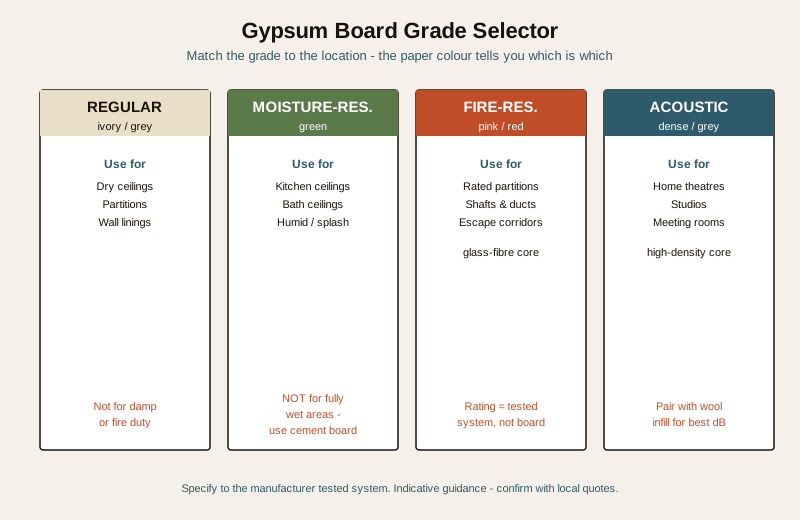
Not all gypsum board is the same board in a different size. The core and the paper are engineered for different jobs, and the industry colour-codes the paper so you can tell them apart on site. Specifying the wrong grade - a regular board in a humid kitchen ceiling, say - is one of the most common and avoidable drywall failures.
| Grade (common colour) | Core / makeup | Best for | Do NOT use for |
|---|---|---|---|
| Regular (ivory / grey paper) | Standard gypsum core | Dry ceilings, partitions, linings | Any damp, wet or fire-rated location |
| Moisture-resistant (green) | Water-repellent additives in core and paper | Semi-wet, humid areas - kitchen and bathroom ceilings, utility, covered balconies | Continuously wet zones (showers, wet walls) |
| Fire-resistant (pink / red) | Gypsum core reinforced with glass fibre | Fire-rated partitions, shafts, service ducts, escape corridors | As a substitute for engineered fire-stopping detail |
| High-impact / abuse-resistant | Denser core, tougher liner or mesh | Corridors, schools, back-of-house, high-traffic walls | - |
| Acoustic / high-density | Dense gypsum core, often with additives | Home theatres, studios, meeting rooms, party walls | - |
Two cautions matter most. First, moisture-resistant (green) board is for humid and splash-prone areas, not for continuously wet ones. A green board is fine on a kitchen or bathroom ceiling where it sees steam and occasional splashes; it is NOT fine as the lining behind a shower or on a wall that gets regularly wetted. For true wet areas you specify cement board or fibre cement or calcium silicate board instead. Second, fire-resistant board contributes to a rated assembly - it does not create one on its own. The rating comes from the whole tested system (board layers, frame, infill, joints and penetrations), which is an engineering decision for your consultant.
Board sizes and thicknesses
Gypsum boards are sold in a manageable set of standard sizes, so panels align to typical frame spacings with minimal cutting.
| Property | Typical range (indicative) | Notes |
|---|---|---|
| Thickness | 9 mm, 12.5 mm, 15 mm | 12.5 mm is the everyday default; 9 mm for curves; 15 mm for fire/acoustic |
| Width | 1,200 mm | Suits studs at 400 or 600 mm centres |
| Length | 1,800 to 3,600 mm | Longer boards mean fewer horizontal joints |
| Edge | Tapered long edges | Forms the trough for tape and jointing compound |
| Weight | roughly 8 to 12 kg per sq m | Varies with thickness and grade |
Thicker and denser boards, or two layers, are specified where fire rating, acoustic performance or impact resistance demand it - always to the manufacturer's tested system rather than by feel.
The drywall system - how it all goes together
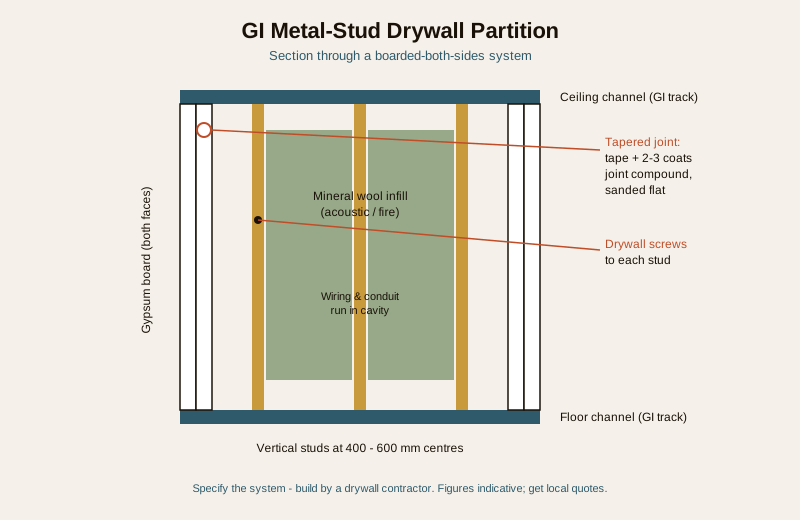
A gypsum board wall or ceiling is only as good as the system behind it. The board is the visible skin; the performance lives in the frame, the fixings and the jointing. At a high level, a partition is built like this:
- The frame. Galvanised iron (GI) sections - floor and ceiling channels (tracks) with vertical studs slotted between them, typically at 400 to 600 mm centres. GI resists rust; timber battens, once common, are avoided for the risk of warping and termites.
- Services and infill. Wiring, conduits and boxes run inside the hollow cavity before boarding. A mineral wool infill or glass wool is added where sound insulation matters - an empty cavity transmits far more noise.
- Boarding. Boards are screwed (not nailed) to the studs with drywall screws at set spacings, joints staggered, cut edges kept off wet floors.
- Jointing. The tapered joints are bedded with paper or fibreglass tape and covered with two to three coats of joint compound, feathered wide and sanded flat, so the wall reads as one continuous surface with no visible seams.
- Finishing. A skim or putty, then paint or texture. Corners get metal or paper beads for a crisp, chip-resistant edge.
Every one of those steps is a skilled operation, and the jointing especially separates a good contractor from a bad one. Specify the system; leave the build to a drywall contractor. Ceiling suspension design, fire and acoustic detailing, and framing spans for tall or long walls are engineering decisions, not site improvisation.
Strengths and limits - an honest read
Gypsum board earns its dominance, but it is not the answer to every surface. Know both sides before you specify.
Strengths. It is fast (a partition that would take days in brick-and-plaster goes up in hours), dry (no curing, no waiting, no water damage to adjacent finishes), light (a big saving in dead load, which matters for ceilings and upper floors), and smooth (a finish plaster rarely equals). It conceals services beautifully, gives good acoustic performance when the cavity is filled with mineral wool, and the fire-rated grades contribute to fire safety. It is also easy to modify - cut in a new socket or doorway without demolition dust everywhere.
Limits. It is not structural - it carries no building load and needs the frame for support; heavy fixtures need proper anchors or blocking. It is not for continuously wet areas - sustained water ruins the gypsum core, so showers, exterior faces and permanently damp walls are out (that is cement-board or calcium-silicate territory). It is damaged by water - a roof or plumbing leak can sag and stain a gypsum ceiling and mean replacement. And it is less impact-resistant than masonry unless you specify an abuse-resistant grade.
Gypsum vs cement board vs calcium silicate
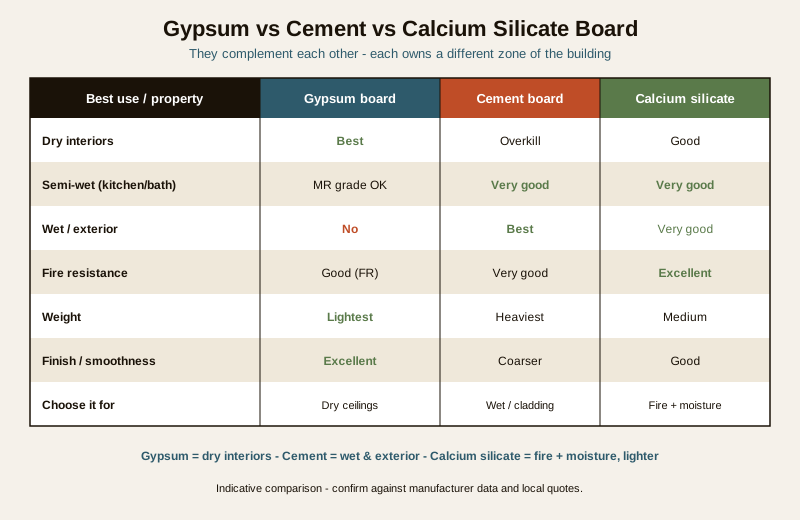
These three flat boards get compared constantly, and the honest answer is that they are complements, not rivals - each owns a different zone of the building.
| Property | Gypsum board | Cement / fibre-cement board | Calcium silicate board |
|---|---|---|---|
| Core | Gypsum, paper-faced | Cement + fibres | Calcium silicate + fibres |
| Dry interior surfaces | Best - smooth, cheap, fast | Overkill, heavier | Good, more costly |
| Semi-wet (kitchen/bath ceiling) | Moisture-resistant grade OK | Very good | Very good |
| Continuously wet / exterior | No | Best (showers, facades, wet walls) | Very good |
| Fire resistance | Good (FR grade) | Very good | Excellent |
| Weight | Lightest | Heaviest | Medium |
| Finish / smoothness | Excellent | Coarser | Good |
| Best reason to choose | Dry ceilings & partitions, smooth finish | Wet areas, external cladding, tile backer | Fire and moisture together, lighter than cement board |
The rule of thumb: gypsum for dry interiors, cement board where it stays wet or goes outside, calcium silicate where you want fire and moisture resistance with less weight than cement board. See the sibling guides on cement and fibre-cement boards and calcium silicate boards for the full detail on those two.
Gypsum drywall vs traditional plaster and masonry partition
Against a conventional half-brick or block partition finished in cement plaster, a gypsum drywall trades some things away and gains others. Masonry wins on impact resistance, on hanging heavy loads directly, and on a feeling of solidity; it is also the honest choice for wet walls. Drywall wins decisively on speed, weight, cleanliness (no wet trades), thickness (a slimmer wall reclaims floor area), and the ease of routing services and later alterations. For non-load-bearing internal walls in offices, retail and flexible homes, drywall is usually the better call; for wet, high-impact or load-carrying walls, masonry still earns its place. The jointing and finishing compounds themselves sit within the wider family of construction chemicals.
Cost - what to expect
As an indicative guide only, plain gypsum board commonly falls around Rs 30 to Rs 70 per sq ft for the board alone, with moisture-resistant, fire-resistant and acoustic grades at the upper end. A completed drywall partition or false ceiling - board, GI framing, screws, tape, compound, finishing and labour - typically lands in the range of roughly Rs 90 to Rs 180 per sq ft installed, moving with grade, height, double-boarding, insulation infill and finish. Treat these as ballpark: grade, brand, ceiling height, access and region all shift the number, so get current local quotes from a drywall contractor.
Standards and sustainability
Gypsum plaster boards in India are broadly covered by the relevant Bureau of Indian Standards (BIS) specification for gypsum plaster boards (named generally here - check the current edition for classification, dimensions and marking), while fire and acoustic performance should come from the manufacturer's tested system data, not generic tables. Fire and life-safety provisions sit within the National Building Code of India (SP 7:2026). On sustainability, gypsum board scores well: the core can incorporate recycled and by-product gypsum, off-cuts are recyclable, and the dry, fast install cuts water use and site waste - all of which can support GRIHA, IGBC or LEED credits. Standards and editions are revised periodically, so verify against the current data sheet rather than relying on memory.
Key takeaways
- Gypsum board (drywall / plasterboard) is a paper-faced gypsum core - light, dry, fast and smooth - and the default material for Indian false ceilings, partitions, wall linings and bulkheads.
- The grades are colour-coded: regular for dry areas, moisture-resistant (green) for humid and splash-prone - but NOT continuously wet - areas, fire-resistant (pink, with glass fibre) for rated assemblies, plus high-impact and acoustic grades.
- It hangs on a GI metal-stud system with screws, taped-and-filled joints and a putty finish; performance lives in the frame, infill and jointing, so specify the system and leave the build to a drywall contractor.
- Strengths: fast, dry, light, smooth, conceals services, good acoustics with mineral wool infill. Limits: not structural, not for wet areas, damaged by water.
- Choose gypsum for dry interiors; cement board for wet and exterior; calcium silicate where fire and moisture resistance matter with less weight - they complement rather than compete.
References
- Bureau of Indian Standards - the specification for gypsum plaster boards and related standards; consult the current editions for classification, dimensions and marking requirements.
- National Building Code of India (SP 7:2026) - fire and life-safety and interior-construction provisions relevant to drywall partitions and suspended ceilings.
- Manufacturer technical data and system manuals - the authoritative source for a specific product's tested fire rating, acoustic performance, span tables and jointing method.
- Studio Matrx guides: false ceiling guide, cement and fibre-cement boards, calcium silicate boards, gypsum plaster vs cement plaster and the complete building materials guide.
Export this guide
Related Guides — Deep-dive reading
Fire-Resistant Building Materials in India: A Specify-and-Select Guide (2026)
The difference between how a material reacts to fire and how long a rated assembly resists it, then the materials that deliver passive fire protection - non-combustible structure, mineral wool, fire-rated boards, intumescent coatings, spray fireproofing and fire-stopping - with a material-to-role selection table.
Building MaterialsAcoustic Insulation Materials in India: Soundproofing Products Explained (2026)
The materials that quiet a room and block noise between rooms - mineral wool, acoustic gypsum, mass-loaded vinyl, resilient channels, damping compound and seals. What each does, where it goes, indicative cost, and why soundproofing is always a system, not a single product.
Building MaterialsCalcium Silicate Boards in India: Fire-Rated Partition, Ceiling & Cladding Guide (2026)
What a calcium silicate board is, why it leads on fire resistance and damp tolerance, where it beats gypsum and cement boards, how to tell it apart from fibre-cement, plus indicative cost and safe cutting - a specify-and-select guide.
Building MaterialsRelated Tools — Try Free
Acoustic Privacy (STC) Visualizer
Indian healthcare acoustic visualizer — compare wall assemblies and noise sources, see received SPL after STC attenuation, and check FGI 2018 / IS 1950 / NABH speech-privacy compliance with live dual-canvas waveform.
Acoustic ToolFalse Ceiling Cost Estimator
Live ₹/sqft across 8 ceiling types — POP, gypsum, designer, metal, PVC, wooden — with cove and spot lighting for 20 Indian cities.
Cost CalculatorMaterial Decision Framework (M-Score)
Score 30+ Indian construction materials across cost, durability, climate fit, maintenance, and sustainability.
Materials