
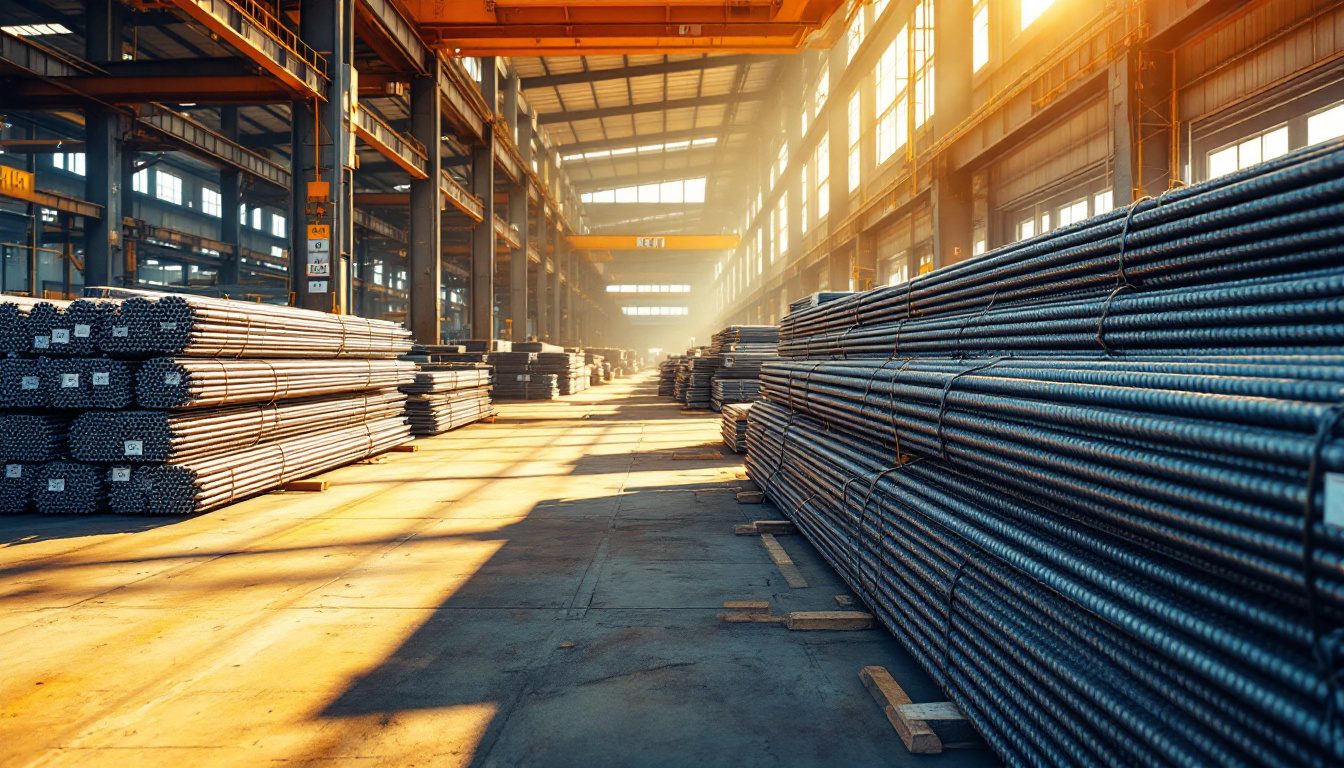
Complete Guide to TMT Steel
What TMT bars are, how they are made, the grades (Fe415/500/550D/600), how to read the markings, and how to buy the right steel for your home without being cheated.
You are standing at the steel yard. The yard owner has laid out three bundles: one stamped Fe500, one Fe550D, one plain "SUPER STRONG 500" with no brand on the tags. The Fe500D costs ₹4 more per kg. The unbranded bundle is ₹9 cheaper per kg. Your contractor is on the phone saying "take the cheap one, steel is steel." You are about to spend ₹2–3 lakh on reinforcement for your slab alone. And you have no idea which bundle to pick.
This guide is written precisely for that moment. Not the "why does reinforcement exist" question — that is answered in why reinforcement steel matters — but the practical product question: what are the grades, what do the stamps mean, how do you check quality, how do you estimate quantity, and how do you not get cheated?
TMT steel — Thermo-Mechanically Treated reinforcement bar — is a ribbed steel bar given a hard outer skin (martensite) and a soft ductile core through rapid water-quenching immediately after hot rolling; the result is a bar that is simultaneously strong and bendable, corrosion-tolerant, and weldable — the mandatory modern standard under IS 1786.
1. What "Thermo-Mechanically Treated" Actually Means
The name sounds intimidating, but the process is elegant and worth understanding, because it is the reason TMT is superior to the older TOR (Torque-twisted) and CTD (Cold-Twisted Deformed) bars that were common before the 1990s.
A steel billet is reheated in a furnace, then rolled through a series of rolling stands to thin it to the target diameter and form the surface ribs. At the final stand, the hot bar — at roughly 900–950°C — passes through a special water-quench box where high-pressure jets rapidly cool only the outer surface. This sudden cooling transforms the surface layer into a very hard microstructure called martensite. The core, however, is still hot and remains austenitic.
The bar then exits the quench box. The residual heat in the core conducts back outward, gently tempering the martensitic shell into a tough, tempered martensite. The core slowly cools in air and transforms into a fine pearlite-ferrite microstructure — soft, ductile, and tough. The result is a bar with a hard ribbed skin (high strength) wrapped around a soft core (high ductility and elongation). No cold-working. No twisting. No residual torsional stress.
This is why TMT beats TOR/CTD: TOR bars derived extra strength through cold-twisting, which increased yield strength but sacrificed elongation and weldability. They also had inconsistent properties along the length. TMT bars have consistent properties end to end, better elongation for seismic zones, and are fully weldable — critical for repair work and splicing.
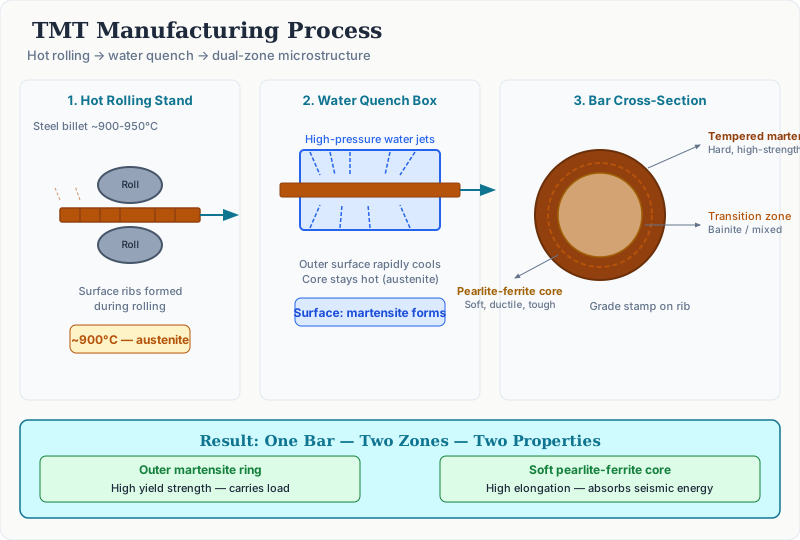
How the quench-and-temper process creates two zones in one bar — the defining feature of TMT.
"Strength without ductility is brittleness; ductility without strength is deformation. TMT delivers both in the same cross-section." — Site engineers' field maxim, Indian structural practice.
2. The Grades: Fe415, Fe500, Fe500D, Fe550D, Fe600
IS 1786 (Indian Standard for High-Strength Deformed Steel Bars and Wires for Concrete Reinforcement) defines the grade designations. The number after "Fe" is the minimum yield strength (0.2% proof stress) in megapascals (MPa). The suffix "D" stands for a ductility-enhanced variant.
| Grade | Min. Yield Strength (MPa) | Min. Tensile Strength (MPa) | Min. Elongation (%) | Typical Use |
|---|---|---|---|---|
| Fe415 | 415 | 485 | 14.5 | Older construction, rarely specified now |
| Fe415D | 415 | 500 | 18.0 | As Fe415 but seismic detailing |
| Fe500 | 500 | 545 | 12.0 | Standard residential construction |
| Fe500D | 500 | 565 | 16.0 | Seismic zones II–V, preferred for RCC frames |
| Fe550 | 550 | 585 | 10.0 | Heavy load-bearing, industrial |
| Fe550D | 550 | 600 | 14.5 | Seismic + heavy-load combination |
| Fe600 | 600 | 660 | 10.0 | Specialised high-rise, bridges, rarely residential |
Source: IS 1786:2008 (Reaffirmed 2018), Tables 1 and 2.
What should a homeowner specify? For typical 2–4 storey residential construction in India, Fe500 or Fe500D is the current standard. Your structural engineer will specify the exact grade; if they say Fe500D and your contractor pushes Fe500 to save money, that is a red flag.
The "D" suffix matters most in seismic zones. India is divided into four seismic zones (II, III, IV, V) under IS 1893. Zones III, IV, and V — which include large parts of South India, Maharashtra, Gujarat, Himalayan foothills, and the northeast — require ductile detailing per IS 13920. For ductile detailing, Fe500D or Fe550D is the right choice: the higher elongation means the bar can absorb energy during an earthquake by yielding and stretching rather than fracturing suddenly. Read more in earthquake zones and home design.
"The requirement of ductility is not merely to prevent collapse — it is to give occupants enough time to escape." — IS 13920:2016 Commentary, Bureau of Indian Standards.
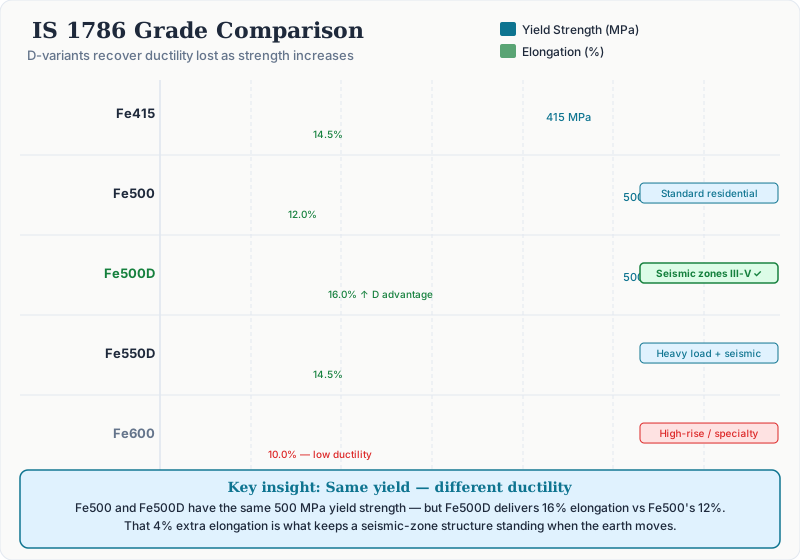
Higher grade = more strength but typically less elongation; the D variants recover the ductility lost as strength increases.
3. TMT vs TOR and CTD — Why the Old Bars Are Gone
| Property | TOR / CTD (old) | TMT (current IS 1786) |
|---|---|---|
| Strength mechanism | Cold-twisting / cold-working | Heat treatment (quench + temper) |
| Elongation | 8–10% (reduced by cold work) | 12–16% (D variants) |
| Weldability | Poor (cold work creates residual stress) | Good (no residual torsional stress) |
| Consistency along length | Variable (twisting non-uniform) | Consistent (rolling is continuous) |
| Corrosion behaviour | Similar base steel | Similar, but CRS variant available |
| IS code reference | Superseded by IS 1786 | IS 1786:2008 current |
| Availability today | Rarely available new; beware re-rolled scrap | Standard; always insist on IS 1786 |
If a contractor produces bars with a twisted appearance and no IS 1786 stamp, that is old-technology steel. Walk away.
4. Special TMT Variants: CRS, Epoxy-Coated, Galvanised
Not all TMT is the same alloy. For aggressive environments — coastal areas, industrial zones, saline groundwater, high-humidity basements — standard Fe500/Fe500D may corrode faster than desired. Three enhanced variants exist:
CRS (Corrosion-Resistant Steel): Alloyed with copper, chromium, and phosphorus at the mill stage. Forms a tight, adherent oxide layer that retards further corrosion. IS 1786 includes CRS variants designated with a "C" suffix (e.g., Fe500C or branded "CRS" by manufacturers). Relevant to coastal India within 5 km of the sea, saline soil zones, and areas with acidic groundwater.
Epoxy-Coated Bars: Fusion-bonded epoxy coating applied after bar manufacture per ASTM A775 / relevant IS clauses. Very effective but brittle; the coating can chip during handling and at cut ends, creating localised corrosion initiation points. Handling discipline is essential. Used in bridges, coastal RCC.
Galvanised (Zinc-Coated) Bars: Effective barrier against chloride-initiated corrosion. More common in prestressed applications and overseas; less common in Indian residential market. More expensive.
| Variant | When to Use | Price Premium (indicative 2026) | Limitation |
|---|---|---|---|
| Standard Fe500/Fe500D | Inland residential, non-saline | Base price | None for typical use |
| CRS (Fe500C or similar) | Coastal (within 5 km sea), saline soil | +₹3–6/kg | Verify alloy certificate |
| Epoxy-Coated | Bridges, coastal critical structures | +₹8–15/kg | Chip damage during handling |
| Galvanised | High-spec coastal, marine structures | +₹10–20/kg | Zinc-cement reaction at bar end |
For most Indian homeowners in inland cities: standard Fe500D from a branded primary mill is sufficient with good concrete cover and mix quality. For coastal and flood-prone areas, CRS is worth the premium. Learn more about the science of durable buildings.
5. Reading the Bar: Marks, Ribs, and Diameters
Every legitimate IS 1786-compliant TMT bar carries physical identification rolled into the surface:
Rolling marks (mill marks): Typically a combination of raised letters/numbers on the ribs indicating the manufacturer's code and the grade. Every primary mill has a registered mark. Look for it. If the bar surface is plain or the marks are unclear/absent, that is a serious warning sign.
Grade stamp: Fe500, Fe500D, Fe550D, etc. — should appear at intervals along the bar length (roughly every 1–1.5 m in most mills).
BIS/ISI mark: A separate IS mark certifying the bar meets IS 1786. This is in addition to the mill's own brand marks.
Rib pattern: TMT bars have transverse ribs (for bond with concrete) and two longitudinal ribs. The height, spacing, and inclination of transverse ribs must meet IS 1786 geometric requirements. Poorly defined, irregular, or missing ribs indicate non-compliant or re-rolled steel.
| Nominal Diameter (mm) | Sectional Area (mm²) | Weight per Metre (kg/m) | Primary Use in RCC |
|---|---|---|---|
| 8 | 50.3 | 0.395 | Stirrups/links, light slabs |
| 10 | 78.5 | 0.617 | Slab main bars, secondary reinforcement |
| 12 | 113.1 | 0.888 | Beams, columns (lightly loaded), slab |
| 16 | 201.1 | 1.578 | Columns, beams — medium loads |
| 20 | 314.2 | 2.466 | Columns, heavy beams, footings |
| 25 | 490.9 | 3.854 | Large columns, heavily loaded members |
| 32 | 804.2 | 6.313 | Large footings, industrial construction |
Weights per IS 1786 Table 4 and SP 34.
The underweight scam: A standard 12 mm bar must weigh 0.888 kg/m ±4% tolerance. Some secondary and re-rolled bars are deliberately under-rolled to a smaller actual diameter while the surface markings still say 12 mm. The bar looks right but is lighter and weaker. How to catch it: weigh a 1-metre length on a digital scale at the yard. The weight should be within 4% of the tabulated value.
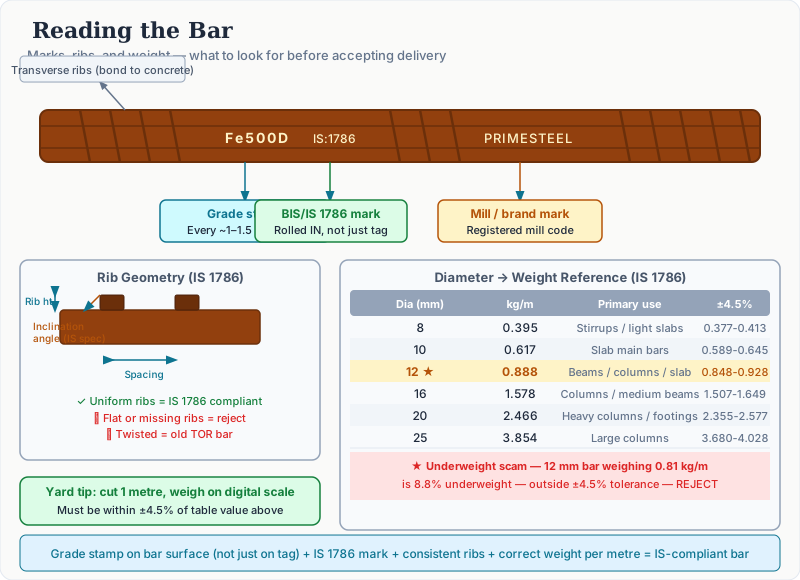
Everything a homeowner needs to read off the bar surface before accepting delivery.
6. Primary Steel vs Secondary / Re-Rolled Steel
This is the most important section in this guide. It is the single biggest quality divide in the Indian steel market, and it is where homeowners most commonly get cheated.
Primary steel is manufactured by an integrated steel plant (blast furnace or EAF route) from ore or scrap, rolled fresh to final shape in a controlled rolling mill with tight chemistry and temperature control. Major Indian producers (in generic category terms: large integrated mills, secondary alloy makers) are BIS-licensed, and each coil or bundle comes with a Mill Test Certificate (MTC) showing chemical composition, yield strength, tensile strength, and elongation for that production heat.
Secondary / re-rolled steel is made by collecting steel scrap — old rails, rejected billets, cut pieces, ship-breaking scrap — and re-melting and rolling it in a small induction furnace and rolling mill, usually in an unorganised cluster. The chemistry is unknown and variable. The rolling temperature and speed are not precisely controlled. The thermo-mechanical quench system may be absent or inadequate. The resulting bars may look similar to primary TMT but have inconsistent strength and elongation along the bar length, inferior ductility, and higher brittleness.
"The difference between primary and re-rolled steel is not a matter of brand pride — it is a matter of whether the steel will yield gracefully or fracture suddenly when overloaded." — Civil engineering field guidance, SERC technical bulletin.
| Parameter | Primary TMT (major mills) | Secondary / Re-Rolled |
|---|---|---|
| Raw material | Controlled chemistry billets | Mixed scrap, unknown chemistry |
| Rolling process | Continuous, temperature-controlled | Smaller mills, variable control |
| Quench system | Engineered multi-jet quench box | Often rudimentary or absent |
| Chemical consistency | Batch-to-batch consistent | Variable within same bundle |
| BIS certification | BIS licence with regular audit | Often uncertified or falsely stamped |
| Mill Test Certificate | Available on request | Often unavailable or fabricated |
| Price (2026 indicative) | ₹55–70 per kg (varies by grade) | ₹46–56 per kg |
| Safety risk | Low (when specification met) | High (unknown ductility in seismic event) |
The price gap of ₹9–14/kg looks attractive. On a 5,000 kg steel order it is ₹45,000–70,000. But a house has a 30–50 year life and carries your family. The risk-reward is badly asymmetric. Always specify primary steel from a BIS-certified mill, and always ask for the Mill Test Certificate.
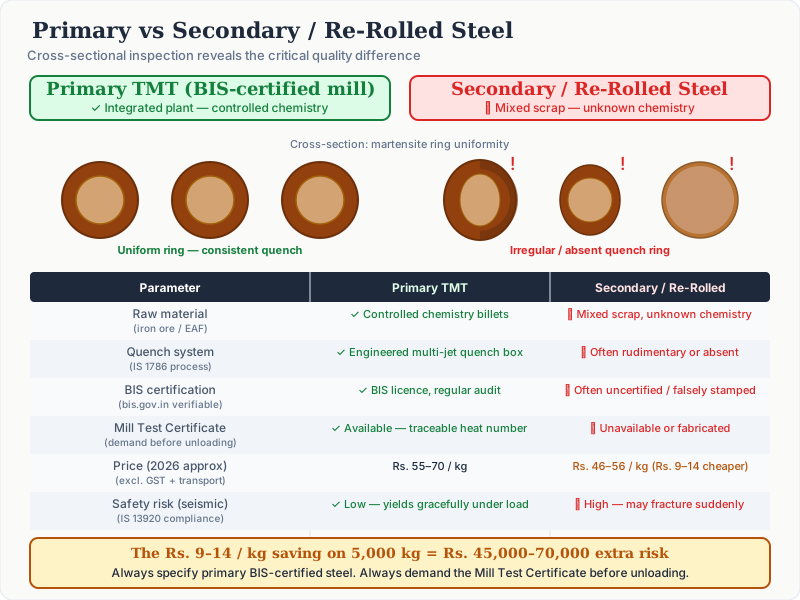
Visual differences between consistent primary TMT and re-rolled secondary steel under cross-sectional inspection.
7. Quality Checks a Homeowner Can Actually Do
You do not need to be a metallurgist to perform meaningful quality checks at the steel yard or on delivery.
Check 1 — BIS/ISI Mark: Every IS 1786-certified bar must carry the BIS standard mark (the ISI mark with the IS 1786 number). Look for it rolled into the bar surface, not just on the bundle tag — tags can be swapped.
Check 2 — Brand and Mill Mark: The rolling marks should identify a known mill. Ask your structural engineer or site supervisor to confirm the mill is a BIS-licensed primary producer.
Check 3 — Mill Test Certificate (MTC): Demand the MTC for the lot you are buying. A legitimate primary steel supplier will provide the MTC showing heat number, chemical analysis (carbon, sulphur, phosphorus, manganese), yield strength, UTS, and elongation for that production batch. If the supplier cannot provide an MTC, do not buy from them.
Check 4 — Weight-per-metre check: Cut or select a 1-metre length, weigh it on a digital scale. Compare with the tabulated sectional weight in the table in Section 5. Tolerance is ±4.5% per IS 1786. A 12 mm bar weighing 0.81 kg/m instead of 0.888 kg/m is 8.8% underweight — outside tolerance and likely re-rolled to a smaller actual diameter.
Check 5 — Visual rib inspection: Ribs should be uniform, well-defined, and consistent along the entire length. Examine 3–4 bars from the middle of the bundle (top bars are sometimes "decoys"). Flat, irregular, or missing ribs — reject.
Check 6 — Bend test visual: IS 1786 requires bars to pass a bend and re-bend test (IS 1599). On site, a simple manual check: bend a short offcut 180° around a mandrel. No cracks should appear on the outer face. Cracking during bending indicates brittleness — dangerous for a seismic region. Note: do not bend bars by heating them with a flame; heat damages the martensite surface and voids the IS compliance.
Check 7 — Surface condition: New bars should have a light mill-scale surface, possibly with thin surface rust from yard storage — this is acceptable and actually helps bond. Pitting rust (rust that has eaten into the steel, leaving pits) is not acceptable and indicates improper storage or old stock. Reject heavily pitted bars.
| Check | What to Look For | Pass | Fail |
|---|---|---|---|
| BIS mark | Rolled into surface | Present, clear | Absent or only on tag |
| Mill mark | Rolling marks identifying mill | Present and identifiable | Missing or generic |
| Mill Test Certificate | Paper/digital document per heat | Available, heat no. traceable | Unavailable or generic |
| Weight per metre | Digital scale, 1 m length | Within ±4.5% of tabulated weight | More than 4.5% underweight |
| Rib uniformity | Visual inspection | Uniform, well-defined | Flat, irregular, or missing |
| Bend test | 180° bend, no crack on outer face | Clean bend, no cracking | Cracks visible |
| Surface rust | Light mill scale / thin red rust | Acceptable | Pitting into steel surface |
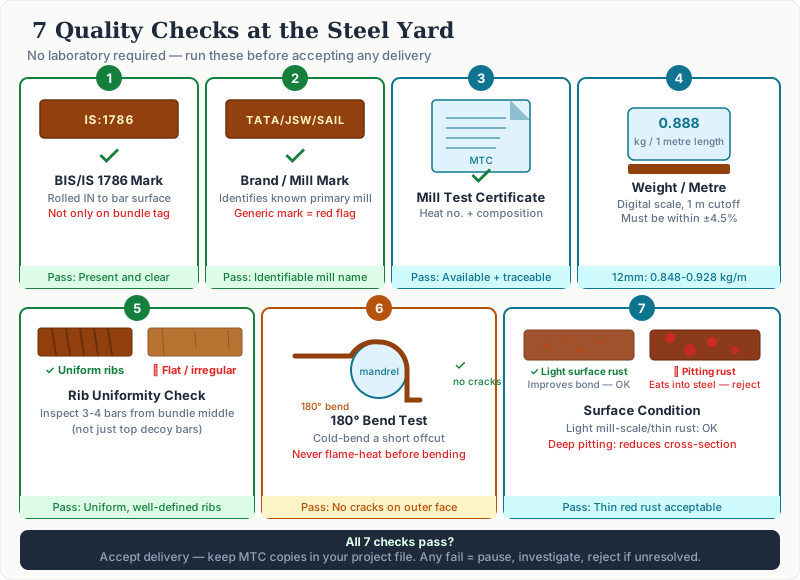
The seven checks any homeowner can run at the yard or on delivery — no laboratory required.
8. How Much Steel Does Your House Need?
Steel estimation is the domain of your structural engineer — they will produce bar-bending schedules (BBS) from the reinforcement drawings. But rough thumb rules help you cross-check your contractor's quantities and catch inflated or deflated estimates.
The steel content of a residential RCC building depends on the structural system, floor heights, soil condition, and seismic zone. Typical ranges:
| Element | Typical Steel Content | Notes |
|---|---|---|
| Ground floor slab (per sq ft BUA) | 3.0–4.5 kg | Thicker slabs, cantilevers increase |
| Upper floor slab (per sq ft BUA) | 2.5–3.5 kg | Two-way slabs slightly more |
| Columns (per floor per sq ft BUA) | 1.0–2.0 kg | More in seismic zones, multi-storey |
| Beams (per floor per sq ft BUA) | 1.5–2.5 kg | Depends on span |
| Footings / foundations | 0.8–1.5 kg per sq ft | Raft foundations more |
| Overall (complete RCC house) | 4–6 kg per sq ft BUA | Thumb rule; structural engineer to confirm |
How to use this: If your structural engineer or contractor gives you a steel quantity wildly outside 4–6 kg per sq ft for a standard 2–4 storey house, ask them to explain. Both inflating (billing more than placed) and deflating (placing less than design) are common in unorganised construction. A bar-bending schedule, verified by your supervisor, is the safeguard. This is covered in detail in reinforcement drawings simplified.
Buying by weight, not by pieces: Always buy steel by the kilogram, not by the bundle or by "rods." A "bundle" varies by mill (usually 500 kg or 1000 kg); a "rod" is usually a 12 m length but actual weights vary by diameter. Negotiating and billing by the kilogram removes ambiguity.
Wastage allowance: Add 3–5% for cut wastage and on-site binding. A well-managed site with good bar scheduling can keep this to 2–3%.
| Indicative 2026 Price Band (₹/kg) | Category |
|---|---|
| ₹55–65/kg | Primary branded Fe500, inland market |
| ₹60–70/kg | Primary Fe500D, branded |
| ₹63–72/kg | CRS Fe500C, branded |
| ₹46–56/kg | Secondary / unbranded (avoid) |
| ₹75–90/kg | Epoxy-coated (specialty) |
Prices are indicative 2026 market ranges; steel is commodity-priced and fluctuates monthly. Confirm with local dealers. Prices exclude GST (currently 18% on steel products), transport, and unloading.
9. Storage and Handling on Site
Steel on a construction site is often mishandled — and bad handling can reduce the bar's performance. Corrosion, improper bending, and incorrect lapping are the main issues.
Storage:
- Store bars off the ground on wooden sleepers or MS supports. Direct ground contact accelerates corrosion, especially in humid or waterlogged conditions.
- Keep under a tarpaulin or covered shed if storage exceeds 2–3 months.
- Separate bars by diameter and grade — mixed bundles cause expensive mistakes.
- Tag bundles clearly with grade and diameter, especially after splitting.
Bending:
- All bending must be cold-bent (using manual or mechanical bar benders). Never heat a TMT bar to bend it. Flame-heating destroys the martensitic surface and renders the IS compliance void.
- Bends must conform to minimum bend radii specified in IS 1786 and your structural drawings. Too sharp a bend can crack or weaken the bar at the bend.
Lapping (bar splicing):
- Where bar lengths are insufficient and bars must be lapped, the lap length must follow your structural drawings (typically 40–50 bar diameters for Fe500 in M25 concrete). Do not shorten laps arbitrarily to save steel.
Rust on delivery:
- Thin, red surface rust (mill rust from yard storage) is acceptable and actually improves bond. Clean it lightly with a wire brush if visible pitting is present.
- Heavily pitted or flaky rust that reduces the effective cross-section is not acceptable — test weight per metre again after cleaning.
| Do | Don't |
|---|---|
| Store on sleepers, off ground | Store directly on soil or in contact with water |
| Keep bundles tagged by grade and dia | Mix grades in a single pile |
| Cold-bend using bar bender | Heat bar with gas flame to ease bending |
| Maintain specified lap lengths | Shorten laps to save steel |
| Request MTC before unloading | Accept delivery without checking documents |
| Weigh-check a sample of bars | Assume all bars are full-weight |
Read more about on-site supervision and quality checks in construction quality control for homeowners, and see modern construction materials for how steel fits into the full material palette. For the concrete that surrounds your steel, understanding concrete strength is the natural companion to this guide.
10. The Buying Decision: A Practical Summary
When you are at the steel yard, or when you are reviewing a procurement list from your contractor, here is the decision tree:
Grade: Fe500D for any RCC building in seismic zones III, IV, or V (most of India). Fe500 acceptable for Zone II. Your structural engineer specifies — do not downgrade without their written agreement.
Variant: Standard TMT for inland areas. CRS for coastal, saline, or flood-prone zones.
Source: Primary steel from a BIS-certified integrated mill. Ask for the Mill Test Certificate. Do not accept secondary or re-rolled steel regardless of price advantage.
Verification: Weigh a 1 m sample. Check BIS mark on the bar surface. Inspect ribs visually. Check MTC document.
Pricing: Bill by kilogram including GST. Add 3–5% for wastage. Cross-check total quantity against the 4–6 kg/sq ft thumb rule.
Documentation: Keep the MTC copies with your project records. If a structural defect ever arises, the MTC is your evidence of what steel was used.
The extra ₹5–10/kg you spend on primary branded Fe500D over secondary steel is the cheapest insurance you can buy. On a ₹2 lakh steel order, that is ₹10,000–20,000 — roughly 1–2% of a typical construction budget — for a building expected to stand 40–60 years. If Studio Matrx DesignAI is helping you plan your home, you can use it to cross-check your material specifications against your design brief.
The science of durable buildings explains how concrete cover, water-cement ratio, and steel quality interact over decades — a worthwhile read before you sign off on your structural drawings.
Author's Note
Amogh used to say that a building's safety is mostly decided in the first few days — when the foundation steel goes in and the columns get cast. Everything after that is finishing. That is what this guide is about: the moment at the steel yard that most homeowners treat as a commodity decision but is actually a safety decision. Knowing the difference between Fe500D and re-rolled scrap, between a BIS mark on the bar and a BIS mark only on the paper — that knowledge is worth infinitely more than the ₹10/kg you might save. Build it right. It will stand long after you have forgotten the price.
Disclaimer
This guide is for educational purposes. Steel prices, IS code revisions, and BIS certification status of specific manufacturers change over time — verify current prices with local dealers and confirm brand BIS licences on the BIS website (bis.gov.in). All structural decisions, including grade selection, quantity, lap lengths, and bar-bending schedules, must be made by a qualified structural engineer and must comply with the applicable IS codes for your specific site, soil, and seismic zone. Do not substitute this guide for professional structural design.
References
1. Bureau of Indian Standards. IS 1786:2008 — High Strength Deformed Steel Bars and Wires for Concrete Reinforcement — Specification (Reaffirmed 2018). New Delhi: BIS.
2. Bureau of Indian Standards. IS 456:2000 — Plain and Reinforced Concrete — Code of Practice (Fourth Revision). New Delhi: BIS.
3. Bureau of Indian Standards. IS 13920:2016 — Ductile Design and Detailing of Reinforced Concrete Structures Subjected to Seismic Forces — Code of Practice. New Delhi: BIS.
4. Bureau of Indian Standards. IS 1893 (Part 1):2016 — Criteria for Earthquake Resistant Design of Structures: General Provisions and Buildings. New Delhi: BIS.
5. Bureau of Indian Standards. IS 1599:2019 — Method of Bend Test for Steel Products — Bars, Sections, Wire, Strip and Plate (Third Revision). New Delhi: BIS.
6. Bureau of Indian Standards. SP 34:1987 — Handbook on Concrete Reinforcement and Detailing. New Delhi: BIS.
7. Pillai, S.U. and Menon, D. (2015). Reinforced Concrete Design (Third Edition). New Delhi: Tata McGraw-Hill.
8. Gambhir, M.L. (2011). Concrete Technology: Theory and Practice (Fifth Edition). New Delhi: Tata McGraw-Hill. Chapter on materials, TMT properties.
9. Duggal, S.K. (2017). Building Materials (Fourth Edition). New Delhi: New Age International. Chapter 4: Metals and Alloys.
10. Neville, A.M. (2011). Properties of Concrete (Fifth Edition). Harlow: Pearson Education. Sections on steel–concrete interaction and corrosion.
11. Rao, P.S. and Menon, D. (2012). Advanced Reinforced Concrete Design. New Delhi: Tata McGraw-Hill.
12. Structural Engineering Research Centre (SERC), Chennai. Technical Guide on Seismic Detailing of RC Buildings. Government of India, Ministry of Science and Technology.
13. Ministry of Steel, Government of India. Steel Scrap Recycling Policy 2019. New Delhi. (Background on secondary steel ecosystem in India.)
14. Mehta, P.K. and Monteiro, P.J.M. (2014). Concrete: Microstructure, Properties and Materials (Fourth Edition). New York: McGraw-Hill. Section on reinforcing steel properties.
15. Bureau of Indian Standards. IS 2502:1963 — Code of Practice for Bending and Fixing of Bars for Concrete Reinforcement (Reaffirmed 2016). New Delhi: BIS.
lastVerified: 2026-06-11 | verifyEvery: 12 months — IS 1786 revision status, BIS licensing database, steel price bands, seismic zone mapping.
Word count: approximately 3,450 words.
Export this guide
Related Guides — Deep-dive reading
Construction Aggregates in India: Sizes, Quality & Selection (2026)
What coarse aggregate actually does in concrete, how to pick the right nominal size (10mm, 20mm, 40mm), and the field and lab checks that separate strong stone from a bad load - a specify-and-select guide for Indian homes.
Building MaterialsThe Complete Building Materials Buying Guide (India) (2026)
The capstone of the Building Materials hub - a stage-by-stage buying process (estimate, specify, shortlist, compare, verify, store) plus how to buy well in every material category, the mistakes that cost the most, and a smart-buyer checklist that routes to every deep guide and calculator.
Building MaterialsConstruction Quality Control for Homeowners
How to make sure your house is actually built well, stage by stage, without an engineering degree — concrete, steel, cover and curing, the cardinal site sins to refuse, and the simple checks anyone can do.
Structural SafetyRelated Tools — Try Free
Electrical Safety & Load Audit
Home electrical audit — 10 categories, 65+ checkpoints across earthing, RCCB, MCB, wiring, switchboards, appliance circuits, DG/inverter backup.
Safety AuditBefore & After Studio
Generate AI before-and-after renders to preview how your redesign could look.
DesignAIBefore vs After — Cost Reality Check
Compare what you expected to pay vs what you actually paid, category by category.
Reality Check