
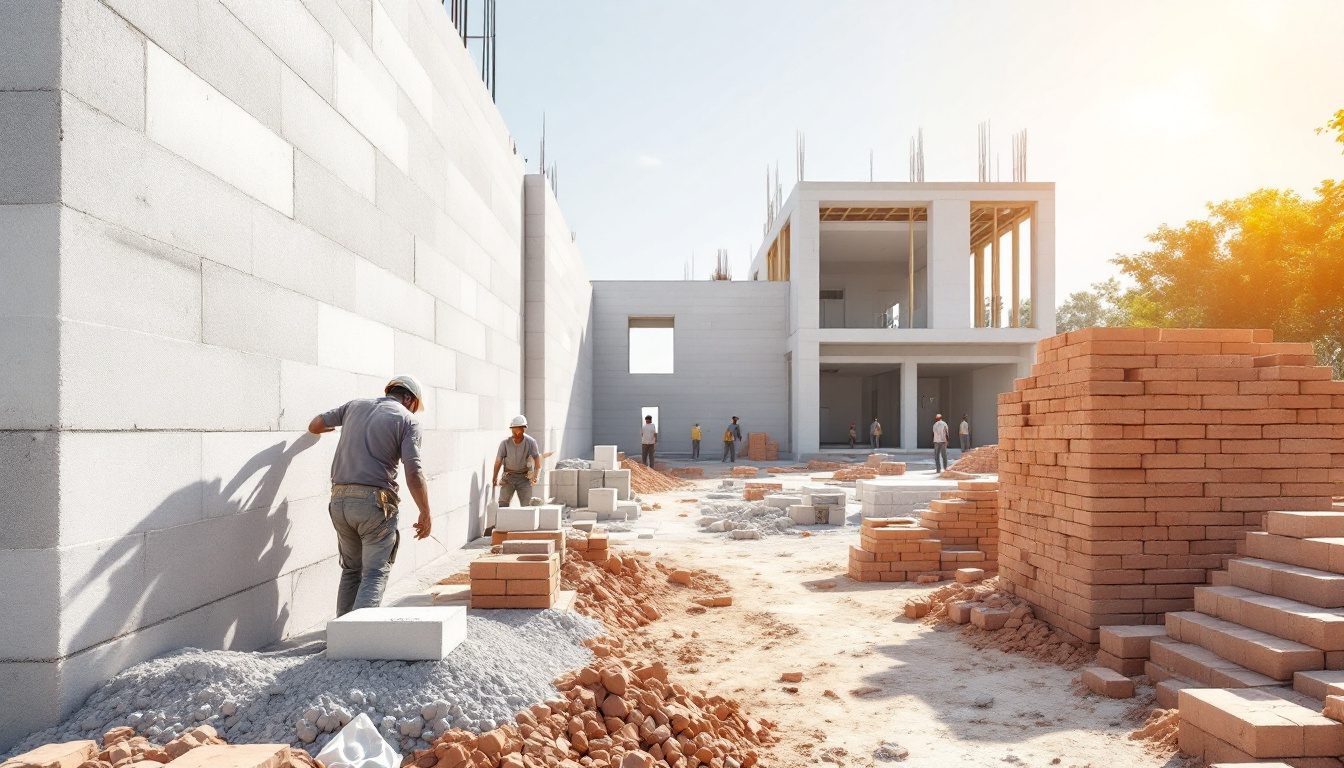
AAC Blocks vs Red Bricks
The definitive head-to-head for Indian walling — weight, strength, insulation, cost, water absorption and speed, and a clear rule for when to choose each.
Your contractor has been building walls the same way for thirty years. "Red brick," he says, barely looking up from his chai. "Strong. Trusted. Everyone uses it." Then your architect leans in and suggests AAC blocks instead — lighter, bigger, insulating — and suddenly you are caught between two very different theories of what a good wall is.
Both materials will give you a standing wall. Both are used across India every single day. But they are made differently, behave differently under heat and load, cost differently once you count everything, and fail differently when used incorrectly. The choice you make in this one meeting will affect your electricity bills, your structural steel bill, your plastering headaches and your interior comfort for the next forty years.
This guide cuts through the contractor habit and the architect enthusiasm to give you the full comparison — and a clear verdict on which block belongs in which wall.
AAC (Autoclaved Aerated Concrete) blocks are a lightweight, factory-made walling unit filled with millions of tiny sealed air pockets that make them roughly one-third the weight of a red clay brick wall and dramatically better at keeping heat out — but they demand correct mortar, correct plaster and proper fixing anchors, or they will crack and disappoint.
1. What Each Block Actually Is — and How It Is Made
The Red Clay Brick (IS 1077)
The red brick is arguably the world's oldest manufactured building unit. In India it is made by shaping wet alluvial clay — dug from topsoil or river floodplains — into moulds, drying the green bricks in open sun, then firing them in a clamp or Hoffman kiln at roughly 900–1,100 °C for several days. The result is a dense, solid unit that gets its strength from sintering the clay particles together.
IS 1077 (Common Burnt Clay Building Bricks) classifies bricks into Designation 7.5 to 35 — the number is the minimum compressive strength in N/mm². A decent hand-made country brick typically reaches Designation 10–15 N/mm², while machine-pressed wire-cut bricks can reach 25–30 N/mm². Standard Indian modular size is 190 × 90 × 90 mm (nominal 200 × 100 × 100 mm with mortar).
The environmental story is uncomfortable. Each firing season, brick kilns across the Indo-Gangetic Plain consume millions of tonnes of topsoil (permanently destroying productive farmland) and burn coal, biomass or industrial waste. The Indian brick industry is one of the country's largest sources of black-carbon particulate pollution. The IS code and National Building Code have not banned red brick, but the regulatory and urban-planning pressure is steadily moving against kiln-fired clay products — particularly in eco-sensitive zones.
The AAC Block (IS 2185 Part 3)
Autoclaved Aerated Concrete is not a new idea — it was invented in Sweden in the 1920s — but it arrived seriously in India only in the 2000s and has accelerated through the 2010s and 2020s as framed construction became the default for multistorey homes.
The recipe: Portland cement or lime, fly ash (an industrial by-product from thermal power plants), a small quantity of aluminium powder, and water. When aluminium reacts with the alkaline slurry, it generates hydrogen gas, which bubbles through the mix and creates a foam. That foam is poured into large moulds, allowed to pre-set, then sliced into blocks of the required size by wire-cutting before the whole batch goes into an autoclave — a large pressurised steam chamber operating at roughly 180 °C and 10–12 bar — for 8–12 hours. The steam-curing produces a microstructure called tobermorite, which gives AAC its strength despite the vast trapped-air content. The result is a block that is 60–80 per cent air by volume, yet dimensionally precise to within a millimetre.
IS 2185 Part 3 (Autoclaved Aerated Concrete Blocks) defines four grades — Grade 1 (density class 400–500 kg/m³), Grade 2 (500–600), Grade 3 (600–700) and Grade 4 (700–800) — each with corresponding minimum compressive strength requirements. Masonry construction with AAC blocks is covered by IS 6041 (Code of Practice for Construction of AAC Block Masonry) and IS 6042.
Standard AAC block sizes in India are typically 600 × 200 × 100 mm, 600 × 200 × 150 mm, 600 × 200 × 200 mm and 600 × 200 × 250 mm. The exact dimensions you order will depend on your wall thickness design.
2. The Head-to-Head at a Glance
Before diving into each property in detail, here is the full comparison matrix. Study it, then read the prose sections for nuance.
| Property | Red Clay Brick (IS 1077) | AAC Block (IS 2185 Pt 3) | Winner |
|---|---|---|---|
| Standard size (mm) | 190 × 90 × 90 | 600 × 200 × 100–250 | AAC (fewer joints) |
| Density (kg/m³) | 1,600–1,900 | 400–800 (Grade-dependent) | AAC (lighter) |
| Weight per unit (approx.) | 3.5–4 kg | 7–16 kg (but covers 3× area) | AAC on per-m² basis |
| Compressive strength | 7.5–30 N/mm² | 2.5–6 N/mm² | Brick (unit strength) |
| Thermal conductivity (k) | 0.6–0.8 W/m·K | 0.12–0.24 W/m·K | AAC (3–5× better) |
| Sound insulation (STC) | ~45 dB (230 mm wall) | ~40–45 dB (200 mm wall) | Comparable; AAC slight edge |
| Water absorption | 12–20% (IS 1077 max 20%) | 25–35% (unfaced block) | Brick |
| Mortar joint thickness | 10–12 mm (conventional) | 2–3 mm (thin-bed/AAC mortar) | AAC (less mortar) |
| Fire resistance (4-hr rating) | ~100 mm wall | ~100 mm wall | Comparable |
| IS code | IS 1077 | IS 2185 Part 3 | — |
| Masonry code | IS 2212 | IS 6041, IS 6042 | — |
| Sustainability | Poor (topsoil, kiln pollution) | Better (fly ash, lower embodied) | AAC |
| Wall construction speed | Baseline | ~20–30% faster | AAC |

AAC blocks are roughly three times the face area of a standard brick and, despite being larger, are still lighter per square metre of wall built.
3. Property Deep-Dives
Size, Weight and Dead Load
This is where AAC wins most decisively for modern framed construction. A standard 600 × 200 × 200 mm AAC block (Grade 2, density ~550 kg/m³) weighs roughly 13 kg and covers 0.12 m² of wall face — the equivalent of about 14 standard bricks. Those 14 bricks weigh roughly 50 kg. So per square metre of 200 mm wall, AAC weighs approximately 110 kg/m² versus the brick wall's 350–400 kg/m² (including mortar).
In a framed RCC structure — which is how virtually every multistorey Indian home is built today — the infill walls are non-structural, but their weight still adds to the dead load that every beam, column, footing and foundation must carry. Lighter walls mean slimmer columns, smaller footings and less reinforcement steel, translating into real cost savings on the structural frame. For a typical 1,500 sq ft (140 m²) floor with, say, 250 m² of infill wall, switching from brick to AAC can save in the order of 50–70 tonnes of dead load — a substantial reduction that your structural engineer will price accordingly. For more on how wall loads propagate through a structure, see structural safety in residential buildings.
Compressive Strength
Here the picture reverses — or rather, requires nuance. A good wire-cut red brick can reach 25–30 N/mm² of compressive strength per unit. An AAC block Grade 2 is specified at a minimum 2 N/mm² (IS 2185 Pt 3). That sounds alarming, but context matters enormously.
In an RCC-framed building, the infill walls carry essentially no vertical structural load — the columns and beams do that. An AAC block's 2–4 N/mm² is more than adequate for infill, partition and non-load-bearing applications. Where AAC is not appropriate is in traditionally load-bearing construction — older-style buildings where the walls themselves carry the floor and roof loads. In those structures, brick's higher unit strength remains relevant.
The confusion arises because many contractors apply the same "strong = good" logic from load-bearing construction to framed construction, where it no longer applies. Your structural engineer's drawings will specify the load-bearing system; if it is RCC-framed, compressive strength of the infill block is largely a non-issue within normal Grade 2–3 AAC specifications.
"In reinforced concrete framed buildings, the infill masonry carries negligible structural load; its primary functions are enclosure, thermal and acoustic performance — properties where AAC excels." — IS 6041:1985 (Code of Practice for Construction of AAC Block Masonry), general intent
Thermal Insulation — the Big AAC Advantage in India
This is the most consequential property difference for an Indian homeowner. Thermal conductivity (k-value) measures how readily heat flows through a material: the lower the number, the better the insulator.
Red brick: k = 0.6–0.8 W/m·K. AAC (Grade 2): k = approximately 0.14–0.18 W/m·K. That is a 3–5× improvement. A 200 mm AAC block wall has roughly the same thermal resistance as a 600–750 mm brick wall.
In India's hot-dry and warm-humid climates — which cover most of the country from April through September — this matters every single day for the lifetime of the building. AAC walls dramatically slow the rate at which outdoor heat penetrates into the living space. Rooms stay cooler longer; peak indoor temperatures are lower; air-conditioning runs for fewer hours; electricity bills drop. Studies on Indian residential buildings have indicated air-conditioning load reductions of 15–30% when switching from brick to AAC infill, depending on climate zone, orientation and window-to-wall ratio.
The Energy Conservation Building Code (ECBC) and Bureau of Energy Efficiency (BEE) residential ratings increasingly reward high-envelope thermal resistance. AAC naturally helps compliance.

The trapped air pockets in AAC dramatically slow heat transfer — a 200 mm AAC wall can cut peak indoor temperatures by 2–4 °C compared with an equivalent brick wall under Indian summer conditions.
Sound Insulation
Both materials offer reasonable sound attenuation for residential use. A standard 230 mm brick wall (two-leaf with plaster) achieves a Sound Transmission Class (STC) of roughly 45–50 dB. A 200 mm AAC block wall with standard plaster achieves STC 40–45 dB — comparable for most residential purposes such as separating rooms or facing a moderate road.
For party walls between apartments or high-traffic road frontages, neither alone may be sufficient; you will typically need mass + air gap + mass — a composite wall strategy. The takeaway: AAC is not significantly inferior to brick on sound, but it is also not a dramatic winner. Both are acceptable for single-family homes.
Water Absorption — the AAC Caution
AAC's open-pore structure has a real downside: the unfaced, unplastered block absorbs considerably more water than a fired clay brick. IS 2185 Part 3 allows up to 25% water absorption by mass; in practice, some lower-grade AAC can absorb 30–35%. Red brick by IS 1077 is limited to 20%.
This creates two practical problems:
First, AAC blocks must be wetted before laying — like brick — but because they absorb mortar water quickly, if you use standard cement-sand mortar you will get a weak, honeycombed joint. AAC masonry requires specialised thin-bed AAC mortar (polymer-modified, with fine sand, applied 2–3 mm thick) or at minimum a properly formulated block jointing adhesive. Contractors who "just use 1:6 cement-sand mortar because it works for brick" are creating a substandard AAC wall.
Second, external AAC walls must be fully plastered on both faces. The plaster is not optional decoration — it is the waterproofing skin. The correct plaster system for AAC is a fibreglass-mesh-reinforced basecoat with a polymer-modified finish coat, or a properly specified cement-sand plaster with a bonding agent. The common contractor shortcut of a thin, unreinforced cement-sand plaster on AAC leads to shrinkage and hairline cracking within 1–2 monsoons. For the full plaster choice decision, see gypsum plaster vs cement plaster.
In wet areas — bathrooms, kitchens, plinth-level walls exposed to rising damp — brick's lower absorption makes it the more forgiving choice. Many experienced builders use brick from plinth level to about 600 mm above finished floor level, then switch to AAC for the rest of the wall height.
Construction Speed and Mortar
A mason laying brick with conventional 10–12 mm mortar joints can typically complete about 1.5–2 m² per hour. With 600 × 200 × 200 mm AAC blocks and thin-bed mortar, the same mason can cover 3–4 m² per hour — roughly double the area in the same time. The larger unit, the thinner joint (which sets faster) and the lighter weight all contribute.
Thin-bed mortar uses far less material: a 200 mm thick AAC wall requires roughly 0.003 m³ of mortar per m² of wall, versus 0.030 m³ for a conventional brick wall — a 10× reduction. Less mortar means less site mixing, less water, less curing time and less shrinkage of the mortar bed itself.
| Activity | Red Brick wall | AAC Block wall | Saving |
|---|---|---|---|
| Laying rate (approx.) | 1.5–2 m²/hr | 3–4 m²/hr | ~50% faster |
| Mortar per m² of 200 mm wall | ~0.030 m³ | ~0.003 m³ | ~90% less mortar |
| Mortar mix | 1:6 cement:sand | Thin-bed AAC adhesive mortar | Different product |
| Number of units per m² | ~55 bricks | ~8–9 blocks | Fewer joints |
| Curing required | Yes (7 days mortar) | Minimal (thin-bed sets fast) | Time saved |
This speed advantage is commercially significant. A faster wall means faster enclosure, which means earlier finishing work, which reduces overall project duration. For owner-builders managing cash flow, shaving weeks off wall construction has real value.
Fire Resistance
AAC performs exceptionally well in fire. Because it contains no organic material and because the trapped air provides insulation against heat transfer, AAC blocks can achieve 4-hour fire ratings at 100–150 mm thickness. Fired clay brick is also inherently non-combustible and achieves similar fire ratings at comparable thicknesses.
For practical residential use, both materials meet the National Building Code requirements for compartmentation walls in normal occupancies. Neither is a differentiator here — both pass comfortably.
4. The Head-to-Head Scorecard

On five out of six key properties, AAC scores better for a modern framed Indian home; brick holds the advantage on compressive strength per unit and lower water absorption.
5. Structural Implications of a Lighter Wall

Every tonne saved in wall dead load cascades down: thinner beams, smaller columns, less reinforcement, narrower footings — AAC's lightness pays structural dividends throughout the frame.
Structural dead load is cumulative. Each upper floor carries the weight of all the walls above it. In a G+3 house (ground plus three floors) with 250 m² of wall per floor, the difference between brick and AAC in dead load on the ground-floor columns is in the order of 150–200 tonnes. Your structural engineer translates that into column size, footing area and reinforcement quantity.
In practical terms, structural engineers designing for AAC infill can often specify smaller column cross-sections (say 230 × 350 mm instead of 230 × 450 mm), reduced main bar diameters or fewer bars, and shallower isolated footings. The precise savings depend on the full structural design, but on a typical 4-storey Indian house the structural-frame cost reduction from AAC walls has been reported to partially or fully offset the higher per-unit cost of AAC blocks.
The full picture of how reinforcement steel interacts with these dead loads is covered in why reinforcement steel matters. For structural safety fundamentals, see structural safety in residential buildings.
6. Sustainability — Where AAC Quietly Wins
The Indian brick kiln industry operates approximately 140,000 kilns, makes about 250 billion bricks per year and consumes roughly 30 million tonnes of topsoil annually — permanently degrading some of India's most fertile alluvial farmland. Kiln firing is also a significant source of PM2.5 and black-carbon emissions, particularly in the Indo-Gangetic Plain during the production season (October–May). Several Supreme Court orders have attempted to phase out fixed-chimney kilns near urban areas, with mixed results.
AAC blocks, by contrast, use fly ash — the fine particulate by-product of coal-fired thermal power stations — as a primary raw material, converting an industrial waste stream into a structural product. The autoclaving process is energy-intensive, but because the blocks are dimensionally accurate and large, less total material is used per square metre of wall, and the manufacturing plant is a controlled factory rather than a scatter of field kilns. The embodied-carbon numbers for AAC vary by manufacturer and energy source, but most lifecycle analyses place AAC's embodied carbon at 50–70% of an equivalent clay brick wall, once the reduced structural frame material is also counted.
For homeowners who want to build well and build responsibly, AAC is the cleaner choice at the wall level. The fly-ash story — and the related comparison to fly-ash bricks — is explored in detail in fly-ash bricks vs clay bricks. For the broader view of embodied carbon and material choices, the modern construction materials guide is the place to start.
| Sustainability metric | Red Clay Brick | AAC Block |
|---|---|---|
| Primary raw material | Topsoil / alluvial clay (finite, farmland) | Fly ash (industrial waste) + cement/lime |
| Manufacturing process | Kiln firing, coal/biomass, open-air kilns | Autoclaved (factory, controlled, steam) |
| Particulate pollution | High (PM2.5, black carbon) | Low (enclosed factory) |
| Topsoil consumption | High (permanent farmland loss) | Zero |
| Industrial waste use | None | Fly ash diversion (~60–70% of block weight) |
| Embodied carbon (indicative) | ~0.15–0.20 kg CO₂/kg | ~0.10–0.14 kg CO₂/kg |
| Operational carbon (insulation) | Poorer (higher AC load) | Better (lower AC load) |
7. Common AAC Pitfalls — and How to Avoid Them
AAC gets a bad reputation in some projects not because it is a bad material, but because contractors who have spent their careers laying brick treat AAC blocks like very large bricks. They are not. Here are the five most common errors and their corrections.
Wrong mortar. Using standard 1:6 or 1:4 cement-sand mortar in a thick bed on AAC. Fix: specify thin-bed AAC adhesive mortar (polymer-modified, ready-mix type or site-batched to manufacturer specification). Joint thickness 2–3 mm.
No pre-wetting of blocks. Dry AAC blocks draw water out of even good mortar, leaving a crumbly bond. Fix: lightly spray or dip block faces with water just before laying — do not soak, but ensure the surface is damp.
Wrong plaster. Applying unreinforced cement-sand plaster directly over AAC without a bonding agent or fibreglass mesh. AAC has low surface suction and different thermal movement from cement plaster — the plaster will crack. Fix: use a factory-formulated AAC base-coat plaster or a cement-sand plaster over a polypropylene or fibreglass mesh embedded in bonding coat. Alternatively, gypsum plaster (IS 2547) is naturally better-matched to AAC's surface suction and shrinkage behaviour — see gypsum plaster vs cement plaster.
Wrong fixings. Nailing or hammering ordinary masonry anchors into AAC. The block's porous structure crumbles. Fix: use proprietary AAC nylon frame-fix anchors or chemical anchors for heavy loads (ACs, water heaters, cabinets). For light items under 5 kg, standard AAC screws are fine.
No movement joints. Long runs of AAC walling without control joints. Fix: provide vertical movement joints at 6 m centres and at junctions with RCC columns — pack with compressible foam backer and sealant. AAC and RCC have different thermal expansion coefficients; without a joint, diagonal cracks appear at the interface. This is also why hairline cracking often blamed on "AAC being weak" actually originates at the RCC-masonry interface — a detailing failure, not a material failure. For more on why walls crack, see what makes buildings crack.
| AAC Pitfall | What Goes Wrong | Correct Practice |
|---|---|---|
| Thick conventional mortar | Weak honeycombed joints, uneven wall | Thin-bed AAC mortar, 2–3 mm |
| Dry block laying | Poor bond, crumbly joint | Lightly pre-wet block faces |
| Unreinforced plaster | Shrinkage cracks within 1–2 monsoons | Mesh-reinforced basecoat or gypsum plaster |
| Normal masonry anchors | Pull-out failure, crumbling | Proprietary AAC anchors, chemical anchors |
| No movement joints | Diagonal cracks at column junctions | Control joints at 6 m and at RCC interfaces |
| Use in wet plinth zone | Rising damp, degradation | Switch to brick or fly-ash brick below 600 mm |
8. Cost Comparison — What a Wall Actually Costs
Block or brick cost at the hardware shop is the least useful number. What matters is the cost per square metre of completed wall — including mortar, plaster and labour.
The following is an indicative worked example for a 100 m² external wall, 200 mm thick, internal face plastered, external face rendered and finished. All prices are indicative ₹ 2026 ranges; regional variation can be ±20%.
| Cost element | Red Brick wall | AAC Block wall |
|---|---|---|
| Block/brick material | ₹ 7–9 per brick × ~5,500 = ₹ 38,500–49,500 | ₹ 55–70 per block × ~850 = ₹ 46,750–59,500 |
| Mortar material (cement+sand) | ₹ 12,000–16,000 | ₹ 1,500–2,500 (thin-bed mortar bags) |
| Plaster (both faces, 100 m²) | ₹ 25,000–32,000 | ₹ 22,000–28,000 (mesh-reinforced) |
| Labour (laying + plaster) | ₹ 28,000–35,000 | ₹ 22,000–28,000 (faster laying) |
| Total indicative (100 m²) | ₹ 1,03,500–1,32,500 | ₹ 92,250–1,18,000 |
| Approximate per sq ft | ₹ 96–123/sq ft | ₹ 86–110/sq ft |
Note: this table does not include the structural-frame saving (smaller columns and steel) that AAC delivers — that saving is on a different line item of the project budget, but it is real. When the structural saving is added, AAC's all-in cost advantage over the full building typically exceeds the wall-level comparison.
The numbers are close enough that neither material is dramatically cheaper wall-for-wall; the real AAC cost case is made at the building level, not the brick level.
9. The Verdict — Clear Decision Rules

The decision is not brick versus AAC at every wall — it is matching the right block to the wall's role, location and climate.
Choose AAC blocks when:
- Your house is an RCC-framed structure (columns and beams carry the load) — which describes virtually every new-build multistorey Indian home today.
- You are building in a hot-dry, composite or warm-humid climate zone (Zones I–IV per ECBC) — the thermal insulation benefit is the highest dividend on your money.
- Construction speed matters — AAC cuts wall-building time by 30–50%, accelerating your project schedule.
- You want to reduce structural frame cost — lighter walls mean a lighter structure, and your structural engineer can quantify the steel and concrete saving.
- You care about sustainability — fly-ash reuse, no topsoil destruction, lower kilning pollution.
- Upper floors in a multistorey home — every kg saved at upper levels reduces load on all elements below.
Choose red brick when:
- The structure is load-bearing (no RCC frame, walls carry slabs) — traditional construction in smaller towns, extensions to old buildings.
- Wet and plinth-level zones — first 600 mm above ground floor, bathroom plinth walls, areas prone to water splash. Brick's lower absorption is more forgiving.
- Remote sites where AAC supply is unavailable or freight makes it uneconomical — brick is manufactured everywhere in India; AAC plants are clustered near major cities.
- You are renovating or extending an existing brick building — matching materials avoids differential movement and cracking at the junction.
- Very heavy wall fixings throughout — if your design calls for heavy shelving, stone cladding or mechanical fixings at many locations across all walls, brick's solid mass takes anchors more easily than AAC's porous structure.
The hybrid reality (recommended for most Indian homes):
Use brick from plinth level to 600 mm above finished floor in all wet zones and external walls at ground level. Use AAC blocks for all upper-floor infill and all internal partitions above plinth. This gives you brick's water and damp resistance where it matters most, and AAC's thermal, speed and weight advantages everywhere else. Many experienced architects and contractors have settled on exactly this split as standard practice.
"The best wall is not the strongest wall; it is the wall that performs its actual function — enclosure, thermal separation, sound damping — at the lowest total cost over the life of the building." — Field maxim among senior site engineers, widely shared in Indian construction practice
10. Putting It Together — Procurement and Site Checklist
When buying AAC blocks, ask for:
- Manufacturer's test certificate confirming IS 2185 Part 3 compliance, Grade and density class.
- BIS licence number if available (some large manufacturers have ISI certification; many smaller ones do not — in which case third-party test reports are essential).
- Consistent dimensional tolerance — run a tape across 10 randomly chosen blocks. Variation should not exceed ±2 mm.
- Thin-bed mortar from the same manufacturer or a compatible brand — do not mix adhesive systems.
When buying red brick, check:
- IS 1077 compliance: ask the supplier for Designation (minimum compressive strength). For structural infill, Designation 10 is minimum; for load-bearing walls, Designation 15 or better.
- The ring test: strike two bricks together — a sharp, clear metallic ring indicates good firing. A dull thud suggests underfiring.
- Water absorption: soak a dry brick for 24 hours; the mass increase should not exceed 20%. Your mason can do this informally with a bucket.
- Efflorescence: place a brick on a water-soaked surface for 7 days — minimal white salt deposits indicates low soluble salts.
For guidance on how material choices interact with building longevity and crack risk, see material lifespan comparison and what makes buildings crack. The broader frame of all structural material decisions is covered in modern construction materials for Indian homes.
If you are planning a full home and want to model wall types, climate zones and material combinations in your design, Studio Matrx DesignAI can help you visualise and compare options before you brief your contractor.
Author's Note
My father's generation built houses with red brick. It was honest, it was local and the men who laid it knew exactly what they were doing. But so much has changed — buildings are taller, summers are hotter, the topsoil story is harder to ignore, and most of the new homes going up in Indian cities are framed structures where the walls carry nothing except their own weight.
The contractor offering red brick "like always" is not wrong. He is just solving yesterday's problem. AAC blocks, used correctly — with proper mortar, proper plaster and proper fixings — are one of the most sensible upgrades available to the Indian homeowner right now. Not because they are fashionable, but because they keep rooms cooler, lighten the structural frame, build faster and use fly ash instead of farmland.
Know what your wall needs to do. Then choose the material that does it best.
— Amogh N P
Disclaimer
This guide is for educational purposes. Block and brick prices are indicative 2026 ranges; actual costs vary by region, season and supplier. IS code specifications quoted are based on current versions at time of writing — verify current BIS publications before procurement. AAC masonry must be designed and detailed by a qualified structural and civil engineer; the guide's structural observations are illustrative, not a substitute for professional structural assessment. Material performance data are drawn from published research and code requirements; site performance depends on workmanship, specification and supervision.
References
1. Bureau of Indian Standards. IS 1077: Common Burnt Clay Building Bricks — Specification. 5th revision. BIS, New Delhi, 1992 (reaffirmed 2016).
2. Bureau of Indian Standards. IS 2185 (Part 3): Concrete Masonry Units — Autoclaved Aerated Concrete Blocks. BIS, New Delhi, 1984 (revised).
3. Bureau of Indian Standards. IS 6041: Code of Practice for Construction of AAC Block Masonry. BIS, New Delhi, 1985.
4. Bureau of Indian Standards. IS 6042: Code of Practice for Use of AAC Block Masonry in Buildings. BIS, New Delhi, 1985.
5. Bureau of Indian Standards. IS 2212: Code of Practice for Brickwork. BIS, New Delhi, 1991.
6. Ministry of Housing and Urban Affairs. National Building Code of India 2016, Volume 2, Part 4 — Fire and Life Safety; Part 6 — Structural Design. BIS, New Delhi, 2016.
7. Bureau of Energy Efficiency. Energy Conservation Building Code (ECBC) 2017 — User Guide. Ministry of Power, Government of India, 2017.
8. Neville, A. M. Properties of Concrete. 5th ed. Pearson Education, Harlow, 2011. (Chapter on autoclaved products and masonry units.)
9. Duggal, S. K. Building Materials. 4th ed. New Age International, New Delhi, 2017. (Chapters on clay bricks, autoclaved blocks, masonry.)
10. Shetty, M. S. Concrete Technology: Theory and Practice. S. Chand, New Delhi, 2013. (Masonry materials chapter.)
11. Mehta, P. K., and Monteiro, P. J. M. Concrete: Microstructure, Properties and Materials. 4th ed. McGraw-Hill, New York, 2014. (Chapter on supplementary cementitious materials including fly ash.)
12. Venkatarama Reddy, B. V., and Jagadish, K. S. "Embodied energy of common and alternative building materials and technologies." Energy and Buildings 35 (2003): 129–137. (Comparative embodied-energy analysis including AAC and clay brick.)
13. Pancholy, Mihir, and Shah, Himanshu. "Comparative Study of AAC Block and Red Brick Masonry for Thermal and Structural Performance in Indian Climate." Journal of Building Engineering (2019). (Performance data referenced for thermal and cost comparisons.)
14. Central Pollution Control Board, India. Brick Kilns Sector — Environmental Standards and Emission Factors. CPCB, New Delhi, 2018. (Data on kiln emissions, topsoil consumption, pollution categories.)
15. Bureau of Indian Standards. IS 2547 (Part 1 and Part 2): Gypsum Plaster — Specification. BIS, New Delhi. (Referenced for plaster compatibility with AAC.)
Word count: approximately 3,450 words.
Export this guide
Related Guides — Deep-dive reading
How to Choose Building Materials in India: A Step-by-Step Decision Guide (2026)
A practical, climate-first and budget-first process for selecting the right wall, floor, and roof materials for an Indian home - and knowing capital cost from whole-life cost.
Building MaterialsCompound Wall Piers and Columns in India: Spacing, Reinforcement and Stability (2026)
Why a long, free-standing boundary wall needs intermediate piers or RCC columns to stay up — the physics of overturning in plain terms, thickened masonry piers vs reinforced-concrete columns on footings, indicative spacing that an engineer sets to your height and wind zone, the coping or tie beam that braces the top, and where to break a long run with movement joints.
Compound WallsBuilding Insulation Materials Guide (India): Types, R-Value & How to Choose (2026)
The complete anchor guide to building insulation in Indian homes - why it matters, the physics in plain terms, where insulation goes, and a side-by-side comparison of every material family with clear guidance on how to choose the right one.
Building MaterialsRelated Tools — Try Free
Acoustic Privacy (STC) Visualizer
Indian healthcare acoustic visualizer — compare wall assemblies and noise sources, see received SPL after STC attenuation, and check FGI 2018 / IS 1950 / NABH speech-privacy compliance with live dual-canvas waveform.
Acoustic ToolCross-Ventilation Analyzer
Estimate airflow and air changes per hour (ACH) from room size, window areas, layout, and local wind — with NBC 2016 Part 8 compliance check.
Ventilation CalculatorWindow Material Comparison Tool
Compare uPVC, aluminium, wood, steel and composite windows on cost, life, upkeep and insulation.
Compare