
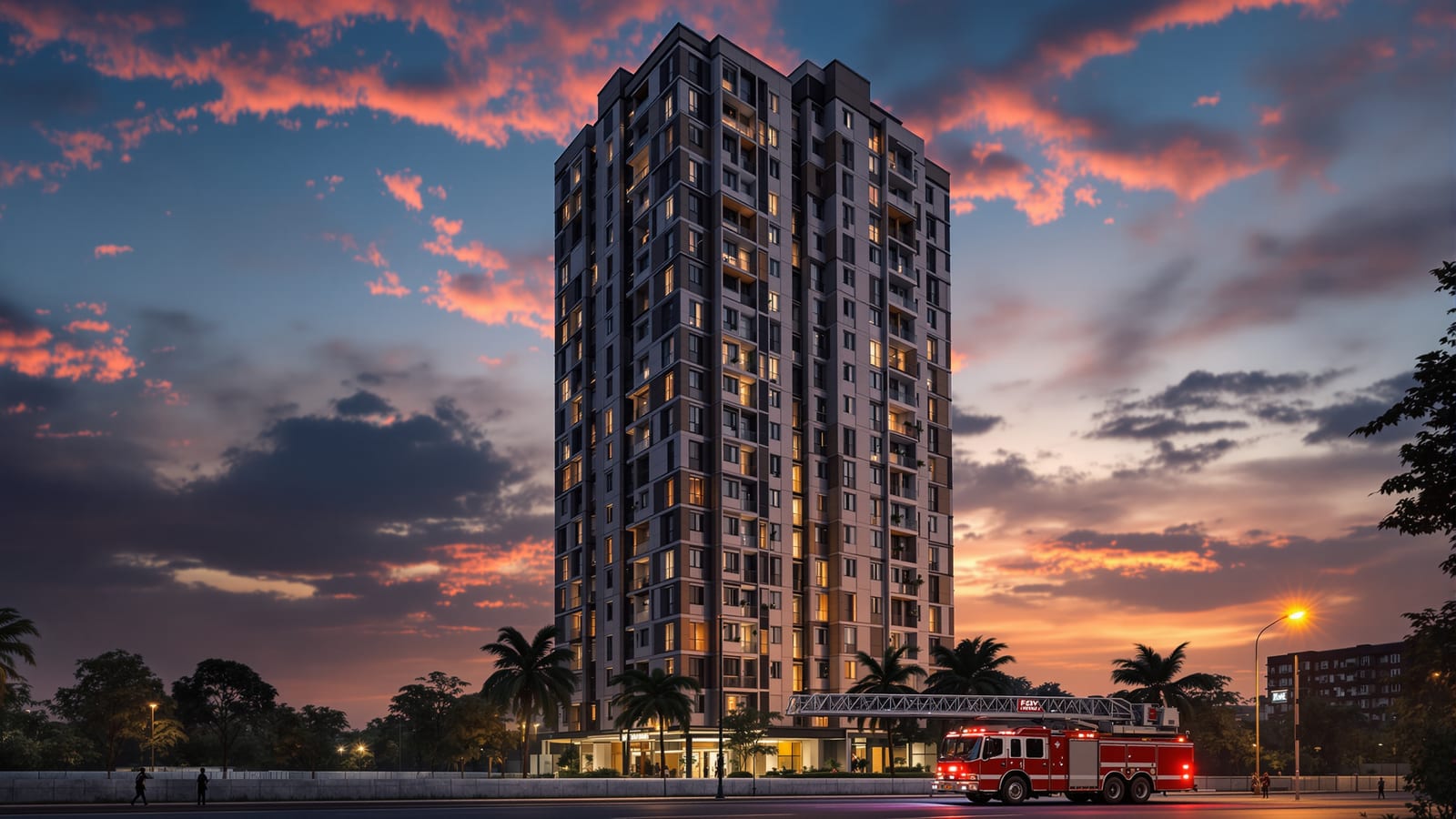
Facade Fire Safety and Cladding in India: How the Building Skin Spreads Fire and How to Make It Safe
Why combustible cladding cores and ventilated cavities can turn a facade into a chimney, the materials risk ladder from PE-core ACM to non-combustible A1 or A2, Euroclass and BS 8414, NBC 2016 Part 4 and IS 17682, and what flat owners should check.
A building's facade is its face, its weather coat, and its energy engine. But on a tall building it can also become something dangerous: a vertical chimney that carries fire from one floor to the next in minutes. The 2017 Grenfell Tower fire in London, in which 72 people died, was caused chiefly by the building's external cladding, not by anything inside the flats. That single fact has reshaped how the world thinks about facades.
This guide explains, in plain language, why the building skin can spread fire, which materials are dangerous and which are safe, what the rules say in India, and the practical questions a flat owner or building committee should be asking. We have kept the science honest and the examples accurate, because this is a life-safety subject.
This is part of our Building Facades series. If you are new to the topic, start with the pillar, why building facades matter, and the material-by-material overview of facade types. For the cladding system most often involved in these fires, see metal and ACP facades.
1. Why a facade can spread fire at all
We expect fire to spread inside a building, room to room, through doors and floors. We do not expect it to spread on the outside. Yet a modern clad facade can do exactly that, for two reasons that work together.
The first is the cladding material itself. Many decorative cladding panels are not solid metal or stone. They are sandwich panels: two thin skins (often aluminium) bonded to a soft core. If that core is a plastic such as polyethylene, it is essentially a layer of solid fuel hidden behind a metal face. When the aluminium skin heats up and the plastic inside ignites, it burns fiercely, melts, and drips burning material downward, starting new fires below.
The second is the air gap behind the cladding. Modern facades are often built as a rainscreen or double-skin: the decorative panels hang a few centimetres off the structural wall, with a continuous cavity in between. That cavity is excellent for keeping rain out and letting the wall breathe. But in a fire it behaves like a flue. Hot gases rise inside the gap, draw in fresh air at the bottom, accelerate, and drag flame upward at frightening speed. Engineers call this the chimney effect or stack effect.
Put a combustible core and an open cavity together and you have built, without meaning to, a chimney lined with fuel.
2. The chimney effect, step by step
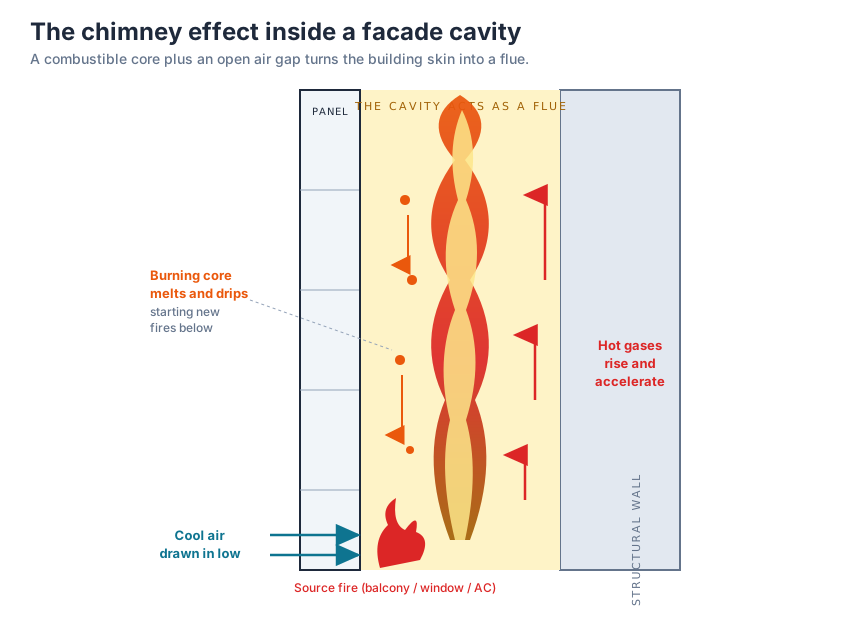
A facade fire usually follows a grim sequence. A small fire starts at a balcony, a window, an air-conditioner unit, or a flat fire that breaks through a window. Flame reaches the cladding. If the panel core is combustible, it ignites. Hot gases rise into the cavity and pull cool air in from below, so the burning speeds up rather than dying down. Flame races up the cavity, igniting more cladding as it climbs, while molten burning core drips down and starts fresh fires several floors below the original.
At Melbourne's Lacrosse tower in 2014, a smouldering cigarette on an eighth-floor balcony ignited combustible aluminium composite cladding, and the fire ran up roughly 13 to 14 storeys in about 11 minutes. No one died, largely through luck and a working sprinkler and alarm system, but it showed the world how fast a clad facade can fail. At Grenfell three years later, the same physics, in a residential tower with people asleep inside, was catastrophic.
The lesson is that facade fire is a speed problem. A normal building fire gives occupants time. A burning combustible facade can outrun the fire brigade and outrun an evacuation.
3. The materials risk ladder
Not all cladding is dangerous. The risk depends almost entirely on what the panel core is made of and how the whole system behaves together. Think of it as a ladder, from worst to safest.
At the bottom, the most dangerous, is aluminium composite material (ACM, also called ACP) with a pure polyethylene (PE) core, sometimes sold as "PE core" or "100 per cent polyethylene". The Grenfell Inquiry found that the polyethylene in the panels has a heat of combustion similar to petrol or diesel, and named these panels the primary cause of the fire's spread. This is the material at the heart of nearly every major facade fire.
One rung up is fire-retardant (FR) core ACM, where mineral fillers are mixed into the plastic to slow burning. FR cores are better than PE but are not non-combustible; in a severe, prolonged fire some FR products still contribute fuel. Better again are mineral-core (often called A2) composite panels, where the core is mostly non-combustible mineral with very little plastic.
At the top of the ladder sit genuinely non-combustible claddings: solid aluminium, steel, stone, terracotta, fibre cement, and mineral-core panels classified A1 or A2. These do not feed a facade fire.
Two other risks deserve naming. Combustible insulation behind the cladding (some foam plastic insulations) is fuel in its own right and was a contributing factor at Grenfell. And combustible decorative finishes such as high-pressure laminate (HPL) panels and untreated timber cladding can behave like ACM if used in tall-building systems without proper fire engineering.
4. Reading the fire classes: Euroclass and the system test
To compare materials objectively, engineers use reaction-to-fire classes. India's National Building Code references the European system, so these letters matter here.
The Euroclass scale runs A1, A2, B, C, D, E, F. A1 is fully non-combustible (stone, steel, mineral panels). A2 is so close to non-combustible that it makes no meaningful contribution to a fire. B through E contribute progressively more, and F means untested or failed. As a rule of thumb for tall buildings, you want A1 or A2 on the outside, and nothing combustible (B or worse) on a high facade unless a fire engineer has proven the complete system is safe.
That last point is crucial. A panel's class describes the material on its own, but real facades are systems: panel plus cavity plus insulation plus brackets plus the way joints and barriers are detailed. A material that looks acceptable in isolation can still fail as part of a badly built system. That is why there is a separate, large-scale system test: BS 8414, judged against the BR 135 criteria. A full mock-up wall, built exactly as it would be on site, is exposed to a large fire, and assessors measure whether flame and heat spread too far up the test rig. Passing BS 8414 tests the whole assembly, not just the panel. Many countries, including post-Grenfell UK, have moved toward simply requiring non-combustible materials on tall buildings rather than relying on the system test, because the test is only as honest as the mock-up built for it.
5. The materials table
The table below summarises the common cladding cores and materials, their typical fire class, the risk, and where they are reasonable to use. Treat it as guidance, not a substitute for a fire engineer's sign-off on a specific building.
| Cladding core / material | Typical fire class | Fire risk | Where it is reasonable |
|---|---|---|---|
| ACM / ACP, polyethylene (PE) core | E or worse | Severe. Burns like solid fuel, melts and drips, spreads fast | Should not be used on facades; banned or restricted for tall buildings in many countries |
| ACM / ACP, fire-retardant (FR) core | B to C typically | Moderate. Slows burning but still contributes fuel in severe fires | Low-rise, with caution; avoid on tall residential without system proof |
| Mineral-core composite panel (A2 core) | A2 | Low. Negligible contribution to fire | Tall buildings, residential, hospitals |
| Solid aluminium / steel sheet | A1 | Very low. Non-combustible | Any height |
| Stone, terracotta, fibre cement | A1 to A2 | Very low. Non-combustible | Any height |
| High-pressure laminate (HPL), standard | C to D | Moderate to high. Combustible | Low-rise only, or fire-rated grades with system proof |
| Timber cladding (untreated) | D to E | High on tall buildings | Low-rise, well-separated buildings |
| Combustible foam plastic insulation | varies, often E | High. Hidden fuel behind the skin | Avoid behind tall-building cladding; use mineral wool (A1) |
6. Cavity barriers, fire-stops and compartmentation
If a facade cavity behaves like a chimney, the cure is to break the chimney into compartments. This is the single most important piece of fire engineering in a clad facade.
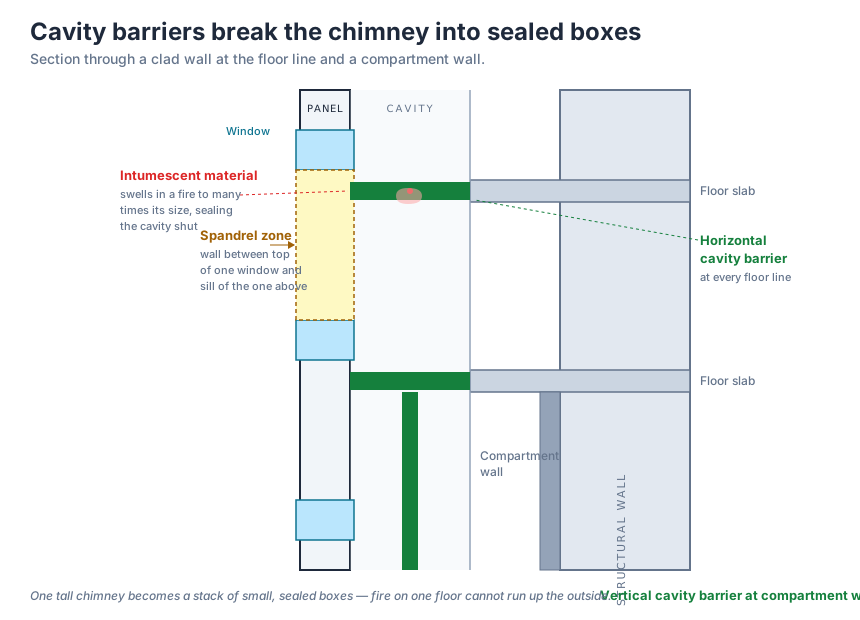
Cavity barriers are strips of fire-resisting material fixed inside the cavity, usually at every floor line and at compartment walls. Many are intumescent: in a fire they swell to many times their size, sealing the gap so flame and hot gas cannot travel past. Properly placed barriers turn one tall chimney into a stack of small, sealed boxes, so a fire on one floor cannot run up the outside to the floors above.
Inside the building, the same principle is called compartmentation: floors and key walls are built to resist fire for a set time (commonly one to two hours) so that fire stays in the flat or floor where it started. The weak link between inside and outside is the spandrel, the band of wall between the top of one window and the bottom of the window above. If a flat fire breaks through a window, the spandrel and the cladding over it must resist the flame long enough to stop it reaching the window above. A combustible cladding skin defeats both the spandrel and the compartmentation by simply burning around the outside of them.
So a safe clad facade is not just about non-combustible panels. It is non-combustible panels plus correctly installed cavity barriers plus intact compartmentation, all detailed and built together. Miss any one and the system can fail.
7. What the rules say in India: NBC 2016 and BIS
India's framework for this sits in two places: the National Building Code of India, 2016 (NBC 2016), Part 4, "Fire and Life Safety", and the Bureau of Indian Standards (BIS) product standards.
NBC 2016 Part 4 sets out fire and life-safety requirements for buildings, including escape routes, compartmentation, fire resistance of construction, and provisions for external walls and cladding. For tall buildings, the direction of travel mirrors international practice: external wall cladding on buildings above a height threshold (commonly cited around 15 metres and above in Indian practice) is expected to be non-combustible, with materials of European Class A1 or A2, and where a combustible component is proposed, the complete wall system is expected to demonstrate fire performance through a recognised large-scale test such as BS 8414 to BR 135. The NBC also requires cavity barriers and fire-stopping in concealed spaces, proper compartmentation, and clear, protected means of escape. Local state fire services and municipal corporations enforce these through the building permit and fire no-objection-certificate (NOC) process.
On the product side, BIS published IS 17682:2021, the Indian Standard for Aluminium Composite Panels, which has since moved into mandatory ISI certification. IS 17682 classifies ACPs by core type, separating fire-retardant (FR) cores from non-FR cores, and sets fire-performance requirements for each, alongside coating, adhesion and weather-resistance tests. In plain terms: a genuine, ISI-marked ACP carries a declared fire grade, and a panel sold without that mark, or sold as cheap "PE core" decorative cladding, may not meet any fire standard at all. The mark is your first, simplest check.
8. India's exposure: a latent risk, told honestly
It would be easy, and wrong, to claim that India has already had its Grenfell. It has not been proven that way, and we will not assert an unverified cause.
What is true is that India has had a number of serious high-rise and commercial-building fires with significant loss of life. But the investigated and reported causes of most of these have been internal failures, blocked or locked escape routes, missing or non-working sprinklers and alarms, illegal internal modifications, combustible interior materials, electrical faults, and obstructed fire-tender access, rather than a proven combustible-cladding facade fire of the Grenfell or Lacrosse type. Attributing those tragedies to cladding without official findings would be inaccurate and unfair.
The honest framing is this: India's combustible-cladding exposure is a latent risk, not a settled history. Indian cities have built, and continue to build, large numbers of high-rise residential and commercial towers clad in ACP. Before IS 17682 became mandatory, there was little to stop cheap PE-core panels going onto tall buildings, and much of that older stock is still in place. The physics that destroyed Grenfell and Lacrosse does not respect borders. The responsible conclusion is not panic but inspection: find out what is actually on these buildings, and remediate the dangerous ones before, not after, a fire teaches the lesson.
9. What to check on a clad tower
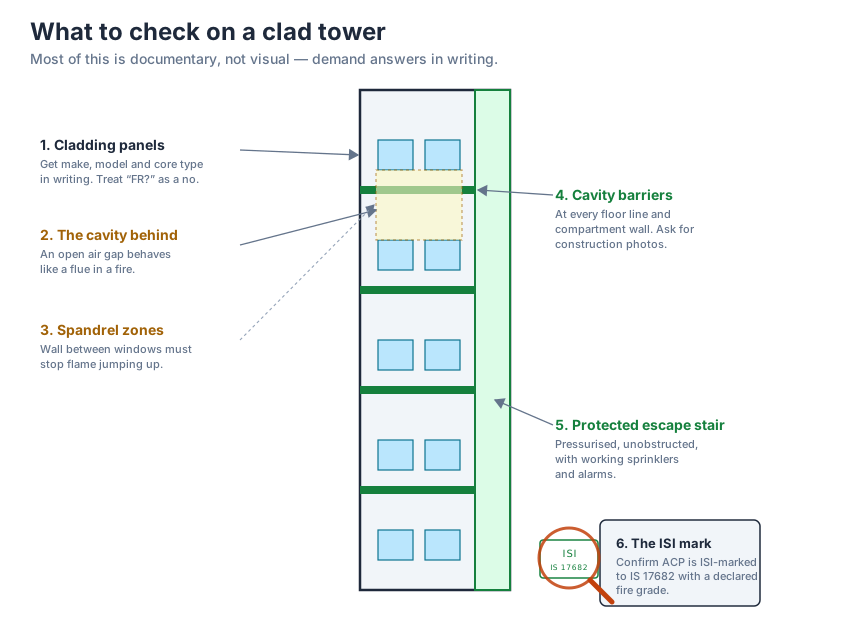
If you own or are buying a flat in a clad building, or sit on a society or owners' committee, here is what to find out. You will not be able to judge most of this by eye, which is exactly why you ask for documents and, where needed, a qualified facade or fire engineer.
Ask what the cladding actually is. Get the panel make, model and core type in writing. For ACP, confirm it is ISI-marked to IS 17682 and ask for its declared fire grade (FR or non-FR, and its class). Treat "we think it is FR" as a no.
Ask for the fire NOC and the approved drawings, and check that the cladding system as built matches what was approved. Cheaper panels are sometimes substituted on site after approval.
Ask whether cavity barriers were installed, at every floor line and at compartment walls, and whether there is documentation or photographs from construction.
Ask about the building's other fire defences, because cladding is only part of the picture: working sprinklers and alarms, pressurised and unobstructed escape stairs, compartmentation, and clear access for fire tenders all decide whether a facade fire is survivable.
For an existing building with suspect cladding, the path is a facade fire-risk assessment by a competent engineer, followed by a remediation plan, removing or replacing combustible panels, adding cavity barriers, and improving the internal defences. It is expensive, and it is far cheaper than the alternative.
What this means for you
The facade is part of the fire-safety system of a tall building, not just its decoration. A combustible cladding core plus an open cavity can turn the building's skin into a chimney that spreads fire faster than people can escape, as Grenfell and Lacrosse showed.
The safe path is well understood: use non-combustible cladding (Euroclass A1 or A2, ISI-marked to IS 17682 for ACP), avoid PE-core ACM entirely on any facade, install cavity barriers and fire-stops at every floor, keep compartmentation and escape routes intact, and never substitute cheaper panels after approval. India's regulations, NBC 2016 Part 4 and the mandatory IS 17682, now point in the right direction, but a great deal of older, untested cladding is still on buildings.
If you live in or are buying into a clad tower, the most useful thing you can do is ask the boring documentary questions: what is the panel, is it ISI-marked, what is its fire grade, were cavity barriers installed, and does the as-built facade match the approved drawings. Demand answers in writing, and bring in a qualified engineer where the answers are vague. This is one part of a home where a healthy suspicion can save lives.
To go deeper, read the series pillar on why building facades matter, the full overview of facade types, and the closely related guide to metal and ACP facades.
Sources
- Grenfell Tower Inquiry, Phase 1 Report (Sir Martin Moore-Bick): finding that ACM panels with polyethylene cores were the primary cause of fire spread; polyethylene's heat of combustion compared to petrol or diesel.
- Grenfell Tower Inquiry, Phase 2 Report: product testing, marketing and regulatory failings around combustible cladding and insulation.
- Victorian Building Authority and Lacrosse tower judgment (Owners Corporation No.1 v LU Simon Builders): account of the 2014 Melbourne Lacrosse fire, combustible ACP with 100 per cent polyethylene core, and rapid vertical spread.
- Bureau of Indian Standards, IS 17682:2021, Aluminium Composite Panel, Specification (mandatory ISI certification scheme; FR and non-FR core classification and fire requirements).
- National Building Code of India, 2016, Part 4, Fire and Life Safety (external wall and cladding provisions, compartmentation, cavity barriers, means of escape).
- BS 8414 (fire performance of external cladding systems) and BR 135 (classification criteria): large-scale system test referenced for combustible facade assemblies.
- European reaction-to-fire classification, EN 13501-1 (Euroclass A1, A2, B to F).
Export this guide
Related Guides — Deep-dive reading
Metal & ACP Facades in India — Appeal, Core Types, and the Fire Lesson
Aluminium composite panels and metal cladding are India's favourite modern facade after glass. Here is how ACP is built, why the PE vs FR vs A2 core decides whether it is a finish or a fuel, what NBC 2016 and IS 17682 require, and the real cladding-fire lessons India must heed.
Building FacadesFire Compartmentation in India (2026): Dividing a Building to Contain the Fire
The building-wide strategy of splitting a structure into fire-resisting cells so a fire and its smoke stay where they start - long enough for people to escape and the brigade to arrive. This guide explains the idea every rated wall, floor, door and damper serves.
SecurityBathroom Fire Safety India: NBC 2016 Part 4, Fire-Rated Materials & Electrical Ignition
The bathroom is rarely thought of as a fire risk, yet it hides several: a leaky geyser element, an over-run exhaust-fan motor, cheap flammable PVC panels overhead, and aerosol cans stored beside a heat source. This is an honest, practical reference to fire and life safety in the Indian bathroom — the NBC 2016 Part 4 context that actually applies to homes, the real ignition sources, self-extinguishing false-ceiling and PVC materials, earth-leakage protection as fire prevention, escape considerations, and the carbon-monoxide danger of gas geysers.
BathroomsRelated Tools — Try Free
Structural Modification Approval Checklist
41 items across structural assessment, society approval, municipal compliance, and safety.
Approval ChecklistCross-Ventilation Analyzer
Estimate airflow and air changes per hour (ACH) from room size, window areas, layout, and local wind — with NBC 2016 Part 8 compliance check.
Ventilation CalculatorWindow Material Comparison Tool
Compare uPVC, aluminium, wood, steel and composite windows on cost, life, upkeep and insulation.
Compare