
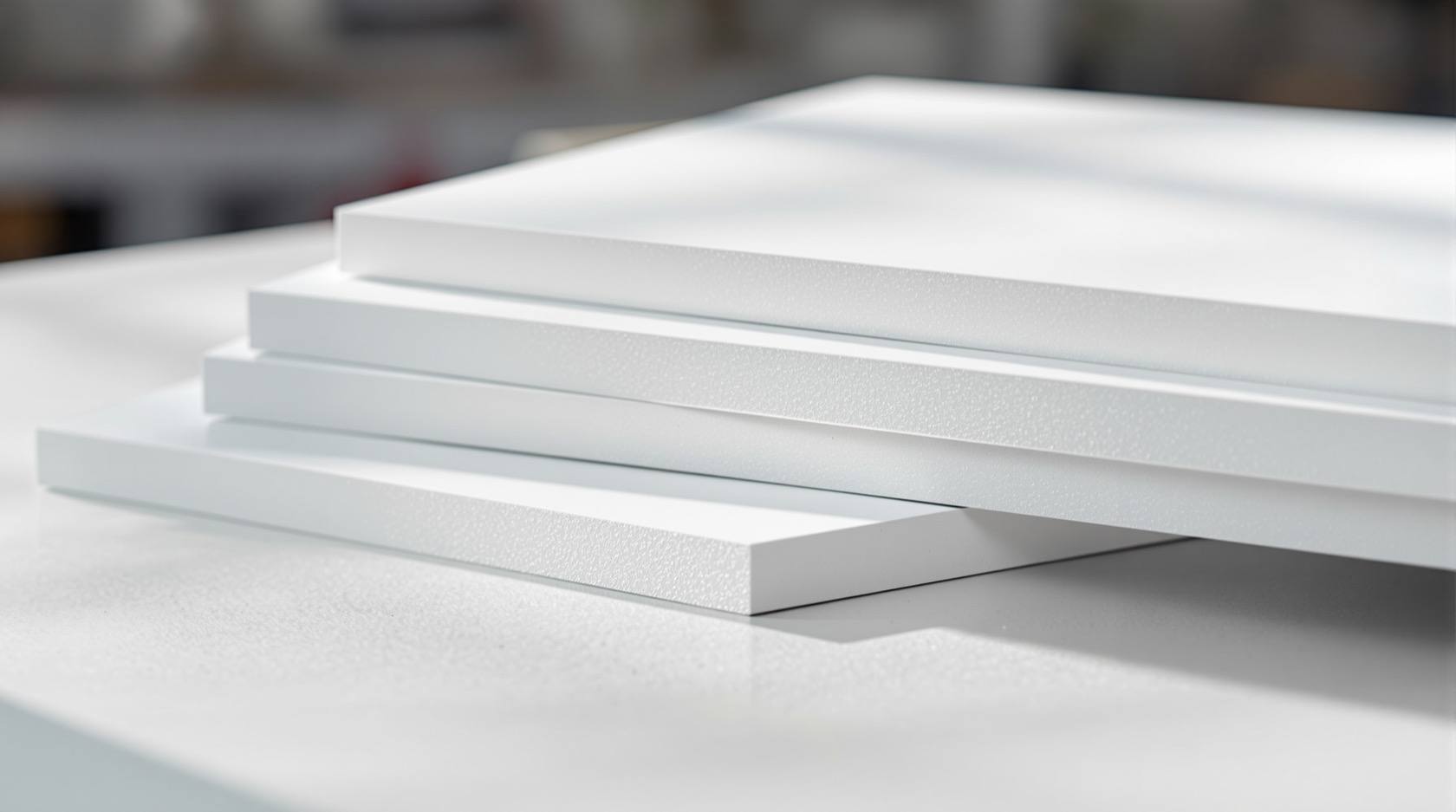
Calcium Silicate Boards in India: Fire-Rated Partition, Ceiling & Cladding Guide (2026)
What a calcium silicate board is, why it leads on fire resistance and damp tolerance, where it beats gypsum and cement boards, how to tell it apart from fibre-cement, plus indicative cost and safe cutting - a specify-and-select guide.
When a partition has to hold back a fire for two hours, a ceiling has to survive a humid public washroom, or a steel column has to keep its strength through a blaze, one board keeps appearing on the drawing: calcium silicate board. It looks a lot like a plain grey-white sheet of gypsum or cement board, and it is regularly confused with both. But it is its own material, engineered for one job above all others - staying intact, stable and non-combustible where ordinary boards would fail.
This guide helps you choose and specify calcium silicate board: what it actually is, the strengths that earn its premium, where it beats gypsum and cement board, how to tell the three apart, and how to handle it safely. It does not ask you to build a fire-rated system yourself - that detailing belongs to a specialist.
Scope and safety: This is a selection guide. Board thicknesses, fire ratings and prices here are indicative only - they move with brand, density, thickness and region, so always get local quotes and the manufacturer's tested data. Fire-rated partitions, structural steel fire protection, fire-stopping and rated ceiling systems are engineering decisions - hand them to a qualified architect, fire-safety consultant or approved drywall or fire-stop contractor. Cutting any mineral board releases silica-bearing dust: leave cutting and fixing to trained installers using the right PPE. Nothing here replaces the IS codes, the manufacturer's data sheet or a licensed professional.
What calcium silicate board actually is
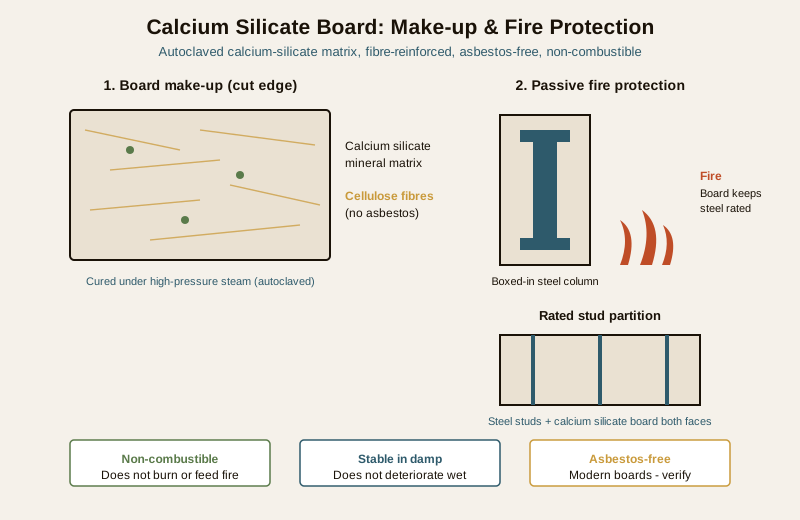
A calcium silicate board is a flat sheet made from calcium silicate - the mineral formed when a lime source (calcium) reacts with a silica source such as fine sand or fly ash - reinforced with fibres and then autoclaved (cured under high-pressure steam). The autoclaving is what matters: it drives the reaction that locks the calcium and silica into a stable, dense mineral matrix that will not burn and does not soften with heat or moisture.
The reinforcing fibres deserve a clear word. Older generations of calcium silicate and fibre-cement boards used asbestos fibres. Modern calcium silicate board is asbestos-free - it is reinforced with cellulose (wood-pulp) fibres, and sometimes mineral or synthetic fibres, instead. Any board you specify today from a reputable manufacturer should be certified asbestos-free; confirm it on the data sheet. This matters for both site safety and long-term occupant health.
The finished board is smooth, dimensionally stable and mineral through and through. Because there is nothing organic and combustible in the matrix, fire has nothing to feed on - which is the whole reason the board exists. For the wider board landscape it sits alongside, start with the gypsum boards guide and cement boards and fibre-cement, and for the full material picture the complete building materials guide.
The strengths that define it
Calcium silicate board is not the cheapest board on the shelf, nor is it what you reach for to line an ordinary dry bedroom wall. You specify it for a specific blend of properties that ordinary boards cannot match:
- Excellent fire resistance. This is the headline. The board is non-combustible and holds its integrity at high temperature, so it contributes directly to the fire rating of a partition, ceiling or floor rather than undermining it. Systems built from it commonly achieve one, two or even four-hour fire ratings depending on build-up. It is a mainstay of passive fire protection.
- Stable in damp and wet areas. Unlike standard gypsum board, which softens and disintegrates when wet, calcium silicate board does not deteriorate in moisture. It suits humid, semi-exposed and splash-prone locations - bathrooms, kitchens, utility rooms, covered soffits.
- Dimensionally stable. It barely moves with changes in temperature and humidity, so joints and finishes stay sound and it does not warp or sag over time.
- Termite, rot and vermin proof. Being a mineral board with no food value, it is immune to termites, fungal rot and rodents - a real advantage in Indian conditions.
- Non-toxic and durable. Modern boards are asbestos-free and give off no significant smoke or toxic gas in a fire; the material lasts the life of the building when detailed correctly.
The trade-off is cost and weight relative to plasterboard, and the reality that its finest qualities only pay off in the jobs that actually need fire or moisture performance.
Where calcium silicate board is used
The board's strengths map onto a fairly specific set of applications:
- Fire-rated partitions and walls. Steel-stud partitions lined with calcium silicate board form rated separating walls, staircase and lift-shaft linings, and service-shaft enclosures.
- Structural steel fire protection / cladding. Boxing-in beams and columns so the steel keeps its strength for the rated period in a fire - a common alternative to spray fireproofing where a clean, boarded finish is wanted.
- False ceilings, especially commercial and public. Durable, fire-rated and moisture-tolerant ceilings for malls, airports, hospitals, kitchens and washrooms where ordinary gypsum ceilings would not last. See the false ceiling guide for ceiling systems overall.
- Semi-exposed soffits and covered external areas. Balcony and corridor soffits, canopy undersides and other sheltered outdoor locations.
- Tile backer board. A stable, water-tolerant substrate to tile onto in wet areas, paired with the right tile adhesives.
- Cladding substrate and duct enclosures. A backing board behind facade systems, and lining for fire-rated ductwork and risers.
Calcium silicate vs gypsum vs cement board
Most specification decisions come down to picking one of these three flat boards. They look similar and are constantly muddled, but they earn their place in different situations. The scorecard below is directional - confirm exact figures against each product's data sheet.
| Property | Calcium silicate board | Gypsum board (plasterboard) | Cement / fibre-cement board |
|---|---|---|---|
| Fire resistance | Excellent (non-combustible; high ratings) | Good (special fire grades only) | Very good (non-combustible) |
| Moisture / wet-area tolerance | Excellent (does not deteriorate) | Poor (standard); fair (moisture grade) | Excellent |
| Weight | Light to medium | Light | Heavier |
| Surface finish | Smooth, easy to finish | Smoothest, paint-ready | Coarser, textured |
| Termite / rot proof | Yes | Board is, paper facing less so | Yes |
| Relative cost | Higher (premium) | Lowest | Medium |
| Best reason to choose | Fire rating plus damp tolerance | Budget dry-wall lining and ceilings | Wet areas, external, tile backer |
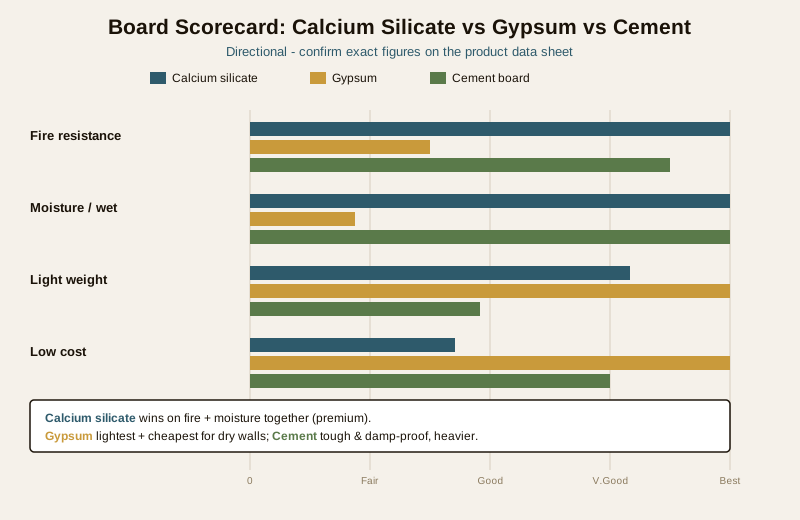
The short version. Gypsum board is the default, cheapest choice for ordinary dry internal walls and ceilings - lightest and easiest to finish, but it fears water and needs special grades to earn a fire rating. Cement / fibre-cement board is the tough, heavy, cheap-enough option for wet areas, external use and tile backing. Calcium silicate board overlaps cement board closely - both are non-combustible and damp-tolerant - but it is generally lighter and smoother than fibre-cement, easier to finish, and it is the board reached for in premium and high fire-rating applications where a clean finish and a certified rated system both matter. It costs more than either alternative, and you pay that premium only when fire performance is the governing requirement.
Do not confuse it with cement or fibre-cement board
This is worth spelling out because the confusion is genuine and common. Calcium silicate board and fibre-cement board are close cousins - both are autoclaved mineral boards, both are non-combustible, both shrug off damp. The practical differences:
- Binder chemistry. Calcium silicate board's matrix is dominated by calcium silicate minerals; fibre-cement board is bound largely by Portland cement. That gives calcium silicate board a somewhat lighter, whiter, smoother character.
- Finish and weight. Fibre-cement tends to be denser, heavier and coarser - excellent for external cladding and floors. Calcium silicate board is usually lighter and smoother, better suited to a fine painted internal finish and to high fire-rating partitions and ceilings.
- Positioning. In many product ranges the two overlap so much that a manufacturer sells both, and the line blurs. What matters is not the label but the tested performance on the data sheet: fire rating, density, moisture class and thickness for the exact board.
If a supplier calls a board "fibre-cement" or "cement board" but it is asbestos-free, autoclaved and rated for fire and wet areas, it may serve the same purpose - always specify by tested performance, not by name alone. Where cement admixtures and board chemistry meet, the construction chemicals guide gives the wider context.
Best-use guide - which board where
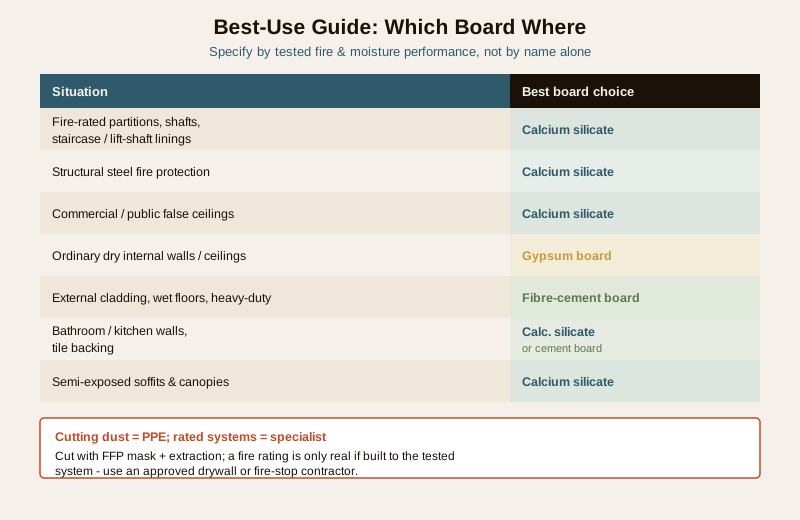
| Situation | Best board choice | Why |
|---|---|---|
| Fire-rated partitions, shafts, staircase linings | Calcium silicate board | Highest fire ratings with a clean, finishable surface |
| Structural steel fire protection / encasement | Calcium silicate board | Non-combustible boxing keeps steel rated for the required period |
| Commercial / public false ceilings | Calcium silicate board | Fire-rated, moisture-tolerant, durable in high-traffic buildings |
| Ordinary dry internal walls and ceilings | Gypsum board | Cheapest, lightest, smoothest paint-ready finish |
| External cladding, wet floors, heavy-duty | Fibre-cement board | Denser and tougher for exposure and load |
| Bathroom / kitchen walls, tile backing | Calcium silicate or cement board | Both stable in damp; choose on finish and cost |
| Semi-exposed soffits and canopies | Calcium silicate board | Handles damp and sun-shade cycles without deteriorating |
For the finishes that go over these boards - putty, paint, texture and cladding - see the wall finishes hub; for the wider board and sheet family, the cement boards and fibre-cement and gypsum boards guides sit right beside this one.
Cost - what to expect
Calcium silicate board sits at the premium end of the flat-board market - above gypsum board and generally on par with or above fibre-cement, depending on grade and thickness. As an indicative guide only, boards commonly fall in the range of roughly Rs 45 to Rs 120 per sq ft depending on thickness (typically 6 mm to 20 mm), density and brand, with high fire-rating grades and thick structural-protection boards at the upper end. Treat these as ballpark - thickness, density, fire class, brand and freight all move the number, so get current local quotes.
Set the premium against what it buys. On a rated partition, a steel-encasement job or a public-building ceiling, the board is not competing with plasterboard on price - it is meeting a fire and moisture requirement that plasterboard simply cannot, in a single durable, finishable sheet.
Handling and safety - defer install to a specialist
The board itself is inert and, once fixed and finished, sits quietly for the life of the building. The care is all at the cutting and fixing stage:
- PPE is non-negotiable during cutting. Sawing or drilling any mineral board releases fine, silica-bearing dust. Use a dust mask or respirator (an FFP-rated mask), safety glasses and gloves, cut with a low-dust method (score-and-snap or a saw with dust extraction) and keep the area ventilated.
- Confirm the board is asbestos-free on the data sheet before you buy - and never disturb an unknown old board, which could contain asbestos.
- Leave the work to an approved installer. A fire rating is only real if every stud spacing, screw pattern, joint, junction and service penetration is built exactly to the tested system. Fixing a fire-rated partition, a steel-encasement or a rated ceiling - and the fire-stopping around it - is a specialist skill; use a drywall or fire-stop contractor approved for the system you have specified.
This is a material you specify and buy with confidence - and hand to a professional to fit. The moment it becomes part of a fire rating, the detailing matters as much as the board.
Standards and certification
Calcium silicate and fibre boards in India are broadly covered by the relevant Bureau of Indian Standards (BIS) specifications for calcium silicate and fibre-reinforced building boards (named generally here - check the current editions and the manufacturer's declared standard). The board's reaction-to-fire and fire-resistance ratings must always come from a tested system, not a generic table - the rating belongs to the whole assembly, not the board alone. Fire and life-safety provisions sit within the National Building Code of India (SP 7:2026). Green-building frameworks such as GRIHA, IGBC and LEED may recognise durability, low-toxicity and non-combustibility. Standards and editions are revised periodically - verify against the current data sheet and system report rather than relying on memory.
Key takeaways
- Calcium silicate board is an autoclaved sheet of calcium silicate reinforced with fibres; modern board is asbestos-free (cellulose or mineral fibres) - confirm it on the data sheet.
- Its stand-out strengths are excellent fire resistance (non-combustible, high system ratings) and damp tolerance, plus dimensional stability and being termite and rot proof.
- Specify it for fire-rated partitions and shafts, structural steel fire protection, commercial and public false ceilings, semi-exposed soffits, tile backing and cladding substrate.
- Versus gypsum board it wins on fire and moisture at higher cost; versus cement / fibre-cement board it is similar but lighter and smoother, favoured for premium high fire-rating jobs.
- It is often confused with cement / fibre-cement board - specify by tested performance, not name; and leave cutting (dust PPE) and rated-system install to a drywall or fire-stop contractor.
References
- Bureau of Indian Standards - specifications for calcium silicate and fibre-reinforced building boards; consult the current editions for classification, density and marking requirements.
- National Building Code of India (SP 7:2026) - fire and life-safety provisions relevant to rated partitions, ceilings and structural fire protection.
- Manufacturer technical data sheets and tested-system reports - the authoritative source for a specific board's fire rating, density, moisture class, thickness and asbestos-free certification.
- Studio Matrx guides: gypsum boards guide, cement boards and fibre-cement, tile adhesives guide, the wall finishes hub and the complete building materials guide.
Export this guide
Related Guides — Deep-dive reading
Fire-Resistant Building Materials in India: A Specify-and-Select Guide (2026)
The difference between how a material reacts to fire and how long a rated assembly resists it, then the materials that deliver passive fire protection - non-combustible structure, mineral wool, fire-rated boards, intumescent coatings, spray fireproofing and fire-stopping - with a material-to-role selection table.
Building MaterialsCement Board & Fibre-Cement Board in India: Wet-Area, Fire & Cladding Guide (2026)
What fibre-cement and cement boards are, why they beat gypsum in wet areas and on facades, the main products - fibre-cement board, cement particle board, HD board and tile backer board - how they compare with gypsum and calcium silicate, indicative cost and safe cutting. A specify-and-select guide.
Building MaterialsEpoxy Grout vs Cement Grout for Tiles in India: Which to Specify (2026)
A plain-English guide to tile grouts for Indian homes: what grout does, how cementitious grout compares with epoxy grout on cost, stain and water resistance, hygiene and durability, and exactly where each one belongs - kitchens, bathrooms, pools, dry rooms and more.
Building MaterialsRelated Tools — Try Free
False Ceiling Cost Estimator
Live ₹/sqft across 8 ceiling types — POP, gypsum, designer, metal, PVC, wooden — with cove and spot lighting for 20 Indian cities.
Cost CalculatorAcoustic Privacy (STC) Visualizer
Indian healthcare acoustic visualizer — compare wall assemblies and noise sources, see received SPL after STC attenuation, and check FGI 2018 / IS 1950 / NABH speech-privacy compliance with live dual-canvas waveform.
Acoustic ToolMaterial Decision Framework (M-Score)
Score 30+ Indian construction materials across cost, durability, climate fit, maintenance, and sustainability.
Materials