
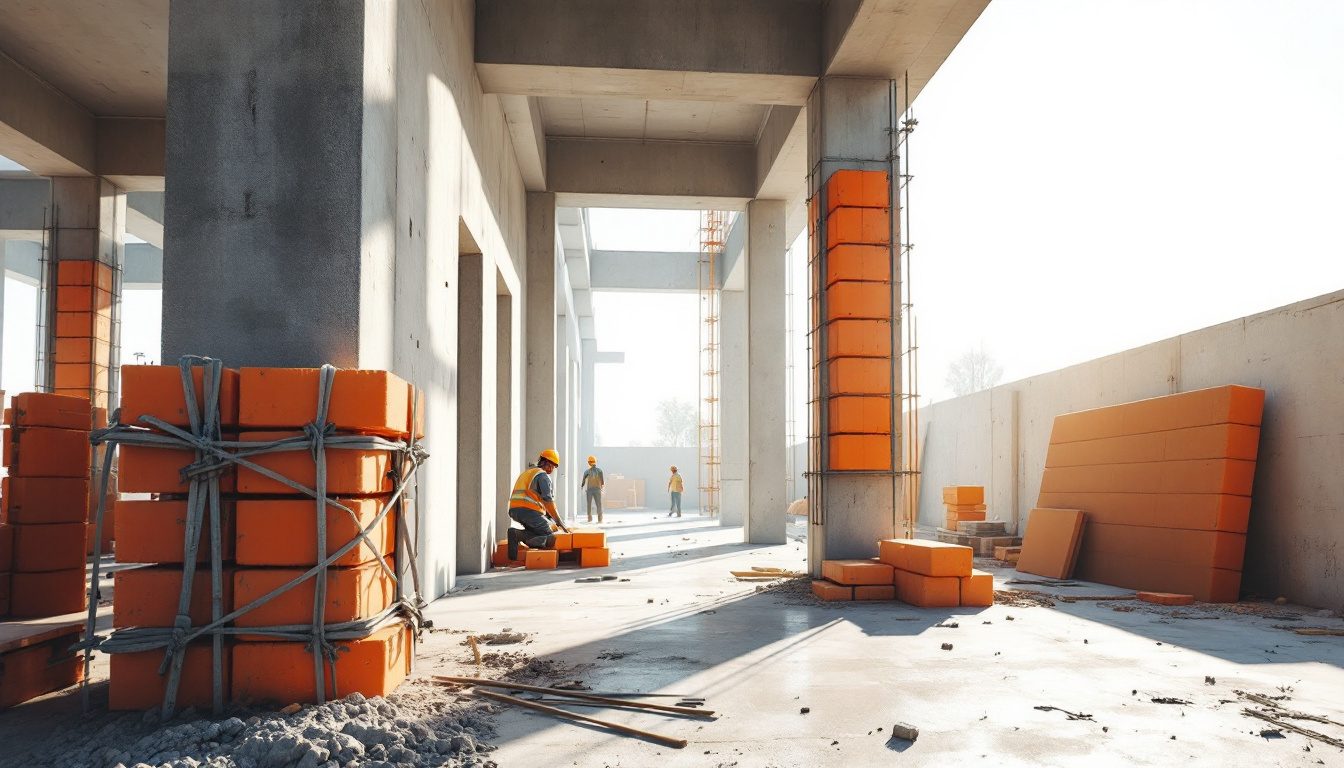
Why Reinforcement Steel Matters
Why steel and concrete are a marriage that makes modern buildings possible — the physics of composite action, where the bars go, and the stakes when reinforcement is skimped.
Picture a concrete beam — plain, no steel — spanning two walls in a new house. A mason stands on it to reach a high corner. There is a sharp crack, the beam drops, and a man falls with it. Now imagine the same beam cast around four ribbed steel bars. The same mason stands there, bounces lightly to test it, and gets back to work. Same cement. Same sand. Same coarse aggregate. Same mix ratio. But one beam holds and one does not. Why?
The answer is one of the most important ideas in all of construction — and it explains every column, every beam, every slab, and every footing of every house being built in India right now. Understanding it will make you a better buyer, a sharper client, and impossible to cheat when you are standing on your own site watching your money become a building.
Reinforced concrete works because the two materials do different jobs in perfect partnership: concrete resists compression and steel resists tension — a division of labour neither material can handle alone.
1. What Concrete Can and Cannot Do
Concrete is extraordinarily strong when you try to squeeze it — it resists compression with brute force. A standard M20 mix (the minimum allowed for reinforced concrete by IS 456) has a characteristic compressive strength of 20 N/mm². For context, a 150 mm cube of M20 concrete can hold the weight of roughly four small cars before it crushes. Raise the grade to M25 or M30 and those numbers climb further.
But concrete has a fatal flaw: it is brittle in tension. When you try to pull it apart, or bend it so that one face stretches, it cracks almost without warning. Its tensile strength is only about one-tenth of its compressive strength — around 2 N/mm² for M20. For understanding concrete strength in detail, including what grades mean and how the mix affects performance, see the companion guide in this series.
This asymmetry matters enormously in a real building. Almost every structural element carries both compression AND tension:
- A beam bending under load is compressed at the top and stretched (tensioned) at the bottom.
- A column under eccentric load — which is nearly always the case — experiences tension on one face.
- A slab spanning between beams is pulled downward by gravity and tensioned along its underside.
- A footing, pushed upward by soil reaction, experiences tension on its bottom face.
Left to plain concrete, all of these elements would crack the moment any significant load was applied. The entire logic of reinforced concrete is to intercept that tension before it tears the concrete — and hand it off to a material that thrives on it.
"Concrete is strong in compression but weak in tension — its tensile strength is roughly one-tenth of its compressive strength. This asymmetry is the design driver of every reinforced concrete element." — Pillai, S.U. and Menon, D., Reinforced Concrete Design, 3rd ed., Tata McGraw-Hill, 2009.
2. What Steel Does: Carrying the Tension
Steel is almost the mirror image of concrete. It is strong in both tension and compression — its yield strength (the stress at which it begins to deform permanently) for Fe500 grade TMT bars is 500 N/mm², more than twenty-five times concrete's tensile strength. It is also ductile — it can stretch and deform substantially before it breaks, giving a structure visible warning before collapse.
The structural engineer's job is to work out where tension occurs in every element and to place steel bars precisely there.
In a simply-supported beam (think of a beam resting on two walls): gravity loads cause the bottom of the beam to stretch and the top to compress. The main reinforcement bars — the longitudinal bars running along the length of the beam — are placed near the bottom. Their job is to carry all the tensile force the beam experiences.
In a continuous beam (a beam that passes over an intermediate column): the beam hogs over the support, meaning the top face is now in tension over the column. Extra bars are therefore placed near the top in those hogging regions.
Stirrups (closed loops of thinner bar, also called links or binders) are placed perpendicular to the longitudinal bars at regular intervals. They carry the diagonal shear forces that develop near the supports, and they also hold the main bars in position and prevent them from buckling outward if compression ever reaches them.
| Structural element | Where main steel goes | Why |
|---|---|---|
| Simply-supported beam (sagging) | Bottom face (tension zone) | Bending pulls the bottom in tension |
| Continuous beam over a column (hogging) | Top face near the support | Bending pulls the top in tension here |
| Column (axial + eccentric load) | Four corners + intermediate bars around perimeter | Both compression reinforcement and tension contingency; ties prevent bar buckling |
| Slab (one-way spanning) | Bottom layer, parallel to span | Sagging tension on the underside |
| Slab (two-way spanning) | Bottom layer in both directions | Tension in both span directions |
| Footing | Bottom face (mat or spread footing) | Soil reaction causes upward bending — tension on bottom |
This is why reinforcement detailing is not a formality. Putting bars in the wrong face, missing bars altogether, or using understrength bars means tension goes unresisted — and the concrete cracks right where you most need it not to.

A plain beam cracks at the tension face; the same beam with bottom steel carries the load — the difference is dramatic.
3. The Three Reasons the Partnership Works
Steel and concrete are not simply placed next to each other and left to cooperate. There are three physical reasons their partnership is stable, durable, and genuinely synergistic:
(a) Bond: the ribbed surface grips the concrete
Modern TMT bars (Thermo-Mechanically Treated — covered in depth in the TMT steel complete guide) have transverse ribs rolled onto their surface. These ribs are not decorative. When concrete is poured around a ribbed bar and cures, the hardened cement paste keys into every groove. Pull on the bar and the ribs have to shear through the surrounding concrete — an enormous resistance. This is called mechanical bond, and it is why smooth plain round bars have been obsolete for structural use for decades.
Bond ensures that when a load tries to elongate the steel bar in tension, the stress transfers smoothly from the concrete into the steel across the full embedded length of the bar. Break the bond — by using a bar thickly coated in loose rust, oil, or mud — and the steel slides, the load is never transferred, and the element fails.
(b) Nearly identical thermal expansion — they move together
Steel expands and contracts with temperature at roughly 12 × 10⁻⁶ per °C. Concrete expands and contracts at roughly 10–12 × 10⁻⁶ per °C (IS 456 uses 12 × 10⁻⁶ as the design value for both). These are almost identical.
This near-match is remarkable — it appears accidental from nature's side, but it is the reason reinforced concrete can serve in the Indian climate where summer temperatures at the surface of a concrete slab can swing 50 °C from predawn to afternoon. If steel expanded much faster than concrete (as aluminium does, at 23 × 10⁻⁶), repeated heating and cooling would pump the bar back and forth inside the concrete, destroying the bond progressively and eventually causing the cover to split. The matching expansion eliminates this internal cycling stress.
(c) Alkaline concrete passivates and protects the steel
Fresh concrete is highly alkaline — its pore solution has a pH of around 12.5 to 13.5. At this pH, a thin, dense iron oxide layer forms on the surface of the embedded steel bars. This passive film stops corrosion almost completely. The steel does not rust because the concrete itself acts as a chemical protector.
This protection persists as long as the alkalinity is maintained. It is threatened by two processes: carbonation (CO₂ from the atmosphere diffuses inward through the cover, reacting with calcium hydroxide and lowering pH) and chloride ingress (salts from the sea, from de-icing, or from poor construction water penetrate and destroy the passive film locally). Both of these are accelerated by inadequate cover, poor-quality concrete, and cracks. See the science of durable buildings for a full treatment of these degradation mechanisms.
"The protection afforded to steel reinforcement by the alkalinity of concrete is one of the great gifts of composite construction. Its loss through carbonation or chloride attack is the beginning of the end for a reinforced concrete element." — Neville, A.M., Properties of Concrete, 5th ed., Pearson Education, 2011.

The three-way compatibility — bond, matching expansion, chemical protection — is why reinforced concrete has outlasted every rival structural system for over a century.
| Partnership mechanism | Physical basis | What breaks it |
|---|---|---|
| Bond / grip | Ribbed bar ribs key into hardened paste — mechanical interlock | Muddy or oily bars; insufficient embedment length; smooth bars |
| Matching thermal expansion | Both ~12 × 10⁻⁶/°C (IS 456 design value) | Would be broken by very different metals (not an issue with steel) |
| Alkaline corrosion protection | pH ~13 pore solution forms passive oxide film on steel | Carbonation (CO₂ lowers pH); chloride ingress (destroys passive film); inadequate cover |
4. Composite Action — the Full Load Path
Viewing the whole picture together: when a reinforced concrete beam carries a load, the load path is not simply "concrete carries this, steel carries that" in isolation. The two materials act as a single composite section.
The load causes the beam to deflect. The top fibres shorten (compression — concrete handles this well). The bottom fibres elongate (tension — steel handles this well). The neutral axis divides the two zones. Stirrups intercept the diagonal tension forces (shear) that radiate from the supports toward the load point.
The engineer sizes the beam, calculates the moments and shear forces, and then calculates exactly how many bars of what diameter are needed at each location to keep every tensile stress within safe limits, with the design safety factors of IS 456 applied. None of this is guesswork — it is calculation based on well-established structural mechanics.

Composite action distributes the load between two materials, each doing what it does best.
5. Concrete Cover — the Unsung Hero
Cover is the thickness of concrete between the outer face of the structure and the nearest face of the reinforcement bar. It is one of the most under-appreciated details in residential construction, and one of the most frequently compromised.
Cover does two jobs:
1. Corrosion protection: the alkaline concrete must have sufficient depth and density to slow carbonation and resist chloride ingress across the design life of the building. Too little cover and the passive film protecting the steel is destroyed within years in a normal environment, within months in a coastal one.
2. Fire resistance: in a fire, the surface temperature of the concrete rises rapidly. Steel loses its yield strength at temperatures above about 400–500 °C. Adequate cover insulates the bars from high temperatures long enough to allow evacuation and firefighting.
IS 456 specifies minimum nominal cover by exposure condition and structural element:
| Structural element | Mild exposure (inland, sheltered) | Moderate exposure | Severe exposure (coastal, humid) | Very severe / extreme |
|---|---|---|---|---|
| Slab | 20 mm | 30 mm | 45 mm | 50–75 mm |
| Beam | 25 mm | 30 mm | 45 mm | 50–75 mm |
| Column | 40 mm | 40 mm | 50 mm | 50–75 mm |
| Footing (against earth) | 50 mm | 50 mm | 50 mm | 75 mm |
Source: IS 456:2000, Table 16 (nominal cover) and Cl. 26.4. These are minimums — structural engineers may specify higher values.
In Indian residential construction, cover is maintained with small precast concrete or plastic spacers (cover blocks) wired to the reinforcement cage before pouring. This is not optional — it is one of the most important quality-control checkpoints on a site. If you see the laborers skipping cover blocks, or pulling them out because "they get in the way of the vibrator," you are watching the long-term durability of your house being eroded.
"A millimetre of cover is worth a tonne of repair work twenty years later." — A maxim often cited by site engineers in India's coastal cities.

Correct cover keeps the alkalinity high around the steel; compromised cover allows carbonation and chlorides to attack.
For a full treatment of how to inspect and enforce this on site, see construction quality control for homeowners.
6. What Reinforcement Looks Like in Your House
Walking onto a construction site before the concrete is poured, you should be able to recognise the reinforcement in every element. Understanding what you are looking at — and what should be there — lets you ask informed questions.
Footings: Spread footings under columns get a mat of steel bars at the bottom face (where bending tension occurs from soil reaction pushing up). Spacing is typically 150–200 mm in each direction. A clear cover of 50–75 mm from the bottom face protects bars from the soil.
Columns: Vertical elements get four or more longitudinal bars (vertical bars running the full storey height) and lateral ties (closed rectangular hoops placed at regular vertical intervals — typically 150–200 mm for normal cases, reduced to 100 mm in the confinement zone near beam-column joints in seismic design). The ties prevent the longitudinal bars from buckling outward under compressive load and provide ductility in earthquakes.
Beams: Longitudinal main bars near the tension face (bottom for simply-supported, top over supports for continuous beams). Stirrups as closed hoops around the full beam section at regular intervals — closer near supports where shear is highest, wider in the middle. Two hanger bars near the top hold the stirrups in position.
Slabs: A mesh of bars in one or two directions depending on the slab geometry. One-way slabs get main bars in the shorter span direction and distribution bars in the longer direction. Two-way slabs get bars in both directions. In slabs, the bars are often smaller diameter (8 mm or 10 mm) at tighter spacing (150–200 mm) rather than large bars at wide spacing.
| Structural element | Typical bar sizes | Main bar placement | Lateral steel |
|---|---|---|---|
| Column (G+1 residential) | 12–16 mm longitudinal, 8 mm ties | Corners + intermediate face bars | Rectangular ties at 150–200 mm (less at joints) |
| Beam (main) | 12–20 mm longitudinal, 8–10 mm stirrups | Bottom face (sagging span), top near supports | Stirrups at 100–200 mm depending on shear |
| One-way slab | 8–12 mm main, 8 mm distribution | Bottom in span direction | Distribution bars perpendicular to span |
| Spread footing | 12–16 mm in both directions | Bottom mat | None (or nominal dowels for column connection) |
| Staircase waist slab | 10–12 mm | Tension face (underside) | Distribution bars |
Bar sizes and spacing are illustrative for typical G+1 residential; actual specification must come from a licensed structural engineer.
For reading the drawings that specify all of this, see reinforcement drawings simplified.

Every element in your house has steel placed exactly where tension occurs — footings, columns, beams, and slabs all follow the same logic.
7. What Goes Wrong — Reinforcement Failure Modes
The gap between a correctly reinforced structure and a poorly reinforced one is not visible once the concrete is poured. This invisibility is exploited by contractors who cut corners on steel because homeowners cannot check after the fact. Yet the failures are well-documented and their causes predictable.
| Reinforcement defect | What it means physically | Failure consequence |
|---|---|---|
| Too few bars (under-reinforcement) | Tensile capacity insufficient for design loads | Excessive deflection, cracking, eventual flexural failure |
| Bars placed in wrong face | Tension zone is unreinforced | Immediate cracking along the tension face under first significant load |
| Insufficient stirrups (especially at joints) | Shear and confinement not provided | Shear-diagonal cracking; brittle joint failure in earthquakes |
| No or inadequate cover blocks | Cover too thin; carbonation front reaches steel quickly | Corrosion, rust expansion, spalling, loss of cross-section |
| Rusty bars used (loose mill scale OK; deep pitting not) | Reduced cross-section; poor bond (flaky rust) | Reduced capacity; early corrosion initiation |
| Bars not lapped or spliced correctly | Stress cannot transfer across the join | Bar "pulls out" at the lap — sudden loss of tension resistance |
| Column-beam joint not detailed for seismic zones | Confinement steel missing in the plastic hinge zone | Brittle joint collapse in an earthquake — the single most common failure mode in Indian seismic events |
The last point deserves emphasis. IS 13920 (the ductile detailing code for seismic zones III, IV, V — most of peninsular India and all of the Himalayan belt) specifies closely-spaced hoops in the confinement zones of columns and beams. Buildings designed to IS 456 alone but not IS 13920 in seismic zones have repeatedly collapsed in Indian earthquakes while properly detailed structures nearby stood.
"Most earthquake collapses in India are not caused by the earthquake exceeding the design load — they are caused by buildings that were never built to the code that was already in force." — Observed repeatedly in post-earthquake survey reports, Bureau of Indian Standards.
If your house is in an earthquake zone, confirm with your structural engineer that IS 13920 detailing is specified on the drawings and that the site supervisor is enforcing the confinement zone stirrup spacing. This is not a nicety — it can determine whether your family survives. For more on structural safety in residential buildings, see the dedicated guide.
When reinforcement fails — through corrosion, wrong placement, or missing bars — the visual signs include: map cracking along bar lines, rust staining, concrete spalling off in chunks, and visible bar exposure. What makes buildings crack explains the full taxonomy of cracking and what each type signals.
8. Corrosion — Steel's Long-Term Enemy
Even in a correctly designed and built structure, the steel's protection is not guaranteed forever. Time, weather, and the Indian environment erode it progressively.
Carbonation: CO₂ in the atmosphere reacts with calcium hydroxide in the concrete pore solution, forming calcium carbonate. This is the process of carbonation, and it lowers the pH from ~13 to below 9. At pH below about 10, the passive oxide film on the steel becomes unstable. The carbonation front moves inward from the outer surface at a rate approximately proportional to the square root of time — slow at first, then persistent. In normal urban outdoor exposure, carbonation can reach 20–30 mm in 25–30 years in moderately permeable concrete.
Chloride attack: In coastal regions — and India has 7,500 km of coastline plus an enormous coastal belt of cities — chlorides carried in sea air penetrate the concrete and destroy the passive film locally even at high pH. This is more aggressive than carbonation and is the dominant cause of premature reinforcement corrosion in Mumbai, Chennai, Kochi, Visakhapatnam, and all their surrounding towns.
What rust does: Iron oxide (rust) occupies 2–4 times the volume of the original steel. When corrosion begins, the expanding rust layer pushes outward with enormous pressure — enough to crack concrete, then split off the cover, a process called spalling. Once the cover spalls, the bar is exposed to air and moisture and the process accelerates catastrophically.
Protective strategies:
- Adequate cover and dense concrete are the first and most powerful protections. IS 456 Cl. 8.2.4 requires a maximum water-cement ratio of 0.40 for severe exposure and 0.50 for moderate exposure.
- Corrosion-Resistant Steel (CRS): Some TMT bar manufacturers now produce copper-bearing or chromium-alloyed bars marketed as CRS or weather-resistant — they form a tighter passive film and resist chloride penetration better.
- Epoxy-coated bars: Used in very aggressive environments; the epoxy layer provides a physical barrier independent of concrete alkalinity. Must be handled carefully on site — any coating damage defeats the purpose.
- Supplementary cementitious materials: Fly ash and GGBS (ground granulated blast-furnace slag) added to the concrete mix reduce permeability substantially, slowing both carbonation and chloride ingress.
- Surface coatings and sealers: Applied to the exposed concrete surface to reduce CO₂ and moisture penetration — a maintenance strategy for existing structures.
| Protection strategy | Primary benefit | Best suited for |
|---|---|---|
| Adequate cover + dense mix (low W/C) | Slows all ingress mechanisms | All construction — mandatory |
| CRS / copper-bearing TMT bars | Better passive film, chloride resistance | Coastal and highly humid zones |
| Epoxy-coated bars | Physical barrier to chlorides | Severe marine or aggressive industrial zones |
| Fly ash / GGBS in mix | Reduced permeability, finer pore structure | All zones — improves long-term durability |
| Silane/siloxane surface sealers | Hydrophobic barrier at surface | Existing structures; exposed faces in coastal cities |
9. From Concept to Confident Buyer
This guide has been about the WHY — why steel and concrete are inseparable, what steel actually does inside the concrete, why the partnership is physically stable, and what happens when it is violated. That understanding is the foundation for every reinforcement-related decision you will make.
The practical next questions are: which grade of TMT bar should I buy, how do I read the BIS mark, what are the real brand categories in India, how do I calculate how many kg of steel I need, and how do I check that my contractor is not substituting inferior steel? All of that is covered in exhaustive detail in the TMT steel complete guide.
For the equally important question of how the concrete around the steel is designed — grades, mix ratios, water-cement ratios, and curing — see understanding concrete strength and choosing the right concrete grade.
And for the broadest picture of all the shell materials in an Indian house — how cement, concrete, steel, blocks, and plaster relate to each other — the modern construction materials overview is the place to start.
If you are in the planning stage of your house and want to think through materials, costs, and structural strategy together, Studio Matrx DesignAI can walk you through the decisions in the context of your specific project.
10. Quick-Reference: Concept vs Product
| Question | This guide covers | Where to go next |
|---|---|---|
| Why does steel go in concrete at all? | Yes — the whole guide | — |
| What is composite action in a beam? | Yes — Section 2 & 4 | — |
| Why do they bond together? | Yes — Section 3 | — |
| What is cover and why does it matter? | Yes — Section 5 | Construction quality control |
| Which TMT grade: Fe500 vs Fe550D? | No | TMT steel complete guide |
| How many kg of steel for my house? | No | TMT steel complete guide |
| Which brands and how to buy? | No | TMT steel complete guide |
| How to read the bar-bending schedule on drawings? | Partially (Section 6) | Reinforcement drawings simplified |
| What causes cracking in my walls? | Partially (Section 7) | What makes buildings crack |
| How do I protect against corrosion? | Yes — Section 8 | Science of durable buildings |
Author's Note
Amogh used to say that the most elegant structures are the ones that look effortless — and that effortlessness is won in the details you never see. The steel inside your concrete is invisible the moment the shuttering comes down. It will never be inspected again, not in your lifetime. Your contractor knows that. Some of them rely on it.
Understanding the physics of reinforcement is your protection against that knowledge asymmetry. When you know that the bottom bars of a beam carry the tension, you can ask: "Show me the bar-bending schedule. Show me the cover blocks in place before the pour. Show me the column ties at the joint spacing IS 13920 requires." You are not being difficult — you are being the client your building deserves.
A house is the single largest investment most Indian families will ever make. The steel inside it is invisible, unglamorous, and small in cost compared to the finishes. But it is the difference between a building that stands for three generations and one that is a liability within a decade. Know what it is, why it is there, and hold your contractor to the standard. That is what this guide is for.
Disclaimer
This article is educational and intended to help homeowners and students understand the conceptual basis of reinforcement in concrete. It does not constitute structural engineering advice. All design decisions — bar sizes, spacing, cover, grade, and detailing — must be specified by a licensed structural engineer registered with the relevant authority. Material prices cited are indicative 2026 ranges and will vary by region, supplier, and market conditions. Verify current BIS certification marks directly with the Bureau of Indian Standards. IS code clause references are provided for general guidance — consult the current edition of each standard for binding requirements.
References
1. Bureau of Indian Standards. IS 456:2000 — Plain and Reinforced Concrete — Code of Practice (4th rev.). BIS, New Delhi.
2. Bureau of Indian Standards. IS 1786:2008 — High Strength Deformed Steel Bars and Wires for Concrete Reinforcement — Specification (4th rev.). BIS, New Delhi.
3. Bureau of Indian Standards. IS 13920:2016 — Ductile Design and Detailing of Reinforced Concrete Structures Subjected to Seismic Forces — Code of Practice. BIS, New Delhi.
4. Bureau of Indian Standards. IS 875 (Parts 1–5) — Code of Practice for Design Loads for Buildings and Structures. BIS, New Delhi.
5. Pillai, S.U. and Menon, D. Reinforced Concrete Design, 3rd ed. Tata McGraw-Hill Education, New Delhi, 2009.
6. Neville, A.M. Properties of Concrete, 5th ed. Pearson Education, Harlow, 2011.
7. Mehta, P.K. and Monteiro, P.J.M. Concrete: Microstructure, Properties and Materials, 4th ed. McGraw-Hill Education, 2014.
8. Shetty, M.S. Concrete Technology: Theory and Practice, 7th ed. S. Chand and Company, New Delhi, 2013.
9. Gambhir, M.L. Concrete Technology, 4th ed. Tata McGraw-Hill, New Delhi, 2009.
10. Duggal, S.K. Building Materials, 4th ed. New Age International, New Delhi, 2017.
11. Varghese, P.C. Limit State Design of Reinforced Concrete, 2nd ed. PHI Learning, New Delhi, 2012.
12. Bureau of Indian Standards. IS 4326:2013 — Earthquake Resistant Design and Construction of Buildings — Code of Practice. BIS, New Delhi.
13. Nair, S.B. Steel Corrosion in Concrete: Fundamentals and Civil Engineering Practice. Thomas Telford, London, 1996.
14. Indian Concrete Journal. Various issues on durability of reinforced concrete in Indian coastal environments. The Concrete Association of India, Mumbai (ongoing).
Word count: approximately 3,350 words.
Export this guide
Related Guides — Deep-dive reading
Compound Wall Piers and Columns in India: Spacing, Reinforcement and Stability (2026)
Why a long, free-standing boundary wall needs intermediate piers or RCC columns to stay up — the physics of overturning in plain terms, thickened masonry piers vs reinforced-concrete columns on footings, indicative spacing that an engineer sets to your height and wind zone, the coping or tie beam that braces the top, and where to break a long run with movement joints.
Compound WallsThe Science Behind Durable Buildings
Why some buildings last a century and others decay in twenty years — reinforcement corrosion, carbonation, chloride and sulphate attack, the role of cover and curing, and how design and maintenance buy a long life.
Structural SafetyConstruction Quality Control for Homeowners
How to make sure your house is actually built well, stage by stage, without an engineering degree — concrete, steel, cover and curing, the cardinal site sins to refuse, and the simple checks anyone can do.
Structural SafetyRelated Tools — Try Free
Cross-Ventilation Analyzer
Estimate airflow and air changes per hour (ACH) from room size, window areas, layout, and local wind — with NBC 2016 Part 8 compliance check.
Ventilation CalculatorBeam Visualiser
Interactive simply-supported beam — shear force, bending moment, deflection and stress diagrams from your span, loads and section.
Structures ToolMaterial Decision Framework (M-Score)
Score 30+ Indian construction materials across cost, durability, climate fit, maintenance, and sustainability.
Materials