

Understanding Concrete Strength
What strength really means in concrete, how the cube test measures it, and the handful of things that make concrete strong or weak — so you can read a test report and spot bad concrete.
Two slabs are poured on the same day, by two different contractors, at almost the same cost. Five years later, one of them is criss-crossed with map cracks and is being drilled out — a ₹4 lakh repair job. The other looks exactly as it did on Day 1. The difference was not the brand of cement. It was not the sand from which river. It was something invisible at the time of pouring: the actual strength of the concrete that was made on site.
Strength in concrete is not something you buy in a bag. It is something you make — through a precise chain of decisions and actions, from mixing to curing, that can be done right or badly in ways that are almost impossible to detect with the naked eye until years later. Most homeowners never see a single cube-test report. Most never know one should have been done.
This guide is about changing that. It explains what concrete strength actually is, how it is measured, what controls it, and — crucially — how to read the numbers your contractor should be giving you. It is the science behind the specification, so you can stop taking "M20" on faith and start understanding what that means.
Concrete strength is its measured ability to resist load — primarily compression — expressed as the characteristic compressive strength fck in N/mm² (MPa), which is the number in the M-grade; M20 means fck = 20 N/mm².
1. What "Strength" Really Means in Concrete
When engineers talk about the strength of concrete, they almost always mean compressive strength — the resistance to being crushed. This is measured in megapascals (MPa), which is the same as N/mm², meaning Newtons of force per square millimetre of area.
Concrete is exceptionally good at being crushed. A typical M20 slab can handle 20 N/mm² of compression — imagine a 2-kg weight balanced on a 1 mm² pinpoint, and you begin to feel the scale. Columns carrying the weight of four floors can do so because the concrete beneath them is resisting enormous compressive loads continuously, year after year.
But concrete is famously brittle in the opposite direction. Pull on it, bend it, or stretch it, and it cracks almost immediately. Its tensile strength — the ability to resist being pulled apart — is roughly one-tenth of its compressive strength. M20 concrete can withstand about 20 N/mm² in compression, but barely 2–2.5 N/mm² in tension before cracking.
This single physical fact explains why we reinforce concrete with steel. A beam bends under load, and the bottom half of the beam is in tension — that is exactly where the rebar sits, taking over the tensile load that concrete cannot handle. Understanding this division of labour is the foundation of everything in reinforced concrete. For a full explanation of this partnership, see why reinforcement steel matters.
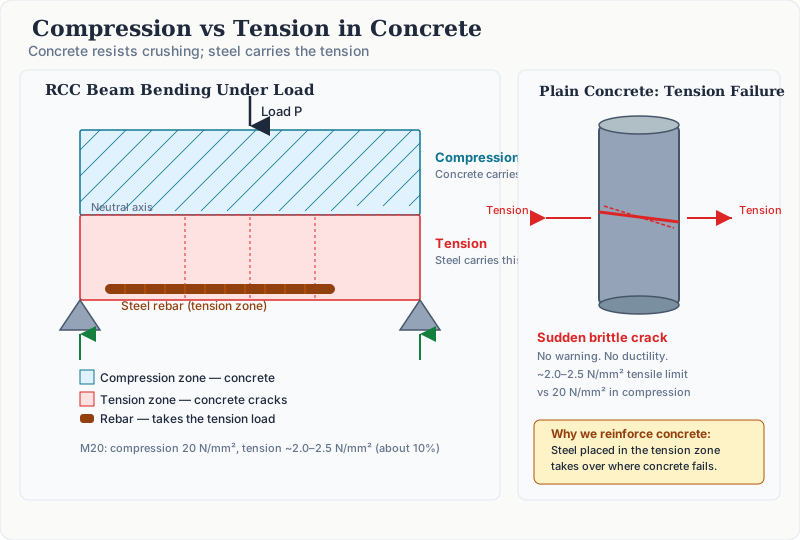
Concrete crushes gracefully but cracks instantly. Steel in the tension zone is not decoration — it is structural necessity.
2. Compressive Strength vs Tensile Strength — A Quick Reference
| Property | Compressive Strength | Tensile Strength |
|---|---|---|
| Definition | Resistance to being crushed | Resistance to being pulled apart |
| Typical value for M20 | 20 N/mm² | ~2.0–2.5 N/mm² |
| Ratio to compressive | 100% | ~8–12% |
| How concrete fails | Gradual crush, with warning cracks | Sudden, brittle, without warning |
| Who carries it in RCC? | Concrete | Steel reinforcement |
| Governed by (IS) | IS 456, IS 516 | IS 5816 (splitting test) |
| Design implication | Determines grade of concrete used | Determines where and how much steel |
There is also flexural strength (modulus of rupture), which matters for roads and pavements, and shear strength, which matters at beam-column junctions. But for a residential homeowner, compressive strength is the number that matters most — and the one that is tested, reported, and specified in every structural drawing.
3. How Strength Is Measured — The Cube Test
The standard Indian method for measuring the compressive strength of fresh concrete is the 150 mm cube test, governed by IS 516. A cube mould 150 mm on each side is filled with fresh concrete from the same batch being poured, compacted in layers (by tamping or vibration), covered, and demoulded after 24 hours. The cube is then cured in water at 27 ± 2°C until the test date.
The critical test is at 28 days. This is not an arbitrary convention: concrete's strength gain follows a curve, and 28 days represents the point at which most of the hydration reaction has completed and the strength is close to its long-term plateau value. The design strength — the M-grade — is always quoted at 28 days.
The cube is crushed in a calibrated compression testing machine. The load at failure, divided by the cross-sectional area (150 × 150 mm = 22,500 mm²), gives the strength in N/mm².
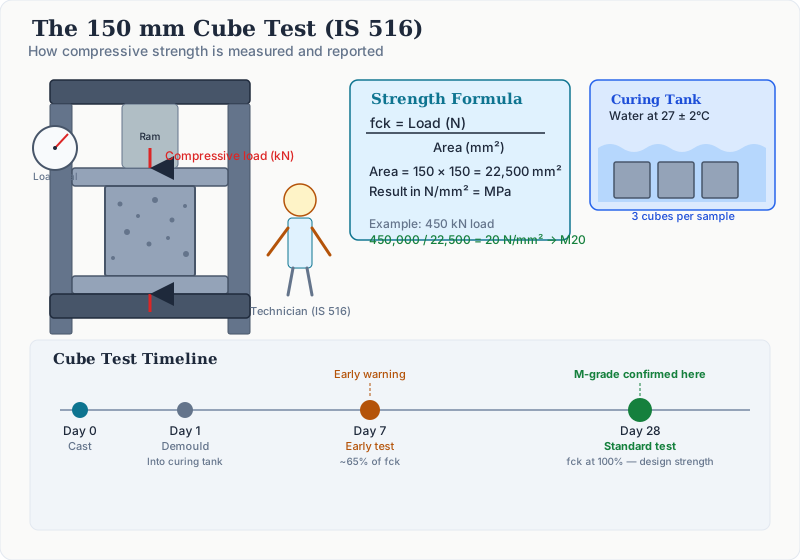
The cube test is the only legally defensible record of what concrete was actually placed in your building.
What Is Characteristic Strength (fck)?
IS 456 defines concrete grades by their characteristic compressive strength at 28 days. "Characteristic" means a statistically defined value: not the average result, but the strength below which no more than 5% of test results are expected to fall. In practice, if you test 10 cubes and only one falls below 20 N/mm², that is exactly what M20 means — the characteristic value is 20, and the actual mean will be higher (by a margin called the standard deviation × 1.65).
This is why a cube that fails at 19.4 N/mm² does not immediately condemn a slab — IS 456 acceptance is statistical, not a single-result pass/fail (see Section 9).
M-Grades and fck Values
| Grade | fck at 28 days (N/mm²) | Typical Use |
|---|---|---|
| M10 | 10 | Plain concrete, levelling courses, blinding |
| M15 | 15 | Mass concrete, non-structural fills |
| M20 | 20 | Slabs, beams, columns — minimum for RCC (IS 456) |
| M25 | 25 | Slabs/columns in moderate exposure, foundation raft |
| M30 | 30 | Columns in high-rise, heavy foundations, basements |
| M35 | 35 | High-load columns, bridge components, water tanks |
| M40 | 40 | High-performance structures, prestressed elements |
| M45–M60 | 45–60 | Special structures, industrial floors, precast |
IS 456 mandates a minimum of M20 for reinforced concrete in "mild" exposure and M25 for "moderate" exposure (which includes coastal regions and those subject to alternate wetting and drying).
Non-Destructive Tests for Existing Concrete
If the building is already built and you suspect weak concrete — or if no cube tests were done — two in-situ methods are widely used:
Rebound Hammer Test (IS 13311, Part 2): A spring-loaded hammer strikes the concrete surface; the rebound value correlates (roughly) to surface hardness, which relates to strength. Quick and cheap, but it reads only the surface layer and is affected by carbonation and surface conditions. A preliminary screening tool, not a definitive verdict.
Ultrasonic Pulse Velocity (UPV) (IS 13311, Part 1): Ultrasonic waves are passed through the concrete; the pulse velocity (in km/s) indicates the density and uniformity of the material. Values above 4.5 km/s generally indicate good concrete; below 3.5 km/s suggests voids, cracks, or weak concrete. More reliable than rebound hammer, especially for identifying honeycombing.
Both non-destructive tests should be interpreted by a qualified structural engineer. Neither replaces the cube test; they are supplements, not substitutes.
4. Strength-Gain Over Time
Concrete is not instantaneously strong. The hydration reaction between cement and water is an ongoing chemical process that continues for months — even years — though at a rapidly diminishing rate. The pattern matters enormously for on-site decisions.
| Age (days) | Approximate Strength (% of 28-day fck) | Significance |
|---|---|---|
| 1 | ~16% | Concrete is barely set — do not disturb |
| 3 | ~40% | Some early hardness, still gaining fast |
| 7 | ~65% | Early-indicator test; formwork may stay in place |
| 14 | ~90% | Approaching design strength |
| 28 | 100% | Standard test date; design strength |
| 56 | ~110–115% | Continues slowly beyond 28 days |
| 90 | ~115–120% | Still gaining, especially with blended cements |
| 365 | ~125–130% | Long-term; pozzolanic cements gain more |
(Values are for OPC-based concrete. PPC and fly-ash blended cements gain more strength beyond 28 days but gain it more slowly in the early days.)
"Concrete grows stronger with age — but only if it is allowed to cure properly. Strip the formwork too early, or let the concrete dry out, and the hydration reaction stops before the strength it could have reached." — M.S. Shetty, Concrete Technology: Theory and Practice
This is why IS 456 specifies minimum periods before striking formwork: for slabs, a minimum of 14 days (and 28 days before loading) is typical; for columns and walls, 24–48 hours for vertical faces is acceptable, but the props supporting slabs stay until the concrete is strong enough to carry its own weight plus construction loads.
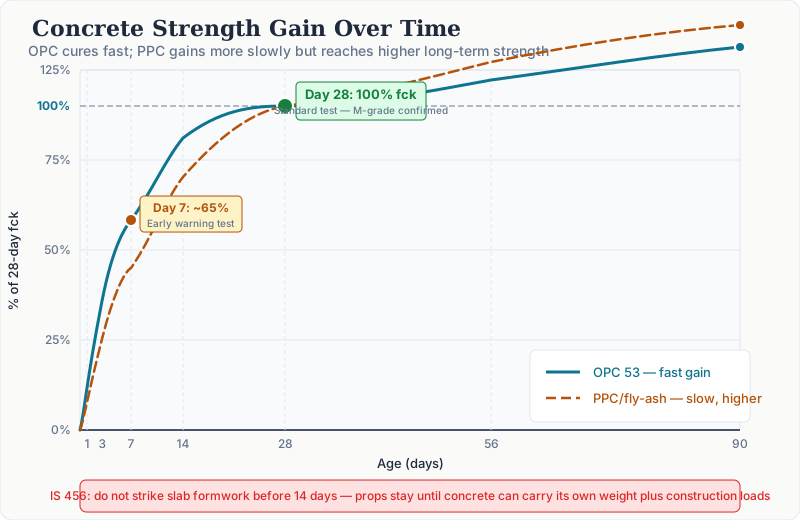
Striking formwork before 28 days does not mean the concrete will fail. It means you are betting on a concrete that has not yet proven itself.
5. The Levers That Control Strength
Strength is not random. It is controlled by a small set of physical and chemical factors that the structural engineer designs for and the site team either honours or violates.
"The strength of concrete is governed primarily by the water-cement ratio — all other factors held equal, lower water means stronger concrete. This has been known since Duff Abrams stated it in 1919. What remains challenging is acting on this knowledge consistently, in every batch, on every site." — A.M. Neville, Properties of Concrete, 5th edition
The Master Lever: Water-Cement Ratio
The water-cement (w/c) ratio is the single most powerful determinant of concrete strength. Lower w/c ratio = stronger concrete. This is counterintuitive to many workers, who see water as "free" and add it to make the mix more workable. Every additional litre of water dilutes the cement paste, increases porosity, and reduces strength — permanently.
IS 456 specifies maximum free w/c ratios for each exposure condition: 0.55 for M20 in mild exposure, going down to 0.40 for M35 in very severe conditions. These limits are not arbitrary — they are the result of decades of research linking w/c ratio directly to strength and durability.
For more on how this chemistry works — why water and cement react and what controls the final structure of the paste — see how cement works.
The Other Levers
| Lever | Effect on Strength | Site Rule |
|---|---|---|
| Water-cement ratio | Most powerful — lower ratio → higher strength | Never add water beyond the design mix |
| Cement quantity (content) | More cement → more binding gel; diminishing returns above ~450 kg/m³ | Follow design mix; do not under-cement to cut cost |
| Cement quality & type | Fresh OPC 53 grade > old or damp cement; PPC gains strength more slowly but durably | Check IS mark, manufacturing date; reject lumpy bags |
| Aggregate quality | Hard, clean, well-graded aggregate → denser packing, less water needed | Avoid dust-coated, elongated, or soft aggregate |
| Aggregate grading | Particle size distribution affects packing; gap-grading increases voids | Use IS 383 graded aggregate; test sieve analysis if in doubt |
| Compaction | Air voids = weakness; 5% air voids can reduce strength by 30% | Vibrate every pour; watch for honeycombing |
| Curing | Hydration needs water; dry concrete = stopped reaction = lost strength | Wet cure for minimum 7 days (IS 456); use curing compounds in hot weather |
| Age | Strength grows with time; more than 28 days for blended cements | Do not load structure at 28 days if blended cement used — wait 56 days |
| Temperature | Cold slows hydration; very hot weather increases early strength but reduces 28-day | In summer, pour at night; in extreme heat, use chilled water |
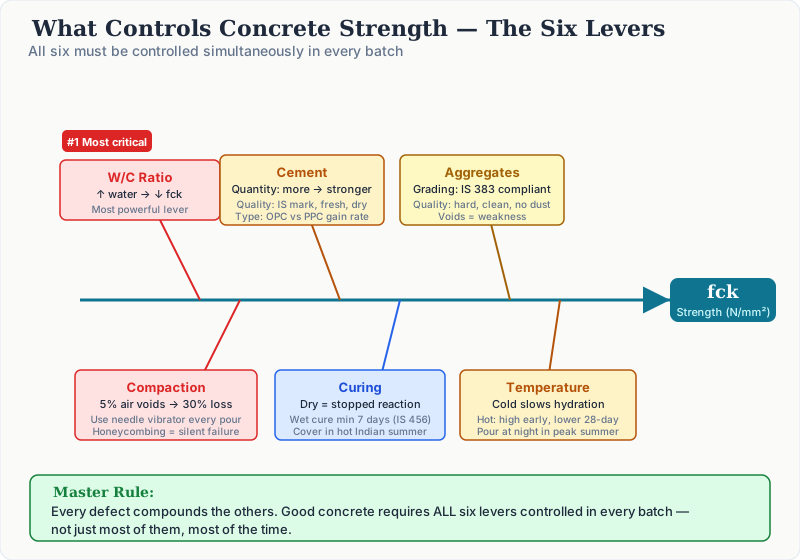
Every defect in this diagram compounds the others. Good concrete requires all levers to be controlled simultaneously, in every batch.
6. Compaction and Honeycombing — The Silent Killer
Of all the levers, compaction is the one most frequently botched on residential sites. When concrete is poured, it traps air unless actively worked out — by vibrating with a poker vibrator, by tamping, or (for thin sections) by careful prodding.
Honeycombing is what you get when air voids are not expelled: a porous, weakened concrete with a rough, stony surface and internal voids. In an exposed column, you can sometimes see it after the formwork is removed — the contractor will often try to patch it with cement mortar before the homeowner visits. In a buried foundation or a slab poured over formwork, you will never see it — until water finds the voids.
A 5% entrapped air void content can reduce the 28-day strength by up to 30%. This is the difference between M20 concrete behaving as M14 — below the structural design requirement, with no warning sign.
Rule of thumb: on every residential site, demand that a needle vibrator (poker vibrator) be used, not just hand tamping. It is cheap, it is available for hire, and it is the difference between solid and honeycombed concrete.
7. Workability vs Strength — The Slump Test and the Water Trap
A freshly mixed concrete must be fluid enough to be placed, compacted, and finished — this is workability. The standard field measurement of workability is the slump test (IS 1199): a 300 mm high truncated cone mould is filled with fresh concrete in three layers, each rodded 25 times. The mould is lifted, and the concrete slumps. The vertical drop in millimetres is the slump — a proxy for workability.
| Application | Recommended Slump (mm) | Notes |
|---|---|---|
| Mass concrete (foundations, blinding) | 25–50 | Low workability adequate; well-compacted |
| Normal RCC (beams, columns, slabs) | 50–100 | Standard range for most residential work |
| Congested reinforcement | 75–125 | Needs to flow around dense rebar |
| Pump-placed concrete (RMC) | 100–150 | High workability but achieved with admixtures, NOT water |
| Self-compacting concrete (SCC) | >200 (flow) | Specialist product; not measured by slump |
The cardinal sin on Indian residential sites is adding water to increase slump. It is done routinely — the concrete seems too stiff to pour, a worker adds a bucket of water, it pours easily, everyone is happy. Except the strength has just been damaged, irreversibly, in a way that no one on site can see.
If fresh concrete seems too stiff, the correct response is to use a plasticiser (superplasticiser admixture), which increases workability chemically without adding free water. This is precisely what ready-mix concrete plants do.
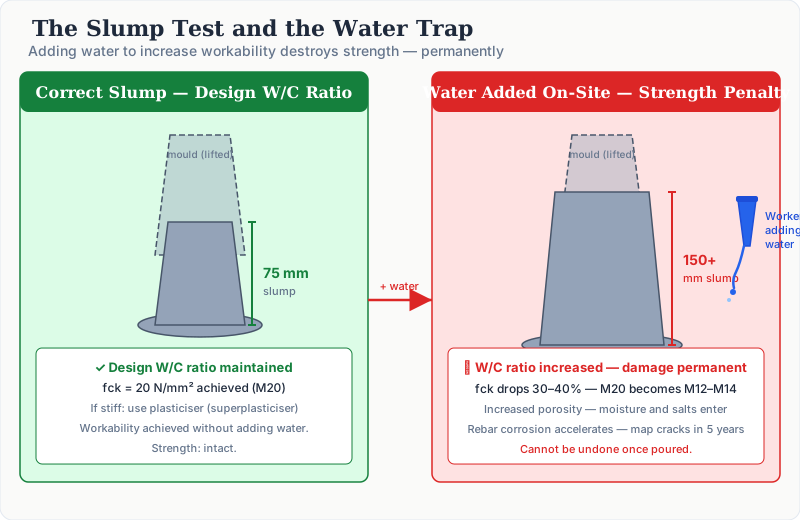
Adding water to concrete on site for ease of pouring is the single most common act of structural self-sabotage in Indian residential construction.
8. Ready-Mix Concrete (RMC) vs Site-Mix
The great divide in Indian residential construction is between concrete mixed at the site (by hand or machine mixer) and concrete that arrives from a batching plant (ready-mix concrete, RMC).
| Factor | Site-Mix | Ready-Mix Concrete (RMC) |
|---|---|---|
| Mix control | Depends on workers; w/c ratio varies by the bucket | Weigh-batched, computer-controlled; mix design certified |
| Consistency batch to batch | Highly variable | High consistency (lower standard deviation) |
| Minimum grade achievable reliably | M20 with care; M25+ very difficult | M20 to M50 routinely |
| Cement bags used | Often underweighted or under-counted | Certified batch tickets show exact proportions |
| Admixtures | Rarely used correctly | Mixed at plant; superplasticisers standard |
| Cube test sampling | Often not done, or poorly done | Plant provides test cubes with each load; TC available |
| Cost (indicative 2026) | ₹4,500–5,800 per m³ (material only) | ₹5,800–7,500 per m³ (M20–M25, delivered) |
| Minimum order | Any quantity | Typically 3–6 m³ minimum; half-load charges apply |
| Logistics | Works in tight sites, remote locations | Needs access road; transit mixer (10–12 m³) may not fit small lanes |
| Failure mode | Silent shortchanging of cement, water excess | Delivery delay (hot weather), pump blockage; manageable risks |
| Best for | Small isolated pours, remote sites | Slabs, columns, any structural element above M20 |
For most middle-class Indian homes being built in urban or peri-urban areas, RMC is the recommendation for any structural pour. The premium over site-mix is typically ₹800–1,500 per m³, and a typical ground-floor slab is 15–25 m³ — a total premium of ₹12,000–37,000 over a slab that will be in your house for the next 50 years. That is one of the best investments in construction quality you can make.
9. Reading a Cube Test Report
Every structural concrete pour should generate cube test reports. For a typical residential bungalow, this means at minimum: foundation raft or footings, plinth beam, every slab, and every column set. For each pour, IS 456 requires a minimum of one sample (set of cubes) per 5 m³ for structural members, with a minimum of one sample per day.
A standard cube test report shows:
- Project name, date of casting, pour location (e.g. "Ground Floor Slab, Grid A-B, 2026-04-12")
- Cube ID numbers (typically 3 cubes per sample — tested at 7 days and 28 days)
- Test date and age in days
- Load at failure (in kN)
- Compressive strength (in N/mm²) = Load / 22,500
- Average of 3 cubes
- Remarks (pass/fail against specified grade)
IS 456 Acceptance Criteria (Cl. 16.1)
IS 456 sets out statistical acceptance criteria — not a single cube value:
| Test | Acceptance Criterion |
|---|---|
| Individual test result (mean of 2 cubes from one sample) | Must not fall below fck - 4 N/mm² |
| Average of any 4 consecutive non-overlapping test results | Must not be less than fck + 0.825 × established standard deviation, or fck + 3 N/mm² (whichever is greater) |
| Early indicator: 7-day result | ~65% of 28-day result; a 7-day result below 0.65 × fck signals potential problem |
For M20 concrete: a single test may go as low as 16 N/mm² (20 - 4) and still be acceptable, provided the run of test results shows adequate average strength. A single low value does not doom the slab — but it should prompt immediate investigation into the cause (too much water added? poor compaction? bad cement batch?).
If the 28-day results fail the criteria: the structural engineer must be consulted immediately. Options range from core tests (drilling and testing actual concrete from the structure) to non-destructive evaluation to, in severe cases, demolition and reconstruction. Waiting or hoping the result was an error is not a strategy.
For more on managing and auditing quality on your construction site, see construction quality control for homeowners.
10. Grades, Durability, and Matching Strength to Need
Choosing a higher grade is not always better. Concrete above M30 needs careful mix design and quality control that most residential sites cannot deliver; it is also more expensive and, counterintuitively, can be more prone to shrinkage cracking if not handled correctly.
The principle is to match the grade to the structural and durability requirement:
- M20: Adequate for most slabs, beams, and internal columns in mild exposure conditions.
- M25: Appropriate for external elements, columns in high-rise floors, foundations in moderate exposure, and coastal (within 50 km of coast) locations.
- M30+: Required for basements, water-retaining structures, heavy columns, and high-load or high-rise elements.
Strength and durability are related but not identical. A high-strength concrete can still be durable if it has low permeability — and low permeability is what actually protects the embedded steel from corrosion. IS 456 addresses this by pairing minimum grade requirements with maximum w/c ratios and minimum cement content for each exposure class. All three parameters — grade, w/c, and cement content — must be satisfied simultaneously.
For a full treatment of exposure classifications, durability design, and the chemistry of concrete deterioration, see science behind durable buildings and what makes buildings crack.
For a decision guide on which grade to specify for each structural element in your home — column vs slab vs foundation vs water tank — see choosing the right concrete grade.
The broader ecosystem of materials in which concrete sits — how it relates to cement, steel, blocks, and finishes in an Indian home — is covered in the cluster pillar modern construction materials for Indian homes.
11. Five Things Every Homeowner Should Do (Checklist)
1. Demand a mix design. Your structural engineer should have issued a concrete mix design document, not just written "M20" on the drawing. That document specifies the w/c ratio, cement content, aggregate proportions, and slump target. Ask for it.
2. Insist on cube tests, documented. One set of cubes per major pour at minimum. Ask for the 7-day result (your early warning) and the 28-day result. Store the reports.
3. Watch for water addition. The most damaging thing that will happen on your site is a worker adding water to concrete without authorization. Be present at pours. Mark the water tank level before concrete arrives. Ask about plasticisers if the mix seems stiff.
4. Verify vibration. The needle vibrator should be visible and running at every pour. If the contractor is pouring and only tamping rods, object.
5. Protect fresh concrete from sun and wind. Within 6 hours of pouring, the surface must be covered (hessian, polythene) and kept wet for at least 7 days. In peak Indian summer (April–June), this is not optional — it is the difference between strength achieved and strength lost.
If your project involves complex structural elements, material substitutions, or a site in an aggressive environment (coastal, expansive soil, high groundwater), consider running a consultation through Studio Matrx DesignAI to flag the risk points early.
Author's Note
Concrete is the most democratic of materials — cheap, abundant, made from things you find anywhere — and yet it is profoundly unforgiving of carelessness. Amogh spent time on construction sites watching how it was mixed and poured, and the gap between what the drawings specified and what was actually put in the formwork was sometimes striking. Water added casually. Cubes not made. Vibrators not used. Curing abandoned after a day.
The knowledge in this guide is not secret. Every civil engineering student learns it in the first year. The problem is that the people who most need to act on it — the homeowner paying the bills, the site supervisor managing daily work — are often the last to know. My hope is that this guide shifts that balance a little: that the next time a contractor on your site reaches for a bucket of water to loosen the concrete, you will know exactly what they are about to destroy, and why it matters.
Build well. Test what you pour. The concrete you cannot see is holding up everything you can.
Disclaimer
This guide is for educational purposes. Prices and availability of materials change; all ₹ figures are indicative for 2026 and should be verified locally. IS code clause numbers and edition dates are correct to the best of the author's knowledge but should be verified against the current BIS publication before use in any structural context. Structural decisions — specifying concrete grades, interpreting cube test failures, assessing existing structures — must be made by or in consultation with a qualified structural engineer registered with the relevant body. The author and Studio Matrx accept no liability for structural outcomes.
References
1. Bureau of Indian Standards. IS 456: 2000 — Plain and Reinforced Concrete — Code of Practice (Fourth Revision). BIS, New Delhi.
2. Bureau of Indian Standards. IS 516: 1959 (Reaffirmed 2018) — Methods of Tests for Strength of Concrete. BIS, New Delhi.
3. Bureau of Indian Standards. IS 1199: 1959 (Reaffirmed 2018) — Methods of Sampling and Analysis of Concrete. BIS, New Delhi.
4. Bureau of Indian Standards. IS 13311 (Part 1): 1992 — Non-Destructive Testing of Concrete — Ultrasonic Pulse Velocity. BIS, New Delhi.
5. Bureau of Indian Standards. IS 13311 (Part 2): 1992 — Non-Destructive Testing of Concrete — Rebound Hammer. BIS, New Delhi.
6. Bureau of Indian Standards. IS 383: 2016 — Coarse and Fine Aggregate for Concrete — Specification (Third Revision). BIS, New Delhi.
7. Neville, A.M. Properties of Concrete, 5th edition. Pearson Education, Harlow, 2011.
8. Mehta, P.K. and Monteiro, P.J.M. Concrete: Microstructure, Properties and Materials, 4th edition. McGraw-Hill, New York, 2014.
9. Shetty, M.S. Concrete Technology: Theory and Practice. S. Chand, New Delhi, 2005.
10. Gambhir, M.L. Concrete Technology, 5th edition. McGraw-Hill Education India, New Delhi, 2013.
11. Duggal, S.K. Building Materials, 4th edition. New Age International, New Delhi, 2017.
12. Abrams, D.A. Design of Concrete Mixtures, Structural Materials Research Laboratory Bulletin 1. Lewis Institute, Chicago, 1919. (Original source of the water-cement ratio law.)
13. Indian Roads Congress. IRC SP:46 — Guidelines for Design of Plain Jointed Rigid Pavements for Highways. IRC, New Delhi, 2013. (Contextual reference for flexural strength in pavements.)
14. Concrete Association of India. Ready Mixed Concrete — A Guide for Users. CAI, Mumbai. (Industry guidance on RMC ordering, batching tickets, and QC.)
Word count: approximately 3,350 words.
Export this guide
Related Guides — Deep-dive reading
Construction Quality Control for Homeowners
How to make sure your house is actually built well, stage by stage, without an engineering degree — concrete, steel, cover and curing, the cardinal site sins to refuse, and the simple checks anyone can do.
Structural SafetyConstruction Aggregates in India: Sizes, Quality & Selection (2026)
What coarse aggregate actually does in concrete, how to pick the right nominal size (10mm, 20mm, 40mm), and the field and lab checks that separate strong stone from a bad load - a specify-and-select guide for Indian homes.
Building MaterialsCompound Wall Piers and Columns in India: Spacing, Reinforcement and Stability (2026)
Why a long, free-standing boundary wall needs intermediate piers or RCC columns to stay up — the physics of overturning in plain terms, thickened masonry piers vs reinforced-concrete columns on footings, indicative spacing that an engineer sets to your height and wind zone, the coping or tie beam that braces the top, and where to break a long run with movement joints.
Compound WallsRelated Tools — Try Free
Material Quality Evaluation Checklist
20-point checklist to evaluate interior materials before signing off at delivery.
Quality ChecklistCross-Ventilation Analyzer
Estimate airflow and air changes per hour (ACH) from room size, window areas, layout, and local wind — with NBC 2016 Part 8 compliance check.
Ventilation CalculatorInterior Contract Clause Checklist
16 sections and 98 checkboxes covering scope, BOQ, milestones, penalties, warranty, and disputes.
Contract Checklist