
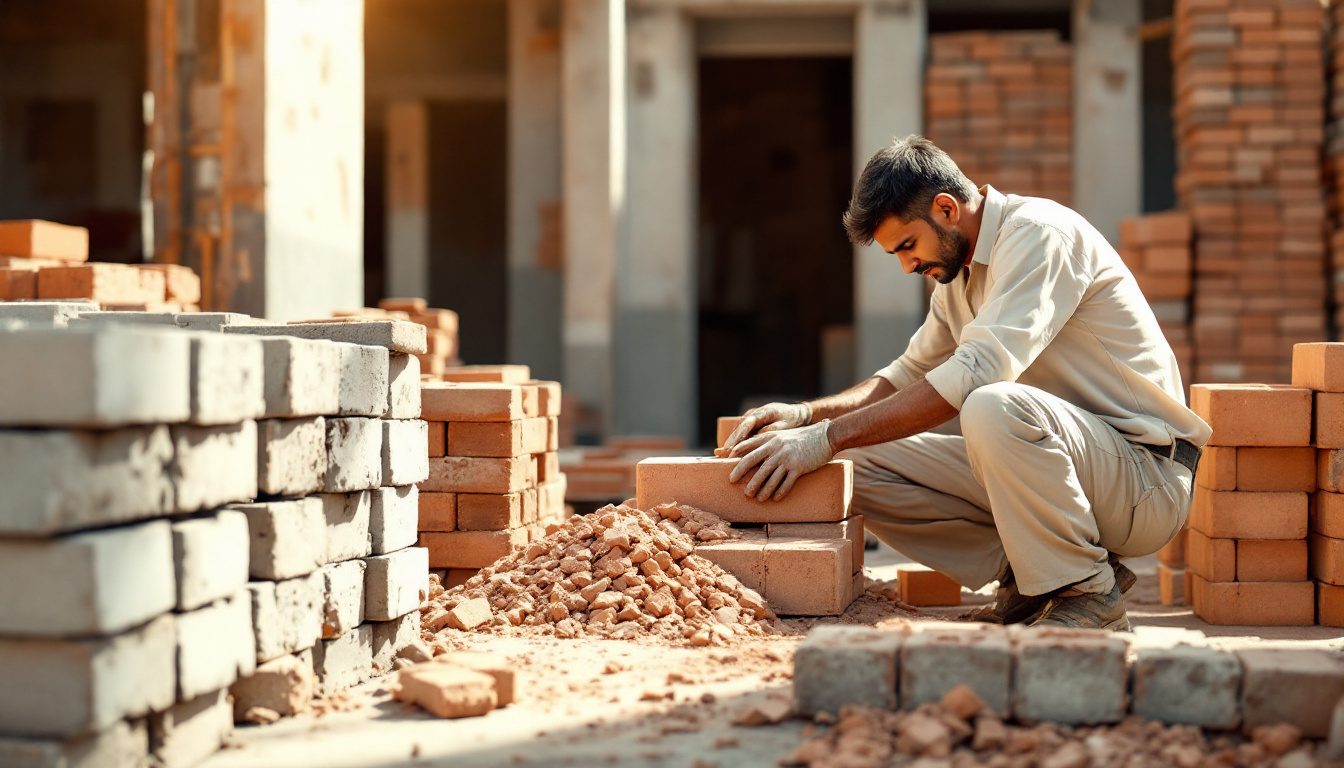
Fly Ash Bricks vs Clay Bricks
Head-to-head on strength, finish, plaster savings, cost and environment — the green brick made from power-plant waste versus the traditional fired clay brick, and when to choose each.
Your contractor calls from the brick yard. "Sir, fly-ash bricks available here — same price as red brick. Should I take them?" You hesitate, because nobody told you the difference. A neighbour swears by the old red brick his grandfather's house is built with. The contractor shrugs. You say, "Take the red ones — at least I know what they are."
That hesitation costs you. Not always in rupees — sometimes in extra plaster, more mortar, a patchier finish on the walls, and a heavier environmental conscience. Fly-ash bricks, when they come from a reliable plant, are a genuinely better walling unit in most respects: more uniform, often cheaper in all-in cost, and made from power-plant waste that would otherwise sit in a landfill.
But "when they come from a reliable plant" is the whole story. Fly-ash brick quality varies wildly across India. This guide gives you the full head-to-head — properties, IS codes, cost arithmetic, the environment angle, and most importantly, how to tell a good fly-ash brick from a bad one. By the end, you will know exactly which brick to specify, and why.
Fly-ash bricks (IS 12894) are hydraulically pressed from fly ash, cement or lime, and sand — cured without firing — and when made well, they beat traditional kiln-fired clay bricks (IS 1077) on dimensional accuracy, finish, and environmental footprint while costing the same or less all-in.
1. What Each Brick Actually Is
Fired Clay Brick — IS 1077
The red brick has been the default for Indian construction for centuries. Its raw material is topsoil clay — typically the rich alluvial or black-cotton soil found near riverbeds and farmlands. The process: clay is mined, puddled with water, hand- or machine-moulded, sun-dried, and then fired in a Bull's Trench Kiln or Hoffman kiln at roughly 900–1,100 °C for several days. The firing vitrifies the clay particles, giving the brick its hardness and reddish colour.
IS 1077 (Common Burnt Clay Building Bricks) classifies bricks into four classes (1 through 4) and sets minimum compressive strength from 3.5 MPa (Class 4) up to 35 MPa for special purposes. The standard nominal size is 230 × 110 × 75 mm, though actual dimensions vary because hand-moulding introduces inconsistency. Water absorption must not exceed 20% for Class 1 or 2 bricks.
The environmental cost is steep: every tonne of fired clay bricks consumes irreplaceable agricultural topsoil and burns coal or biomass in the kiln, releasing CO₂, sulphur oxides, and particulates. The Supreme Court and the Ministry of Environment, Forest and Climate Change (MoEF&CC) have been progressively restricting clay-brick kilns near cities and agricultural land.
Fly-Ash Brick — IS 12894
Fly-ash bricks are a completely different manufacturing route. Fly ash — the fine grey particulate captured from the exhaust of coal-fired thermal power stations — is the primary raw material. It is mixed with cement or hydrated lime, fine sand, and sometimes gypsum, then hydraulically pressed under high pressure into a mould and cured: either by steam (accelerated) or ambient moist curing for 21–28 days. No kiln firing at all.
IS 12894 (Pulverised Fuel Ash — Lime Bricks) sets a minimum compressive strength of 7.5 MPa and maximum water absorption of 15%. The standard nominal size is the same 230 × 110 × 75 mm (to be interchangeable with clay bricks). Because the bricks are machine-pressed in a rigid mould, dimensional accuracy is significantly better than hand-moulded clay bricks — a crucial practical advantage.
The MoEF&CC fly-ash utilisation notification (originally 1999, amended 2016) mandates that thermal power plants, brick-making units, and construction projects within a certain radius of a plant must use fly ash. This regulatory push has expanded fly-ash brick production capacity substantially across India.
"The utilisation of fly ash, a by-product of thermal power stations, in construction materials is one of the most successful examples of waste-to-resource conversion in the Indian building industry." — MoEF&CC, Fly Ash Notification, 2016 amendment

Fig. 1 — Physical comparison: the pressed, cured fly-ash brick versus the kiln-fired clay brick. Note the sharper corners and smoother face of the fly-ash unit.
2. How Each Is Made — A Visual Journey
Understanding the manufacturing process clarifies why the two bricks behave differently on site.
Clay brick route: Topsoil mined → Clay puddled with water → Hand or machine moulded → Sun dried (2–3 days) → Stacked in kiln → Fired at 900–1,100 °C for 5–10 days → Cooled → Sorted, dispatched. Variation creeps in at every hand step — moulding, drying speed, position in kiln.
Fly-ash brick route: Fly ash collected from power-plant ESP (electrostatic precipitator) → Mixed with cement/lime + sand + water → Hydraulically pressed in steel mould under 15–20 MPa → Green bricks extracted → Stacked and moist-cured or steam-cured for 21–28 days → Tested → Dispatched. The mould imposes geometry; curing chemistry develops strength gradually.

Fig. 2 — Manufacturing routes side by side: the fired clay route vs the pressed-and-cured fly-ash route. No kiln, no topsoil in the fly-ash path.
3. Head-to-Head: Property Comparison
This is the heart of the decision. The table below covers every property that matters on a real Indian construction site.
| Property | Clay Brick (IS 1077) | Fly-Ash Brick (IS 12894) | Winner |
|---|---|---|---|
| Compressive strength (typical) | 3.5–10 MPa (Class 1–2) | 7.5–15 MPa (good plant) | Fly-ash (consistent) |
| IS code minimum strength | 3.5 MPa (Class 4) | 7.5 MPa | Fly-ash |
| Dimensional accuracy | ±3–8 mm (hand-moulded) | ±1–2 mm (pressed) | Fly-ash |
| Water absorption | 15–25% (Class 1–3) | 10–15% (IS limit 15%) | Fly-ash |
| Bulk density | 1,600–1,900 kg/m³ | 1,700–2,000 kg/m³ | Similar |
| Surface texture | Slightly rough, varied | Smooth, uniform grey | Fly-ash |
| Efflorescence tendency | Moderate–high | Low–moderate (if cured well) | Fly-ash |
| Thermal conductivity | 0.6–0.8 W/m·K | 0.7–0.9 W/m·K | Similar (slight edge clay) |
| Nail/screw fixing ease | Good | Good (harder face, drill preferred) | Clay (marginally) |
| Availability in India | Pan-India | Near thermal plants; growing | Clay |
| Colour | Red (varies) | Grey–off-white (uniform) | Depends on preference |
Dimensional Accuracy — The Most Underrated Win
On a typical hand-moulded clay-brick wall, joint thickness can swing from 8 mm to 16 mm just to accommodate irregular bricks. That means more mortar, more levelling work, and a bumpier surface that needs a thicker plaster coat. A fly-ash brick wall — with bricks accurate to ±1–2 mm — can be laid with 8–10 mm joints consistently. The finished surface needs less plaster to achieve the same smoothness.
"Dimensional variation in hand-moulded bricks is the single biggest hidden cost in brick masonry — it inflates mortar, plaster, and labour." — S.K. Duggal, Building Materials, Laxmi Publications
Water Absorption
Clay bricks can absorb 20–25% of their weight in water if poorly fired, which matters for two reasons: the brick must be wetted before laying (to prevent it sucking water from the fresh mortar and killing the bond), and a highly absorptive brick in a wall transmits moisture more readily. Fly-ash bricks, when properly pressed and cured, typically absorb 10–15% — within IS 12894 limits and better than many clay bricks. Important caveat: a poorly manufactured fly-ash brick (under-cured, inadequate cement) can absorb more than a good clay brick. Quality of the product matters more than the category.
Strength
IS 12894 mandates a minimum of 7.5 MPa — double the IS 1077 Class 4 floor of 3.5 MPa. In practice, a good fly-ash plant produces bricks at 10–15 MPa consistently. A good clay brick kiln also hits 7–10 MPa, but with more batch-to-batch variation. For load-bearing masonry in a G+2 residential structure, either can work structurally when specified correctly with an engineer — but fly-ash gives a more predictable number. Always confirm with your structural engineer; do not pick the brick without a structural review for load-bearing walls.
Thermal and Sound
Neither fly-ash nor clay bricks are thermally efficient in the way AAC blocks are. Both conduct heat relatively well. If thermal insulation is a priority — particularly in the plains where summers hit 42–48 °C — you should look at the AAC blocks vs red bricks comparison and the broader discussion of wall materials in modern construction materials for Indian homes. For sound, both materials perform similarly.
4. The Plaster and Mortar Savings — Real Arithmetic
Dimensional accuracy translates directly into money. This deserves its own section because it is the single most compelling cost argument for fly-ash bricks.
Clay brick wall scenario: Bricks with ±5 mm variation in height. Mason uses 12–16 mm thick mortar joints to compensate. Wall face is uneven. Plaster coat: minimum 15 mm (often 18–20 mm) to get a flat surface for paint.
Fly-ash brick wall scenario: Bricks with ±1–2 mm variation. Mason achieves 8–10 mm joints uniformly. Wall face is already near-flat. Plaster coat: 10–12 mm is sufficient.
That 6–8 mm difference in plaster thickness across a 1,000 sq ft house (say 4,000 sq ft of wall surface) adds up to roughly 1.5–2 cu m of extra plaster for the clay-brick house — equivalent to 12–16 bags of cement just in plaster. At current rates, that is ₹6,000–₹10,000 in material alone, plus labour.

Fig. 4 — The plaster saving: uniform fly-ash bricks produce a flatter wall that needs less plaster to finish. The clay-brick wall requires a thicker coat to hide surface irregularities.
When you also apply gypsum finishing plaster instead of cement plaster over fly-ash bricks (which is increasingly common because the smooth base supports it), you save further — read the gypsum plaster vs cement plaster guide for the full numbers.
5. The Environment Angle — Why This Actually Matters
The environmental case for fly-ash bricks is unusually strong among construction materials, and it is not just marketing.
| Factor | Clay Brick (fired) | Fly-Ash Brick |
|---|---|---|
| Primary raw material | Topsoil clay (non-renewable, farmland) | Fly ash (industrial waste, displaces landfill) |
| Fuel / energy for making | Coal or biomass — kiln firing | Electricity for pressing + curing energy (steam) |
| CO₂ per 1,000 bricks (approx.) | 200–280 kg (kiln emissions) | 50–80 kg (cement + curing) |
| Topsoil consumed | ~25–30 tonnes per lakh bricks | Zero |
| Kiln pollutants | SO₂, PM, CO₂ | None (no kiln) |
| Regulatory status | Restricted near cities, river-beds | Actively promoted by MoEF&CC notification |
| Fly-ash landfill displacement | None | ~60–65% of brick mass is fly ash waste |
India generates roughly 200–220 million tonnes of fly ash annually from thermal power plants. Utilising it in bricks keeps it from contaminating groundwater and riverbanks. The MoEF&CC notification (amended 2016) made it compulsory for power plants, cement plants, and large construction projects in notified zones to use fly ash. Compliance is uneven, but the regulatory direction is clear — fly-ash products will only gain traction over time.
Clay-brick kilns, meanwhile, are being progressively banned near riverbeds (where the best alluvial clay sits) and agricultural land. Several Indian states have issued orders restricting new kiln licences. In the long run, the regulatory and supply picture favours fly-ash bricks.
"Fly ash utilisation in building materials conserves natural resources, reduces land used for disposal, and cuts particulate pollution from kilns — a rare case where the sustainable option is also frequently the economically superior one." — Ministry of Environment, Forest and Climate Change, Environmental Guidelines for Brick Kilns
6. The Quality Catch — How to Spot a Good Fly-Ash Brick
This is the section that separates informed buyers from people who get burned. Fly-ash brick quality is far more variable than clay brick quality, because:
1. Fly ash itself varies — Class C (calcium-rich, self-cementitious) vs Class F (low calcium, needs more lime/cement). Reputable plants test their fly ash.
2. Cement/lime dosage varies — under-dosing to cut costs is the single biggest source of weak bricks.
3. Curing compliance varies — a brick that is dispatched at 7 days instead of 21 days has less than half the design strength.
4. Press pressure varies — an under-maintained hydraulic press produces bricks with internal voids.
| Quality Indicator | Good Fly-Ash Brick | Reject Indicator |
|---|---|---|
| BIS Mark | IS 12894 mark visible | No marking |
| Colour | Uniform grey or light buff | Blotchy, dark patches, greenish tinge |
| Surface | Smooth, no visible pores | Pitted, sandy, surface dusts off |
| Edge sharpness | Clean right-angle corners | Chipped or rounded corners |
| Efflorescence | None or very light | White salt streaks on surface |
| Ring test | Clear metallic ring when struck | Dull thud (internal crack or voids) |
| Scratch test | Hard surface, nail leaves faint mark | Nail digs in easily (under-cured) |
| Water absorption test (field) | Weigh dry, soak 24h, weigh wet — gain less than 15% | Greater than 15% gain |
| Compressive strength (lab) | Greater than 7.5 MPa (IS 12894) | Test if buying in bulk — ask for mill certificate |
"Never buy fly-ash bricks based on price alone. The difference between a 7.5 MPa brick and a 3 MPa brick looks identical on the lorry." — A common caution among site engineers, corroborated by IS 12894 testing protocols
IS 3495 (Methods of Tests of Burnt Clay Building Bricks) test methods — compressive strength, water absorption, efflorescence — apply to fly-ash bricks by reference in IS 12894. For any large purchase (more than one lakh bricks), insist on test certificates from a NABL-accredited lab or get an independent sample tested.
7. Cost Analysis — The All-In Picture
Unit brick price is only part of the story. Here is how the economics work out for a typical 100 sq ft stretch of 9-inch (230 mm) thick external wall, plastered and ready for paint — using indicative 2026 rates.
| Cost Component | Clay Brick Wall (per 100 sq ft) | Fly-Ash Brick Wall (per 100 sq ft) |
|---|---|---|
| Brick unit cost (₹/brick) | ₹6–9 | ₹5.5–8 |
| Bricks required (100 sq ft, 9") | ~480 bricks | ~480 bricks |
| Brick material cost | ₹2,900–4,300 | ₹2,650–3,850 |
| Mortar (cement:sand, 1:6) | ₹950–1,200 (more for irregular bricks) | ₹750–950 |
| Plastering material (2-coat) | ₹1,200–1,600 (18–20 mm thick) | ₹850–1,100 (12 mm thick) |
| Labour (masonry + plaster) | ₹2,800–3,500 | ₹2,400–3,000 |
| Total (indicative) | ₹7,850–10,600 | ₹6,650–8,900 |
Prices are indicative 2026 ranges. Rates vary by region, supply chain, and project scale. Verify locally before budgeting.
The fly-ash wall typically works out ₹10–20 per sq ft cheaper all-in, even if the brick unit price is similar. The saving comes from mortar (thinner joints), plaster (thinner coat), and faster laying speed (uniform bricks lay faster).
8. The Three-Way Picture — Clay, Fly-Ash, and AAC
A common confusion in the market: fly-ash bricks are sometimes conflated with AAC (Autoclaved Aerated Concrete) blocks. They are completely different products serving different purposes.
| Feature | Clay Brick | Fly-Ash Brick | AAC Block |
|---|---|---|---|
| IS Code | IS 1077 | IS 12894 | IS 2185 Part 3 |
| Manufacturing | Kiln-fired | Pressed + cured | Autoclaved (pressurised steam) |
| Density | 1,600–1,900 kg/m³ | 1,700–2,000 kg/m³ | 550–650 kg/m³ |
| Weight (9" wall/sq ft) | ~50–55 kg | ~52–58 kg | ~18–22 kg |
| Thermal insulation | Low | Low | High (air pores) |
| Compressive strength | 3.5–10 MPa | 7.5–15 MPa | 3.5–5 MPa |
| Size accuracy | Poor–moderate | Good | Very good |
| Plaster thickness | 15–20 mm | 10–12 mm | 6–10 mm (skim coat) |
| Approximate unit cost (2026) | ₹6–9/brick | ₹5.5–8/brick | ₹40–60/block (larger unit) |
| Best use case | Heritage, heritage look, rural | Most urban residential walling | Partitions, upper floors, thermally sensitive walls |
| Load-bearing (masonry) | Yes (Class 1–2) | Yes | Limited (structural engineer must confirm) |
| Pan-India availability | Excellent | Good near plants | Good in Tier 1–2 cities |
AAC blocks win on insulation and weight — important for high-rise projects, upper floors, and energy-efficient design. But they are not interchangeable with fly-ash bricks in all structural contexts, and they cost more per equivalent wall area. The AAC blocks vs red bricks guide covers that comparison in full.

Fig. 5 — Positioning the three walling materials: clay, fly-ash, and AAC on cost vs insulation vs availability. All three serve different parts of the walling spectrum.

Fig. 3 — Scorecard: fly-ash bricks win four of five criteria. Clay bricks retain the availability advantage in regions without a nearby plant.
9. Using Fly-Ash Bricks Right — Site Practice
Buying the right brick is step one. Using it correctly is step two.
Pre-wetting: Fly-ash bricks must be wetted before laying — just like clay bricks — to prevent them absorbing water from the fresh mortar. Sprinkle water and leave for 10–15 minutes; the surface should be damp, not dripping. Never lay fly-ash bricks dry.
Mortar mix: Standard cement:sand 1:5 or 1:6 mortar works well. Because fly-ash bricks are denser and smoother, bond strength is typically good. Do not over-water the mortar mix — a stiff mix (slump 50–75 mm) beds cleanly on the flat face.
Joint thickness: 8–10 mm is achievable and desirable with consistent fly-ash bricks. Flushed joints (not raked) should be struck while mortar is still green to avoid water ingress points.
Curing the wall: After masonry, cure the wall with water for at least 7 days — especially important in hot dry weather. Fly-ash brick masonry that is allowed to dry out too fast before the mortar gains strength can develop shrinkage cracks at joints.
Plaster compatibility: Fly-ash bricks accept both cement plaster and gypsum plaster well. The smooth surface means a bonding agent or a roughened scratch coat is sometimes recommended for thick cement plaster applications. For a premium finish, a 6–8 mm gypsum undercoat followed by a skim is ideal — see the gypsum plaster vs cement plaster comparison for the trade-offs.
Drilling and fixing: Fly-ash bricks are denser and harder-faced than hand-moulded clay bricks. Standard masonry anchors and rawl plugs work fine but drilling can take slightly more effort. Avoid hammer-chiselling — use a rotary drill.
Do not mix types in the same wall: Mixing clay bricks and fly-ash bricks in the same wall course creates inconsistencies in joint thickness and long-term differential movement. Commit to one type per wall.
10. Where Each Wins — Verdict and Decision Rule
Here is the clear decision framework, without sitting on the fence.
| Choose Fly-Ash Bricks if… | Choose Clay Bricks if… |
|---|---|
| You are near a reputable, BIS-certified fly-ash brick plant (within 100–200 km) | No reliable fly-ash plant nearby — quality is the primary risk |
| You want a cleaner, flatter wall with less plaster cost | The project has a specific heritage aesthetic requiring the red-brick look |
| Budget is tight and you want all-in savings from less mortar and plaster | You are doing a rural project where clay brick is the established local craft |
| Environmental footprint of the project matters | You have had a bad experience with sub-standard fly-ash bricks and cannot vet the supplier |
| You are building G+2 or lower, standard residential construction | Structural engineer specifies a particular clay-brick class for a load-bearing design |
| Your plasterer recommends gypsum skim (fly-ash suits this beautifully) | You need maximum nail/hook fixing points across the wall (clay is slightly more forgiving) |
The default recommendation for most Indian urban or peri-urban residential construction in 2026: specify fly-ash bricks from a BIS IS 12894-certified plant, verify a sample against the quality checklist above, and enjoy the savings in mortar and plaster. If you cannot verify the source, a good clay brick from a known kiln is safer than a bad fly-ash brick from an uncertified shed.
The materials landscape is well covered in modern construction materials for Indian homes. For the durability angle — how long both types of brick last in Indian climates, what affects their lifespan, and when to consider replacement — see material lifespan comparison India. And for structural context in load-bearing decisions, structural safety in residential buildings is essential reading.
If you want a second opinion on how your wall system will hold up structurally and thermally, Studio Matrx DesignAI can review your material choices in the context of your specific building and climate zone.
11. A Note on the Regulatory Tailwind
India is in an active policy transition on brick manufacturing. The MoEF&CC fly-ash notification requires:
- Thermal power plants to achieve 100% fly-ash utilisation (dispatched or used on-site) within a set number of years.
- Brick manufacturers within 50–100 km of a thermal plant to use fly ash in specified proportions.
- Construction projects in notified areas to use fly-ash bricks, blocks, or tiles for specific elements.
State-level environment departments have additionally placed restrictions on clay-brick kilns near rivers, wetlands, and agricultural land in many states including Uttar Pradesh, Bihar, West Bengal, Karnataka, and Tamil Nadu. While enforcement is uneven, the direction is clear: the regulatory environment increasingly disadvantages clay bricks in urban India.
This matters for long-term supply. If you are building a house you plan to hold for 20–30 years, and plan to extend or renovate later, securing the relationship with a consistent fly-ash brick supplier now may save you material-matching headaches later.
Author's Note
When Amogh designed spaces, he was always thinking about the material from the quarry or the kiln to the finished wall. It troubled him that the brick industry — one of India's oldest and most visible construction trades — was consuming topsoil at an industrial scale while an equivalent product made from waste sat underutilised at power-plant dumps. The fly-ash brick is not a new technology; it is a proven, code-specified, regulatory-backed product that has been available in India for decades. The reason it has not fully replaced clay bricks is not technical — it is supply chain and quality assurance. This guide exists to give you, the homeowner, the knowledge to ask the right questions at the brick yard and choose confidently. Build well. Build sustainably. Do not let your contractor's convenience become your wall's permanent shortcoming.
Disclaimer
This guide is for educational purposes. Prices quoted are indicative 2026 ranges and will vary by region, project scale, and supplier. Compressive strength, water absorption, and other property figures are based on IS code specifications and reported typical ranges — actual batch performance must be verified by testing. IS code clause numbers are cited for guidance; always obtain current editions from BIS. Structural decisions — including brick specification for load-bearing walls — must be made in consultation with a qualified structural engineer. The author and Studio Matrx are not liable for decisions taken solely on the basis of this article.
References
1. Bureau of Indian Standards. IS 12894: 2002 — Pulverised Fuel Ash — Lime Bricks — Specification. New Delhi: BIS.
2. Bureau of Indian Standards. IS 1077: 1992 — Common Burnt Clay Building Bricks — Specification (Fifth Revision). New Delhi: BIS.
3. Bureau of Indian Standards. IS 3495 (Parts 1–4): 1992 — Methods of Tests of Burnt Clay Building Bricks. New Delhi: BIS.
4. Bureau of Indian Standards. IS 2185 (Part 3): 2005 — Concrete Masonry Units — Autoclaved Cellular (Aerated) Concrete Blocks. New Delhi: BIS.
5. Ministry of Environment, Forest and Climate Change. Fly Ash Notification S.O. 2076(E) (as amended 2016). Government of India.
6. Duggal, S.K. Building Materials (Fifth Edition). New Delhi: Laxmi Publications, 2023.
7. Neville, A.M. Properties of Concrete (Fifth Edition). Harlow: Pearson Education, 2011.
8. Mehta, P.K. and Monteiro, P.J.M. Concrete: Microstructure, Properties and Materials (Fourth Edition). New York: McGraw-Hill, 2014.
9. Shetty, M.S. Concrete Technology — Theory and Practice (Revised Edition). New Delhi: S. Chand, 2019.
10. Central Electricity Authority, Government of India. Report on Fly Ash Generation and Utilisation (various annual editions, most recent 2023–24). CEA, Ministry of Power.
11. Gambhir, M.L. Concrete Technology (Fifth Edition). New Delhi: Tata McGraw-Hill, 2019.
12. Chandra, S. and Berntsson, L. Lightweight Aggregate Concrete: Science, Technology and Applications. Norwich: Noyes Publications/William Andrew, 2002. (Reference on density and thermal properties comparison.)
13. Indian Green Building Council (IGBC). Green Homes Rating System Documentation: Materials and Resources Credits. Hyderabad: IGBC/CII, 2022.
14. National Mission for Enhanced Energy Efficiency (NMEEE), Bureau of Energy Efficiency. Energy Conservation Building Code (ECBC) 2017 — User Guide. New Delhi: Ministry of Power.
Word count: approximately 3,250 words.
Export this guide
Related Guides — Deep-dive reading
Compressed Stabilised Earth Blocks (CSEB): A Specify-and-Select Guide for India (2026)
What CSEB is - local soil plus a small percentage of cement or lime, compressed in a press and cured, never kiln-fired - its low-carbon and thermal-mass strengths, its real limits around soil, quality control and water, and how it compares with fired clay brick and fly-ash brick. A specify-and-select guide.
Building MaterialsBuilding Material Standards and Certifications in India: BIS, ISI, NBC and Green Labels Explained (2026)
How to know a building material is genuine and fit for purpose. A plain-language guide to the BIS / IS ecosystem and the ISI mark, the international standards you will see on datasheets, the NBC (SP 7:2026) umbrella code, and the sustainability certifications - GRIHA, IGBC, LEED, GreenPro - that tell you a product is genuinely green.
Building MaterialsAAC Blocks vs Red Bricks
The definitive head-to-head for Indian walling — weight, strength, insulation, cost, water absorption and speed, and a clear rule for when to choose each.
ConstructionRelated Tools — Try Free
Cross-Ventilation Analyzer
Estimate airflow and air changes per hour (ACH) from room size, window areas, layout, and local wind — with NBC 2016 Part 8 compliance check.
Ventilation CalculatorMaterial Decision Framework (M-Score)
Score 30+ Indian construction materials across cost, durability, climate fit, maintenance, and sustainability.
MaterialsStamp Duty Calculator — All Indian States
Stamp duty + registration charges for all 28 states and 8 UTs — gender concessions, urban/rural variants, metro cess built in.
Stamp Duty