
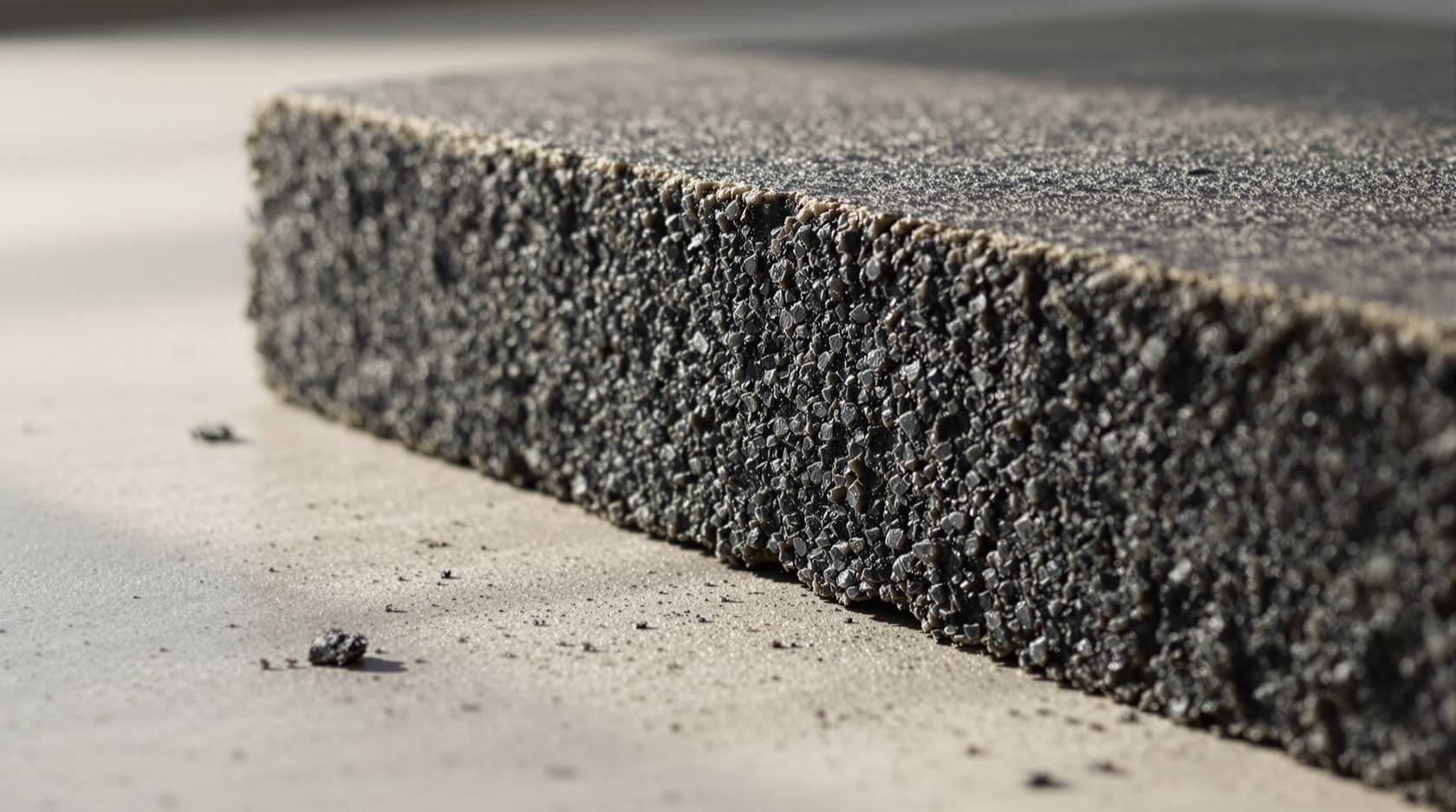
Rock Wool Insulation in India: Fire-Rated Thermal & Acoustic Insulation Guide (2026)
What rock wool (stone mineral wool) is, why it beats most insulants on fire and sound, the forms and densities it comes in, where it wins over glass wool and foams, indicative cost and safe fibre handling - a specify-and-select guide.
When a wall has to stop a fire, hush a noisy neighbour, or wrap a hot boiler without melting, one material keeps turning up on the specification: rock wool. Also sold as stone wool or, more broadly, mineral wool, it is spun from molten rock and industrial slag into a dense mat of fine fibres. That humble-looking golden-brown board quietly does three jobs at once - it resists fire, absorbs sound and slows heat - and it does the first two better than almost anything else on the shelf.
This guide helps you choose and specify rock wool: what it is, where its strengths genuinely earn their keep, the forms and densities you will be quoted, how it stacks up against glass wool and foam, and how to handle it safely. It does not tell you to install it yourself - fibre insulation belongs in trained hands.
Scope and safety: This is a selection guide. Densities, R-values and prices here are indicative only - they move with brand, thickness, region and freight, so always get local quotes and the manufacturer's tested data. Fire-rated assemblies, duct lagging, structural fireproofing and party-wall acoustic detailing are engineering decisions - hand them to a qualified architect, acoustic consultant or fire-safety professional. Mineral fibres are an irritant: leave cutting and fixing to trained installers using the right PPE. Nothing here replaces the IS codes, the manufacturer's data sheet or a licensed professional.
What rock wool actually is
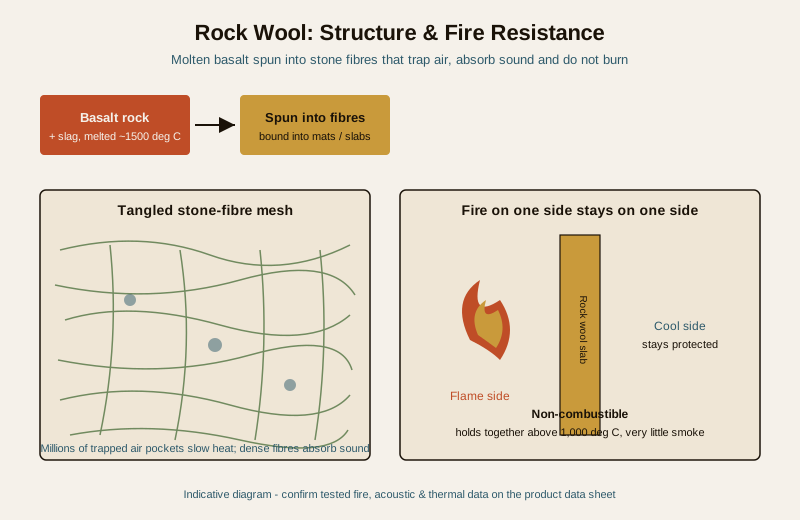
Rock wool starts as rock - typically basalt, a volcanic stone - often blended with slag, a by-product of steel-making. The mix is melted at around 1,500 deg C, then spun or blown into thin fibres, much like candy floss, and bound into mats or boards with a small amount of resin binder and a water-repellent oil. The result is a tangle of stone fibres holding millions of tiny air pockets. Those trapped air pockets slow heat; the dense, interlocked fibre network soaks up sound; and because the fibres are literally made of rock, the material simply does not burn.
That last point is the headline. Rock wool is non-combustible and holds together above 1,000 deg C - far hotter than most insulants survive. Where a plastic foam would ignite, drip and give off dense smoke, rock wool stays put and buys time. This is why it dominates fire-rated partitions, service-shaft linings and industrial lagging.
Rock wool sits inside the wider mineral wool family alongside glass wool (spun from molten glass and sand). They share a lot - both fibrous, both breathe, both resist fire - but rock wool is generally denser, more fire-resistant and better at absorbing sound, while glass wool is lighter and cheaper per rupee on pure thermal duty. For the full landscape, start with our building insulation materials guide and the close comparison in glass wool insulation.
The four strengths that define rock wool
Rock wool is not the cheapest insulant, nor the thinnest for a given R-value. You specify it for a specific blend of properties:
- Excellent fire resistance. Non-combustible, with a melting point above 1,000 deg C. It contributes to the fire rating of a wall or floor rather than undermining it, and gives off very little smoke. This is its single biggest reason to exist.
- Very good acoustic absorption. Its density and open fibre structure trap sound energy, cutting airborne noise through walls and floors and taming reverberation inside a room. Denser boards absorb more.
- Good thermal insulation. Thermal conductivity ("lambda") sits around 0.033 to 0.040 W/m.K - solid, though marginally behind the best foams for a given thickness.
- Water-repellent but vapour-permeable. The fibres shed liquid water (a splash beads off) yet the material still lets water vapour pass, so walls can breathe and dry out rather than trapping damp. It does not rot, and it holds no food value for rodents or insects.
No single insulant leads on every axis. Rock wool's promise is that it is very good at everything and outstanding on fire and sound - which is exactly what a fire-rated or acoustic wall needs.
The forms you can specify
Rock wool is sold in several formats, each suited to a different job:
- Rigid slabs / boards. Firm, self-supporting panels for walls, flat roofs, floors and facades. Higher densities give better fire and acoustic performance and can take some load in over-deck roof build-ups.
- Flexible batts and rolls. Softer, friction-fit pieces sized to slot between studs, joists and rafters - the usual choice for framed partitions and timber floors.
- Loose / granulated wool. Blown or poured to fill irregular cavities and hard-to-reach voids.
- Pipe sections and lamella mats. Pre-formed sleeves and faced mats that wrap pipework, ducts, boilers, flues and vessels for thermal and fire protection.
- Faced products. Slabs and pipe sections come with foil, tissue or wire-mesh facings for vapour control, cleanliness or mechanical protection.
Density is the number that matters most after thickness. It is quoted in kg/m3 and typically ranges from around 40 kg/m3 for light thermal batts up to 100 to 150 kg/m3 or more for high-performance acoustic and fire slabs and duct lagging. Higher density means better sound absorption, better fire performance and more rigidity - at higher cost and weight.
Typical densities, R-values and where each wins
R-value measures resistance to heat flow: higher is better, and it climbs with thickness. As a rough guide, a 50 mm rock wool layer delivers roughly R-1.3 to R-1.5 (metric, m2.K/W), and a 100 mm layer roughly R-2.6 to R-3.0 - always confirm against the specific product's tested figure. To size a layer for your climate and target U-value, use our insulation R-value calculator alongside the manufacturer's data.
| Form / grade | Typical density (kg/m3) | Common thickness (mm) | Best at |
|---|---|---|---|
| Light thermal batt / roll | 40 - 60 | 50 - 100 | Framed walls and roofs where warmth is the goal |
| Acoustic slab | 60 - 100 | 50 - 100 | Party walls, home theatres, studios, noisy plant rooms |
| High-density fire slab | 100 - 150+ | 25 - 100 | Fire-rated partitions, floors, service shafts, facades |
| Pipe section / duct lagging | 80 - 150 | 25 - 50 | Around ducts, boilers, flues, hot and chilled pipes |
| Loose / granulated | n/a (poured) | fill to depth | Irregular cavities and awkward voids |
The pattern is simple: pick higher density as fire and acoustic demands rise, and more thickness as thermal demand rises.
Rock wool vs glass wool vs foam
The choice between the common insulants comes down to what your wall or roof most needs to do. The scorecard below is directional - confirm exact figures against each product's data sheet.
| Property | Rock wool | Glass wool | Rigid foam (XPS / PU / PIR) |
|---|---|---|---|
| Fire resistance | Excellent (non-combustible, 1,000+ deg C) | Good (non-combustible, lower melt point) | Poor to fair (combustible; PIR chars) |
| Acoustic absorption | Very good (dense fibres) | Good | Poor (closed cell, reflects sound) |
| Thermal per unit thickness | Good | Good | Best (thinnest for same R) |
| Density / weight | Higher | Low | Low |
| Moisture behaviour | Repels water, vapour-open (breathes) | Vapour-open; absorbs if soaked | Closed-cell, low water uptake |
| Compressive strength | Moderate to high (high-density slabs) | Low | High |
| Relative cost | Higher | Lower | Higher |
| Best reason to choose | Fire and sound | Budget thermal and sound | Thin, high-R, damp or below-grade |
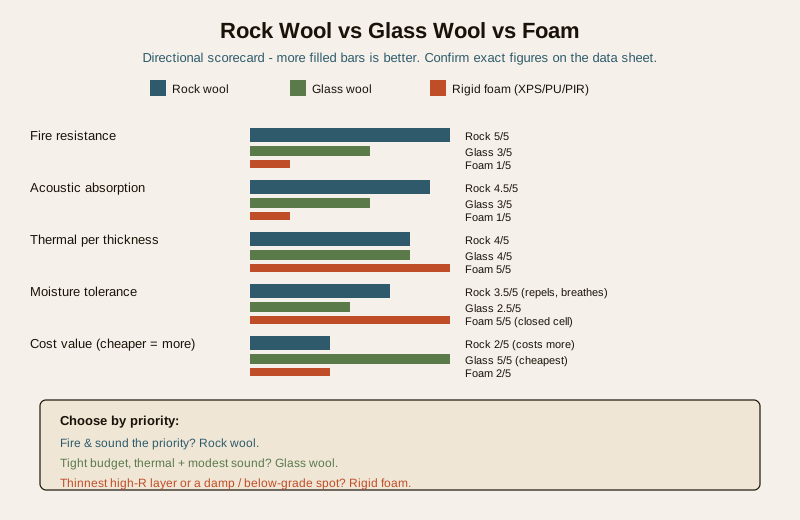
The short version: choose rock wool when fire and sound are the priority, glass wool when the budget is tight and thermal-plus-modest-acoustic is enough, and rigid foam when you need the thinnest possible high-R layer or an insulant that shrugs off damp - as covered in XPS insulation, EPS insulation and PU and PIR foam insulation. If breathability and low embodied carbon top your list, weigh it against natural insulation materials.
Where rock wool wins - a use map
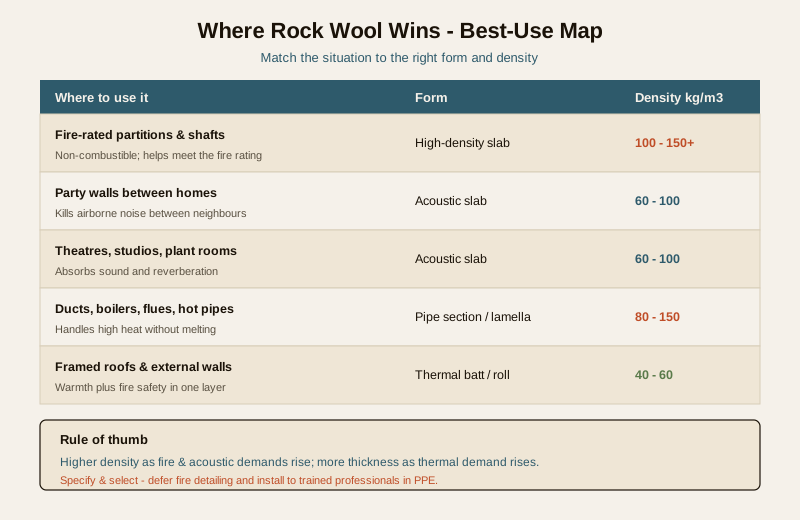
| Where to use it | Why rock wool | Typical form / density |
|---|---|---|
| Fire-rated partitions & service shafts | Non-combustible; helps achieve the fire rating | High-density slab, 100 - 150 kg/m3 |
| Party walls between homes / flats | Kills airborne noise between neighbours | Acoustic slab, 60 - 100 kg/m3 |
| Home theatres, studios, plant rooms | Absorbs sound and reverberation | Acoustic slab, 60 - 100 kg/m3 |
| Around ducts, boilers, flues, hot pipes | Handles high heat without melting | Pipe section / lamella, 80 - 150 kg/m3 |
| Framed roofs and external walls | Warmth plus fire safety in one layer | Thermal batt, 40 - 60 kg/m3 |
| Industrial and commercial fire protection | Passive fire protection to structure | High-density slab / mat |
For roof-specific decisions it pairs with our roof insulation guide and the over-deck vs under-deck insulation comparison; where the goal is beating summer heat gain, read it alongside the cool roof guide. Because rock wool so often wraps ducts and plant, it also touches whole-home comfort covered in the HVAC hub.
Handling and safety - defer install to trained hands
Rock wool is chemically inert and, when installed and enclosed, sits quietly in the wall for the life of the building. The care is all at the cutting and fixing stage, because loose stone fibres and dust irritate skin, eyes and airways:
- PPE is non-negotiable during install: gloves, long sleeves, safety glasses and a dust mask or respirator (an FFP-rated mask), plus good ventilation.
- Cut with a sharp knife, not by tearing, to limit airborne dust, and keep offcuts bagged.
- Enclose it. Once boarded or plastered over, the fibres are sealed away from occupants.
- Leave the work to trained installers. Correct fibre handling, density selection and - above all - the detailing of a fire-rated or acoustic assembly are specialist skills. A fire barrier only works if every junction, penetration and service gap is sealed exactly to the tested system.
This is a material you specify and buy with confidence - and hand to a professional to fit. The moment it becomes part of a fire or acoustic rating, the detailing matters as much as the board.
Cost - what to expect
Rock wool costs more than glass wool and sits in a similar bracket to rigid foam. As an indicative guide only, boards and slabs commonly fall in the range of roughly Rs 40 to Rs 120 per sq ft depending on density and thickness, with high-density fire and acoustic grades and pipe sections at the upper end. Treat these as ballpark - density, thickness, facing, brand and freight all move the number, so get current local quotes.
Set the higher cost against what it buys: a single layer delivering fire safety, sound control and thermal comfort together, with no rot, no pest food value and a service life measured in decades. On a party wall or fire-rated shaft, there is often no cheaper way to meet the requirement.
Standards and certification
Mineral wool products in India are broadly covered by the relevant Bureau of Indian Standards (BIS) specifications for mineral and rock wool insulation (named generally here - IS 8183 and related standards govern bonded mineral wool; check the current edition). Fire and reaction-to-fire classifications, acoustic ratings and thermal conductivity should always come from the manufacturer's tested data sheet for the specific product, not from generic tables. Green-building frameworks such as GRIHA, IGBC and LEED may award credit for thermal performance and, for some products, recycled content. Standards and editions are revised periodically - verify against the current data sheet rather than relying on memory.
Key takeaways
- Rock wool (stone mineral wool) is spun from molten basalt and slag into a dense fibre mat - a single material that resists fire, absorbs sound and slows heat.
- Its stand-out strengths are excellent fire resistance (non-combustible, 1,000+ deg C) and very good acoustic absorption; thermal performance is good, and it is water-repellent yet vapour-open.
- Comes as slabs, batts, rolls, loose fill and pipe sections; density (roughly 40 to 150+ kg/m3) rises with fire and acoustic demand, thickness with thermal demand.
- Choose it for fire-rated partitions, party walls, acoustic rooms and duct/boiler lagging; choose glass wool for budget thermal, or foam for the thinnest high-R or damp locations.
- It costs more than glass wool - and the fire detailing and fibre handling belong to trained professionals in the right PPE.
References
- Bureau of Indian Standards - IS 8183 and related standards for bonded mineral (rock/slag) wool insulation; consult the current editions for classification, density and marking requirements.
- National Building Code of India (SP 7:2026) - fire and life-safety and thermal-comfort provisions relevant to insulation in building assemblies.
- Manufacturer technical data sheets - the authoritative source for a specific product's tested thermal conductivity, density, fire classification and acoustic rating.
- Studio Matrx guides: building insulation materials guide, glass wool insulation, natural insulation materials and the complete building materials guide.
Export this guide
Related Guides — Deep-dive reading
Glass Wool Insulation in India: Properties, Uses & How to Specify It (2026)
The most common building insulation in India, decoded - what glass wool is, its thermal and acoustic strengths, the rolls and batts you can buy, where it belongs (false ceilings, AC ducts, PEB roofs, drywall) and how it compares with rock wool and foam.
Building MaterialsFire-Resistant Building Materials in India: A Specify-and-Select Guide (2026)
The difference between how a material reacts to fire and how long a rated assembly resists it, then the materials that deliver passive fire protection - non-combustible structure, mineral wool, fire-rated boards, intumescent coatings, spray fireproofing and fire-stopping - with a material-to-role selection table.
Building MaterialsBuilding Insulation Materials Guide (India): Types, R-Value & How to Choose (2026)
The complete anchor guide to building insulation in Indian homes - why it matters, the physics in plain terms, where insulation goes, and a side-by-side comparison of every material family with clear guidance on how to choose the right one.
Building MaterialsRelated Tools — Try Free
Cross-Ventilation Analyzer
Estimate airflow and air changes per hour (ACH) from room size, window areas, layout, and local wind — with NBC 2016 Part 8 compliance check.
Ventilation CalculatorAcoustic Privacy (STC) Visualizer
Indian healthcare acoustic visualizer — compare wall assemblies and noise sources, see received SPL after STC attenuation, and check FGI 2018 / IS 1950 / NABH speech-privacy compliance with live dual-canvas waveform.
Acoustic ToolMaterial Decision Framework (M-Score)
Score 30+ Indian construction materials across cost, durability, climate fit, maintenance, and sustainability.
Materials