
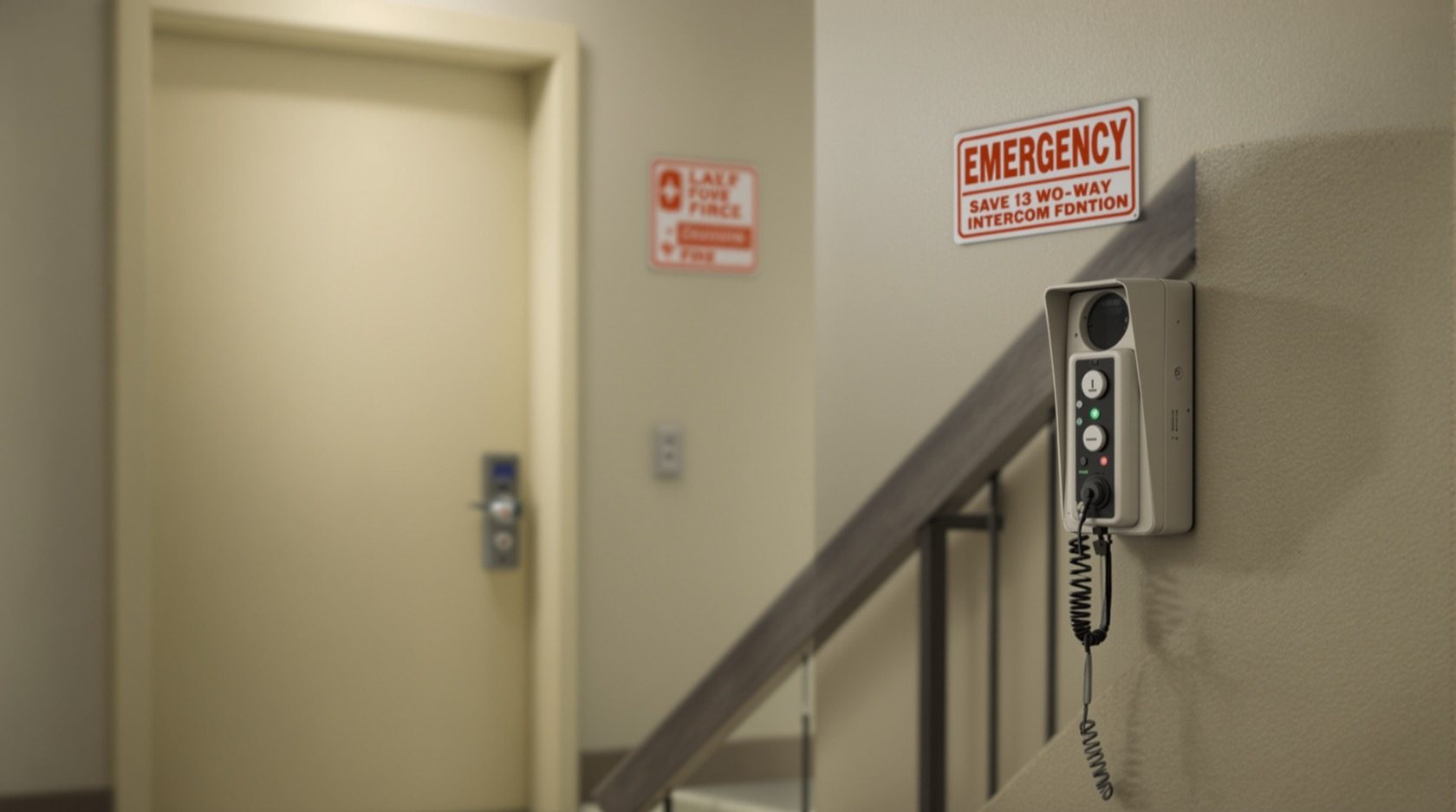
Emergency Communication Systems in India (2026): Refuge Phones, Warden Intercom & Mass Notification
Beyond the sounder - the two-way firefighter phones, area-of-refuge intercoms and mass notification that let a building coordinate a fire response and keep faith with people who cannot self-evacuate.
When a fire starts in a large or complex building, the sounder does one job: it tells everyone something is wrong. But saving lives in a hotel, hospital, mall or high-rise needs far more than noise. The fire crew arriving on the ground floor need to talk to a colleague on the eighteenth. A person in a wheelchair who cannot go down the stairs needs to reach a control room, say where they are, and be told help is coming. Wardens on each floor need to coordinate a staged evacuation - some floors moving, others standing by. All of this is the job of a building's emergency communication systems: the broader family of two-way and one-way communication that turns a fire alarm into a coordinated response.
This is part of the detection-and-alarm chapter of Studio Matrx's fire-safety library, sitting under the complete guide to fire safety in India. It is written for the people who own, manage or specify a building - RWA committees, facility managers, builders, and hotel, hospital and office owners - so you understand what these systems are, why the accessible-refuge layer is not optional, and how to make sure the ones you paid for actually work. It is the companion to the voice-evacuation systems guide, which covers the loudspeaker side in depth.
Scope and safety - read this first. Emergency communication systems in a building - firefighter and warden telephones, area-of-refuge intercoms, mass notification and the fireman's intercom - are statutory, engineered installations, designed, installed, commissioned and certified by a licensed fire-alarm contractor to IS 2189 : 2026 and the National Building Code (via SP 7 : 2026, Part 4 Fire and Life Safety), and tied to the premises Fire NOC under your State Fire Services Act and Rules. This guide helps you specify, understand and maintain them; it is educational guidance, not legal advice, and never a manual for installing, silencing or bypassing any part of the system. When there is a fire, one rule overrides everything: get everyone out who can move, protect those who cannot, and call the fire brigade on 101 or 112.
What "emergency communication" means - beyond the bell
A basic fire-alarm system is one-way and one-message: detectors and manual call points report to the fire-alarm panel, and the panel drives sounders that say "there is a fire." That is enough for a small shop or home. In a building where hundreds of people, some of whom cannot walk down stairs, must be moved in a controlled way while a fire crew works inside, the building needs to carry actual conversations and targeted instructions. Emergency communication systems are that capability.
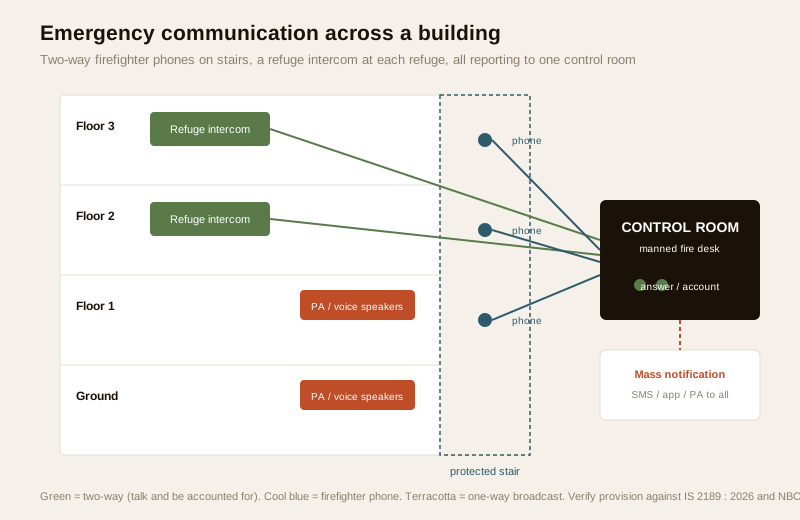
It is useful to split the family into two directions of flow:
- Two-way (people talk to each other): firefighter/warden telephones on the escape stairs, and the area-of-refuge intercom. These let responders and trapped or waiting occupants speak with the control room.
- One-way (the building tells occupants what to do): voice evacuation and public address, and mass notification to phones, screens and PA.
Both directions run off the same fire-alarm panel, share its battery standby and supervision, and are logged and maintained under the same AMC. They are one integrated life-safety system, not a set of gadgets.
| Layer | Direction | Who uses it | What it is for |
|---|---|---|---|
| Firefighter / warden telephone | Two-way | Fire crew, floor wardens, control room | Responders on different floors coordinate the attack and the evacuation |
| Area-of-refuge intercom | Two-way | A person waiting in a refuge, control room | The person is heard, reassured and accounted for - critical for those who cannot use stairs |
| Fireman's intercom | Two-way | Fire officer, control room | A dedicated hard-wired talk path for the responding brigade |
| Voice evacuation / PA | One-way | The whole building or selected zones | Clear spoken instructions - evacuate, or stand by - by zone |
| Mass notification | One-way | Occupants and staff on phones, screens | Reaches people beyond earshot of a speaker; alerts, updates, all-clear |
Two-way firefighter and warden telephones
In a tall or large building, the single most dangerous gap is that the fire officer entering at ground level cannot talk to a colleague on an upper floor - mobile phone coverage inside a burning concrete structure is unreliable, and the crew are wearing breathing apparatus in smoke. The answer is a dedicated, hard-wired firefighter (or warden) telephone system: fixed handset jacks at each floor landing inside the protected escape stair, at the control room, and at other key points, all connected on their own supervised circuits back to a master station at the fire control panel.
A firefighter arriving plugs a handset into the jack on the floor they are working, and speaks directly and privately with the fire-command post at the entrance. Because the circuit is part of the fire system, it is monitored for faults, runs on the panel's battery standby, and survives a power cut - exactly when it is needed. Wardens use the same network to coordinate a floor-by-floor sweep and report which floors are clear. This is the communication backbone of the defend-in-place and phased-evacuation strategy that tall buildings rely on: without it, phased evacuation is guesswork.
The owner's job is not to design this - the fire consultant sizes it and the licensed contractor installs it - but to insist it exists where the code requires, to make sure the jacks are not painted over or ripped out during interior fit-outs, and to confirm at every test that a call from each floor actually reaches the control room.
The area-of-refuge intercom - keeping faith with people who cannot self-evacuate
This is the part of emergency communication that matters most and is neglected most, so it gets its own section. A refuge area is a fire-protected space - typically a fire-rated lobby beside a protected stair, or a dedicated refuge floor - where a person who cannot descend the stairs unaided can wait in relative safety to be rescued by the fire service. Refuge areas exist precisely for wheelchair users, for the elderly and mobility-impaired, and for patients in hospitals who cannot be moved down stairs during the first phase of an evacuation.
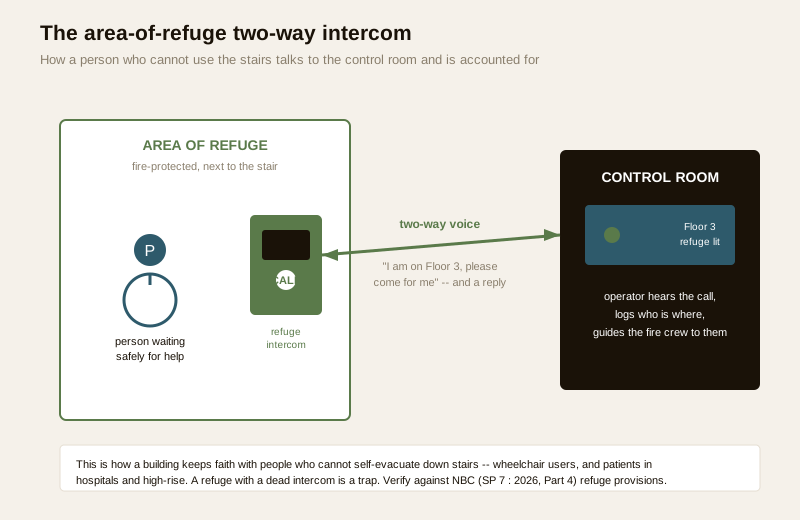
A refuge is only as good as the communication in it. A person sitting in a protected lobby while smoke fills the building, with no way to tell anyone they are there, is not safe - they are trapped and invisible. So every refuge must have a two-way refuge intercom: a wall station with a clearly marked call button that, when pressed, opens a voice link to the manned control room. On the control-room side, the operator sees exactly which refuge is calling (often on a lit display or floor plan), hears the person, can reassure them that help is on the way, records who is waiting where, and directs the arriving fire crew straight to them.
That last function - being accounted for - is the whole point. It feeds directly into the building's assembly and roll-call discipline: the control room knows not only who has reached the assembly point outside, but who is still inside, in which refuge, waiting for rescue. This is how a building keeps faith with the people it asked to wait rather than run.
| Refuge communication - what good looks like | Why it matters |
|---|---|
| A two-way intercom at every refuge, clearly marked and reachable from a wheelchair | A refuge with no working communication is a trap, not a place of safety |
| The call annunciates at the manned control room, identifying the refuge | The operator must know instantly where the call is from, without asking |
| The operator can talk back and reassure | A waiting person must know they have been heard and help is coming |
| The refuge and its occupants are logged / accounted for | The fire crew is directed to exactly where people are waiting |
| Tested at every drill, on battery standby, under AMC | An untested refuge intercom is presumed dead - see the India reality below |
Do not confuse the refuge intercom, or any of these systems, with the everyday security and visitor intercom or video door phone at the gate - part of the building's ordinary security systems. Those are convenience and access-control devices on ordinary power, with no fire supervision, no battery standby and no link to the fire panel. A building may have both, but the security intercom is never a substitute for a fire-supervised refuge intercom - they are different systems for different jobs.
Mass notification and the fireman's intercom
Two further pieces complete the picture:
- Mass notification. Speakers and strobes only reach people who are near them. Mass notification extends the reach - pushing alerts and instructions to occupants' and staff phones (SMS or an app), to digital signage and screens, and across the PA - so that people in a car park, a plant room, or simply out of earshot get the same message, along with updates and the eventual all-clear. In large campuses, hospitals and hotels it is how a message reaches everyone, not just those in a corridor with a speaker. Specify it as an extension of the fire system, integrated and supervised, not a stand-alone marketing app.
- The fireman's intercom. Many Indian installations provide a dedicated, hard-wired talk path reserved for the responding fire brigade - distinct from the wardens' network - so the fire officer has a clean, priority channel to the command post. Where provided, it is part of the same supervised system and tested with the rest.
How it all integrates - one coordinated response
The reason these are called systems, plural, but treated as one, is that they all hang off the fire-alarm control panel and act together through its programmed cause-and-effect. When a detector or call point confirms a fire, the panel does not just ring bells - it triggers the voice-evacuation messages for the right zones, brings up the emergency-communication network, and lights the affected zone on the control-room display.
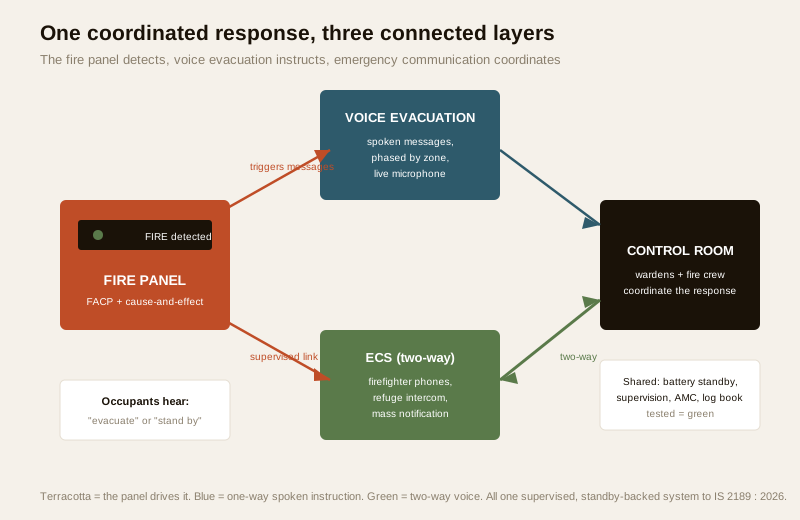
The coordinated sequence in a well-run building looks like this:
| The panel and control room do | The emergency-communication layer does |
|---|---|
| Detect and confirm the fire, identify the zone | Voice evacuation broadcasts "evacuate this floor" to the fire zone |
| Apply phased evacuation for a high-rise | Adjacent and distant floors hear "stand by" - not a blanket stampede |
| Recall lifts, start pressurization, close dampers | Firefighter phones let the crew coordinate the attack floor by floor |
| Account for occupants | Refuge intercoms report who is waiting where; roll-call is completed |
| Keep everyone informed | Mass notification carries updates and the all-clear beyond the speakers |
All of it shares one power supply with battery standby, one supervised wiring scheme, one AMC and one log book. That shared foundation is also the shared point of failure: if the panel is neglected, every one of these layers goes down together. Which brings us to the honest reality.
The India reality - specified for the NOC, then silent
Here is the pattern that this guide exists to counter. A developer building a mall or a high-rise puts a firefighter-phone network, refuge intercoms and a voice system on the drawings because the Fire NOC demands them. The system is installed, the NOC is granted, the building is occupied - and then nobody ever tests the refuge intercoms again. Batteries die. A fit-out contractor paints over a firefighter-phone jack or cuts its cable. The refuge lobby becomes a store room. The control-room display gathers dust and the guard on duty has never heard the system speak.
The result is a building that looks fully equipped and is, in the moment that matters, mute. A refuge intercom that does not connect leaves a wheelchair user calling into a dead handset while smoke rises. A firefighter phone that was cut during a renovation leaves the fire crew unable to coordinate. "Installed" is not "working." The only thing that closes this gap is disciplined maintenance and testing: every one of these communication paths must be exercised at each drill and periodic test, logged, and repaired the moment it fails - the same regime set out in the fire-alarm testing guide. A refuge intercom that has not been tested in a year should be treated as broken until proven otherwise.
For the wider building picture, the office, hotel and hospital fire-safety guides show how these communication layers sit within each occupancy's compliance, and the apartment fire-safety guide covers the RWA's responsibilities. Use the fire-alarm system selector to think through the architecture your building needs, and tie the whole thing into your emergency-preparedness plan.
When the law requires a professional - and why you never leave it silent. The firefighter phones, refuge intercoms, mass notification and fireman's intercom, their wiring, programming and commissioning are qualified professional tasks. A building emergency-communication system must be designed, installed, tested and certified by a licensed fire-alarm contractor to IS 2189 : 2026 and the National Building Code (SP 7 : 2026, Part 4), tied to the Fire NOC under the State Fire Services Act and Rules; component-level intelligibility and interface specifications follow the applicable BIS, IEC or EN standard - verify the current one before relying on a number. What is squarely on the owner and manager is the discipline: insist these systems are provided where required, protect the jacks and refuge stations from fit-out damage, test every path at every drill, keep the log book, maintain the batteries under AMC, and never - for a person waiting in a refuge who cannot walk down the stairs - allow the communication that keeps them alive to sit unserviced and silent.
Key takeaways
- Emergency communication systems are the layer beyond the sounder - two-way firefighter and warden telephones on the protected stairs, area-of-refuge intercoms, the fireman's intercom, and one-way mass notification, all hung off the fire-alarm panel and working together as one coordinated response.
- The area-of-refuge intercom is how a building keeps faith with people who cannot self-evacuate - a wheelchair user or a patient waiting in a protected refuge must be able to talk to the control room, be reassured, be accounted for, and be found by the fire crew; a refuge with a dead intercom is a trap.
- Firefighter telephones make phased evacuation and defend-in-place possible - a supervised, battery-backed, hard-wired talk path lets the fire crew coordinate floor by floor where mobile phones fail.
- This is not the everyday security or visitor intercom - those run on ordinary power with no fire supervision or standby; a fire-supervised refuge intercom is a different system for a different job.
- The India failure mode is "specified for the NOC, then silent" - installed is not working; only disciplined testing, maintenance under AMC, protection from fit-out damage, and an honest log book keep these life-saving paths alive, all to IS 2189 : 2026 and the Fire NOC.
References
- IS 2189 : 2026, Bureau of Indian Standards - Selection, Installation and Maintenance of Automatic Fire Detection and Alarm System, Code of Practice. The core code governing the fire-alarm panel, its supervised circuits and battery standby, and the emergency-communication and voice-alarm provisions that integrate with it. Verify the current edition via the BIS catalogue: https://www.services.bis.gov.in/
- National Building Code of India, SP 7 : 2026 (the NBC), Part 4 "Fire and Life Safety" - the framework requiring areas of refuge, refuge-area communication, firefighter access and integrated fire-safety and communication measures in buildings by occupancy and height; the older SP 7 : 2016 edition is withdrawn but still widely quoted. Verify the current edition via the BIS catalogue: https://www.services.bis.gov.in/
- The relevant State Fire Services Act and Rules and the Model Building Bye-Laws (MoHUA) - these set when a Fire NOC and certified, maintained emergency-communication and voice-alarm systems are legally required for a given premises, together with refuge provision and the periodic maintenance obligations that follow.
- Manufacturer datasheets and installation manuals for the specific firefighter-telephone, refuge-intercom, mass-notification and voice-alarm equipment installed - the authority for supervised-circuit ratings, battery standby, annunciation and interface conventions; for component-level intelligibility and interface specifications, confirm the applicable BIS, IEC or EN standard before relying on it, and always follow the equipment's own documentation and the commissioning contractor's records.
This is an educational overview, not legal advice, and not a substitute for a licensed fire-safety consultant or fire-alarm contractor. Building emergency-communication systems, refuge provision, their commissioning, the Fire NOC and any statutory installation or maintenance are qualified professional tasks - engage licensed fire professionals and the State Fire Services, and verify any standard's current status via the BIS catalogue before relying on it.
Export this guide
Related Guides — Deep-dive reading
Voice Evacuation Systems in India (2026): PAVA, Phased Messages & Intelligibility
Why malls, hotels, hospitals, airports and high-rises replace the bell with spoken instructions - how a voice-alarm (PAVA / EVAC) system tells people exactly what to do, floor by floor, and why intelligibility, zoning and standby power decide whether it works.
SecurityHigh-Rise Fire Safety Requirements in India (2026): Why Height Changes Everything
As a building gets tall, a whole layer of fire and life-safety systems stops being optional and becomes the reason the building is legal to occupy. A plain-language guide for professionals to what generally kicks in with height, why, and who to verify it with.
SecurityAddressable Fire Alarm Systems in India (2026): Loops, Exact Location & When You Need One
The system for larger, complex buildings where you must know exactly which device triggered - how the loop and unique device addresses work, when the Fire NOC demands one, and how to specify it well.
SecurityRelated Tools — Try Free
Video Door Phone Type Selector
Answer a few questions about your building, cabling, budget and internet and get the right video door phone — analog / wired / wireless / IP, single-home or multi-apartment, monitor or app.
Door Phone SelectorAcoustic Privacy (STC) Visualizer
Indian healthcare acoustic visualizer — compare wall assemblies and noise sources, see received SPL after STC attenuation, and check FGI 2018 / IS 1950 / NABH speech-privacy compliance with live dual-canvas waveform.
Acoustic ToolApartment Video Door System Planner
Enter flats, entrances, floors and guard desk for a first-pass building intercom plan — door stations, indoor monitors, guard station, the right architecture and an indicative cost band.
Building Planner