
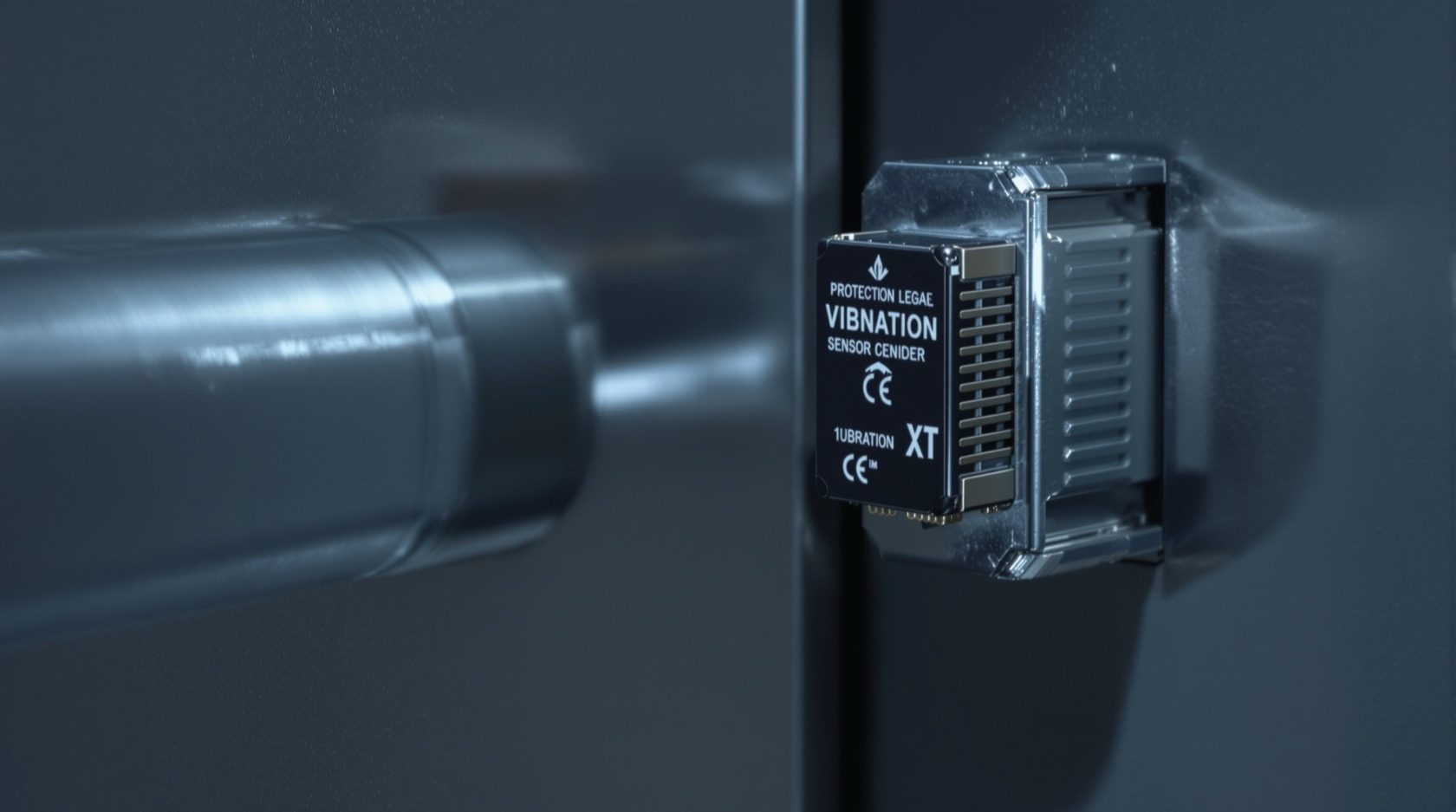
Vibration Sensors in India (2026): Catching an Attack Through the Wall, Safe or Shutter
How a vibration or seismic sensor feels the sustained tremor of a wall, safe or shutter being drilled, hammered or prised open, where they earn their place in Indian shops and homes, and how to tune out passing trucks and thunder.
Most alarm sensors watch a gap: a door opening, a window sliding, a body crossing a room. A vibration sensor watches something quite different — the surface itself. Bonded onto the steel of a safe, the brick of a compound wall or the slats of a shop shutter, it feels the sustained tremble of that structure being attacked: a drill biting in, a hammer swinging, a hacksaw or angle grinder chewing through, a crowbar levering a joint. It is the sensor that catches the burglar who never opens anything the normal way, but instead cuts a path through the barrier itself.
That makes vibration detection the natural partner to contact sensors in the places where the real prize sits behind a solid wall or a locked strongbox — jewellers, cash rooms, godowns, strongrooms, ATM enclosures and the boundary walls of villas and factories. This guide, part of the complete burglar-alarm picture, explains how a vibration sensor actually senses an attack, where it earns its keep across Indian settings, how it differs from its close cousin the shock sensor, and — honestly — how to tune it so a passing truck or a monsoon thunderclap does not wake the whole street.
Scope & safety. This guide helps you choose and place vibration sensors and plan sensible coverage — owner-level decisions. Sticking or bolting a sensor onto a reachable safe or wall is straightforward. Anything that runs cable through walls back to a panel, ties into the mains, or works at height on a shutter or boundary wall belongs to a licensed installer or electrician. Everything below describes how detection WORKS and how to place and tune it well; it is never a guide to defeating a sensor. Any system that logs alarm events is personal data under the Digital Personal Data Protection Act, 2023. This is educational guidance, not legal advice.
How a vibration sensor works
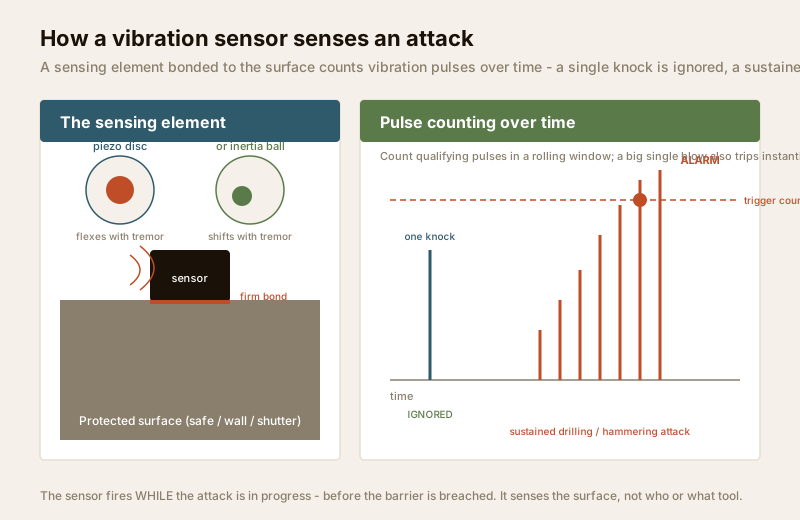
Inside the small metal or plastic case is a tiny element that turns movement into an electrical signal. There are two common designs, and both do the same job:
- A piezoelectric element — a crystal or ceramic disc that produces a small voltage every time it is flexed or shaken. The tremor of the surface flexes it thousands of times a second, and it reports each wobble.
- An inertia element — a tiny sprung mass or a gold-plated contact ball that shifts when the surface it is bonded to vibrates, opening and closing a delicate contact. Older, mechanical, but robust and cheap.
Either way, the sensor is not measuring a single event. It is listening to the signature of an attack over time. And that is the clever part.
Pulse counting: why a single knock is ignored
If a vibration sensor simply screamed at the first tremor, it would be useless — a slammed door, a bird landing on the shutter, a lorry rumbling past would set it off every few minutes. So a good vibration sensor, or the alarm panel behind it, does something smarter: it counts pulses within a time window.
A real attack — drilling, sawing, repeated hammering, grinding — produces a sustained stream of vibration: many pulses, close together, going on for seconds and building. A single accidental knock produces one sharp burst and then silence. The sensor is set to trigger only when it counts, say, a certain number of qualifying pulses inside a rolling few-second window. One knock never reaches the count and is ignored. A sustained attack sails past it and raises the alarm.
Many units add a second rule: a gross-attack or big-hit threshold. A single, enormous impact — a sledgehammer blow that would crack the surface — is so violent that no burglar could deliver it "by accident," so that one hit trips the alarm on its own, without waiting for a count. Between the pulse count and the gross threshold, the sensor separates the innocent tap from the determined attack.
What it reports — and what it does not
Being precise about this matters, because the strengths and limits flow straight from it. A vibration sensor reports one thing: that the surface it is bonded to is being subjected to sustained, attack-like vibration. It does not know who is doing it, whether the wall has actually been breached yet, or what tool is being used. Crucially, it fires while the attack is in progress — before the hole is through, before the safe is open — which is exactly what makes it valuable: it buys warning time. It is the earliest possible alert on a "through the barrier" attack, where a door contact or window sensor would stay silent because nothing was ever opened.
Vibration versus shock — the close cousins
People use "vibration sensor" and "shock sensor" loosely, and cheap catalogues muddle them, but there is a real and useful distinction worth getting right before you buy.
| Vibration (seismic) sensor | Shock sensor | |
|---|---|---|
| What it senses | Sustained, structural vibration over time | A single sharp impact or blow |
| Signature it looks for | Many pulses building over seconds | One high-energy spike |
| Catches best | Drilling, sawing, grinding, prising, patient hammering | A sudden hit, kick or heavy blow |
| Typical mount | Safe body, strongroom wall, shutter, boundary wall | Window frame, glass, door leaf, thin panel |
| Nuisance triggers | Traffic rumble, machinery, construction next door | Slams, hail, someone leaning on the glass |
| Tuning lever | Pulse count and time window | Impact threshold |
In practice the two overlap and many modern detectors do both — they carry a pulse counter for the slow, grinding attack and a gross-impact threshold for the single heavy blow. The mental model that helps: vibration = the sustained work of getting through a structure; shock = one sharp hit. A jeweller's safe wants vibration detection because thieves drill and grind at it patiently; a large shopfront window is better served by a shock sensor tuned to a sudden blow, alongside a glass-break sensor that listens for the specific sound of shattering glass. Choosing between the three is really a question of how the barrier is likely to be attacked.
Where vibration sensors earn their place in India
Vibration detection is a specialist tool, not a whole-home sensor. It shines wherever something valuable sits behind a solid, attackable barrier — and Indian commercial and residential settings have plenty.
| Setting | What it protects | Why vibration detection fits |
|---|---|---|
| Jeweller / bullion shop | Safe, strongroom, display vault | Thieves drill and grind at safes patiently — the classic sustained attack |
| Bank / cash room / ATM | Vault door, ATM body, cash cassette | High-value target; standard to bond seismic sensors to the metal |
| Retail shop | Roller shutter, shopfront | Shutters are prised, sawn and levered from the street after hours |
| Godown / warehouse | Boundary wall, roof, side walls | Long, quiet perimeters where a hole through a wall is a real method |
| Villa / farmhouse | Compound wall, safe room, home safe | Isolated properties; a home safe or a section of boundary wall |
| Strongroom / records vault | Reinforced walls, vault door | Purpose-built to resist a through-the-wall breach |
Two India-specific patterns are worth naming. First, the shop roller shutter: a huge proportion of Indian retail closes behind a steel shutter at night, and shutters are a favourite target for levering and cutting from the empty street. A vibration sensor bonded to the shutter box or a slat, tuned to the shutter's own rattle in the wind, catches the sustained work of prising it — and pairs naturally with the outer line of a perimeter alarm system. Second, the compound wall: on a villa or godown boundary, vibration sensors set into the wall detect the patient chipping or drilling of a breach, complementing fence-intrusion detection on the fence line above. Both belong inside a proper layered security design, where vibration detection is the last, innermost warning around the thing that actually matters.
Placement: getting the sensor to feel the attack
A vibration sensor only senses what actually reaches it through the material, so where and how it is bonded decides whether it works at all.
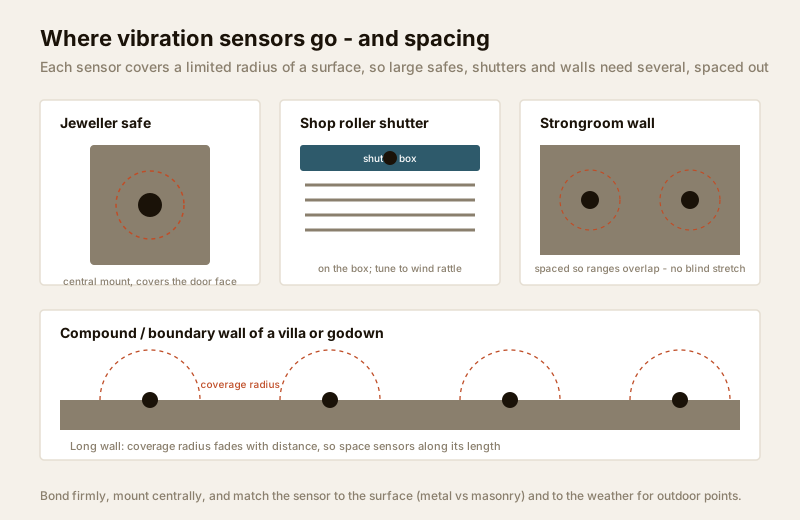
1. Bond it firmly to the surface. The sensor must be in solid, rigid contact with the metal, brick or concrete — screwed, bolted or bonded with a proper structural adhesive, not stuck on loosely with weak tape. A poor bond dampens the very tremor it is meant to feel.
2. Mind the coverage radius. Vibration travels only so far through a material before it fades. Each sensor effectively watches a limited area around it — often quoted as a radius on a given surface (concrete, brick and steel each carry vibration differently). On a large safe, a long shutter or a run of boundary wall, one sensor is not enough: space several across the surface so no stretch is out of range.
3. Central, not at the edge. On a safe or panel, mounting toward the middle of the protected face gives the most even coverage; a sensor tucked in a corner leaves the far side under-watched.
4. Match the surface to the sensor. Some sensors are rated for metal (safes, shutters), others for masonry (walls); outdoor and shutter units need a weatherproof (IP-rated) case to survive Indian monsoon, dust and heat. Check the datasheet's rated surface and coverage before buying.
5. Route the wiring to a pro. Bonding the sensor is often a homeowner or shop-owner job; running its cable back through the wall to the panel, or working at height on a shutter box or high on a compound wall, is installer territory.
Tuning out nuisance vibration — honestly
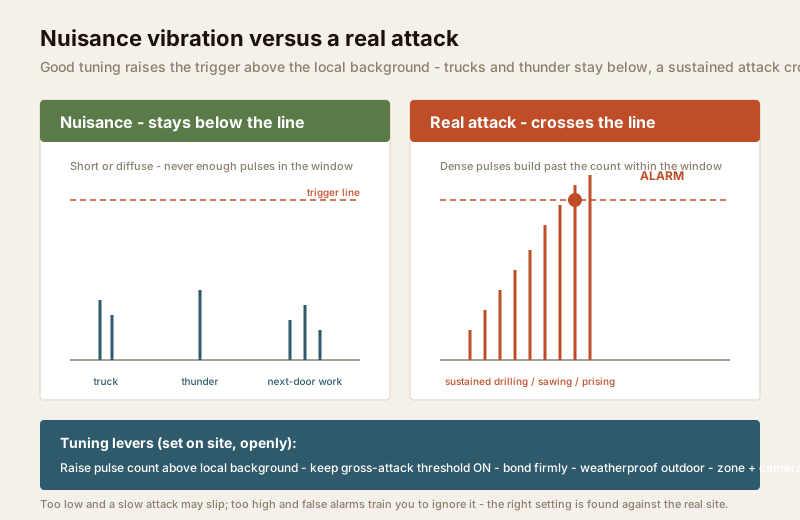
The single biggest reason a vibration sensor gets switched off in frustration is nuisance triggers, and India offers plenty: heavy trucks rumbling past a roadside shop, a monsoon thunderclap, hail on a shutter, machinery in the next unit, or construction on the neighbouring plot shaking a shared wall. Good tuning is what separates a sensor that protects from one that cries wolf — and it is a design task, done openly, not a way to weaken protection.
The levers a competent installer uses:
- Set the pulse count and window to the environment. A quiet strongroom can run sensitive, tripping on a small sustained tremor. A shutter beside a busy road needs a higher count over a slightly longer window so the steady background of passing traffic never reaches the threshold, while the concentrated burst of an actual attack still does. The aim is to raise the bar above the background, not above an attack.
- Keep the gross-attack threshold on. Even a de-sensitised sensor should still fire instantly on one massive blow — so raising the pulse count for a noisy site does not blind it to a sledgehammer.
- Bond well and mount away from obvious noise. A firmly bonded sensor reads the real signal cleanly; one placed right next to a rattling machine or a loose shutter panel reads mostly noise. Good mechanical mounting reduces false alarms before any electronic tuning.
- Zone and verify with cameras. Put vibration sensors on their own alarm zone so a trigger tells you exactly which safe or wall reported, and pair the zone with a camera so a human can verify a real attack versus a truck — see CCTV intrusion-zone detection. Camera verification is the honest answer to "was that real?", especially for self-monitored Indian systems.
- Account for weather. Outdoor and shutter sensors should be weather-rated and tuned to shrug off wind, rain and thunder; where a whole boundary is exposed, dual or overlapping detection with camera verification prevents a single gust from raising the alarm.
The honest tension: turn the sensitivity too low and you might miss a slow, careful attack; too high and monsoon and traffic will train you to ignore the alarm. The right setting is found on site, against the real background of that shop or wall, and it is worth an installer's time to get it right. The burglar-alarm system selector helps you decide whether vibration detection belongs in your mix at all.
Honest limits — and how design answers them
Bought with open eyes, a vibration sensor is superb at its one job and reliant on good design for the rest:
- It protects a surface, not a space. It says nothing about someone walking across a room or climbing through a window they simply opened. Pair it with motion sensors for interior presence and contacts for openings; vibration is the specialist, not the whole system.
- Coverage is limited — spacing matters. One sensor watches only a radius of the surface. Under-cover a long shutter or wall and there is a blind stretch. The fix is honest: enough sensors, well spaced, per the datasheet's coverage figure.
- Nuisance triggers are real. Traffic, weather and machinery can false-alarm a poorly tuned unit. The fix is careful tuning, good bonding, weather-rated cases, zoning and camera verification — not switching it off.
- Self-monitored reality. Most Indian alarms sound a siren and push an app or GSM alert to the owner or guard rather than dialling a monitoring centre with police auto-response, which is still rare here. A vibration sensor will raise that alert faithfully — but who responds, and how fast, is yours to arrange. For a cash room or jeweller, that plan matters as much as the sensor.
- Power cuts. When the mains drop, the panel runs on backup battery (or solar for outdoor perimeters); keep that battery healthy so the safe and shutter stay watched through an outage.
None of these argue against vibration detection — they argue for placing it well, tuning it honestly, and pairing it inside a layered system.
When to bring in a professional. Deciding where vibration sensors belong and bonding one onto a reachable safe or wall are owner-level tasks. Bring in a licensed installer for tuning the pulse count and thresholds on site, any cable chased through walls to the panel, work at height on a shutter box or boundary wall, weatherproofing outdoor units, and anything mains-connected — see the electrical hub. For a whole-property design that ties safes, shutters, walls and interior sensors together, an installer can survey the site; frame the brief with the villa and independent-house security guide or the burglar-alarms sub-hub.
Key takeaways
- Vibration sensors feel the surface, not a gap — bonded to a safe, wall or shutter, they sense the sustained tremor of an attack (drilling, sawing, grinding, prising, hammering) while it is happening, before the barrier is breached.
- Pulse counting is the trick: the sensor counts vibration pulses in a time window, so a single knock is ignored while a sustained attack crosses the threshold — and a gross-impact rule still fires instantly on one massive blow.
- Vibration is not shock: vibration detection catches the sustained work of getting through a structure; a shock sensor catches one sharp impact, and a glass-break sensor listens for shattering glass — choose by how the barrier is likely to be attacked.
- It is a specialist for high-value, solid targets — jeweller safes, cash rooms, ATMs, shop shutters, godown and villa walls, strongrooms — and must be spaced across large surfaces because each sensor covers only a limited radius.
- Tuning is everything for false alarms: set the pulse count above the local background (traffic, weather, machinery), keep the gross-attack threshold on, bond firmly, weatherproof outdoor units, and zone with camera verification — then place it inside a layered design.
References
- Manufacturer datasheets for seismic / vibration / inertia detectors — verify the sensing technology (piezoelectric or inertia), the rated coverage radius on your surface material, pulse-count and gross-attack settings, IP rating for outdoor or shutter use, and any bonding or mounting requirement on the maker's own specification before ordering.
- Digital Personal Data Protection Act, 2023 — any alarm system that logs events, or any camera used to verify a vibration trigger, records personal data; keep app credentials private and agree access and retention terms with any installer or monitoring provider in writing.
- National Building Code of India (SP 7), Bureau of Indian Standards, and local municipal bye-laws for any mains-connected, at-height or weather-exposed aspect of an outdoor install; verify the current edition via the BIS catalogue: https://www.services.bis.gov.in/
This is an educational overview, not legal advice. On-site sensitivity tuning, wall-chased cabling, mains-connected work, weatherproofing, and any work at height are qualified professional tasks — engage licensed installers and verify any standard's current status via the BIS catalogue before relying on it.
Export this guide
Related Guides — Deep-dive reading
How to Choose a Burglar Alarm in India (2026): Sensors, Alerts and What Actually Matters
A homeowner's guide to selecting an intruder alarm that fits your flat, villa or shop and alerts you the way you want — matching the sensor mix, control panel and the big siren-versus-monitored decision to your real risk, and dodging the false-alarm traps that make people switch systems off.
SecurityPerimeter Alarm Systems in India (2026): Detect an Intruder at the Boundary
How an outer detection layer — outdoor motion sensors, beam barriers, fence and wall-top sensors and gate contacts — warns you the moment someone crosses your compound wall, and how to design it for Indian weather without endless false alarms.
SecurityShock Sensors in India (2026): Catching the First Blow to a Door, Window or Safe
How a shock sensor senses a sudden impact, how it differs from a vibration sensor, where it adds value beside a door or window contact, and how to tune out ordinary knocks in an Indian home.
SecurityRelated Tools — Try Free
CCTV Camera Overlap Calculator
The overlap or blind gap between two adjacent cameras, from coverage width and spacing, plus the spacing for a target overlap.
OverlapAcoustic Privacy (STC) Visualizer
Indian healthcare acoustic visualizer — compare wall assemblies and noise sources, see received SPL after STC attenuation, and check FGI 2018 / IS 1950 / NABH speech-privacy compliance with live dual-canvas waveform.
Acoustic ToolBurglar Alarm System Selector
Answer a few questions about your property, cabling, coverage, monitoring and power and get the right burglar alarm — wired / wireless / hybrid, self or professionally monitored — with the design non-negotiables.
Alarm Selector