
Anti-Climb Fencing in India (2026): 358 Mesh, Palisade & Roller-Barrier Specified
The higher-security step up from ordinary fencing — how 358 welded mesh, palisade tops, roller-barrier and anti-climb spikes are engineered to resist climbing and cutting, and where each belongs on an Indian site.
Ordinary fencing marks a boundary. Anti climb fencing is engineered to do something harder: to resist a person who is deliberately trying to get over or through it. The difference is not the height or the paint — it is in the geometry. A standard chain-link or wide-mesh fence hands a climber everything they need: apertures big enough for a toe and finger, horizontal rails to stand on, a flat top to swing over. An anti-climb fence removes those aids by design, and pairs a hard-to-scale face with a topping that a hand cannot grip. This is the higher-security tier — the fence you specify for a substation, a factory yard, a data centre campus, a warehouse or any site where a determined intruder, not just a wandering trespasser, is the real threat.
This guide is written for architects, facility managers, security consultants and site owners who are choosing between systems. It sits inside Studio Matrx's perimeter security library and builds on the general security fencing guide; where the compound wall is the solid boundary and razor wire is one aggressive topping, anti-climb fencing is the transparent, engineered, mid-to-high-security answer for sites that need to see out as well as keep people out.
Scope, honesty & the layered view. This guide is strictly a design and specification aid — it explains what makes a fence hard to climb and cut so you can buy and place the right one, and it never explains how to defeat a fence. Hold onto the core truth of perimeter security: no fence is impenetrable. A determined intruder with tools and time can eventually defeat any barrier. What a good anti-climb fence buys is delay — the minutes that let a perimeter alarm detect the attempt and a response reach the fence before entry succeeds. Deter, delay, detect, deny — the fence owns "deter" and "delay"; it must be married to detection to be worth its cost. Structural design of tall fencing, foundations and any gate automation is licensed-professional work.
What "anti-climb" actually means
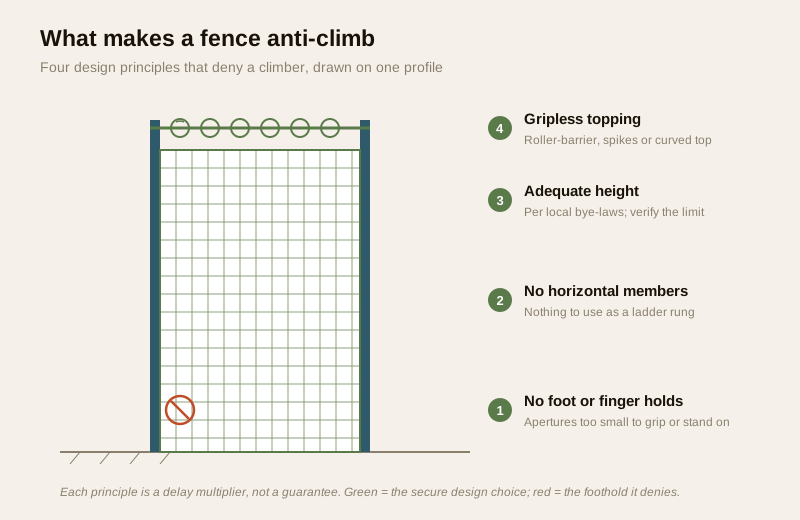
An anti-climb fence is defined by what it denies a climber, not by a single feature. Four design principles do the work, and a good specification checks all four rather than relying on one:
- No footholds or handholds. The face gives nothing to push up on or pull against. That means very small apertures (too tight for a toe or a gripping finger), a smooth or vertical profile, and no ledges. This is the single biggest difference from ordinary fencing.
- No horizontal members to stand on. Standard fence panels have horizontal rails or wide horizontal wires that act like a ladder. Anti-climb systems either remove intermediate horizontals, hide them behind the mesh, or use vertical pales so there is nothing to stand on partway up.
- Adequate height. Height alone is weak, but height plus a non-climbable face plus a topping is strong. Higher sites (industrial, critical infrastructure) specify taller fences so that even a boosted climber cannot easily reach the top — but always with the local building bye-laws and boundary rules in mind.
- An anti-climb topping. The top is where a climber is most exposed and most committed, so it is where a topping earns its keep: a rotating roller-barrier, spikes or combs, an outward-canted extension, or a curved smooth section that offers nothing to grip.
The honest framing for all four is the same: each one is a delay multiplier. It does not make climbing impossible; it makes it slower, noisier, riskier and more visible — which is exactly what gives your detection layer time to work.
The main anti-climb systems
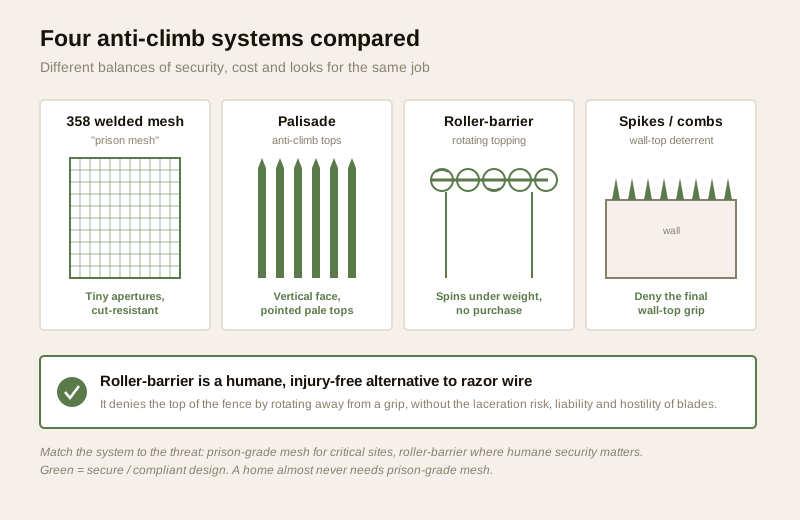
There is no single "anti-climb fence" product — it is a family of systems, each with a different balance of security, cost, transparency and looks. Match the system to the threat level and the setting.
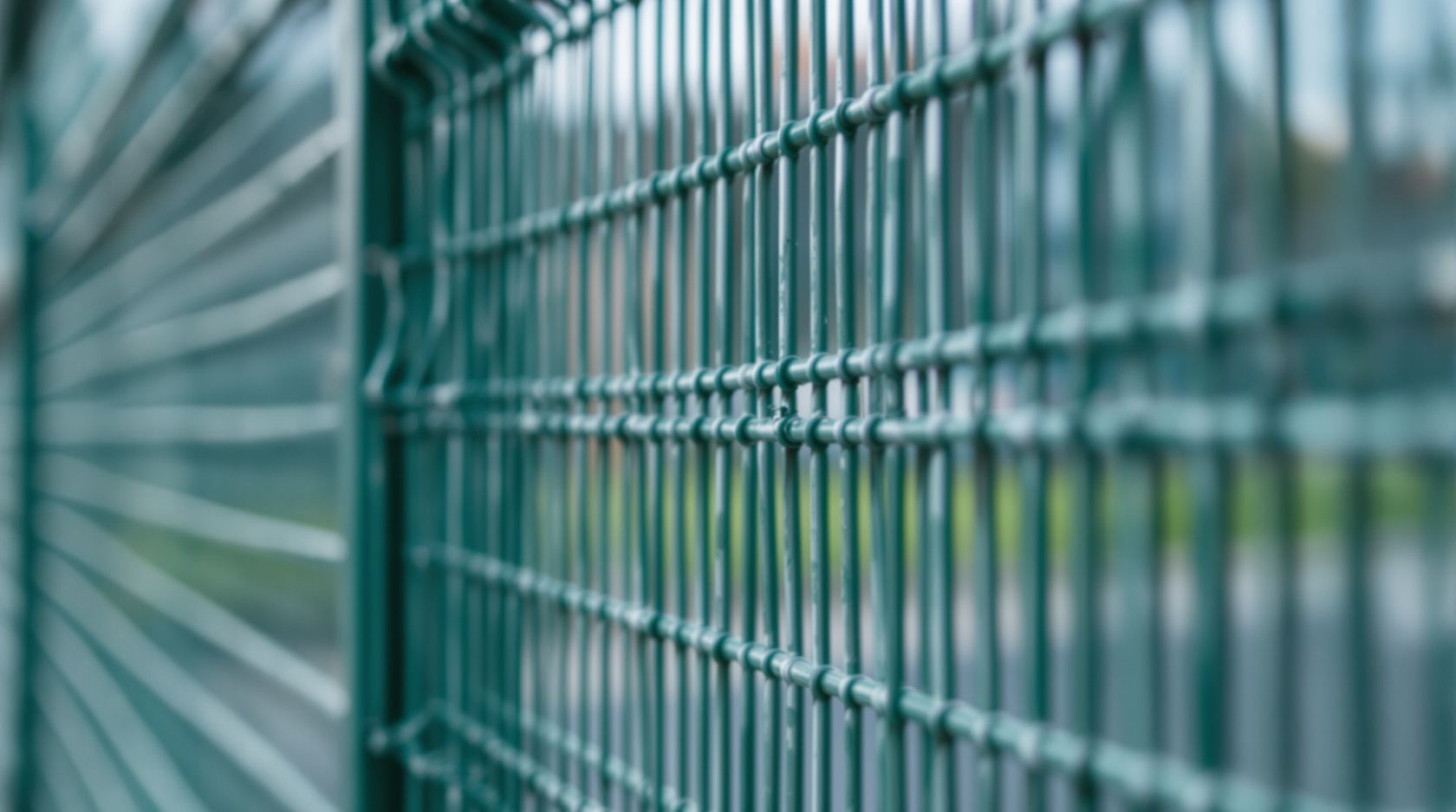
358 welded mesh ("anti-climb" or "prison mesh")
The workhorse of high-security fencing. The name "358" refers to a common panel geometry — very small rectangular apertures (roughly on the order of 76 by 12.5 millimetres, verify against the manufacturer) formed by closely spaced vertical and horizontal wires welded at every intersection. Two properties make it anti-climb:
- The apertures are too small for a finger or toe-hold, so there is almost nothing to grip or stand on across the whole face.
- It resists cutting, because the tight mesh leaves no room to get a bolt-cutter jaw around a single wire easily, and the welded intersections hold the panel together even if attacked.
358 mesh is transparent (good for surveillance and CCTV sightlines across the fence), rigid, and looks far less hostile than razor wire — which is why it is the default for prisons, substations, data centres, airports, utilities and premium industrial and campus perimeters. It is usually specified with a matching anti-climb topping for the tallest sites.
Palisade with anti-climb tops
Steel palisade is a line of vertical pales (D-section or W-section) fixed to horizontal rails set behind the pales. Its anti-climb strength comes from the vertical-only face — there is nothing horizontal on the outside to stand on — finished with pointed, splayed or triple-pointed pale tops that deny a safe grip at the very top. Palisade is robust, hard to cut through quickly, and reads as overtly secure, which makes it common on industrial estates, yards, plant rooms and utility compounds. It is more visually aggressive than mesh and gives less clean a sightline, so it suits function-first sites more than public-facing frontages.
Roller-barrier (rotating topping)
A roller-barrier is a topping made of independently rotating cups or sleeves threaded on a top rail or angled bracket. The principle is elegant and defensive: the sections spin freely, so a hand or foot placed on them cannot get purchase — the topping turns under any attempt to bear weight on it. Its great advantage is that it is a humane, injury-free alternative to razor wire: it denies the top of the fence without the laceration risk, the liability and the ugliness of blades. That makes it the preferred topping for schools, hospitals, care settings, residential-adjacent boundaries and any site that wants strong security without a hostile, injurious edge. Compare this honestly with razor wire, which delays more aggressively but carries real injury-liability and aesthetic costs.
Anti-climb spikes and combs
Spikes (rows of blunt or pointed metal points) and "combs" (angled, saw-tooth strips) are fitted along the top of a wall or fence to deny the final grip. They are lower-cost, easy to retrofit to an existing compound wall, and — when specified as blunt, wall-top deterrent spikes rather than blades — are a proportionate topping for many commercial and residential boundaries. They deter and delay; they are not as formidable as a roller-barrier or a taller engineered topping, and, like anything sharp, they carry a duty-of-care consideration where the public can reach them.
Smooth-faced and curved-top profiles
Some systems add a smooth, ledge-free face (welded panels or sheet with no protruding fixings) and a curved top that turns outward and downward, presenting a convex, gripless surface at the very point a climber needs a hold. These are quieter, more architectural answers used where looks matter — campus frontages, corporate perimeters — trading a little raw hostility for a cleaner, still highly climb-resistant boundary.
Choosing the right system
| System | How it resists climbing | Cut resistance | Transparency / sightline | Injury / liability | Typical setting |
|---|---|---|---|---|---|
| 358 welded mesh | Tiny apertures give no toe or finger hold | High (tight mesh, welded joints) | High — see-through, CCTV-friendly | Low | Substations, data centres, prisons, premium industrial |
| Palisade + anti-climb tops | Vertical-only face, splayed pale tops | High | Medium | Medium (pointed tops) | Industrial estates, yards, utility compounds |
| Roller-barrier topping | Rotating sections deny purchase | N/A (a topping) | High | Very low — humane, no blades | Schools, hospitals, residential-adjacent, campuses |
| Anti-climb spikes / combs | Deny the final wall-top grip | N/A (a topping) | High | Medium (duty of care where public can reach) | Commercial + residential wall tops, retrofits |
| Smooth / curved-top profile | Ledge-free face, convex outward top | High | High | Low | Corporate frontages, campuses |
Two selection rules keep specifications honest:
- Match the system to the threat, not to fashion. A substation or a warehouse holding high-value stock justifies 358 mesh with a topping; a school boundary wants roller-barrier for humane, injury-free security; a modest commercial yard may be well served by palisade or a smooth-faced panel; a home almost never needs prison-grade mesh — for most residences a good compound wall with a proportionate topping and security fencing basics is enough, and anything more is overkill. See the villas and independent houses security guide for the residential balance.
- Cost tracks security, so buy where the risk is. Anti-climb systems cost meaningfully more than chain-link. Spend the budget on the runs and the sites that face a real, determined threat, and use lighter fencing where the threat is only casual trespass.
The India realities that decide performance
Even the best fence underperforms if the site around it is ignored. On Indian sites, watch:
- Climb aids next to the line. A fence is only as tall as the nearest thing beside it. Parked trucks, stacked pallets, a neighbouring low roof, a tree, an electricity pole or a heap of material against the fence all cancel its height. Keep a clear zone on both sides so the fence cannot be shortcut — this is a placement decision, stated defensively, not a how-to.
- Monsoon and rust. Coastal and monsoon exposure attacks steel. Specify hot-dip galvanising and/or polyester powder coating, stainless fixings where budget allows, and inspect after each monsoon — a corroded fence is a weak fence.
- The gate is the weak point. The strongest fence is defeated at a poorly secured gate. The vehicle and pedestrian gates, their locks and any automation deserve at least the same security rating as the fence line (gates, boom barriers and bollards are covered later in this library).
- Foundations and structure. Tall fencing is a structural element that must resist wind and forced attack; posts, footings and panel fixings need proper engineering, especially for high fences and exposed sites.
- Boundary and bye-laws. Height limits, setbacks and gate lines are governed by the local municipal or development-authority bye-laws and the National Building Code framework — verify the permitted height for your city before committing to a tall fence, and keep clear of any boundary or encroachment dispute.
A fence buys delay — detection makes it count
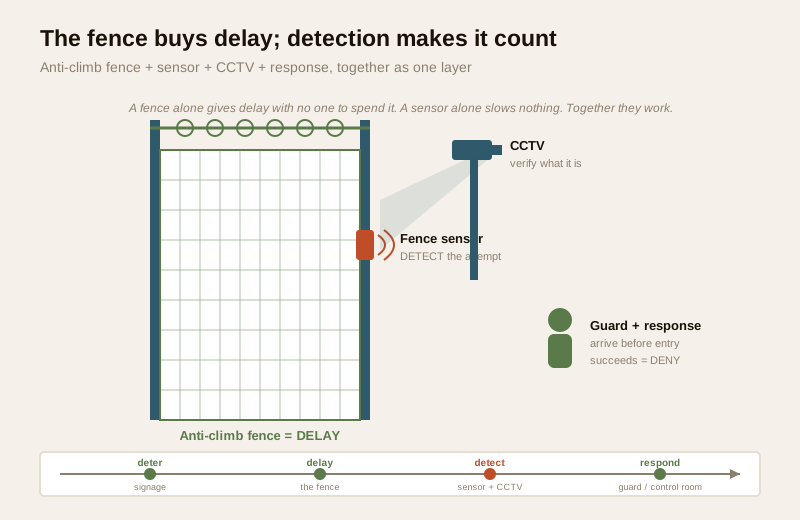
This is the most important idea in the guide, and it is the one most often forgotten. An anti-climb fence does not stop a determined intruder — it slows one down. Given enough tools, time and privacy, any fence can be defeated. The value of "hard to climb and cut" is that it converts a fast, quiet breach into a slow, noisy, exposed one. That extra time is worthless unless something is watching to use it.
So specify the fence as one layer of four:
- Deter — a visibly serious fence and clear signage tell an opportunist to look elsewhere.
- Delay — the anti-climb face and topping stretch the attempt out.
- Detect — a perimeter alarm (fence-mounted vibration/tension sensors, beam barriers or wall-top lines) and perimeter CCTV catch the attempt while it is still happening. Fence sensors turn the anti-climb fence itself into the tripwire.
- Deny / respond — lighting, a guard, a control room and a response plan turn a detection into an intervention before entry succeeds.
A fence alone gives you delay with no one to spend it. A sensor alone gives you an alert with nothing to slow the intruder down. Together — fence plus sensor plus camera plus a lit boundary plus a response — they form the layered perimeter that actually works. Map your weak points first with a perimeter vulnerability assessment, or use the site perimeter security assessment tool to structure the review, and read the perimeter security pillar for how the whole boundary system fits together.
Life-safety: never trap people inside
A perimeter that keeps intruders out must never trap occupants in. A tall, spiked, roller-barriered or otherwise hard-to-cross boundary with no quick, code-compliant exit is a life-safety hazard in a fire or emergency. Coordinate every high-security fence and gate with escape and egress: emergency exit gates that open from the inside, a clear route from occupied buildings to a place of safety, and gate automation that fails safe. Security and life-safety are not in tension when the design accounts for both from the start — bring in the fire and egress requirements (State Fire Services and the building code) alongside the security specification.
The law, liability & when to bring in a professional. You can plan the layout, choose the system family and set the security level yourself, and this guide gives you the vocabulary to write a proper specification. Hand the rest to professionals: a structural engineer for tall-fence foundations, posts and wind/attack loading; a licensed installer for erection, galvanising/coating and gate automation; and your fire and egress consultant to ensure the boundary never blocks escape. On liability, any topping that can injure a passer-by, child or animal — spikes, combs and especially razor wire — carries a duty of care: keep injurious toppings off boundaries the public can reach and check local municipal and RWA rules. This is educational guidance, not legal advice; verify every standard's current status and every height limit against the local authority before you build.
Key takeaways
- Anti-climb fencing is defined by geometry, not height alone — no footholds or handholds, no horizontal members to stand on, adequate height and a gripless topping — the higher-security step up from ordinary security fencing for factories, substations, campuses and warehouses.
- Know the systems: 358 welded "prison" mesh (tiny apertures, cut-resistant, transparent), palisade with anti-climb tops, roller-barrier (rotating, humane, injury-free), and anti-climb spikes and combs — each with a different balance of security, cost and looks.
- Roller-barrier is the humane alternative to razor wire — its rotating sections deny a grip without the laceration risk, liability and hostility of blades, which is why it suits schools, hospitals and residential-adjacent boundaries.
- Match the system to the threat: prison-grade mesh for critical and high-value sites, roller-barrier where humane security matters, palisade or smooth panels for yards, and nothing more than a proportionate wall topping for a home — anti-climb mesh is overkill for most residences.
- A fence buys delay, not denial — any barrier yields to enough tools and time, so pair anti-climb fencing with a perimeter alarm, CCTV, lighting and a response, coordinate it with fire egress so it never traps people in, and read the perimeter security pillar for the whole layered design.
References
- Bureau of Indian Standards — the applicable BIS fencing and welded-mesh specification for chain-link, welded-mesh and palisade fencing, and IS 278 : 2009 (Reaffirmed 2020), Galvanized Steel Barbed Wire for Fencing, where barbed-wire toppings are used; verify the current specification and edition via the BIS catalogue: https://www.services.bis.gov.in/
- National Building Code of India (SP 7) and the local Municipal / Development-Authority building bye-laws — for compound-wall and fence height limits, boundary setbacks and gate lines, which vary by city and authority; verify the current edition via the BIS catalogue: https://www.services.bis.gov.in/
- Manufacturer specifications and datasheets — verify 358 mesh aperture and wire dimensions, panel and post structural ratings, roller-barrier and topping details, galvanising and coating grades and warranty for Indian monsoon and coastal exposure on the maker's own datasheet before ordering.
- State Fire Services and the building code egress provisions, plus local Police and municipal rules — for the life-safety escape interface of any high-security boundary and any local restrictions on toppings the public can reach.
This is an educational specification aid, not legal advice, and it is strictly defensive — it explains how to make a boundary harder to defeat and what its limits are, never how to defeat one. Structural design of tall fencing, gate automation and any life-safety egress interface are qualified professional tasks — engage licensed engineers and installers, and verify any standard's current status and any height limit with the local authority before relying on it.
Export this guide
Related Guides — Deep-dive reading
Razor Wire in India (2026): Security Use, Placement and the Legal & Liability Considerations
What razor wire and concertina coil really do as a perimeter topping, where it fits and where it does not, and the honest legal, injury-liability and humane trade-offs every Indian owner must weigh before stringing it up.
SecurityHow to Choose a Security System (2026): The Master Buying Guide for Indian Homes and Buildings
The mental model that ties the whole buying decision together: start from your own risk, not a product; build the layers your situation actually needs; make the big architecture choices (wired vs wireless, local vs cloud, DIY vs professional); tell real product quality from marketing; and choose a vendor you can trust.
SecuritySecurity Fencing in India (2026): Chain-Link, Welded Mesh, Palisade & Choosing the Right Type
A see-through boundary can be as secure as a solid wall when you choose the right fence — this guide compares chain-link, welded and 358 mesh, palisade and expanded metal on security, cost and visibility.
SecurityRelated Tools — Try Free
CCTV Camera Coverage & Count Calculator
Estimate how many CCTV cameras you need, the NVR channels, storage in TB for your retention period, and an indicative all-in cost with GST.
CCTV CalculatorSecurity System Cost Estimator
Estimate the all-in capex with GST, annual running cost and 5-year total cost of ownership of a home or building security system.
Cost EstimatorAcoustic Privacy (STC) Visualizer
Indian healthcare acoustic visualizer — compare wall assemblies and noise sources, see received SPL after STC attenuation, and check FGI 2018 / IS 1950 / NABH speech-privacy compliance with live dual-canvas waveform.
Acoustic Tool