
Compound Wall Materials in India: Brick, Stone, RCC, Precast and Block Compared (2026)
A plain, India-grounded guide to choosing what your boundary wall is made of — burnt-clay brick, random-rubble stone, concrete and AAC block, cast-in-situ RCC and precast RCC panels compared on cost band, strength, durability, speed, maintenance, look and where each one fits your budget, soil, height and coast.
Every compound wall is a choice of material before it is anything else, and that one decision quietly sets your budget, your build time, how the wall ages, and how it looks from the road for the next twenty years. The five that matter in India are burnt-clay brick masonry, random-rubble (RR) stone masonry, concrete or AAC or fly-ash block masonry, cast-in-situ RCC, and precast RCC panels. There is no single "best" — there is the one that fits your plot, your soil, your height and your wallet.
This is the material-selection guide for the Compound Walls and Gates hub. It sits alongside the compound wall design guide, which covers footing, thickness, piers and coping, and it deliberately does not re-teach each material from scratch — for that, follow the deep guides on AAC blocks vs red bricks, fly-ash bricks vs clay bricks, concrete strength and random-rubble stone masonry. Here the job is narrower and more useful: compare them as a compound wall and help you pick.
Scope & how to read this. Every cost band, thickness and height figure here is typical and indicative to help you plan and compare — confirm the exact specification against the relevant IS codes (IS 1905 for masonry, IS 456 for RCC, IS 2185 and IS 383 for blocks and aggregates), NBC (SP 7:2026) and your local municipal bye-laws, and get local quotes. Structure is engineer-led: whatever the material, the wall still needs an engineer-designed foundation, and above a modest height it needs reinforcement, piers and often a structural design — a tall unreinforced wall can fall and injure someone. Gate security, automation and fencing are covered in the Perimeter Security library, not here.
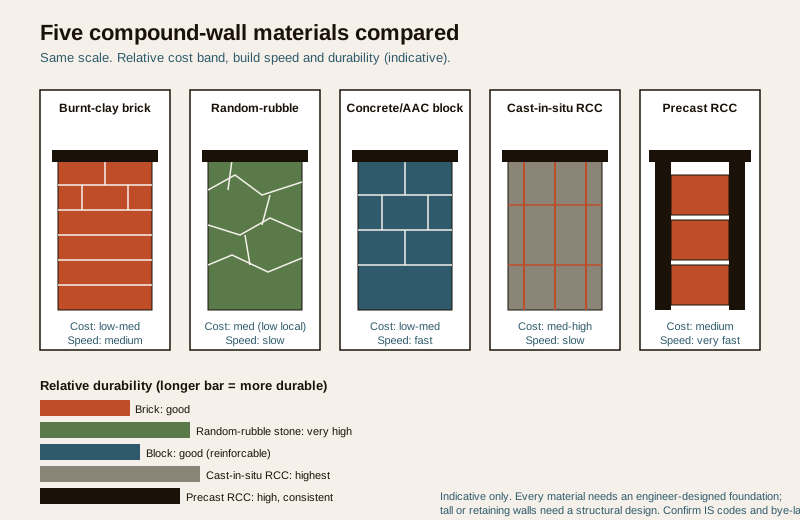
The five materials at a glance
Before the detail, the shape of the decision. Read cost as a relative band, not a price — actual rates swing with city, transport, labour and the day's steel and cement rate, so always get local quotes.
| Material | Relative cost band | Strength & durability | Build speed | Maintenance | Typical look | Best for |
|---|---|---|---|---|---|---|
| Burnt-clay brick masonry | Low to medium | Good in compression; needs piers/reinforcement when tall | Medium (wet trade, curing) | Plaster + paint upkeep; repointing if exposed | Warm, traditional; can be left exposed | The everyday default; most homes on stable soil |
| Random-rubble (RR) stone | Medium (low where stone is local) | Very high mass and durability; heavy | Slow (skilled masons, hand-fitted) | Very low; ages gracefully | Rugged, characterful, regional | Stony/sloping sites, farmhouses, where stone is quarried nearby |
| Concrete / AAC / fly-ash block | Low to medium | Good; hollow blocks can be reinforced and grouted | Fast (large units, less mortar) | Plaster + paint; AAC needs the right render | Clean, uniform once plastered | Fast, tidy walls; long straight runs; lighter AAC on weak soil |
| Cast-in-situ RCC | Medium to high | Highest; monolithic, handles height and retaining | Slow (formwork, steel, curing) | Low; occasional crack sealing | Solid, modern, can be board-formed | Tall walls, retaining walls, high-security, poor soil |
| Precast RCC panels | Medium | High and consistent (factory-cured) | Very fast (bolt-up in days) | Low; joints checked periodically | Grey panels; textured/finished options | Long boundaries, plots/farms, factories, speed-critical jobs |
Each row is a starting point, not a verdict. The rest of this guide unpacks the "best for" column so you can match a material to your plot rather than a generic one. Two structural truths cut across all five: the wall is only as good as the foundation under it, and every material still catches wind load as it gets taller, which is exactly when an engineer's design stops being optional.
Masonry walls: brick, stone and block
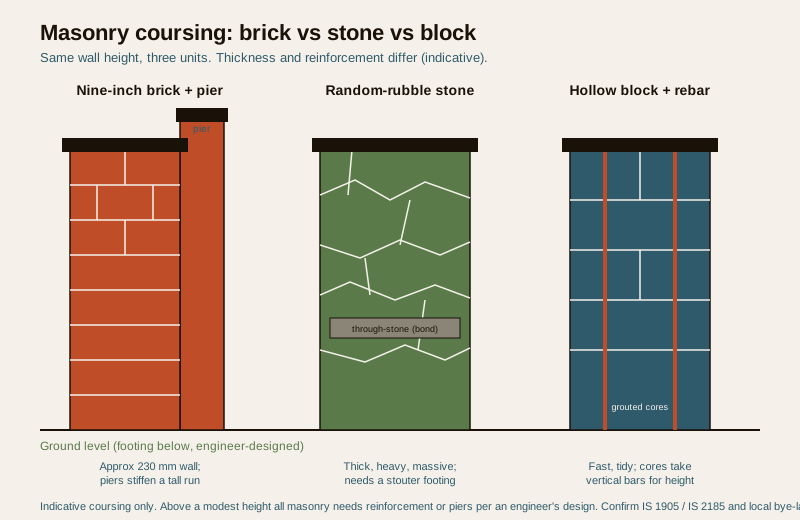
Three of the five are masonry — units laid in mortar, course upon course. They share a family resemblance: they are built wet and by hand, they need curing time, and above roughly 1.5 to 1.8 m they generally want intermediate piers and reinforcement so a long thin wall does not act like a sail. Where they differ is unit, weight, speed and character.
Burnt-clay brick masonry
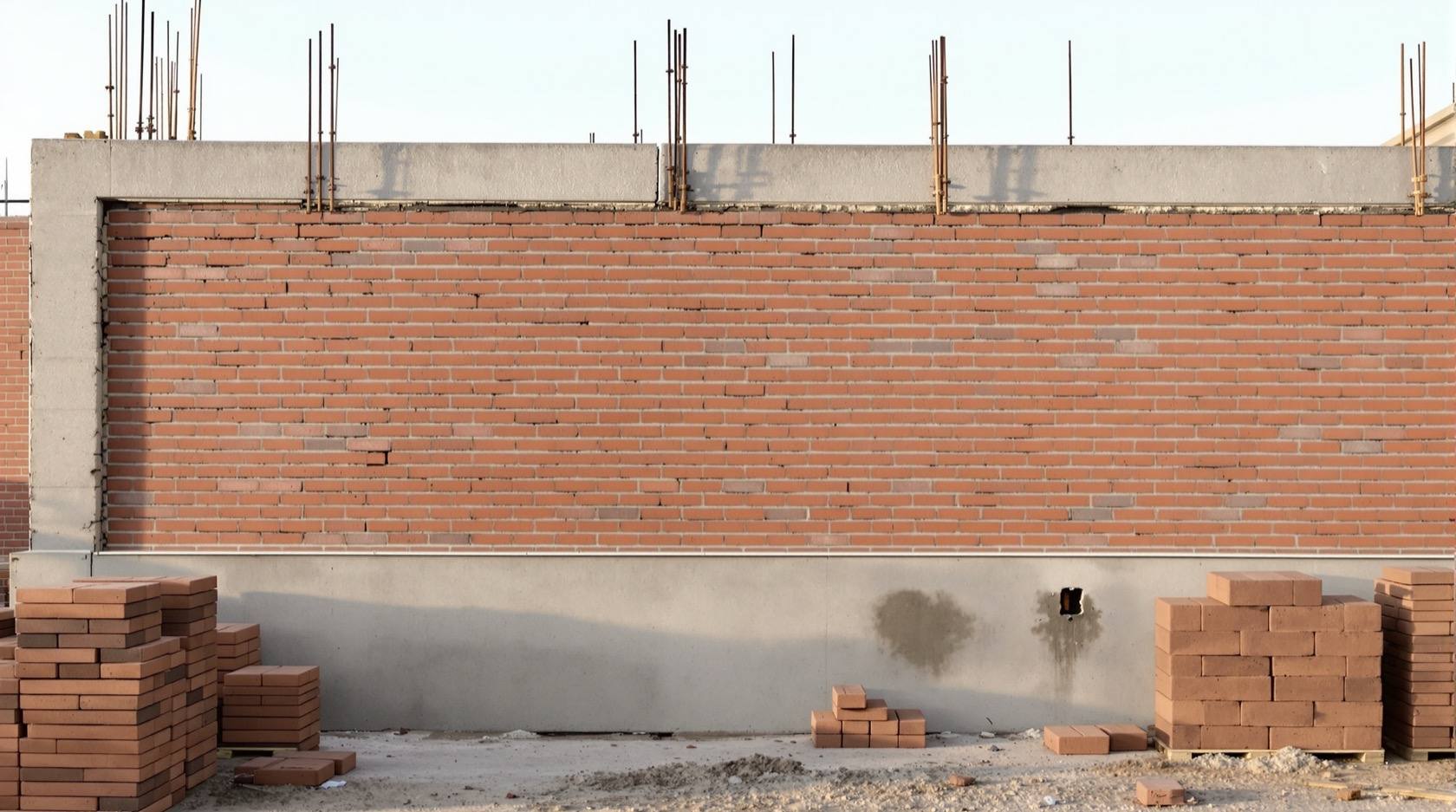
The default Indian boundary wall. Standard modular bricks laid in cement mortar give a 230 mm (nine-inch) or 115 mm (four-and-a-half-inch, with piers) wall that is honest, repairable and understood by every mason in the country. It takes plaster and paint happily, or it can be left as an exposed-brick face for character. Its limits are height (a thin brick wall needs piers and often reinforcement to stand tall against wind) and water — a poorly-coped, un-plastered brick wall wicks damp. Brick is the material to beat on cost and familiarity for a normal-height residential boundary on stable soil.
Random-rubble (RR) stone masonry
Where stone is quarried locally — much of peninsular, western and hill India — random-rubble stone is superb value and almost immortal. Irregular stones are hand-fitted in mortar into a thick, heavy, massive wall that shrugs off weather, needs almost no maintenance, and looks like it grew from the site. The trade-offs are weight (a heavier wall means a more substantial foundation), skilled labour (good rubble masons are getting scarce and the work is slow), and cost that rises sharply once you have to truck the stone in. For stony or sloping sites and farmhouses it is often the honest first choice; the deeper craft is in the stone masonry guide.
Concrete, AAC and fly-ash block masonry
Blocks are bigger than bricks, so a block wall goes up faster with less mortar and comes out tidy and uniform under plaster. The family splits three ways, and the deep guides compare them properly:
- Hollow / solid concrete blocks are strong and can be reinforced and grouted vertically — the cores take rebar, which is a real advantage for a taller or windier boundary.
- AAC blocks are light (easy on the foundation and on weak soil) and quick, but they are not a structural mass wall — they need the right render, careful detailing at the coping and base against water, and reinforcement where loaded. The trade-offs are laid out in AAC blocks vs red bricks.
- Fly-ash bricks / blocks are dimensionally neat and give a very even wall; fly-ash bricks vs clay bricks covers where they win. All blockwork depends on the block itself meeting IS 2185, so buy to spec, not to the cheapest pallet.
Concrete walls: cast-in-situ RCC vs precast panels
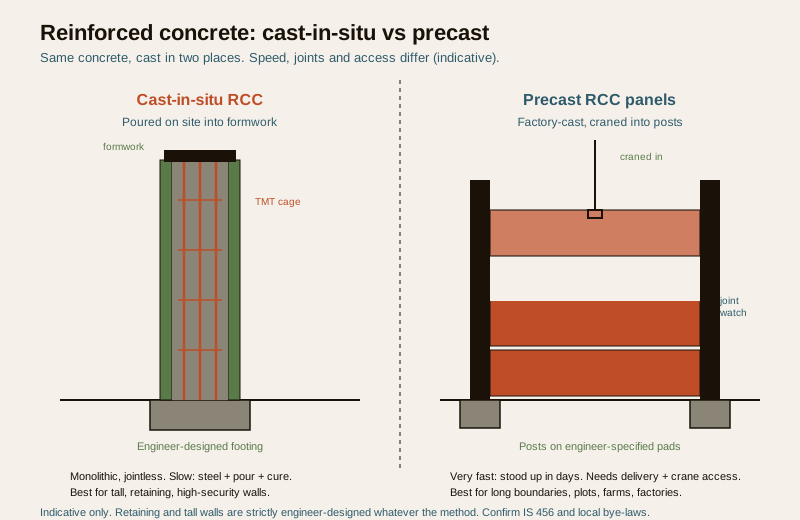
The other two materials are reinforced concrete — the strongest option, and the answer when a wall must be tall, must retain earth, or must go up fast over a long boundary. The choice inside the family is where the concrete is cast: on site, or in a factory.
Cast-in-situ RCC
Poured on site into formwork around a cage of TMT reinforcement steel, a cast-in-situ RCC wall is monolithic — one continuous, jointless element. That makes it the material of choice for tall walls, retaining walls that hold back a level difference, and high-security boundaries where nothing thinner will do. Its concrete strength and steel are designed by an engineer to the wall's exact height, soil and load. The price is time and disruption: formwork, steel-fixing, pouring and curing are slow and site-heavy, and it costs more than masonry. But no other material handles a genuinely tall or earth-retaining wall as cleanly — and any retaining wall is strictly engineer-designed, never eyeballed.
Precast RCC panels
Precast takes the same reinforced concrete and casts it as panels in a factory, cured under controlled conditions, then trucked to site and slotted between grooved posts. A boundary that would take weeks in masonry can be stood up in days, with consistent factory quality and a clean, repeatable look — which is why it dominates long boundaries for plots, farms, factories, warehouses and schools. The precast compound walls guide covers it in full. Trade-offs: you need vehicle access for delivery and craneage, the panel joints are the detail to watch over time, and the posts still sit on an engineer-specified foundation. For speed over a long, straight, level run, precast is hard to beat.
How to choose your wall material
Material selection is really a short series of questions about your plot. Work down this checklist and the field narrows fast — then confirm the shortlist with your engineer and local quotes.
| Question about your site | If yes / this applies | Lean towards |
|---|---|---|
| Is the budget tight and the height normal (under ~1.5 m)? | Standard residential boundary | Burnt-clay brick, or fly-ash / concrete block |
| Is good stone quarried locally? | Peninsular / western / hill sites | Random-rubble stone masonry |
| Is the soil weak or the load to be kept light? | Made-up / soft ground | AAC block (light) or precast (point-loaded posts) |
| Does the wall need to be tall or high-security? | Above ~1.8 m, factory / institution | Cast-in-situ RCC, or reinforced block / precast |
| Must the wall retain a level difference (earth behind it)? | Sloping / cut-and-fill plot | Cast-in-situ RCC retaining wall (engineer-designed, always) |
| Is speed over a long boundary the priority? | Plot, farm, factory perimeter | Precast RCC panels |
| Is it a coastal / high-humidity site? | Near the sea, salt air | Dense concrete (RCC / precast / solid block) with good cover; avoid thin under-cured work |
| Do you want a specific look left exposed? | Character / no plaster | Exposed brick, or random-rubble stone |
A few cross-cutting notes that decide more walls than people expect:
- Foundation first, always. Heavier materials (stone, RCC) need a more substantial foundation; lighter ones (AAC, precast panels) can ease it — but every material needs an engineer-designed footing, not a guessed trench.
- Height changes the material. A knee-high garden wall and a 2.4 m security wall are different structural problems. Past a modest height, masonry needs piers and reinforcement and RCC needs a real design; the height and privacy guide covers where the line sits and what local rules allow.
- Coast and water punish weak work. Salt air and monsoon attack thin, porous, badly-cured walls. Coastal sites favour dense concrete with generous cover to steel and good coping and plaster; get the mix and cover from an engineer, not a thumb-rule.
- Finish is a separate decision. Whatever the body, the surface is chosen later — see wall finishes, exterior wall paint and, for a softer boundary, green and living walls.
Estimating quantities and cost
Once you have a material and a rough length and height, you can get an early sense of quantities and spend before you ever call a contractor:
- The brick and block quantity calculator turns your wall's length, height and thickness into an indicative brick or block count (and a mortar allowance) so you can sanity-check a supplier's number.
- The compound wall cost calculator puts an indicative cost band on the whole wall by material, length and height — a planning figure to compare options, not a quote.
Treat both as planning aids. The real number comes from local quotes against a drawing your engineer has checked, because rates, soil, transport and the day's steel and cement price move the total far more than any online estimate can.
How it connects
- Sits under the Compound Walls and Gates hub and pairs with the compound wall design guide (footing, thickness, piers, coping) and the precast compound walls guide.
- For where each material lands, see residential compound walls and commercial compound walls; for how tall and how private, the height and privacy guide.
- The deep material references live in the Construction Materials library: AAC vs red bricks, fly-ash vs clay bricks, concrete strength, TMT steel and stone masonry.
- Structure and site: foundation problems and wind loads; security of the finished boundary lives in the Perimeter Security library.
- Estimate with the brick and block quantity calculator and the compound wall cost calculator.
Key takeaways
- There is no single best material — brick, stone, block, cast-in-situ RCC and precast each win on a different plot; match the material to your budget, soil, height, coast and look.
- Burnt-clay brick is the everyday default; random-rubble stone is superb where stone is local; blocks build fast and tidy (AAC light, concrete reinforcable).
- Cast-in-situ RCC is the strongest and the answer for tall, retaining or high-security walls; precast panels win on speed over long boundaries for plots, farms and factories.
- Every material still needs an engineer-designed foundation, and above a modest height, reinforcement, piers or a structural design — a tall unreinforced wall can fall.
- Retaining walls are always engineer-designed, whatever the material; coastal sites favour dense concrete with good cover.
- Every cost band and dimension here is indicative — confirm the specification against IS 1905, IS 456, IS 2185 and IS 383, NBC (SP 7:2026) and local bye-laws, and get local quotes.
References
- IS 1905, Bureau of Indian Standards — code of practice for structural use of unreinforced masonry (brick, stone and block walls; named generally).
- IS 456, Bureau of Indian Standards — code of practice for plain and reinforced concrete (cast-in-situ and precast RCC walls; named generally).
- IS 2185 and IS 383, Bureau of Indian Standards — concrete masonry units and coarse/fine aggregates for concrete (blocks and mixes; named generally).
- National Building Code of India, NBC (SP 7:2026), Bureau of Indian Standards — general building, materials and structural-safety provisions.
- Local municipal bye-laws and development-control regulations — boundary-wall material, height and setback requirements (city-specific; these govern approval).
- Local contractor and supplier quotations — current material, steel, cement, transport and labour rates for your specific site.
All cost bands, thicknesses, heights and material comparisons here are indicative planning aids only; confirm the governing specification against the relevant IS codes, NBC (SP 7:2026) and your local municipal bye-laws, and have a licensed structural engineer design, finalise and certify the foundation and any tall, reinforced or retaining wall.
Export this guide
Related Guides — Deep-dive reading
The Homeowner's Guide to Compound Walls and Gates in India (2026)
A plain-language, start-to-finish walkthrough of building a boundary wall and gate in India — plan and permit first, then material and height, foundation and structure, building and supervision, the gate, finishes, lighting and greenery, budget and long-term upkeep — with a stage-by-stage roadmap, a full planning checklist and answers to the questions every homeowner asks.
Compound WallsCompound Wall Cost in India: Materials, Labour and What Drives the Price (2026)
An honest, indicative cost-literacy guide to what a boundary wall really costs in India — why the price swings so much (material first, then height, foundation, finish, gate and site), the full cost stack most people forget, how the wall is measured, and where to trim without cutting the wrong corner. Relative bands, not quotes — get local numbers.
Compound WallsCompound Wall Design in India: The Complete Planning Guide (2026)
The start-here field guide to planning a compound wall for an Indian home, farmhouse or plot — what a boundary wall is really for, the questions to settle before you build, the decision sequence from survey to gate to finish, an honest wall-type comparison, and where structure and security hand off to the experts.
Compound WallsRelated Tools — Try Free
Structural Modification Approval Checklist
41 items across structural assessment, society approval, municipal compliance, and safety.
Approval ChecklistMaterial Quality Evaluation Checklist
20-point checklist to evaluate interior materials before signing off at delivery.
Quality ChecklistWindow Hardware Cost Calculator
Estimate window hardware cost — hinges, handles, locks, rollers and multipoint gears.
Window Calculator