

Foundation Problems Every Homeowner Should Understand
What lies beneath the house — foundation types, the problem soils of India, black-cotton heave and differential settlement, the warning signs of foundation movement, and the soil test that prevents lakhs in damage.
The bathroom door suddenly refuses to latch. A thin crack appears along the corner where the living-room wall meets the ceiling, then slowly climbs diagonally, one brick step at a time. On the verandah, a marble tile has cracked clean through in a straight line — and you could swear the floor tilts a few millimetres toward the south. These are not cosmetic annoyances. They are the building sending you a message from underground.
Foundation problems are the most expensive category of structural repair. They are also, almost without exception, preventable — or at least manageable — if you understand what is happening beneath your feet before the building goes up, or catch the early signs before they become crises. By the time a crack is wide enough to slip a coin into, the damage is already done and the remediation bill has grown very large.
This guide is for the intelligent homeowner who wants to understand what a foundation actually does, why Indian soils are among the most challenging in the world, what the warning signs look like, and — most importantly — what you can do about it at every stage: before construction, during construction, and if trouble has already appeared. No engineering degree required; a healthy respect for what lies beneath is enough.
A foundation spreads the building's load onto soil that can safely carry it without excessive or uneven settlement.
That single sentence contains four concepts every homeowner needs to hold together: load, soil, bearing, and settlement. Each one can go wrong independently. Foundation engineering is largely the art of matching the structure above to the soil below so that all four stay in balance over decades.
1. What a Foundation Does — and Why Soil is the Real Foundation
Think of a foundation as the translator between the building above and the earth below. The walls, columns, beams, floors, and roof create a load — the dead weight of the structure plus the live load of occupants, furniture, water tanks, and everything else — that must be transferred safely into the ground. The foundation spreads that concentrated load over a large enough area of soil that the soil is not overstressed.
Every soil has a Safe Bearing Capacity (SBC) — the maximum load per unit area it can support without shearing or settling excessively. IS 6403 (Code of Practice for Determination of Bearing Capacity of Shallow Foundations) provides the methods by which structural and geotechnical engineers calculate this. IS 1904 (Code of Practice for Design and Construction of Foundations in Soils: General Requirements) gives the design rules. A typical hard laterite or rock can carry 200–300 kN/m² or more. Soft black-cotton soil at the surface may carry as little as 50 kN/m² — sometimes less.
When load exceeds what soil can carry, one of two things happens: shear failure (the soil literally breaks and moves sideways — dramatic and rare in practice) or settlement (the soil compresses slowly under load — common, gradual, and the main source of homeowner nightmares).
"The soil is the real foundation. The concrete we call the foundation is merely the intermediary."
— Site engineering maxim, widely cited in Indian geotechnical practice
Settlement is not inherently catastrophic. Buildings settle. The question is whether they settle uniformly — the whole building going down together — or differentially, with one part going down more than another. Differential settlement is the one that cracks walls, jams doors, and in severe cases compromises structural integrity.
IS 1904 sets the permissible differential settlement limits: for frame structures on clay, 0.002 × L (where L is the distance between adjacent columns); for load-bearing walls on clay, 1/2000 × L. These are tight numbers. Exceeding them is precisely what produces the stepped cracks on your walls.
2. Foundation Types Used in Indian Homes
Not every soil or building type calls for the same foundation. Indian residential construction uses five main foundation types, each suited to different conditions.
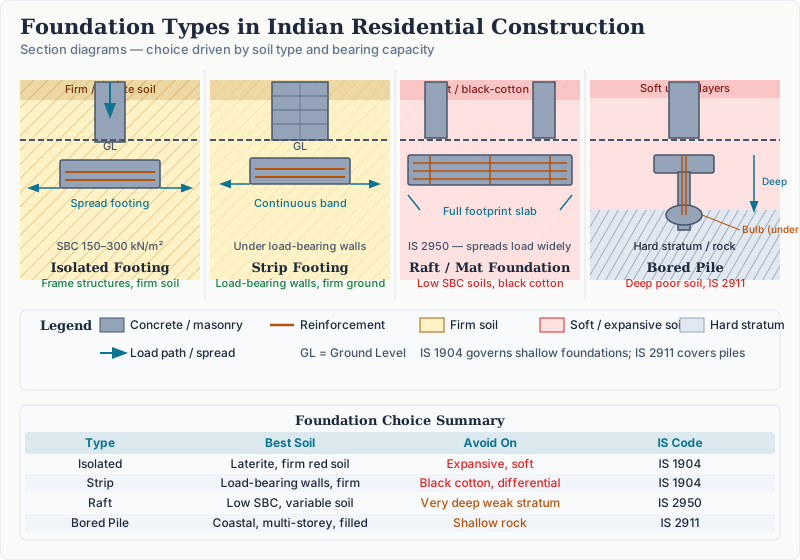
The four main foundation types in Indian residential construction, shown in section. The choice is driven almost entirely by soil type and bearing capacity at the founding depth.
Isolated or spread footings sit under individual columns in a frame structure. They are square or rectangular pads that widen the column load over a larger soil area. This is the default in most RCC frame construction on reasonably firm soil — good laterite, murram, firm red soil — and is the most economical option when conditions allow.
Strip (continuous) footings run in a continuous band under load-bearing walls. Traditional load-bearing construction in India — older homes and low-cost housing — uses this type. The wall load is spread along the length of the strip. These are simple and economical on firm soil but perform poorly on soft or expansive ground.
Combined footings link two or more columns (typically when they are close together or near a property boundary) into a single footing to prevent soil overstress or rotation.
Raft or mat foundations (IS 2950: Code of Practice for Design and Construction of Raft Foundations) cover the full building footprint with a single reinforced slab. When soil SBC is low — as in much of the black-cotton belt, soft deltaic soils along coastlines, or reclaimed land — the raft spreads the load over the largest possible area and helps equalise differential movement. Rafts are heavier, use more concrete, and cost more, but are often the only sound option on poor ground.
Pile foundations (IS 2911: Code of Practice for Design and Construction of Pile Foundations) are used when good bearing stratum lies too deep for a shallow foundation. A pile — a long column of concrete or steel driven or bored into the ground — reaches down to rock or dense soil below. Piles are common in coastal cities (Mumbai, Chennai, Kochi), on filled ground, and under multi-storey buildings. The under-reamed pile — a bored pile with enlarged bulbs at the bottom — was specifically developed in India to anchor into black-cotton soil and resist the upward heaving forces that expansive soil exerts.
| Foundation Type | Best Suited For | Problematic On | Relative Cost (1–5) | IS Reference |
|---|---|---|---|---|
| Isolated footing | Frame structures, firm/medium soils | Expansive/soft soil, low SBC | 1 | IS 1904 |
| Strip footing | Load-bearing walls, firm ground | Expansive/differential-settlement soils | 1–2 | IS 1904 |
| Combined footing | Close columns, boundary conditions | Very soft soil | 2 | IS 1904 |
| Raft / mat | Low SBC soils, black cotton, variable soil | Very deep weak stratum | 3–4 | IS 2950 |
| Pile (bored) | Deep poor soil, coastal, multi-storey | Very shallow rock | 4–5 | IS 2911 |
| Under-reamed pile | Black-cotton soil, expansive/shrink-swell | Hard rock (difficult to drill) | 3–4 | IS 2911 (Pt 3) |
For a fuller understanding of how the structural system above ground affects the load reaching the foundation, see load-bearing vs frame structures in India.
3. The Problem Soils of India
India has some of the most geologically diverse — and geotechnically challenging — soils in the world. Understanding the soil beneath your plot is not optional; it is the single most important piece of information for getting the foundation right.
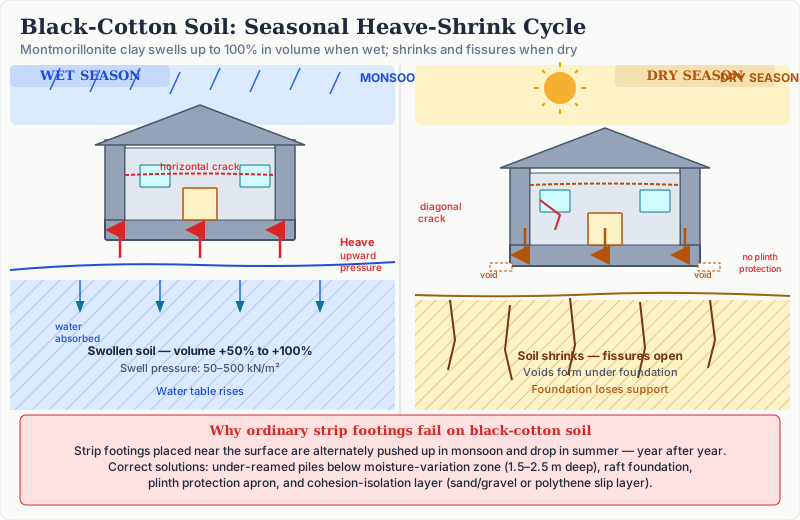
The seasonal heave-shrink cycle of black-cotton soil. In wet season, swelling creates upward pressures that no ordinary strip footing can resist. In dry season, the soil pulls away from the structure, leaving voids underneath.
Black-Cotton Soil (Expansive Soil)
This is the great Indian foundation villain. Black-cotton soil — technically a montmorillonite-rich expansive clay — covers an estimated 20% of India's landmass: most of Maharashtra, Madhya Pradesh, Gujarat, parts of Karnataka, Andhra Pradesh, and Telangana (the Deccan Plateau and its fringes). It takes its name from the cotton crops historically grown on it; structurally, it is among the most problematic soils in the world.
The mechanism is straightforward and relentless. Montmorillonite clay minerals absorb water and swell — volumetric expansion can reach 100% or more in extreme cases, and swell pressures of 50–500 kN/m² have been recorded in Indian black-cotton soils. When the soil dries in summer, it shrinks, forming deep fissures. A foundation sitting on this soil experiences upward heave in the monsoon and differential sinking in the dry season — year after year.
Ordinary strip or isolated footings placed near the surface on black-cotton soil will crack the structure above them within a few monsoon cycles. The correct responses are:
- Depth: take the foundation below the zone of moisture variation (typically 1.5–2.5 m in most black-cotton areas; the geotechnical report will specify this).
- Under-reamed piles: anchor the structure against heave with enlarged bulbs that lock into stable soil.
- Raft foundations: spread load widely and stiffen the structure against differential movement.
- Plinth protection: apron of plain concrete or stone sloping away from the building to prevent rainwater from infiltrating alongside the foundation.
- Cohesion isolation: a sand-and-gravel or polythene slip layer between the expanding soil and the foundation to reduce drag forces.
Bhuj (2001) earthquake damage surveys noted that buildings on black-cotton soil performed significantly worse than those on hard rock — the combination of poor soil and inadequate seismic detailing was devastating. The relationship between soil and seismic response is covered in the earthquake zones and home design guide.
Soft Clay and Silt
Deltaic and coastal areas — the Ganga delta, the coasts of Odisha, West Bengal, Kerala, and parts of Tamil Nadu — often have layers of very soft marine clay or alluvial silt near the surface. These soils have low shear strength, low SBC (sometimes below 30 kN/m²), and consolidate slowly under load, meaning the building continues to settle for months or years. This is primary consolidation settlement, well described in Terzaghi's consolidation theory, and is the dominant concern for any multi-storey structure in these zones.
Shallow foundations are almost always inadequate here. Pile foundations reaching a competent stratum — dense sand or rock — are the standard solution.
Filled / Made-Up Ground
One of the most common causes of foundation distress in rapidly urbanising India is uncompacted filled ground. Low-lying areas, old quarries, seasonal pond beds, or simply plots where debris, construction waste, or household fill has been dumped over years — all of these create ground that appears stable but is riddled with voids and incompletely consolidated material. The fill may be only 1 m deep, or it may extend 5–6 m. Without a soil investigation, there is no way to know.
The failure mode is differential settlement: the foundation sits partly on firm original ground and partly on loose fill, and the two halves sink at different rates. The resulting cracks are particularly painful because they often appear after the building is occupied and construction defects are hard to claim.
Always ask for a soil investigation report, even on plots that look solid. A standard borehole or trial pit investigation costs a few thousand rupees — a fraction of the lakhs required to remediate differential settlement damage.
High Water Table and Liquefiable Soils
Sandy soils with high water tables — common in coastal belts and many river-floodplain areas — carry a specific seismic risk: liquefaction. During an earthquake, loose saturated sand can temporarily behave like a liquid, losing all bearing capacity. IS 1893 and the National Building Code 2016 identify liquefaction-prone zones. In these areas, pile foundations are mandatory for any significant structure. This is explored further in the earthquake zones and home design guide.
High water tables also cause uplift pressure on raft foundations and basement slabs — a significant engineering concern for any basement construction in water-table-high zones.
Sloped Sites and Cut-and-Fill
Hillside plots in Shimla, Dehradun, Munnar, or Pune's hills require cut-and-fill earthwork: cutting into the hill on one side, building up fill on the other. The cut side is typically on original, firm ground. The fill side is, by definition, disturbed and potentially poorly compacted. A building straddling this boundary will have one part on firm material and another on fill — a recipe for differential settlement unless the fill is properly compacted and tested, or the foundation design accounts for it explicitly.
| Soil Type | Behaviour | Typical Indian Locations | SBC Range (kN/m²) | Primary Mitigation |
|---|---|---|---|---|
| Black-cotton / expansive | Heave when wet, shrink when dry | Maharashtra, MP, Gujarat, Deccan | 50–100 (in situ) | Under-reamed piles, raft, depth |
| Soft marine clay | Slow consolidation, low SBC | Bengal delta, Kerala coast, Odisha coast | 20–50 | Piles to competent stratum |
| Alluvial silt | Variable, settlement-prone | Ganga plain, river flood zones | 50–150 | Depth, sometimes piles |
| Filled / made-up ground | Differential settlement, voids | Any rapidly urbanised plot | Highly variable | Investigation, compaction, piles |
| Loose saturated sand | Liquefaction risk in earthquakes | Coastal belts, river-close plots | 75–150 (static) | Piles, ground improvement |
| Laterite / hard red soil | Good bearing, stable | Kerala, Goa, coastal Karnataka | 150–300+ | Isolated footings, normal design |
| Hard rock | Excellent bearing | Peninsular rock outcrops | 300–1000+ | Shallow footings, minimal depth |
4. Understanding Settlement — Uniform vs Differential
All buildings settle to some degree after construction. This is normal, expected, and accounted for in good design. What matters is the pattern of settlement.
Uniform settlement — the whole building going down evenly — is largely harmless unless it is excessive in absolute terms (affecting drainage, connections to services, adjacent structures). A well-designed building on uniform soft clay may settle 50–100 mm uniformly and show no distress at all.
Differential settlement — one part of the building sinking more than another — is the dangerous condition. The structural system resists being deformed into two different planes; as it is forced to do so by the soil beneath, stresses build in walls, beams, and slabs until the weakest element cracks.
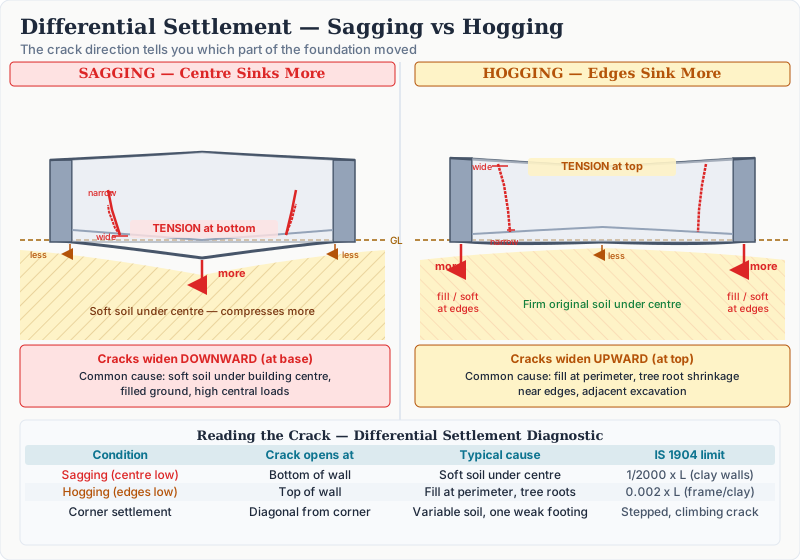
Sagging (centre settling more than edges) creates tension at the bottom, producing cracks that widen downward. Hogging (edges settling more) creates tension at the top, producing cracks that widen upward. The crack direction tells you which half is moving.
Sagging occurs when the centre of a span or building settles more than the edges — common on soft soils where the central loads are highest. The bottom of the wall is in tension; cracks widen at the base.
Hogging occurs when the ends or edges settle more than the centre — common on filled ground at the perimeter. The top of the wall is in tension; cracks widen at the top.
Diagonal cracks in masonry almost always indicate differential settlement. The direction they step — which corner they climb toward — tells the structural engineer which part of the foundation has moved. Understanding this is critical to what makes buildings crack in India, which covers crack diagnosis in detail.
"A structure is not damaged by its loads alone but by the difference in how different parts of it carry those loads."
— Matthys Levy and Mario Salvadori, Why Buildings Fall Down (1992)
| Differential Settlement Condition | Typical Cause | Crack Location | Crack Pattern |
|---|---|---|---|
| Central sagging | Soft soil under building centre | Lower half of walls | Opens at bottom, closes at top |
| Edge hogging | Fill at perimeter; tree root shrinkage | Upper portion of walls | Opens at top, closes at bottom |
| Corner settlement | Variable soil under one footing | Diagonal from corner | Stepped, climbing corner |
| One-side sinking | Adjacent excavation; leaking drain | One elevation, usually lower floor | Long diagonal, floor slope visible |
5. Warning Signs of Foundation Trouble
The building always signals before it becomes a serious problem. The signals are just easy to dismiss as "normal" or "cosmetic." Here is what to look for, what it likely means, and how urgently to act.
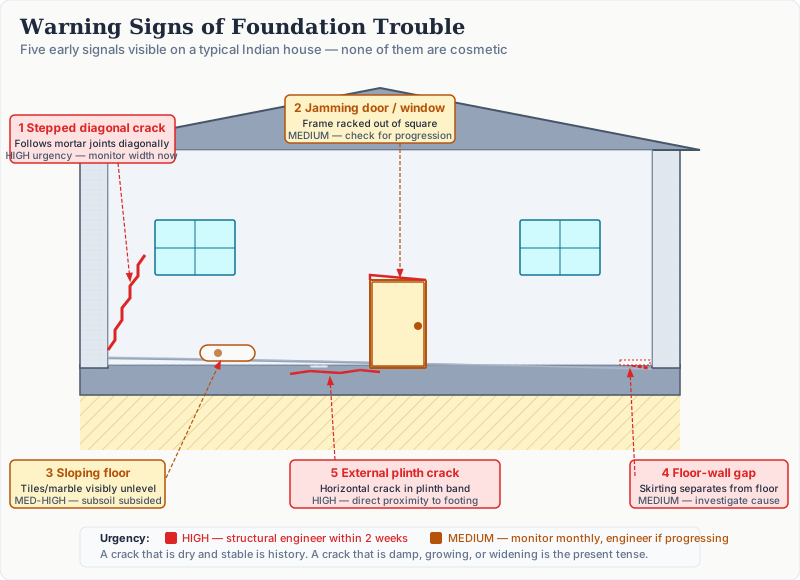
Five of the seven warning signs shown on a single house. Each sign points to a different zone of movement below ground. None of them is cosmetic.
| Warning Sign | Description | Likely Cause | Urgency |
|---|---|---|---|
| Stepped diagonal crack | Crack follows mortar joints diagonally up a masonry wall | Differential settlement, usually at a footing or corner | High — monitor width immediately |
| Jamming doors and windows | Frame has racked slightly out of square | Wall rotation from settlement or heave | Medium — check for progression |
| Sloping floor | Floor tiles or marble visibly not level | Slab or beam has deflected or subsoil has subsided | Medium–High depending on degree |
| Floor-wall junction gap | Visible gap or crack where skirting meets floor | Relative movement between wall and slab | Medium — investigate cause |
| External plinth crack | Horizontal or diagonal crack in the plinth band | Subsoil movement; poor plinth protection; tree roots | High — direct proximity to foundation |
| Tilting | Wall or column visibly out of plumb | Foundation rotation; severe differential settlement | Critical — structural engineer immediately |
| Extension separation | Gap opening between original structure and an added portion | Differential settlement between old and new foundations | High — check connection details |
"A crack that is dry and stable is history. A crack that is damp, growing, or stained with efflorescence is the present tense."
— Commonly stated in Indian structural assessment practice
For a systematic crack classification — width thresholds, crack mapping, and repair protocols — see the companion guide on what makes buildings crack in India. The broader safety context sits in structural safety in residential buildings.
6. Causes of Foundation Distress — A Diagnostic Framework
Understanding why foundation distress occurs is essential before choosing a remedy. Treating the symptom — filling the crack — without addressing the cause is expensive and futile.
| Cause | Mechanism | Common in | Key Indicator |
|---|---|---|---|
| Expansive soil movement | Seasonal heave/shrink cycle | Black-cotton belt | Cracks close in monsoon, reopen in summer |
| Inadequate founding depth | Foundation sits in zone of moisture variation | Any expansive-soil area, sloped sites | Early cracking, within first 2–3 monsoons |
| Insufficient footing size | Soil over-stressed → shear or settlement | Old buildings, extensions | Settlement cracking, sloping floors |
| Leaking underground drains | Water softens soil, reduces SBC locally | Urban plots with old plumbing | Cracks concentrated near plumbing routes |
| Poor surface drainage | Water ponds at foundation, saturates soil | Flat plots, poorly graded sites | Cracks after monsoon season |
| Tree root moisture extraction | Roots draw moisture → soil shrinks → void | Sites with large mature trees close by | Progressive cracking on tree-facing wall |
| Adjacent excavation | Removes lateral support from soil | Plots next to new construction or road widening | Sudden crack appearance during neighbour's work |
| Overloading (extra floors) | Load exceeds original foundation design capacity | Unauthorised additional floors | New cracks appearing after addition |
| Vibration | Loosens granular soils | Near heavy traffic, blasting, piling | Gradual worsening |
| Fill settlement | Incompletely consolidated fill compresses | Made-up ground, reclaimed land | Differential cracks in early years |
Water is the single greatest enabler of foundation distress. It reduces bearing capacity, lubricates failure planes, expands expansive soils, dissolves lime in old mortars, and transports fine particles (piping). Almost every cause in the table above either involves water directly or is worsened by it. The relationship between water and structural damage is explored in why buildings leak in India and waterproofing failures explained.
7. Water, Drainage, and Trees Around Your Foundation
These three elements — drainage, plumbing, and vegetation — are within a homeowner's control and collectively account for a large proportion of avoidable foundation damage.
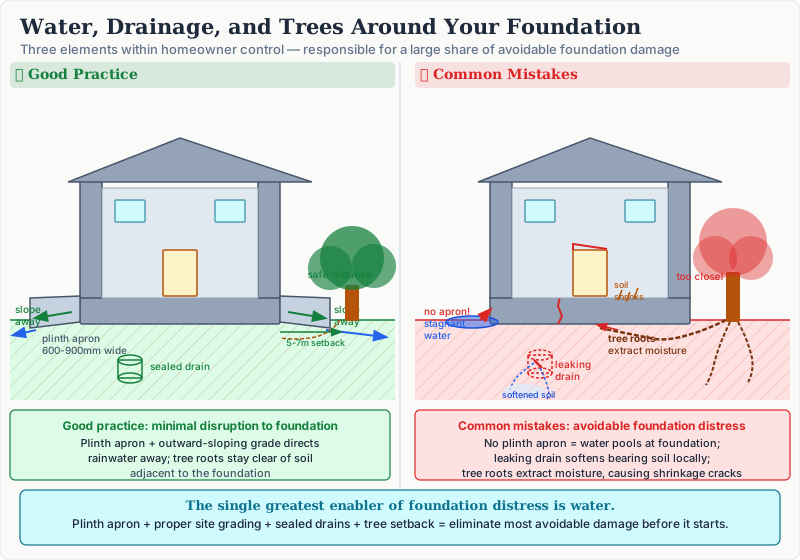
Good practice (left) vs common mistakes (right). The plinth protection apron, proper surface grading, and tree setback cost almost nothing during construction and prevent years of distress.
The Plinth Protection Apron
A 600–900 mm wide band of concrete or stone sloping at least 1 in 50 (2%) away from the building perimeter — the plinth protection apron — is one of the cheapest and most effective foundation protections. It prevents rainwater from infiltrating the soil directly adjacent to the foundation, where it does the most damage. If your building lacks this, adding it is almost always worthwhile.
The space between the apron and the external wall should be sealed with a flexible sealant (not rigid mortar, which will crack) because some differential movement at that joint is inevitable.
Surface Drainage
The ground around your building should slope away from the foundation on all sides. A common error on urban plots: the road has been raised over the years (from successive resurfacing) until it sits higher than the plinth, and rainwater flows toward the building. If this is your situation, improving site drainage — or raising the plinth protection level — is the first step.
Plumbing Leaks
Underground water pipes and drain lines that leak slowly and continuously are among the most insidious causes of foundation softening. The leak may be in a drain running beneath or alongside the foundation, leaking slowly for years before anyone notices. If cracks appear progressively in one area of the building — especially near a bathroom, kitchen, or where a drain line runs — inspect the plumbing before calling a structural engineer.
Trees
Large trees — particularly fast-growing species like eucalyptus, neem, and mango with aggressive root systems — can extract sufficient moisture from the soil adjacent to a building to cause shrinkage and settlement on that face. The effect is most pronounced in clay soils during dry seasons. As a general rule, keep trees with a projected mature canopy width of 5 m or more at least 5–7 m from the building foundation. If a large tree already exists close to a building and diagonal cracks appear on the tree-facing elevation in summer, tree root desiccation should be considered as a cause.
8. What To Do If You Suspect Foundation Problems
The single worst thing to do is nothing. The second worst is to fill the cracks and assume the problem is gone. Here is a systematic approach.
Step 1: Document and monitor. Photograph every crack with a scale reference. Mark the crack ends with a pencil line and date. Check weekly for a month. Is the crack growing? Widening? Appearing in new locations? A crack that is stable over six months is a historical event; a crack that is actively growing is a present threat.
Step 2: Look for the pattern. Are the cracks on one side of the building? After a monsoon? Near a specific plumbing run? Near a large tree? Pattern recognition narrows the likely cause.
Step 3: Get a structural and geotechnical assessment — together. A structural engineer assesses the building; a geotechnical engineer (or combined geotech-structural firm, common in India) assesses the soil. You need both. A structural engineer cannot tell you whether the soil is moving without soil data; a geotechnical engineer cannot tell you whether the damage is serious without knowing the structural system. The combined assessment typically costs ₹15,000–₹60,000 depending on scope — minor compared to repair costs.
Step 4: Soil investigation if not previously done. If there is no existing soil test for the plot, a trial pit or borehole test will be ordered. Basic tests:
| Soil Test | What It Tells You | Typical Cost Range |
|---|---|---|
| Trial pit + visual classification | Soil type, layer depths, water table, preliminary SBC | ₹3,000–₹8,000 |
| Standard Penetration Test (SPT) borehole | SBC, relative density, N-values for each stratum | ₹8,000–₹25,000 per borehole |
| Plate Load Test | Direct measurement of SBC at founding depth | ₹20,000–₹50,000 |
| Free Swell Index test | Confirms expansive soil; quantifies swell potential | ₹2,000–₹5,000 |
| Consolidation test | Settlement prediction for soft clays | ₹5,000–₹15,000 per sample |
Step 5: Diagnosis first, repair second. Do not let anyone sell you a repair without a clear diagnosis of cause. Common remedies — and they are expensive:
| Remedy | Applicable When | Approximate Cost (₹, wide range) |
|---|---|---|
| Drainage correction + plinth apron | Water is the primary cause; soil is otherwise adequate | 50,000–2,00,000 |
| Underpinning (traditional) | Foundation too shallow, needs deepening | 3,00,000–15,00,000+ |
| Micro-piling | Existing building cannot be underpinned conventionally | 5,00,000–25,00,000+ |
| Chemical grouting / compaction grouting | Voids under slab or fill settlement | 2,00,000–10,00,000+ |
| Soil stabilisation (lime/cement injection) | Expansive soil with accessible subsoil | 1,50,000–8,00,000+ |
Costs are highly site-specific and represent order-of-magnitude ranges only. The point is that investigation plus prevention at the design stage typically costs 1–5% of what remediation costs.
9. Getting It Right at the Start — The Most Valuable Investment
The cheapest time to solve a foundation problem is before it exists. This means getting the geotechnical investigation done before the structural design is finalised — not after the building is started, and certainly not after it has cracked.
"A soil investigation is not an expense — it is the most valuable piece of engineering insurance you will ever purchase."
— Indian geotechnical engineering practice consensus
In India, the soil investigation is the single most commonly skipped step in private residential construction. The architect and structural engineer often proceed with design based on a visual assessment of the site, neighbourhood precedent, or the builder's judgment. This is not adequate. A ₹10,000–₹25,000 soil investigation is the foundation of the foundation design.
What good pre-construction practice looks like:
1. Commission a soil investigation before or alongside the architectural design. The SBC and soil type are inputs to the structural engineer's foundation design — not afterthoughts.
2. Share the soil report with both the structural engineer and the architect. The structural engineer uses it to design the foundation; the architect needs to understand it to plan site drainage and plinth levels.
3. Ensure the foundation type is appropriate for your soil, not just the cheapest option. The structural engineer's drawings should explicitly reference the soil investigation.
4. During construction, verify that the foundation is being constructed to design depth. It is common — particularly in cost-pressured residential construction — for foundations to be poured shallower than designed. A few days of site supervision at the foundation stage pays enormous dividends.
5. Build the plinth protection apron as part of construction, not an afterthought.
6. Plan surface drainage before landscaping. Ensure all finished grades slope away from the building.
For a comprehensive framework on supervising construction quality — including foundation checks, concrete testing, and the site-visit schedule a homeowner should maintain — see construction quality control for homeowners.
The broader picture — what makes a building last decades rather than crack in years — is covered in the science behind durable buildings in India.
"In the whole art of civil engineering, there is no chapter more important, yet more neglected, than the investigation of the properties of the soil."
— Karl Terzaghi (1883–1963), founder of soil mechanics, paraphrased from his foundational texts
10. Foundation Drawings and What They Should Show
When your structural engineer produces foundation drawings, they should contain specific information that you — as a homeowner — can verify at site. Foundation drawings are a complete subject on their own, covered in the guide on foundation drawings explained.
Key things a homeowner can check against the drawings at site:
- The founding depth (depth from original ground level to the base of the footing). Ask the contractor to show this in the excavation before pouring.
- The plan dimensions of each footing.
- The reinforcement: bar diameter, spacing, and that bars extend into the columns above.
- That the concrete is poured against undisturbed soil (not backfill).
- That the concrete mix specified is used — M20 minimum for footings under IS 456; M25 is preferable in aggressive soils or coastal zones.
If you are working with Studio Matrx DesignAI to review your project documentation, foundation drawings are one of the categories where a structured checklist against IS 1904 requirements can catch common deficiencies before construction.
Author's Note
Foundations are invisible by design. We pour concrete into the earth, cover it over, build above, and never see it again — which is exactly why they are so easy to get wrong and so hard to fix when something goes wrong. Over the years, the pattern I have seen most often is not dramatic soil failure or catastrophic design error. It is a series of small compromises: a foundation a little shallower than designed because the contractor said the soil looked fine, a plinth apron that was never built because the landscaping budget ran out, a soil test that was skipped because "the neighbour's builder did the same thing."
The homeowner who asks the right questions before construction begins — What is this soil? What foundation type is appropriate? Where does the water go? How deep are we going? — protects not just their financial investment but a building that their family will inhabit for generations. That conversation costs nothing. The silence, sometimes, costs everything.
This guide exists because I believe every person building a home in India deserves to understand what is happening beneath their feet.
Disclaimer
This guide is for general educational purposes only. Foundation engineering is a technical discipline requiring site-specific soil investigation and professional assessment. If you observe warning signs of foundation distress in your building, commission a qualified structural engineer and geotechnical engineer to assess the site. Do not attempt repairs without a diagnosis. This guide does not constitute professional structural or geotechnical engineering advice.
References
1. Bureau of Indian Standards. IS 1904: 1986 — Code of Practice for Design and Construction of Foundations in Soils: General Requirements (Reaffirmed 2006). BIS, New Delhi.
2. Bureau of Indian Standards. IS 6403: 1981 — Code of Practice for Determination of Breaking Capacity of Shallow Foundations (Reaffirmed 2002). BIS, New Delhi.
3. Bureau of Indian Standards. IS 2950 (Part 1): 1981 — Code of Practice for Design and Construction of Raft Foundations: Design (Reaffirmed 2006). BIS, New Delhi.
4. Bureau of Indian Standards. IS 2911 (Part 1/Sec 2): 2010 — Design and Construction of Pile Foundations — Bored Cast In-Situ Concrete Piles. BIS, New Delhi.
5. Bureau of Indian Standards. IS 1893 (Part 1): 2016 — Criteria for Earthquake Resistant Design of Structures. BIS, New Delhi.
6. Bureau of Indian Standards. IS 456: 2000 — Plain and Reinforced Concrete — Code of Practice (Reaffirmed 2021). BIS, New Delhi.
7. Ministry of Housing and Urban Affairs. National Building Code of India 2016, Vol. 2, Part 4 (Fire and Life Safety), Part 6 (Structural Design). BIS, New Delhi.
8. Terzaghi, K., Peck, R. B., and Mesri, G. Soil Mechanics in Engineering Practice (3rd ed.). John Wiley and Sons, New York, 1996.
9. Bowles, J. E. Foundation Analysis and Design (5th ed.). McGraw-Hill, New York, 1997. (Standard reference for safe bearing capacity methods.)
10. Levy, M. and Salvadori, M. Why Buildings Fall Down: How Structures Fail. W. W. Norton and Company, New York, 1992.
11. Salvadori, M. Why Buildings Stand Up: The Strength of Architecture. W. W. Norton and Company, New York, 1980.
12. Katti, R. K., and Katti, D. R. "Swelling Behaviour of Black Cotton Soils." In Proceedings of the Indian Geotechnical Conference, 1994. (Seminal work on expansive soil mechanics in Indian conditions.)
13. Sridharan, A., and Prakash, K. "Classification Procedures for Expansive Soils." Proceedings of the Institution of Civil Engineers — Geotechnical Engineering, 153(4), 235–240, 2000.
14. Desai, I. D. and Oza, B. N. "Influence of Anhydrous Ammonia on Shear Strength of Expansive Soils." In Proceedings of the Southeast Asian Conference on Soil Engineering, Bangkok, 1977. (Cited for context on black-cotton soil treatment history in India.)
15. Indian Institute of Technology Bombay / Kanpur. IITK-GSDMA Guidelines for Seismic Design of Liquid Storage Tanks and Buildings on Difficult Soils. National Disaster Management Authority, New Delhi, 2007.
Export this guide
Related Guides — Deep-dive reading
Waterproofing Failures Explained: Why Systems Fail and How to Spot It
Why waterproofing so often leaks again within a year or two — the weak links in the system, the junctions that really fail, the flood test everyone skips, and how to tell a real repair from a cosmetic patch.
Structural SafetyWhat Makes Buildings Crack? Reading the Cracks in Your Home
The homeowner's guide to cracks — why every building cracks a little, how to tell a harmless cosmetic crack from a dangerous structural one by its width, direction and pattern, and when to call an engineer.
Structural SafetyCompound Wall Piers and Columns in India: Spacing, Reinforcement and Stability (2026)
Why a long, free-standing boundary wall needs intermediate piers or RCC columns to stay up — the physics of overturning in plain terms, thickened masonry piers vs reinforced-concrete columns on footings, indicative spacing that an engineer sets to your height and wind zone, the coping or tie beam that braces the top, and where to break a long run with movement joints.
Compound WallsRelated Tools — Try Free
Monsoon-Readiness Checklist
Pre-rain home audit across 9 categories — terrace, drains, waterproofing, electrical, HVAC, pest, vehicles, documents.
Seasonal AuditRainwater Tank Sizer
How big should your rainwater tank be? Computes annual harvest, recommended tank capacity in litres, water-bill savings, and payback — for 10 Indian cities.
RWH CalculatorMaterial Schedule Generator
Generate a room-wise finish schedule — walls, floors, ceilings, trim, and joinery by location.
Material Schedule