
Stone & Masonry Façades in India: Brick, Stone & Concrete Explained
Guide to stone and masonry façades in India: exposed brick vs veneer vs cladding, Dholpur/Jaisalmer sandstone, Kota, Makrana, granite, Kadappa, dry stone cladding vs full masonry, exposed concrete and precast, plus pros, cons and detailing.
Brick, stone and concrete are the oldest faces a building can wear, and in India they are also the most enduring. Long before glass towers and aluminium panels arrived, our forts, temples, havelis and government offices were built from heavy, solid masonry that has stood for centuries. This family of façades is sometimes called "the timeless family" for good reason: a well-built stone or brick wall outlives almost everything else on a building, ages with character instead of decaying, and asks very little of you in return.
This guide explains the three heavy hitters together, because they share a personality: mass, weight, durability and a sense of permanence. We will cover masonry façades broadly (brick, stone, concrete blocks and fly-ash blocks), then go deep on brick, on Indian building stones, on stone cladding versus full masonry, and on exposed architectural concrete and precast panels. We will be honest about the trade-offs too, because a heavy façade brings real costs in weight, time and money.
For the bigger picture of why a building's outer skin matters, start with our pillar guide on why building façades matter, and to see where masonry sits among all the options, read the overview of types of building façades.
1. What "masonry façade" really means
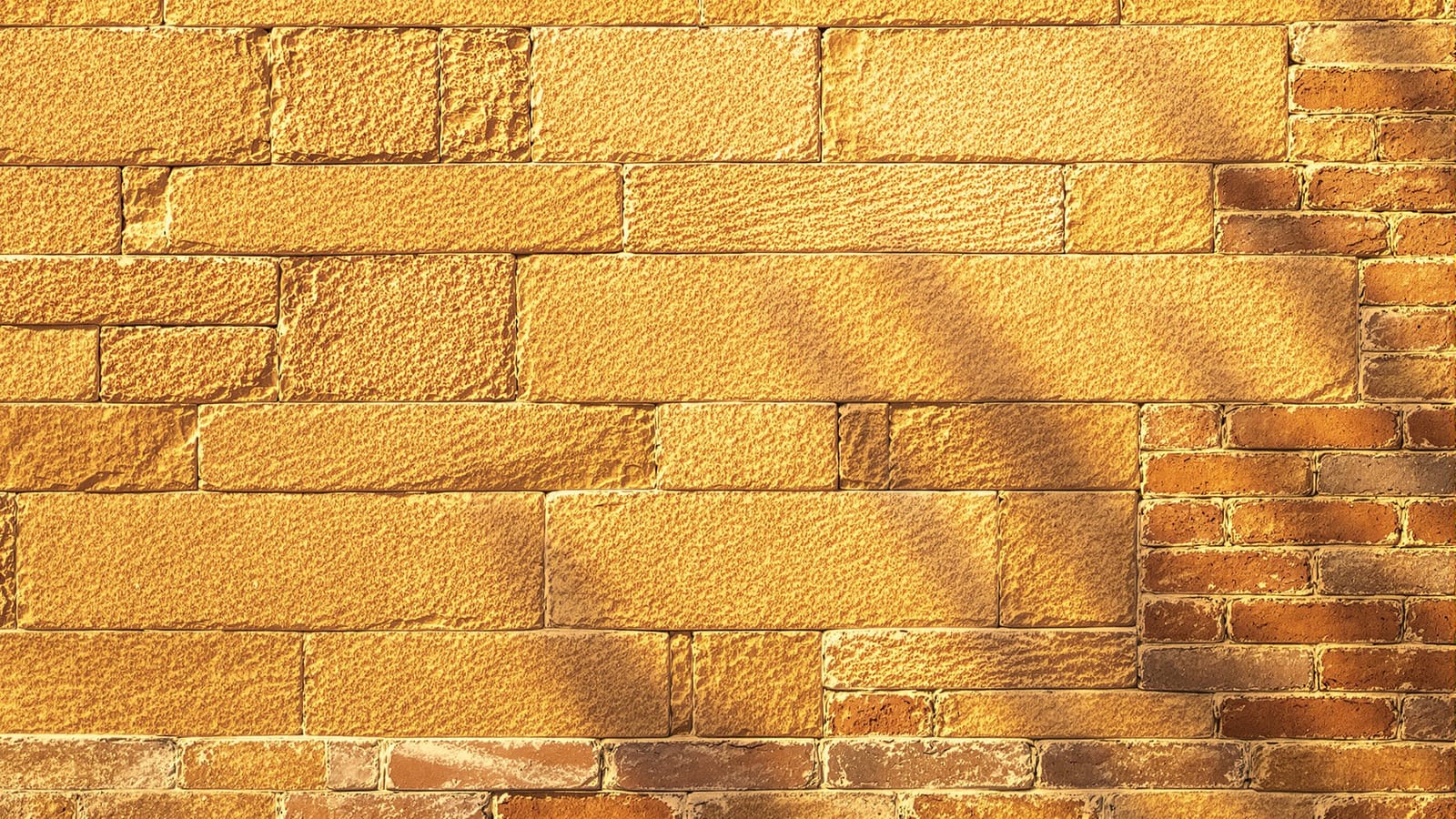
Masonry simply means a wall built from individual units stacked and bonded together: bricks, stone blocks, concrete blocks or fly-ash blocks, held by mortar (a paste of cement, sand and sometimes lime). When that wall is also the building's outer face, you have a masonry façade.
There are two big ideas to keep straight:
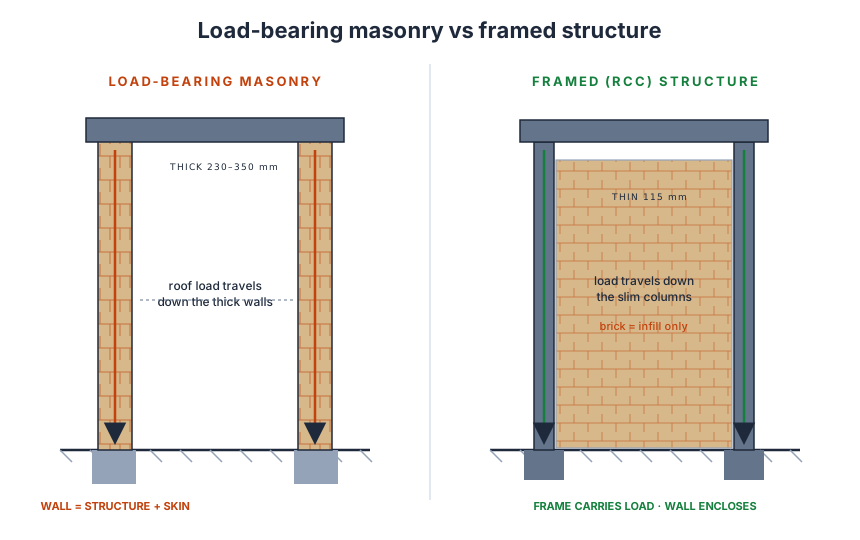
- Load-bearing masonry carries the weight of the building itself. The wall is both structure and skin. Most traditional Indian homes and heritage buildings work this way.
- Non-load-bearing masonry sits as an infill or a skin in front of a separate frame of reinforced concrete columns and beams. The frame holds the building up; the masonry just encloses and faces it. Almost every modern multi-storey building in India uses this approach.
The four common unit types you will meet:
- Burnt clay brick — fired mud, warm and characterful, the workhorse of Indian construction.
- Natural stone — sandstone, granite, limestone, marble and slate, quarried and dressed.
- Concrete block — hollow or solid grey blocks, fast to lay, often plastered over.
- Fly-ash brick / block — made from power-plant fly ash, lime and gypsum; smoother, lighter on resources, increasingly common because it reuses an industrial waste. (For how these stack up against newer products, see modern construction materials for Indian homes.)
The shared virtues of all masonry are worth stating plainly: it is durable, has good thermal mass (it soaks up daytime heat and releases it slowly, smoothing indoor temperatures), is excellent in fire, needs low maintenance, and looks timeless. The shared drawbacks: it is heavy, slow to build, and less flexible than lightweight systems once decisions are locked in.
2. Brick: the warmest face in the family
Brick is the oldest façade system humans have, and in India it carries deep cultural memory. A brick façade can appear in four broad ways:
- Exposed brick — the structural brick wall is left bare, no plaster, no paint. Every brick shows its colour and texture. This is the most honest and the most demanding, because nothing hides poor workmanship.
- Brick veneer — a single decorative layer of brick (often half-brick thick) built in front of a structural wall, tied back to it. You get the look of solid brick with less material.
- Brick cladding / tiles — thin brick slips or tiles glued onto a backing wall, giving a brick appearance as a finish rather than a wall.
- Decorative brickwork — jaalis (perforated screens), corbelled patterns, soldier courses and projecting bonds that turn the wall itself into ornament.
Brick's strengths are real: a warm, human character that improves with age, good thermal performance thanks to mass, and a very long lifespan. It suits homes, schools, boutique hotels and cultural buildings beautifully.
No discussion of Indian brick is complete without Laurie Baker, the British-born architect who made Kerala his home and turned humble exposed brick into a philosophy. His Centre for Development Studies in Thiruvananthapuram (early 1970s) is a landmark of exposed brick built in "rat-trap bond" — a way of laying bricks on edge that leaves a hollow cavity, saving roughly a fifth of the bricks and improving insulation. Baker refused to plaster over good brickwork, comparing each brick to a human face full of small, characterful variations. His buildings prove that a beautiful, lasting façade need not be expensive.
The other towering example is the Indian Institute of Management Ahmedabad, designed by Louis Kahn with B. V. Doshi and Anant Raje and completed in 1974. Its monumental exposed-brick walls, great circular openings and brick arches paired with concrete ties show brick working at an institutional scale — a dialogue between modern architecture and Indian craft.
3. Indian building stones: a regional treasure
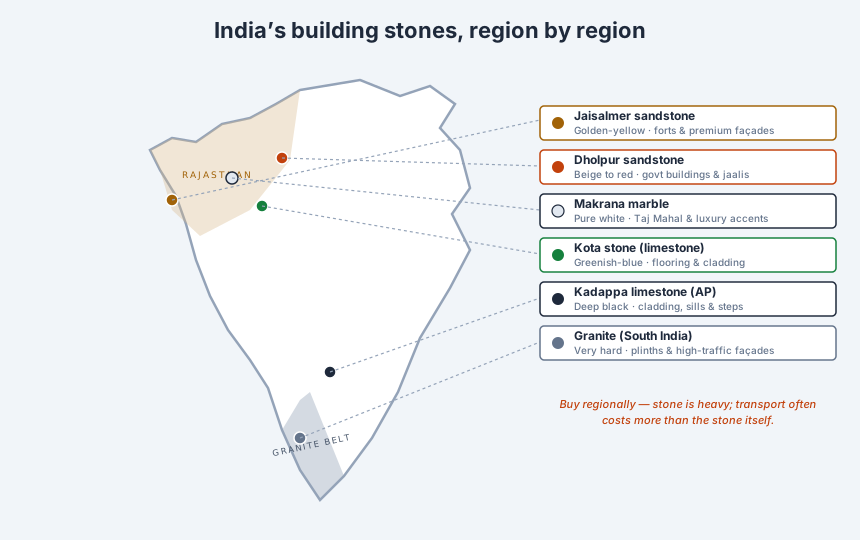
India is one of the richest stone-producing countries on earth, and each region has its own signature material. Choosing a stone is choosing a colour, a texture and often a piece of local identity. Here is an orientation table.
| Stone | Type & origin | Character | Typical use | Relative cost |
|---|---|---|---|---|
| Dholpur sandstone | Sandstone, Dholpur/Bharatpur (Rajasthan) | Beige to red, even grain, carves well | Government buildings, façades, jaalis | Medium |
| Jaisalmer sandstone | Sandstone, Jaisalmer (Rajasthan) | Golden-yellow, glowing in sun | Forts, palaces, premium façades | Medium-high |
| Kota stone | Limestone, Kota (Rajasthan) | Greenish-blue / brown, hard-wearing | Flooring, outdoor & wall cladding | Low |
| Kadappa (Cuddapah) | Black limestone, Andhra Pradesh | Deep black, smooth | Cladding, sills, steps, decorative façades | Low-medium |
| Makrana marble | Marble, Makrana (Rajasthan) | Pure white, translucent, prestige | Monuments, luxury façade accents | High |
| Granite | Igneous, South India (Karnataka, TN, AP) | Very hard, many colours, polishable | Plinths, cladding, high-traffic façades | Medium-high |
The history is written in these stones. The Taj Mahal is clad in Makrana marble; the Red Fort and Rashtrapati Bhavan in New Delhi use Rajasthani sandstone; the forts and havelis of Jaisalmer glow gold because the whole city was cut from the same sandstone. Most recently, India's new Parliament building in the Central Vista was faced with red Dholpur sandstone from Sarmathura and granite from Lakha village near Jaisalmer — a deliberate continuity with that heritage.
For a home, the lesson is to buy regionally. Stone is heavy; transport often costs more than the stone itself, so a local sandstone or Kota will almost always beat an imported marble on price and on carbon. (Stone's weight is exactly why it carries embodied-carbon implications worth understanding — see embodied carbon in construction.)
4. Stone cladding versus full stone masonry
There are two completely different ways to put stone on a building, and confusing them causes expensive mistakes.
Full stone masonry uses thick, solid blocks (often 100-200 mm or more) laid in mortar to build a real structural or semi-structural wall. This is how forts and old palaces were built. It is enormously durable but heavy, slow and labour-intensive, and needs deep foundations to carry the load.
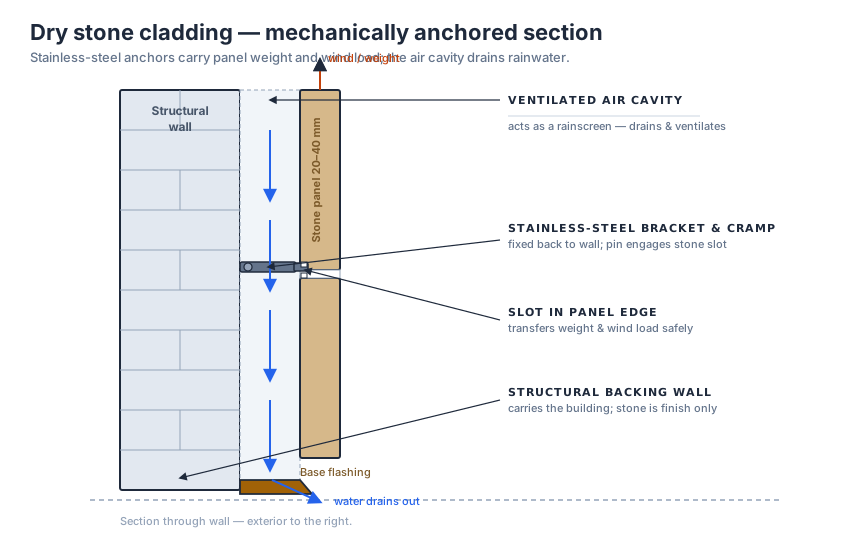
Stone cladding uses thin stone panels (typically 20-40 mm) fixed to a backing wall purely as a finish. The structural job is done by the wall or frame behind; the stone is just the face. Cladding itself splits into two methods:
- Wet (adhesive) cladding — thin tiles stuck on with cement mortar or adhesive. Cheaper, fine at low levels and small panels, but risky at height because the bond can fail and panels can fall.
- Dry cladding (mechanically anchored / dry-clad) — each panel is held by stainless-steel anchors, cramps and clamps fixed back to the wall, with an air gap behind. No reliance on glue. This is the correct, safe method for tall buildings and large panels, and it doubles as a ventilated rainscreen that drains water and lets the wall breathe.
The critical detail in dry cladding is the anchor: stainless-steel pins and angles engage slots cut into the edge of each stone panel, transferring the panel's weight and wind load safely back to the structure while leaving a drained, ventilated cavity. Get this wrong and stone panels become falling hazards; get it right and the façade lasts for generations with almost no maintenance.
5. Exposed concrete and precast panels
Concrete completes the heavy family. As a façade it appears in two forms.
Exposed (architectural) concrete, sometimes called by its French name beton brut ("raw concrete"), is concrete cast so carefully that the finished surface itself is the final face — no plaster, no paint, just the texture left by the formwork. It is bold, monolithic and maintenance-light, and it defines India's Brutalist architecture. The Indian Institute of Management Bangalore, designed by B. V. Doshi (1973), pairs exposed concrete with hand-chipped local granite; Doshi's Tagore Memorial Hall and Premabhai Hall in Ahmedabad are sculptural concrete landmarks. Done well, exposed concrete is honest and timeless; done badly, it streaks and stains, so the formwork, the mix and the curing must all be excellent the first time, because there is no cover-up.
Precast concrete panels are cast in a factory, cured under controlled conditions, then transported and lifted into place on site. Because they are made off-site:
- construction is faster — the façade arrives ready-made,
- quality control is far better than site casting,
- and site labour and mess are reduced.
Precast suits residential towers, hospitals and hotels where speed and repetition pay off. The trade-off is the need for cranes, careful joint design and good logistics — and, as with all heavy systems, the weight must be planned for from the start.
6. The honest pros and cons
Pulling the whole family together:
Strengths
- Durability — measured in decades and centuries, not years.
- Thermal mass — heavy walls buffer Indian heat, keeping interiors steadier and cutting cooling loads.
- Fire resistance — brick, stone and concrete simply do not burn, a serious advantage after India's cladding-fire tragedies with combustible panels.
- Low maintenance — no repainting cycles, no panel replacement programmes.
- Timeless character — these façades age gracefully and rarely look dated.
Weaknesses
- Weight — heavy walls demand stronger foundations and structure, adding cost and ruling out some thin-frame designs.
- Time — laying brick or stone by hand is slow; masonry projects take longer than panel systems.
- Cost — material and skilled labour can be expensive, especially for natural stone and fine exposed concrete.
- Less flexibility — once built, masonry is hard to alter or open up.
7. Detailing that decides success
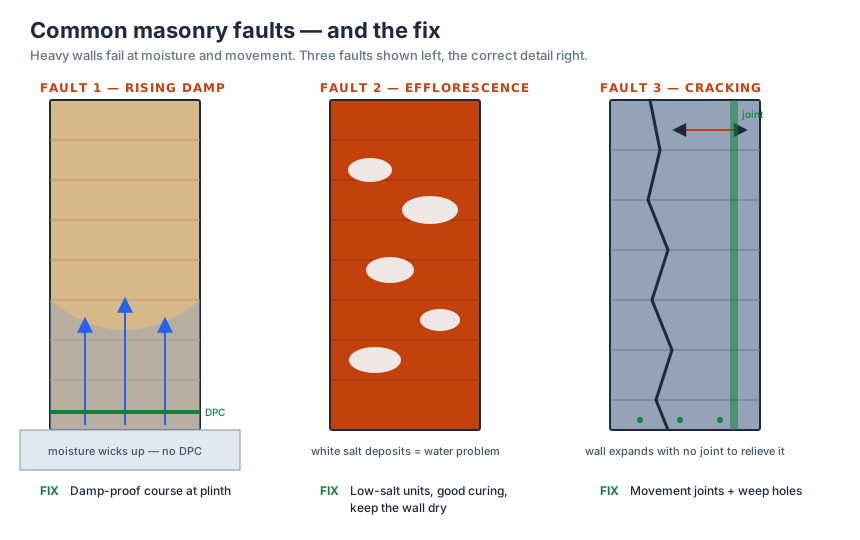
Heavy façades fail in predictable ways, almost always at the details. Watch four things:
- Anchoring and ties — every cladding panel and veneer must be tied back to the structure with corrosion-resistant (stainless-steel) fixings sized for wind and weight. This is non-negotiable on tall buildings.
- Damp proofing — masonry can wick ground moisture upward (rising damp). A damp-proof course at plinth level, plus proper flashings and drips above openings, keeps water out.
- Efflorescence — those white powdery patches on brick and stone are salts carried to the surface by moisture. Prevent them with low-salt materials, good curing and keeping the wall dry; they signal a water-management problem, not just a cosmetic one.
- Movement and weep holes — heavy walls expand, contract and need to drain. Movement joints and weep holes in cavity and rainscreen walls let water escape and stop cracking.
Because moisture is the common enemy across all of these, masonry pairs naturally with our sibling guide on façade maintenance and durability, which goes deeper into keeping any façade healthy over its life.
What this means for you
If you are drawn to a façade that will outlive you, brick, stone and concrete are the safe, beautiful choice — provided you plan for their weight and their pace from day one.
- Want warmth and character on a sensible budget? Exposed brick, ideally a regional brick laid in a proper bond, is hard to beat. Laurie Baker proved it can be both economical and lovely.
- Want prestige and longevity? Natural stone delivers, but buy local — a Rajasthani sandstone or Kota costs and carries far less than imported marble for similar life and look.
- Going above two or three storeys with stone? Insist on dry (mechanically anchored) cladding, never glued tiles, and make the anchor detail a design priority.
- Want speed at scale? Precast concrete panels trade site time for factory quality, but commit early because the structure must be designed around them.
- Above all, respect the details — anchors, damp-proofing and drainage are where heavy façades live or die. Spend your scrutiny there.
A masonry façade is a long-term relationship, not a quick dress. Chosen well and detailed honestly, it is the closest thing in building to permanence.
Sources
- Centre for Development Studies and the brick philosophy of Laurie Baker — ArchEyes and STIR World profiles of Laurie Baker.
- Laurie Baker, Wikipedia.
- IIM Ahmedabad (Louis Kahn, brick) and IIM Bangalore (B. V. Doshi, exposed concrete and hand-chipped granite) — ArchEyes; Dezeen roundup of B. V. Doshi projects; Novatr on Brutalist architecture in India.
- New Parliament building / Central Vista materials (Dholpur sandstone, Jaisalmer granite); Rashtrapati Bhavan and Red Fort sandstone — Stone-Ideas and Central Vista project notes.
- Jaisalmer yellow sandstone, Kota stone, Kadappa (Cuddapah) limestone characteristics and uses — Wikipedia (Kota Stone), Royal Indian Stones, supplier and trade references.
- Makrana marble and the Taj Mahal — Stone-Ideas; Makrana marble, Wikipedia; CAPEXIL write-up.
Export this guide
Related Guides — Deep-dive reading
Porcelain, Ceramic & Sintered-Stone Facade Cladding in India: A Practical Guide
Thin large-format porcelain and sintered-stone slabs can clad a building with the look of marble, concrete or weathered steel at a fraction of stone's weight — but on a facade, the fixing system is a life-safety decision, not a finish choice.
Building FacadesCompressed Stabilised Earth Blocks (CSEB): A Specify-and-Select Guide for India (2026)
What CSEB is - local soil plus a small percentage of cement or lime, compressed in a press and cured, never kiln-fired - its low-carbon and thermal-mass strengths, its real limits around soil, quality control and water, and how it compares with fired clay brick and fly-ash brick. A specify-and-select guide.
Building MaterialsExposed Brick Facades in India: Bonds, Jaali, Weathering and the Laurie Baker Tradition
A practitioner-grade guide to brick left as the finished skin — English and Flemish bonds, rat-trap economy, brick jaali, pointing, efflorescence and the monsoon physics that decide whether exposed brick ages gracefully or stains.
Building FacadesRelated Tools — Try Free
Brise-Soleil Visualizer
Interactive horizontal-louvre cut-off angle calculator — sun altitude, louvre depth, and spacing inputs with a live shadow preview. Computes θ = arctan(spacing/depth) for façade shading, ECBC envelope compliance, hospital daylight design, and tropical sun-control detailing.
Sun Shading ToolHome Building & Interior Cost Calculator — 20 Cities
Construction + interior costs for 20 Indian cities across kitchen, wardrobes, flooring, painting, ceiling.
Cost CalculatorCross-Ventilation Analyzer
Estimate airflow and air changes per hour (ACH) from room size, window areas, layout, and local wind — with NBC 2016 Part 8 compliance check.
Ventilation Calculator