

How Wind Loads Affect Buildings: A Homeowner's Guide
Wind as a structural force — push, suction and the roof-lifting uplift that wrecks homes in India's cyclone belt; what makes a house wind-resilient, and why so many compound walls fall.
The morning after Cyclone Fani crossed the Odisha coast in 2019, the images were the same as they always are after a major storm: concrete walls standing, roofs gone. Entire neighbourhoods of brick-and-mortar houses sat open to the sky — their structure mostly intact, their corrugated-iron or AC-sheet roofs stripped away like the lids of tins. The walls did not fall. The roof flew.
This is the single most important thing homeowners misunderstand about wind. We picture wind as something that pushes. We imagine the force pressing against a wall like a hand against a door. That part is real. But the force that tears roofs off buildings is mostly the opposite — it is suction. Wind flowing over a roof creates lift, exactly the same aerodynamic principle that gets a 400-tonne aircraft off the ground. When you add a broken window on the windward side pressurising the interior, you have a textbook recipe for roof failure. The wall was never the weak link.
Wind load is the dynamic pressure of moving air acting on a building as a combination of push, suction and uplift — forces that must be designed for just as carefully as the weight of people and furniture inside.
Understanding what wind actually does to your house is especially important if you live on or near India's coastlines, on an exposed hilltop, or in a city with tall neighbouring buildings that funnel gusts into unpredictable corridors. This guide explains the physics in plain language, maps India's wind zones from IS 875 Part 3, identifies the most vulnerable parts of your home, and tells you what to look for and what to ask your engineer.
1. India's Wind Map — How Fast Is the Wind Where You Are?
India's wind design standard is IS 875 (Part 3): 2015 — Wind Loads on Buildings and Structures, published by the Bureau of Indian Standards. It establishes the Basic Wind Speed (Vb) for 1,476 locations across India, measured at 10 m height over level open terrain, averaged over a 3-second gust at a 50-year return period. This is the starting point before applying terrain, height, and topography factors.
The country divides broadly into five speed zones:
| Zone | Basic Wind Speed | Representative Cities/Coasts |
|---|---|---|
| Zone I | 33 m/s (119 km/h) | Most of interior Rajasthan, parts of MP, sheltered river valleys |
| Zone II | 39 m/s (140 km/h) | Delhi, Jaipur, Ahmedabad (inner), Pune, interior Karnataka |
| Zone III | 44 m/s (158 km/h) | Mumbai, Bengaluru, Hyderabad, Chennai (inner), most of Kerala |
| Zone IV | 47 m/s (169 km/h) | Kolkata, Bhubaneswar, Visakhapatnam, coastal AP, Surat |
| Zone V | 55 m/s (198 km/h) | Cyclone-prone east coast (Paradip, Bheemunipatnam), Rann of Kutch, Andaman & Nicobar |
"The basic wind speed map is not a worst-case — it is a statistical return period. Along India's cyclone-prone eastern and north-western coasts, actual storm gusts in a severe cyclonic storm regularly exceed the mapped value for very short durations." — Field note, National Disaster Management Authority guidance on cyclone-resilient construction, 2020.
The high-wind belt in India runs in two main arcs. The first follows the entire eastern coastline from West Bengal through Odisha, Andhra Pradesh and Tamil Nadu — the Bay of Bengal cyclone corridor that produces 6–7 tropical cyclones per year on average. The second is the north-western Gujarat coast (Saurashtra, Kutch) exposed to Arabian Sea storms. Hill stations in the northeast, the Andaman Islands, and exposed plateau edges also see elevated wind speeds. If your site is on a hilltop, a coastal promontory, or at the edge of a coastal plain, the mapped basic wind speed can increase by a terrain/topography factor of 1.1–1.4 under IS 875.
Your structural engineer is required by code to apply three correction factors to Vb before computing design wind pressure: k1 (risk/return period factor — usually 1.0 for permanent homes), k2 (terrain, height and structure-size factor — increases with height), and k3 (topography factor — higher on hills, ridges). The design wind speed Vz = Vb × k1 × k2 × k3. The design wind pressure p = 0.6 × Vz² (in Pa, with Vz in m/s). That squaring of velocity is the critical relationship — doubling wind speed quadruples pressure.
2. The Four Ways Wind Loads a Building
Wind acts on a building through four distinct mechanisms. Understanding them separately makes it far easier to understand why different parts of a house fail in different ways.
| Effect | Where It Acts | Direction | Typical Target |
|---|---|---|---|
| Windward pressure | Face of building facing wind | Inward push | Walls, windows, shutters |
| Leeward suction | Face of building away from wind | Outward pull | Walls, leeward openings |
| Roof uplift | Upper surface of roof | Upward lift | Sheet roofs, light slabs, parapets |
| Overturning / sliding | Whole building base | Tipping/sliding | Compound walls, tall narrow structures, water tanks on terrace |
Windward pressure is the intuitive one. Air piles up against the face of a building and pushes inward. Pressure is roughly 0.8 times the free-stream dynamic pressure on a normal windward wall.
Leeward suction is less obvious but equally real. As wind separates around a building, the wake zone on the downwind side is at lower pressure than the surroundings — so it pulls outward on the leeward wall with roughly 0.5 times the dynamic pressure. This is why you can see windows and shutters blowing outward in storms, not just inward.
Roof uplift is the most dangerous effect for most Indian homes. Air has to accelerate over a roof to maintain continuity — it speeds up, pressure drops (Bernoulli's principle, the same physics as an aircraft wing). The roof surface is then at lower pressure than the air inside the building, and the pressure difference acts as a net upward force on the roof. For a moderately pitched roof at a basic wind speed of 44 m/s, uplift pressures can reach 600–900 Pa — that is equivalent to 60–90 kg pressing upward on every square metre of roof. A 100 m² roof could experience total uplift in the range of 6,000–9,000 kg. If the sheet anchors or timber purlins are fastened with undersized or corroded bolts, the result is the empty-shell image from every post-cyclone news report.
Overturning and sliding affect the whole building as a rigid body. A tall, slender, or lightweight structure — a compound wall, a pre-fabricated site office, a water tank on stilts — can be pushed sideways (sliding) or tipped over (overturning). Compound-wall failures are the single most common wind-related structural failure in Indian cities, and will be covered in detail in Section 8.
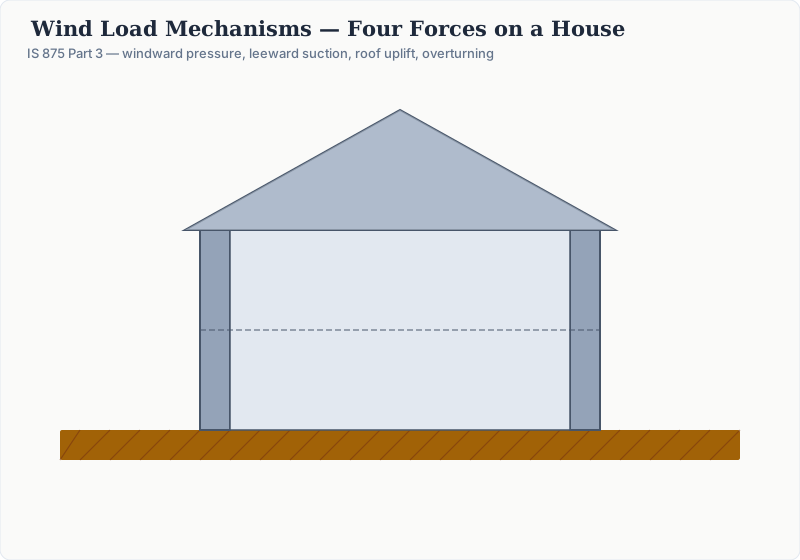
The four wind load mechanisms act simultaneously. Roof uplift is almost always the dominant force for residential buildings — it is a pulling force, not a push.
3. Why Roofs Blow Off — The Aerodynamics of Uplift
Imagine holding a piece of paper flat in front of you and blowing hard across its top surface. The paper rises. That is Bernoulli's principle at domestic scale — fast air means low pressure; slow or still air means high pressure. The roof of your house does exactly the same thing.
When wind meets a house, it must flow around and over the obstruction. Over the roof, it accelerates. The faster the air moves, the lower the pressure it exerts on the roof surface. Meanwhile, inside the building, the air is still or moving slowly — so interior pressure is relatively higher. This pressure difference acts as a net upward force on the roof.
For a gable (triangular pitched) roof, the situation is especially severe at the windward eave and at the ridge — IS 875 defines suction coefficients of -0.8 to -1.0 on windward roof slopes and -0.4 to -0.6 on leeward slopes for typical pitch angles. The worst uplift zone is the roof corners and the first metre from the eave — this is where sheet roofs peel first.
A hip roof (sloping on all four sides, no vertical gable ends) performs better because the aerodynamic pressure distribution is more balanced and the absence of vertical gable walls reduces the overall wind catch area. This is why coastal and cyclone-resilient building guides — including NDMA's Cyclone Resilient Construction guidelines — consistently recommend hip roofs for high-wind zones.
"A roof is essentially an inverted aircraft wing. The design philosophy must explicitly account for the direction and magnitude of uplift, not just gravity loads." — Mario Salvadori, Why Buildings Stand Up, W.W. Norton, 1980.
Roof type matters, but so does how the roof is fixed. Corrugated steel/GI sheets must be fastened with J-hooks or hook bolts through the sheet and into the purlin, at every corrugation at the eave and every other corrugation in the field. IS 875 Part 3 requires holding-down bolt design for all lightweight sheet roofs in wind zones IV and V. In practice, many contractor-built roofs use four to six bolts per sheet instead of the required 20–30, and the difference shows after the first major storm.
| Roof Type | Wind Performance | Key Vulnerability | Best for High-Wind? |
|---|---|---|---|
| Hip roof (4 slopes) | Best | Eave corners | Yes — preferred |
| Gable roof (2 slopes + vertical ends) | Moderate | Windward gable end, ridge | Acceptable with tie-downs |
| Flat concrete slab | Good (if well built) | Parapet walls, inadequate waterproofing | Yes — if parapets anchored |
| Corrugated sheet (GI/asbestos) | Poor without anchors | Purlin connections, eave bolts | Only with full bolt schedule |
| Thatched / lightweight | Very poor | All connections | Not for exposed high-wind sites |
A hip roof gives wind fewer purchase points. The absence of a large vertical gable face alone reduces the windward pressure load significantly.
4. The Broken Window Problem — Internal Pressure
Now add one more element to the roof-uplift scenario: an open or broken window on the windward side of the house.
When the windward wall is intact and all openings are closed, the wind pressure on the outside of the roof and the internal pressure inside the building approximately balance in a way that the code accounts for. The standard assumes that a building is "predominantly closed" unless openings are present.
But if the windward face has a large opening — a door blown in, a window shattered by debris — high-pressure air from outside floods the interior. Interior pressure rises sharply. The roof is now being lifted from below by the pressurised interior air AND sucked upward from above by the aerodynamic effect. The combined uplift can be 30–50% greater than for a sealed building. This is the failure mode behind the "the wall survived but the roof is gone" pattern. It is also why cyclone protocols everywhere say the same thing: seal all openings and board up windows before the storm arrives. The structural integrity of the roof literally depends on it.
IS 875 Part 3 includes an internal pressure coefficient (Cpi) for buildings with openings. For a building with dominant openings on the windward wall, Cpi = +0.7 (internal suction on the roof is increased). Engineers must add this to the external suction coefficient to get the total design uplift.
A single broken window on the windward side can transform a building from a survivable wind event to a roof-loss event. Cyclone shutters and storm-proof glazing are structural decisions, not cosmetic ones.
5. Factors That Change the Wind Load on Your Building
Wind loads are not fixed at the basic wind speed. Five factors determine whether your actual design wind pressure is close to the mapped value or significantly above it.
Velocity squared. Because wind pressure p = 0.6 × Vz², a 25% increase in wind speed produces a 56% increase in pressure. Going from a 44 m/s design speed to a 55 m/s cyclone-zone speed increases design pressure by 56% — not 25%. The non-linear relationship is why cyclone zones require fundamentally different structural detailing, not just slightly stronger elements.
Height. Wind speed increases with height above ground. A terrace-level shed at 9 m sees roughly 15–20% higher wind pressure than the same structure at ground level, depending on terrain. An exposed terrace water tank at 10 m, a solar panel array on a flat roof, or a staircase room (mumty) on top of the building all experience meaningfully higher wind loads than the code-minimum assumptions for a low-height residential structure.
Terrain category. IS 875 Part 3 defines four terrain categories based on how much roughness the surrounding landscape provides. Open coastal terrain (Category 1) gives the wind no obstacles — the k2 factor is highest. Dense urban zones with many closely-spaced buildings (Category 4) provide significant sheltering. A house in a dense old city neighbourhood and a house at the edge of a coastal fishing village can face the same nominal wind zone but very different actual design pressures.
| Terrain Category | Description | Effect on Wind Load |
|---|---|---|
| Category 1 | Open sea coast, flat open terrain, few obstacles | Highest — full exposure |
| Category 2 | Open terrain with scattered trees / low structures | High |
| Category 3 | Well-wooded areas, suburbs, small towns | Moderate |
| Category 4 | Dense urban with large tall buildings nearby | Lowest — significant sheltering |
Building shape. Curved plan forms, octagonal rooms, and buildings with no large flat faces experience lower pressure. Rectangular boxes are the least aerodynamic. Long facades facing the prevailing wind maximise windward pressure; L-shaped plans create turbulent pockets at the re-entrant corner that can be worse locally. Overhanging elements — chajjas, cantilevered balconies, pergolas — act as sails, catching upward suction on their undersides.
Openings and their distribution. As discussed in Section 4, the ratio of windward to leeward openings determines the internal pressure coefficient and therefore the roof uplift design load. A building engineer will classify your building as "predominantly closed," "with dominant openings on windward wall," etc., and apply the appropriate Cpi value.
6. What Makes a Home Wind-Resilient
Wind resilience in a residential building is about the continuous load path — the ability of the wind force to be transferred through every connection from the roof sheet, through the purlin, through the rafter or truss, through the wall or column, through the foundation, into the earth. Every link in that chain must be adequate. The chain fails at its weakest link, which in Indian construction is almost always the connection, not the member itself.
Roof tie-downs and anchor bolts. For sheet roofs, this means the full complement of J-hooks or hook bolts at the designed spacing, with adequate washer and nut size to resist pullout. For concrete or clay-tile roofs over timber trusses, hurricane ties (metal anchor clips) connect the truss to the top of the wall plate. For RCC roofs, the slab and beam-to-column joint provides inherent robustness — but parapet walls and the mumty must still be checked.
Hip roof vs gable roof. In a high-wind zone, the choice of roof form is a structural decision. If you are building in Wind Zone IV or V, asking your architect to design a hip or hipped-gable roof is not an aesthetic preference — it is a meaningful reduction in design wind load.
Cyclone shutters and impact-resistant glazing. These are classified as structural elements in NDMA's cyclone-resilient construction guidelines. Standard glass shutters in aluminium frames fail at relatively modest wind pressures and produce a windward opening that triggers the internal pressure failure mode. Cyclone-grade shutters use thicker gauge steel with concealed bolt anchorage; impact-resistant laminated glass prevents the shattering-debris spiral.
Parapets, chajjas and canopies. Unreinforced brick parapets on terrace rooftops are extraordinarily vulnerable to wind. They act as sails at the highest wind-speed zone (top of building) with minimal connection to the main structure. Chajjas (sun shading overhangs) over windows present a large horizontal upward-facing surface that wind can get under — if not properly anchored with rods embedded in the lintel above, they tear off and become projectiles.
Solar panels, water tanks, signage. Anything mounted on a flat roof at the highest wind exposure point must be professionally anchored. A 500-litre overhead water tank on a 3 m riser pipe has significant overturning moment in a 50 m/s wind. Solar panel frames specified by installers for gravity loads may not be sized for wind uplift.
Continuous load path to foundation. Roof anchor → rafter/purlin → wall/column → plinth beam → foundation. If any element in the chain is not designed for the wind uplift, the chain breaks there. In an RCC framed building, the column-foundation connection is usually robust. In a load-bearing masonry building, the roof-to-wall connection needs explicit ties or ring beams (IS 4326 and IS 13828 recommend a reinforced concrete band at roof level for all seismic zones — this also provides the continuous tie-down for wind). For the full treatment of load-bearing vs framed structures, see the companion guide on load-bearing vs frame structures.
Heavier vs lighter roofs. Counter-intuitively, a heavier roof — a 125 mm RCC slab — is more resistant to uplift than a lightweight GI sheet roof for the same plan area, because its dead weight must be overcome before uplift can happen. This does not mean RCC roofs are undesigned for wind; they must still be designed for wind pressure on parapets and for the lateral force on the building as a whole. But for pure "will the roof stay on" resilience in a cyclone, mass works in your favour.
7. The Most Vulnerable Elements — A Homeowner's Reference Table
| Element | Why Vulnerable | Typical Failure Mode | Mitigation |
|---|---|---|---|
| GI/AC sheet roof | Low dead weight, weak purlin connections | Peeling from eave corners inward | Full bolt schedule, J-hooks at every corrugation at eave |
| Unreinforced brick parapet | Tall sail at highest wind zone, weak base joint | Overturning, toppling onto terrace or street | RCC coping, vertical dowels into slab, limit height to 600 mm without piers |
| Cantilever chajja | Upward wind pressure on underside, bending at root | Shear/tearing at wall connection | Anchor rods into lintel/beam above, adequate concrete cover |
| Compound / boundary wall | Large sail with no moment-resisting base | Overturning along length | Masonry piers at max 3 m centres, embedded footing, RCC coping |
| Boundary gate (wide leaf) | Wind load × gate area = large force on hinges and latch | Hinge failure, gate wrapping, post pullout | Limit gate leaf width, heavy-duty hinges, windproof latch |
| Solar panel array | Uplift on panel underside, torsion on frame | Frame anchor pullout from slab | Wind-load-certified mounting frames, anchor into structural slab not screed |
| Overhead water tank | Overturning moment on riser pipe | Pipe/joint failure, tank toppling | Proper structural support frame with bracing, professional design |
| Temporary site structures | No design, weak connections | Collapse, sheets becoming projectiles | Remove or lash down before storm; not substitute for permanent structures |
| Signage / hoardings | Large flat sail, poor anchorage | Mast failure, hoarding becoming a missile | Engineer-certified frames, municipal approvals required |
8. Compound Walls and Wind — India's Underrated Failure
The collapse of compound walls during high-wind events and during earthquakes is one of the leading causes of injury and death in Indian residential areas — yet it receives almost no attention in mainstream building discussions. In every major cyclone that tracks inland, boundary walls along roads fall outward and injure or kill pedestrians and motorists. It is a real, recurring, preventable failure.
A standard 230 mm thick brick compound wall, 2 m tall, presents roughly 2 m² of vertical surface per metre of length. At a design wind pressure of 800 Pa (typical for Zone III at 10 m height), each metre of wall receives a lateral force of approximately 1,600 N — that is a 160 kg push along every metre of wall length. A wall that is simply a continuous brick ribbon with no piers and no embedded footing has very little resistance to this overturning moment. Mortar joints are the weak point; they fail in tension.
IS 875 Part 3 and the National Building Code 2016 both require that freestanding walls be designed for the appropriate wind pressure. The standard solution used by competent contractors is:
"Every post-cyclone damage survey in India reports compound wall collapses as a major source of injury. The irony is that the walls are not structurally complex — they simply need piers, a footing, and a coping. The cost is marginal; the ignorance is expensive." — National Cyclone Risk Mitigation Project, post-disaster assessment notes, 2014.
1. Masonry piers (pilasters) at intervals of no more than 3 m, bonded into the wall and embedded in a pad footing.
2. A reinforced concrete strip footing under the full length of the wall, not just under the piers.
3. An RCC coping at the top of the wall — a capping beam that ties the masonry together and prevents the top course from flying off.
4. Wall height limited to a ratio that the unreinforced masonry can carry — typically 2 m maximum between piers for a 230 mm wall.
5. Weep holes or open-joint panels in garden walls where wind can pass through (perforated compound walls carry lower wind loads than solid ones).
A compound wall is a structural element. A wall that topples during a storm or earthquake becomes a weapon. The cost difference between a correct design and a hollow-brick ribbon is minimal; the safety difference is enormous.
9. Wind, Earthquake, and the Lateral Load Family
Wind and earthquake are both lateral loads — forces that push a building sideways rather than straight down. Many of the structural elements that resist one also resist the other: shear walls, moment frames, diaphragm action in floor and roof slabs, and robust column-to-foundation connections.
But they are fundamentally different in character.
Wind is a sustained, quasi-static force during a storm — it may blow steadily for hours, with gusts superimposed. The engineer must design for the peak gust pressure, but the structure has time to respond quasi-statically. The critical design case is usually a combination of gravity + peak wind on the windward face with suction on the leeward.
An earthquake is a short, cyclic, reversing force — it lasts 10–60 seconds and changes direction many times per second. The structure must not just resist the peak force but dissipate energy through many loading cycles. Design rules for ductility (IS 13920) are specific to earthquakes and are not directly required for wind. However, a building designed for a high seismic zone (Zone IV or V under IS 1893) is inherently well-connected, well-tied, and well-anchored — qualities that also make it wind-resilient.
For a homeowner in coastal Andhra Pradesh or coastal Gujarat, the most demanding scenario is often the combination of both — a severe cyclonic storm produces strong winds (wind design governs for the roof) AND can cause ground shaking (earthquake design governs for the lateral frame). Both loads must be checked, though codes typically do not require them to act simultaneously at their full design values.
For the full treatment of seismic design, see the companion guide on earthquake zones and home design. Both guides together give a complete picture of the lateral load demands on your home. These are part of the broader structural safety for residential buildings series.
"Wind and earthquake are siblings — both lateral, both invisible, both indifferent to whether your building was formally designed. The difference is duration: wind gives you hours of warning; earthquake gives you none." — S.K. Duggal, Earthquake Resistant Design of Structures, paraphrased field application note.
10. Pre-Monsoon Wind Checklist and What to Ask Your Engineer
Pre-Monsoon Wind and Storm Check
Run this check every year before the monsoon in India's high-wind zones, and before cyclone season on the eastern and north-western coasts.
| Item | Check | Action if Problem Found |
|---|---|---|
| GI/AC sheet roof | Look for loose sheets, missing bolts, rust at bolt holes | Re-anchor with new J-hooks; replace corroded sheets |
| Roof eave edges | Check for lifted or bent eave corners | Press down and re-anchor; add extra bolts at corners |
| Parapet wall | Check for cracks at base, bulging, missing coping | Do not ignore — engage mason immediately; loose parapets are deadly |
| Chajjas and canopies | Look for cracks at root, tilting, open joints | Structural engineer assessment before monsoon; do not use below until assessed |
| Compound wall | Check for leaning, cracking at base, missing piers | Engage structural engineer; do not wait — if leaning, emergency shoring |
| Overhead water tank | Check pipe connections and support frame | Engineer check if tank is over 500 litres on a riser |
| Solar panels | Check all mounting bolts and frame anchors | Re-torque loose bolts; replace corroded anchors |
| Doors, windows, shutters | Check hinges, latches, frame anchors | Replace worn hardware; board up large glass panels before a named storm |
| Trees and branches | Check for branches overhanging roof or wall | Prune before storm season; large trees near the house should be assessed by an arborist |
| Site drainage | Check that terrace drain pipes are clear | Clear blocked drains — waterlogging adds dead load to terrace |
What to Ask Your Engineer in a High-Wind Zone
If you are building in Wind Zone III, IV, or V, or on an exposed coastal/hilltop site, here are the questions your structural engineer should be able to answer without hesitation:
1. What is the Basic Wind Speed for my site, and what terrain category applies to my specific plot?
2. Have the roof anchor and purlin connections been designed for the calculated uplift — what is the bolt schedule for the sheet roof, if any?
3. Are the parapets and chajjas designed as separate structural elements with their own wind load calculations?
4. Has the compound wall been designed to IS 875, with piers and footing at the correct spacing?
5. Is the building classified as "predominantly closed" or "with dominant openings" for internal pressure calculation?
6. For a cyclone-prone site: has the building been designed for the Cyclone Resilient Construction guidelines of NDMA 2020?
7. What is the continuous load path from the roof sheet anchor to the foundation, and where is the weakest link?
"The engineer's job is not to make a building that cannot fail — it is to make a building that fails safely and predictably, giving occupants time to escape. In wind design, 'failing safely' almost always means the roof lifts before the walls fall." — Field maxim, structural engineering practice.
11. The Most Dangerous Combination: Wind + Poor Construction Quality
All the wind-load calculations in IS 875 assume that materials meet their specified strengths and that connections are built as designed. In practice, much of India's residential construction bypasses formal structural design entirely. A contractor-built house with no structural drawings, built in Wind Zone IV, with a corrugated-iron roof held down by six bolts per sheet, no piers in the compound wall, and unreinforced brick parapets is not a design failure — it is a construction practice that was never designed at all.
The cost of doing it right is modest relative to the total construction budget:
- Roof tie-down bolt upgrade for a 100 m² sheet roof: ₹8,000–₹18,000 (labour + materials, 2026 estimate).
- RCC ring beam at roof level instead of no beam: ₹25,000–₹60,000 for a typical 1,000 sq ft home.
- Compound wall with piers vs continuous unreinforced brick: ₹150–₹300 per running metre additional, depending on wall height.
- Cyclone shutters vs standard aluminium-frame windows: 2×–3× the window cost, but a fraction of roof-repair cost.
The damage from a single severe cyclone to a poorly constructed home — roof replacement, water damage, structural repair, temporary accommodation — routinely runs into ₹3–₹10 lakh or more. The math strongly favours getting it right during construction.
For guidance on monitoring construction quality yourself, the companion guide on construction quality control for homeowners covers what to observe at each stage. Understanding how wind and other forces interact with the building over its lifetime is core to the science behind durable buildings. And if wind-induced damage leads to foundation movement or cracks, the guides on foundation problems and what makes buildings crack will help you interpret what you see.
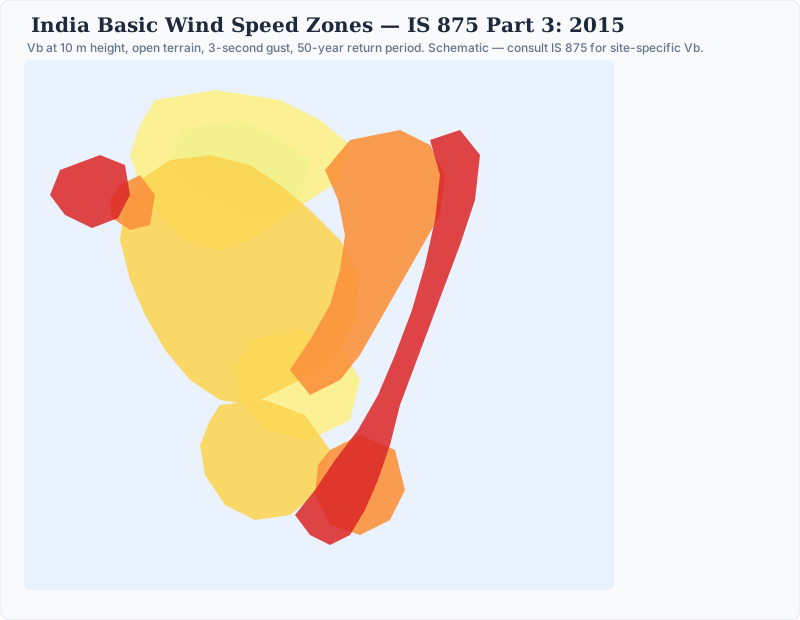
India's two high-wind arcs: the Bay of Bengal eastern coast cyclone corridor, and the Arabian Sea north-western Gujarat coast. Interior cities are in lower wind zones, but elevated sites and hilltops can experience significantly higher local speeds.
If you are early in the design process for a home in a high-wind zone, Studio Matrx DesignAI can help you explore wind-resilient design options and brief your architect on the right questions to ask.
Author's Note
My father designed buildings in coastal Karnataka for more than two decades. After every monsoon, he would walk sites and look at what the wind had tried and failed to pull apart. He used to say that a building tells you exactly what it is afraid of — if you know where to look. A lifted eave tells you the bolt schedule was wrong. A cracked parapet base tells you it was never tied to the slab. A toppled compound wall tells you there were no piers.
Wind forces are invisible until they are not. The physics is well understood and codified in IS 875. The gap is almost never in the knowledge — it is in whether anyone demanded that the knowledge be applied on your specific site, on your specific building. That is why homeowners asking the right questions matters. A client who asks "what is the bolt schedule for my roof?" is a client whose roof survives the storm.
Disclaimer
This guide is intended as educational material to help Indian homeowners understand wind loading concepts and ask better questions. It does not constitute structural engineering advice for any specific building or site. Wind load calculations must be performed by a licensed structural engineer using IS 875 (Part 3): 2015, applicable IS codes, and site-specific data. Never use this guide as a substitute for a professional structural assessment, particularly in cyclone-prone or high-wind-exposure locations.
References
1. Bureau of Indian Standards. IS 875 (Part 3): 2015 — Code of Practice for Design Loads (Other than Earthquake) for Buildings and Structures, Part 3: Wind Loads. BIS, New Delhi.
2. Bureau of Indian Standards. IS 875 (Part 1): 2015 — Dead Loads. BIS, New Delhi.
3. Bureau of Indian Standards. IS 875 (Part 2): 2015 — Imposed Loads. BIS, New Delhi.
4. Bureau of Indian Standards. IS 1893 (Part 1): 2016 — Criteria for Earthquake Resistant Design of Structures. BIS, New Delhi.
5. Bureau of Indian Standards. IS 4326: 2013 — Earthquake Resistant Design and Construction of Buildings — Code of Practice. BIS, New Delhi.
6. Bureau of Indian Standards. IS 13828: 1993 — Improving Earthquake Resistance of Low Strength Masonry Buildings: Guidelines. BIS, New Delhi.
7. Ministry of Housing and Urban Affairs. National Building Code of India 2016, Volume 1 and 2. BIS, New Delhi.
8. National Disaster Management Authority, Government of India. Guidelines for Cyclone Resilient Construction of Housing in India. NDMA, New Delhi, 2020.
9. India Meteorological Department. Tracks of Cyclones and Depressions over North Indian Ocean, 1891–2020. IMD, New Delhi, 2021.
10. Salvadori, Mario. Why Buildings Stand Up: The Strength of Architecture. W.W. Norton and Company, New York, 1980.
11. Levy, Matthys and Salvadori, Mario. Why Buildings Fall Down: How Structures Fail. W.W. Norton and Company, New York, 1992.
12. Duggal, S.K. Earthquake Resistant Design of Structures. 2nd edition. Oxford University Press, New Delhi, 2013.
13. Pillai, S.U. and Menon, Devdas. Reinforced Concrete Design. 3rd edition. Tata McGraw-Hill, New Delhi, 2009.
14. Simiu, Emil and Scanlan, Robert H. Wind Effects on Structures: Fundamentals and Applications to Design. 3rd edition. John Wiley and Sons, New York, 1996.
15. Holmes, John D. Wind Loading of Structures. 3rd edition. CRC Press, Boca Raton, 2015.
16. Building Materials and Technology Promotion Council, Ministry of Housing and Urban Affairs. Cyclone Resistant Buildings: Architectural and Structural Guidelines. BMTPC, New Delhi, 2019.
Export this guide
Related Guides — Deep-dive reading
Compound Wall Piers and Columns in India: Spacing, Reinforcement and Stability (2026)
Why a long, free-standing boundary wall needs intermediate piers or RCC columns to stay up — the physics of overturning in plain terms, thickened masonry piers vs reinforced-concrete columns on footings, indicative spacing that an engineer sets to your height and wind zone, the coping or tie beam that braces the top, and where to break a long run with movement joints.
Compound WallsRoofing in Seismic Zones
In India’s high-earthquake belts — the Himalaya, the North-East, Kutch, the Andaman & Nicobar and parts of the Indo-Gangetic plain (BIS Seismic Zones IV–V) — the counter-intuitive rule is that a lighter roof is a safer roof, and how the roof ties to the walls matters more than what it is made of. A plain-language, India-grounded guide to how earthquakes shape roof design.
RoofingHow Earthquake Zones Affect Your Home's Design
What India's seismic zones mean for an ordinary homeowner — finding your zone, the features that make a house earthquake-resilient, the soft-storey danger, and the questions to ask before you build or buy.
Structural SafetyRelated Tools — Try Free
Brise-Soleil Visualizer
Interactive horizontal-louvre cut-off angle calculator — sun altitude, louvre depth, and spacing inputs with a live shadow preview. Computes θ = arctan(spacing/depth) for façade shading, ECBC envelope compliance, hospital daylight design, and tropical sun-control detailing.
Sun Shading ToolCross-Ventilation Analyzer
Estimate airflow and air changes per hour (ACH) from room size, window areas, layout, and local wind — with NBC 2016 Part 8 compliance check.
Ventilation CalculatorWindow Material Comparison Tool
Compare uPVC, aluminium, wood, steel and composite windows on cost, life, upkeep and insulation.
Compare