
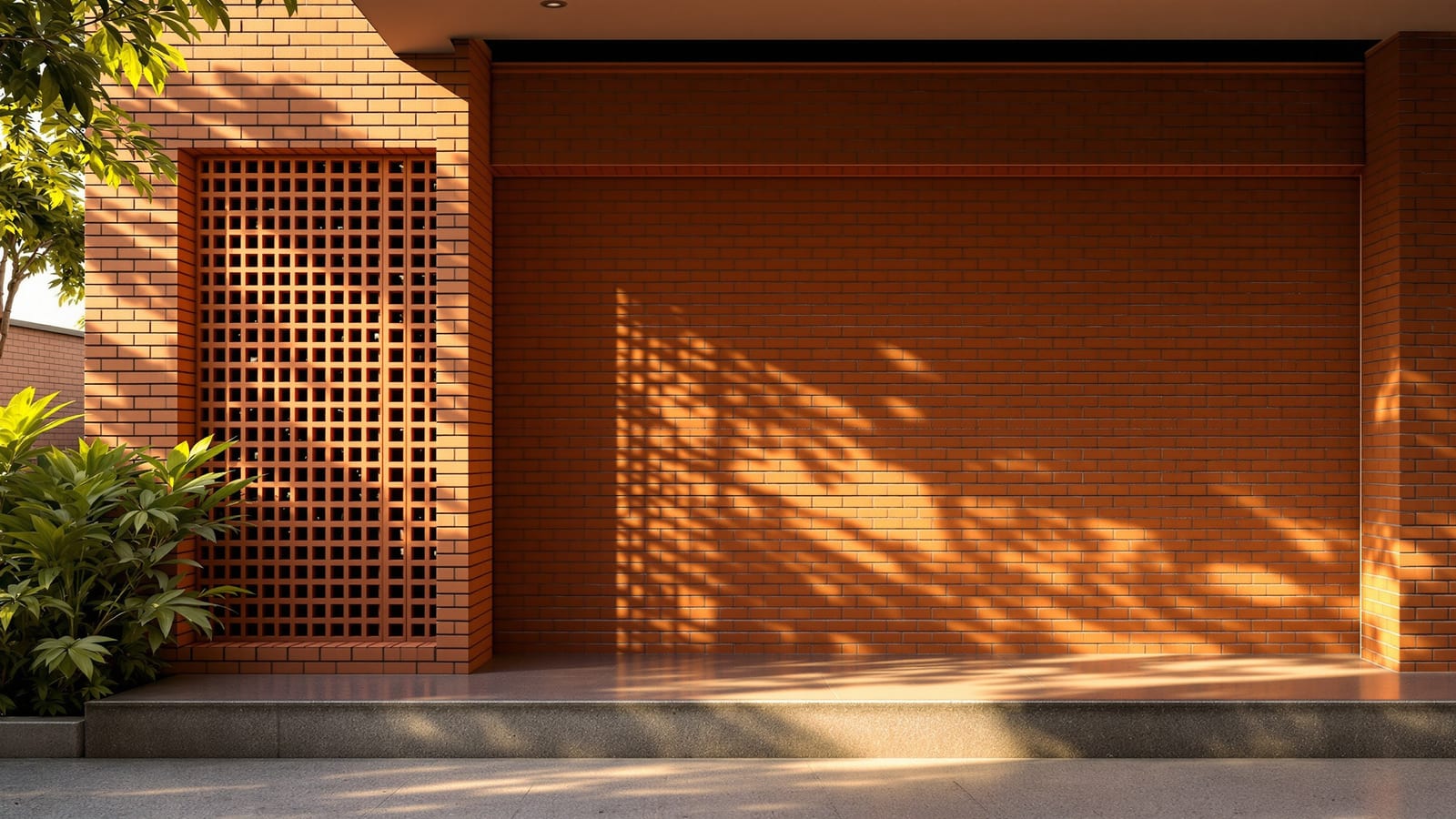
Exposed Brick Facades in India: Bonds, Jaali, Weathering and the Laurie Baker Tradition
A practitioner-grade guide to brick left as the finished skin — English and Flemish bonds, rat-trap economy, brick jaali, pointing, efflorescence and the monsoon physics that decide whether exposed brick ages gracefully or stains.
There is a particular warmth to a brick wall left as it is. No plaster, no paint, no render hiding the work — just the fired clay, the mortar lines, the small irregularities of a hand-laid thing. Walk through IIM Ahmedabad at four in the afternoon and the brick almost glows; the arches and the great circular cut-outs throw shadows that move with the sun. That is brick doing what no painted wall can do: ageing in public, honestly, and looking better for it.
Exposed brick carries a deep Indian modernist lineage. Louis Kahn, B. V. Doshi and Anant Raje built it monumental at Ahmedabad. Laurie Baker built it humble and cheap across Kerala — perforated jaali towers, rat-trap-bond walls, brick that did the structure and the surface and the screen all at once. It is one of the few facade materials that is simultaneously the wall, the finish and, when you want it, the breeze.
This is part of our Building Facades series — see also types of building facades and facade maintenance and durability. Importantly, this guide is not a brick-buying comparison: if you want AAC-versus-red-brick or fly-ash-versus-clay for your structural walls, those are material buyer guides. Here we treat exposed brick as a facade system — brickwork left as the finished skin, with all the questions that raises about bonds, jaali, pointing, weathering and detailing. Exposed brick also overlaps closely with our stone and masonry facades guide (the detailing logic is shared) and the jaali and traditional facades guide — and brick jaali is the natural bridge between the two, so cross-read both.
1. What "exposed brick" actually means
Exposed brick (also called face brick or facing brick) is brickwork built to be seen — the brick is the finished surface, with no plaster or paint over it. That single decision changes everything upstream. On a plastered wall, the brick is hidden; sloppy coursing, a chipped corner or a stained brick disappears under render. On an exposed wall, every joint, every brick face and every error is permanent and visible. You cannot hide bad brickwork. That is the first and most important honesty of this material: the skill bar is simply higher.
Three things are doing the work on an exposed-brick facade. First, the brick itself — its colour, texture, dimensional consistency and durability. Second, the mortar joint — the lines between the bricks, which are usually 10–12 mm and which, crucially, are where exposed brick walls actually fail (water gets in through the joints, almost never through a sound brick). Third, the bond — the pattern in which bricks are arranged, which is both structural and visual.
A note on terms you will meet throughout. A brick laid with its long face showing is a stretcher; one laid end-on, showing its short face, is a header. The shallow depression pressed into the top of a moulded brick (to key the mortar) is the frog. How those headers and stretchers are arranged across the wall is the bond.
2. Bonds: the pattern that is also the structure
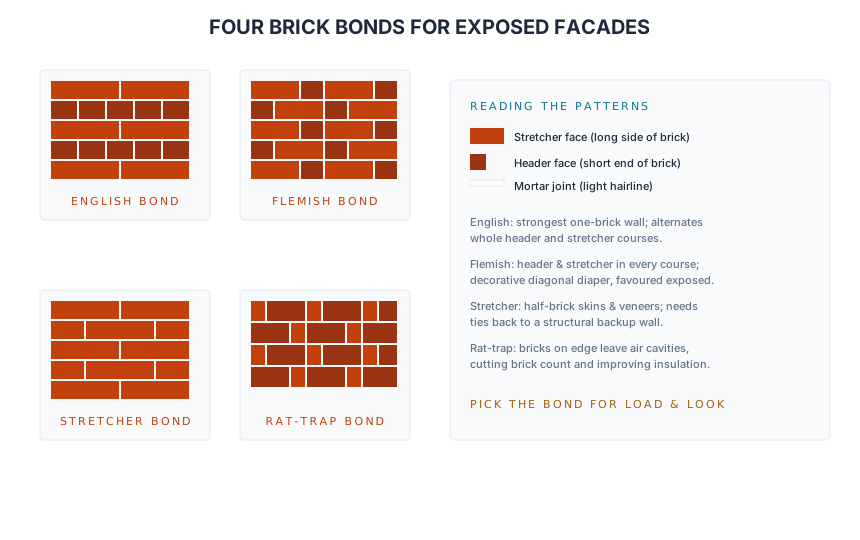
A bond is the arrangement that ties a wall together by overlapping the vertical joints so loads spread and the wall acts as one. IS 2212 (the Indian code of practice for brickwork) covers these. The four you will see on Indian facades:
English bond alternates whole courses of headers with whole courses of stretchers. It is the strongest common bond and the traditional choice for load-bearing exposed work — lots of headers means good through-thickness tying. It reads as busy and rhythmic.
Flemish bond alternates a header and a stretcher within every course. It is widely considered the most handsome face bond — the headers make a diagonal diaper pattern across the wall — and it is the classic choice when appearance matters as much as strength. It is slightly weaker than English bond and wastes more bricks in cutting (more closers), so it costs a little more in labour and material.
Stretcher (running) bond shows only stretchers, with each course offset by half a brick. This is the bond of a half-brick (115 mm) skin — which is exactly what you build when the brick is a veneer or cladding rather than a structural wall (see section 5). It is the most economical to lay and reads as clean, modern and quiet.
Rat-trap bond (also "Chinese bond") stands the bricks on edge so that each course forms a regular internal cavity — and it deserves its own section, because in India it is the single smartest exposed-brick move there is.
3. Rat-trap bond: Baker's climate-smart economy
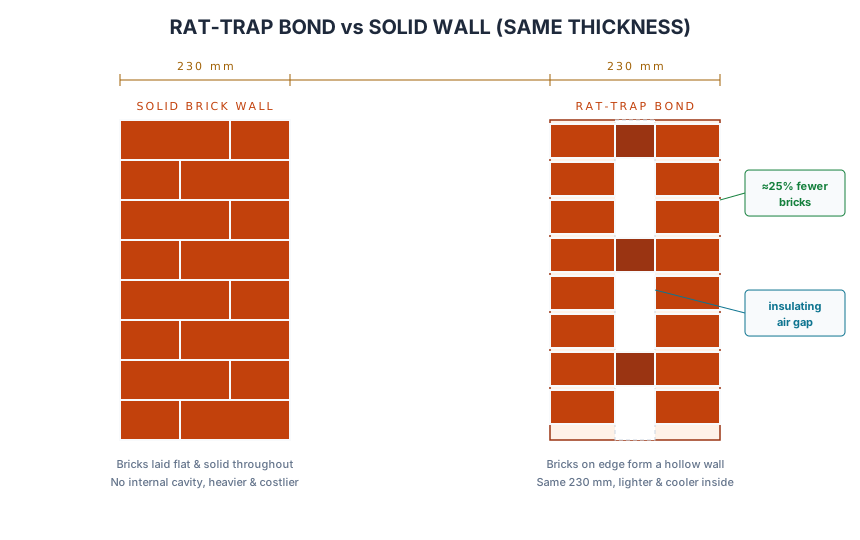
Rat-trap bond lays bricks on their edge (rather than flat) so that a 9-inch (≈230 mm) wall is built with a continuous internal air cavity running through it, while still presenting a normal solid-looking face outside. Architect Laurie Baker popularised it in Kerala from the 1970s, and COSTFORD (the Centre of Science and Technology for Rural Development, which he co-founded) still teaches it.
The economics are real. Because the bricks stand on edge with a gap between, a rat-trap wall uses roughly 20–30% fewer bricks and less mortar than a conventional solid 9-inch wall of the same thickness — a genuine saving on both material and money. The cavity is also an insulating air gap: it cuts heat transmission, so interiors stay cooler in summer and the wall is quieter. And left exposed in Baker's manner, it needs no plaster, saving that cost too. This is one of the rare cases where the cheaper, lower-material option is also the better-performing one — climate-smart and economical at once.
The honest caveats: rat-trap demands a disciplined mason, because the cavity must stay clean (mortar droppings bridging the gap defeat the insulation and create damp paths), and concentrated loads, lintels and corners need solid bricks worked in. Built badly it is worse than solid brick; built well it is one of the best-value exposed walls in the country. The Baker-tradition centres and many Auroville and Kerala homes show it working at scale.
4. Brick jaali: the wall that breathes
A brick jaali is a perforated brick screen — bricks laid with deliberate gaps so the wall becomes a lattice of light, shadow and air. It is the bridge between exposed brick and our jaali facades tradition, and it is one of the most climate-intelligent things you can build in India.
Laurie Baker's library tower at the Centre for Development Studies, Trivandrum (early 1970s) is the canonical example: a tall circular brick-jaali drum wrapped around a central stair shaft, with the perforations admitting soft, diffused daylight and driving stack-effect ventilation so the reading rooms need no air conditioning. The jaali does the facade, the daylighting and the cooling simultaneously — which is exactly why exposed brick suits India so well: a single material, well detailed, replaces three separate systems.
Patterns range from simple half-brick gaps to elaborate corbelled and angled bricks. The detailing rules are the same as any jaali: pitch the perforations or set drip details so monsoon rain does not simply pour through the openings onto floors below, and remember that a jaali is a screen, not a weather wall — behind it you usually want either an air gap and a glazed/solid inner skin or a deep verandah.
5. Brick veneer and rainscreen: exposed brick on a modern frame
Most contemporary Indian buildings are RCC-framed, not load-bearing brick. So the most common way to get an exposed-brick facade today is to build a thin brick skin in front of the structure — and how you build it matters enormously for monsoon performance.
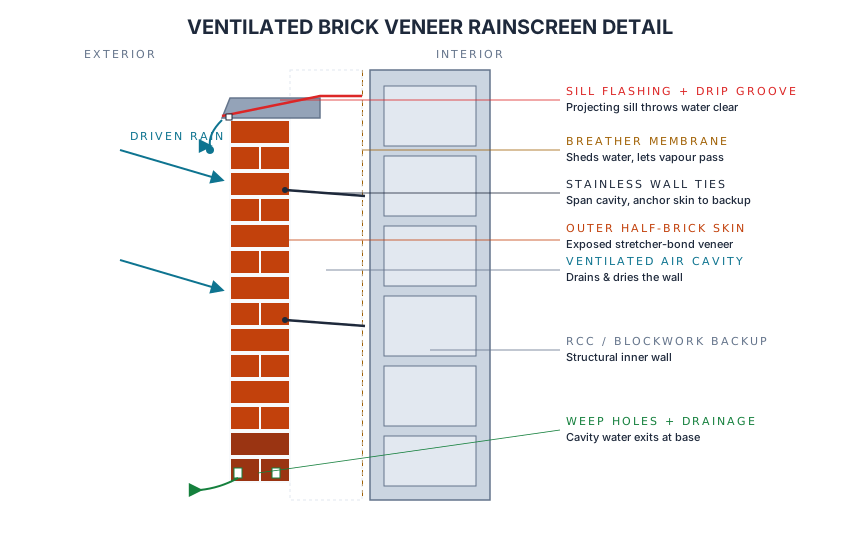
A brick veneer is a single-leaf (half-brick, ≈115 mm) skin of facing brick built in front of the real structural wall, tied back to it with metal wall ties. A brick rainscreen is a veneer done properly as a drained-and-ventilated cavity: the outer brick skin is deliberately treated as a sacrificial first defence that will let some rain through, a continuous air cavity sits behind it, a breather membrane and the backup wall (RCC or blockwork) form the real weather barrier, and weep holes at the base let any water that gets into the cavity drain back out. The cavity also allows pressure equalisation, which is the physics that actually stops wind-driven rain — by removing the pressure difference that pushes water through the outer skin.
This matters because of a hard Indian truth (section 7): a single-skin exposed brick wall in a heavy-rain zone will let driven rain through. A drained cavity veneer/rainscreen solves it; a solid single-leaf wall in coastal Kerala, the Western Ghats or the Northeast does not. If you want exposed brick in those zones, build the cavity — or accept an internal lining and breathable water repellent and ongoing vigilance.
6. Choosing the approach: a comparison
| Approach | What it is | Look | India fit | Cost note | Key risk |
|---|---|---|---|---|---|
| Solid exposed brickwork (English/Flemish bond) | Load-bearing or thick brick wall left unplastered both reasonable sides | Rich, monumental, traditional | Best in moderate-rain inland zones (Deccan, much of North/Central) | Mason-skill premium; saves plaster/paint cost | Driven rain through joints; efflorescence |
| Rat-trap bond | Bricks on edge creating an internal cavity | Solid face outside, distinctive coursing | Excellent nationwide; the value pick | ~25% fewer bricks; cheapest good option | Cavity bridged by sloppy mortar; needs disciplined mason |
| Brick veneer / rainscreen over RCC | Half-brick skin tied to a framed structure, ideally a drained cavity | Clean, modern, usually stretcher bond | The right way to do exposed brick on contemporary RCC, and essential in heavy-rain zones | Adds ties, cavity, membrane, weeps — costs more than render | Skipped weep holes/flashing = trapped water, stains |
| Exposed brick jaali | Perforated screen of bricks | Light, shadow, breeze | Superb for verandahs, stairs, screens, hot-dry and warm-humid | Slow, skilled labour | Rain ingress through openings if not detailed |
| Reclaimed / handmade brick | Old salvaged or table-moulded bricks left exposed | The most character and patina | Beautiful but quality-variable | Cheap-to-premium depending on source | Inconsistent strength and absorption; sorting needed |
A word on brick types, since the choice feeds the facade. Wirecut (extruded) bricks are machine-made, dense, sharp-edged and dimensionally precise — they give crisp, modern joints and lower water absorption, the easiest brick to lay exposed well. Handmade / table-moulded bricks are softer, warmer, slightly irregular and full of character, but more variable in size and strength. Reclaimed bricks have the most patina of all and are genuinely sustainable, but their strength and salt content are unknown until tested — sort and test before you trust them on a facade.
7. The building physics: why exposed brick stains, blooms or spalls
Brick is a porous, salt-bearing, water-absorbing material, and India throws monsoon at it. Four failure modes to understand.
Efflorescence — the white, powdery salt bloom that is the classic Indian exposed-brick problem. It happens when water moves through the wall, dissolves soluble salts (sulphates, carbonates) present in the brick, mortar, sand or backing, carries them to the surface, and leaves them behind as the water evaporates. It is cosmetic, not structural, but it is unsightly and it tells you water is moving where it should not. IS 1077 actually grades bricks for efflorescence: the rating must not exceed moderate for bricks up to class 12.5, and only slight for higher classes. The defence is low-salt bricks, clean low-alkali sand, keeping bricks dry on site, and — above all — keeping bulk water out of the wall.
Rain penetration. Brick absorbs water; mortar joints absorb more. In high-rainfall, wind-driven-rain zones a solid single-leaf exposed wall can wet right through to the inside face during a sustained monsoon. This is the strongest argument for a cavity (rainscreen) wall, deep eaves and verandahs, and excellent pointing.
Joint failure. This is the big one: the joints fail before the bricks do. Poor, under-filled or weathered pointing opens hairline paths for water; once water is in, freeze-thaw is irrelevant in most of India but wet-dry salt cycling is not, and the joint erodes further. Most "leaking brick wall" problems are really "failed pointing" problems, fixable by repointing — not by sealing the whole wall.
Spalling. When trapped water and salt crystallisation build pressure inside the brick face, the surface flakes or spalls off. A notorious contributor — documented in the very restoration debates at IIM Ahmedabad — is using a mortar harder than the brick. When cement mortar is stronger than the surrounding brick, movement and moisture stress get concentrated in the bricks rather than the (sacrificial, repointable) joints, and the soft local bricks spall. The traditional rule holds: the mortar should be weaker than the brick, so the cheap joint is the part that wears, not the wall.
Real buildings, not renders
IIM Ahmedabad (Louis Kahn with B. V. Doshi and Anant Raje, built 1962–1974) is the country's defining exposed-brick monument — load-bearing brick married to exposed concrete ties and lintels, with Kahn's signature brick arches, circular cut-outs and deep light-wells that keep the tropical sun off the glass. It is also an honest teacher: the original local bricks were porous, the cement mortar was harder than the brick, and reinforcement lacked cover — all of which drove the major restoration work decades later. Beauty and lessons in the same walls.
The Centre for Development Studies, Trivandrum (Laurie Baker, early 1970s) shows the other pole — exposed brick as economy and climate response. Its circular jaali library tower wraps a central stair shaft, using stack-effect ventilation and a perforated brick lattice to light and cool the building without air conditioning. Baker's wider Kerala body of work — rat-trap-bond houses, filler-slab roofs, curved brick walls and brick jaali everywhere — is the template most Indian exposed-brick homes still draw from.
Anant Raje's own later work in and around Ahmedabad (he completed parts of the IIM campus after Kahn) continued the exposed-brick-and-concrete language with real rigour. And across Auroville, decades of compressed-earth and fired-brick exposed building have produced a deep, tested catalogue of exposed-masonry detailing for the Indian climate. These are the verifiable reference points — visit them before you finalise a brick facade.
The honest case: cost, skill and weathering
Here is the candid India verdict. Exposed brick is low-maintenance only if it is laid well. A skilled mason laying consistent 10 mm joints, striking them to a weather-struck or bucket-handle profile that sheds water, keeping the bricks clean, and building a drained cavity where the rain demands it — that wall will look magnificent for decades on little more than an occasional wash. The same design built by an unskilled crew, with smeared joints, no flashing and no drip details, will efface, stain and weep within a couple of monsoons, and there is no paint to hide it.
On cost: exposed brick saves you plaster and paint, but spends that saving (and sometimes more) on better bricks, a more skilled mason, slower laying, and — for veneer/rainscreen — ties, cavity and flashing. Rat-trap bond is the exception that genuinely saves money and performs better. Against a plain plastered-and-painted wall, plan for exposed brick to cost similar-to-somewhat-more upfront, with the trade being far lower lifetime maintenance if the work is good.
On weathering: design the water out before you rely on any coating. Deep eaves, verandahs and projecting drip details under every sill and band keep the wall dry. Good pointing keeps the joints sound. Only after those should you consider a clear, breathable (vapour-permeable) water repellent — never a film-forming "sealer," which traps moisture behind the face and makes spalling and efflorescence worse. And in the heaviest-rain zones, build the cavity. Coatings are insurance, not architecture.
What this means for you
If you are a homeowner: decide your zone first. Inland and moderate-rain (Deccan, much of North/Central India) — solid exposed brick or, better, rat-trap bond is a superb, economical, cool-running choice. Coastal Kerala, the Ghats, the Northeast — insist on a drained cavity veneer (rainscreen) or accept that you are signing up for vigilant maintenance. Everywhere: hire a mason whose previous exposed work you have physically inspected (ask to see joints up close), specify low-efflorescence bricks (IS 1077, moderate-or-better rating), insist on weather-struck joints and drip details, and refuse film-forming sealers. Budget for similar or slightly higher first cost than a painted wall, repaid in low upkeep.
If you are a practitioner: specify the bond for both structure and appearance (Flemish where the face matters, English or rat-trap where it carries load), keep mortar weaker than the brick, detail the cavity, ties, breather membrane and weep holes explicitly on drawings (the IIM lesson is what happens when these are skipped), and protect every horizontal — copings, sills, bands — with a throating/drip. Pull a sample panel on site, get it approved, and make it the quality benchmark for the whole facade. Cross-link your client to the stone and masonry facades and facade maintenance and durability guides so the upkeep expectation is set before the first brick is laid.
Sources
- IS 1077: Common Burnt Clay Building Bricks — Specification (Bureau of Indian Standards) — classes by compressive strength, water absorption limits (≤20% up to class 12.5; ≤15% above), efflorescence rating limits (not more than "moderate" up to class 12.5; "slight" above).
- IS 2212: Code of Practice for Brickwork (Bureau of Indian Standards) — bonds, mortar, jointing, workmanship.
- National Building Code of India (NBC) and SP 20 — masonry provisions.
- Laurie Baker / COSTFORD references on rat-trap bond — cavity construction, ~20–30% brick-and-mortar saving, thermal benefit.
- Brick Industry Association Technical Note 23A, "Efflorescence — Causes and Prevention," and Technical Note 27, "Brick Masonry Rain Screen Walls" — efflorescence mechanism and drained-cavity rainscreen physics.
- IIM Ahmedabad (Louis Kahn with B. V. Doshi and Anant Raje, 1962–1974) and IIMA restoration documentation — exposed brick, porous local bricks, mortar-harder-than-brick spalling lesson.
- Centre for Development Studies, Trivandrum (Laurie Baker) — jaali library tower, stack-effect ventilation.
Export this guide
Related Guides — Deep-dive reading
Laurie Baker's Façade Signature: Brick Jaali, Rat-Trap Bond and the Honest Low-Cost Indian Wall
How India's "Gandhi of architecture" turned cheap, honest, climate-wise materials — exposed brick, the perforated brick jaali, rat-trap bond and curved walls — into the most affordable and most beautiful façade in the country.
Building FacadesBrick House, Wada: How iSTUDIO Bent an Ancient Craft into a Curve
A 2,500-square-foot farmhouse in rural Maharashtra bends the poorest, most ordinary building material — the fired clay brick — into free-flowing curved walls, and proves that low-cost, low-carbon, hand-built architecture can be as spatially ambitious as anything made of steel and glass. A close reading of its rat-trap-bond masonry, earthen-pot filler slabs, ferrocement roofs, and the Laurie Baker lineage it carries forward.
The Future of ArchitecturePlaster, Render and Texture-Paint Facades in India: The Honest Guide to the Country's Default Wall Finish
A building-physics guide to cement and lime render, exterior emulsion and weatherproof paints, and textured coatings — how these everyday facades are built, why they crack, streak and grow algae, and what actually keeps them looking good in the Indian monsoon.
Building FacadesRelated Tools — Try Free
Cross-Ventilation Analyzer
Estimate airflow and air changes per hour (ACH) from room size, window areas, layout, and local wind — with NBC 2016 Part 8 compliance check.
Ventilation CalculatorBrise-Soleil Visualizer
Interactive horizontal-louvre cut-off angle calculator — sun altitude, louvre depth, and spacing inputs with a live shadow preview. Computes θ = arctan(spacing/depth) for façade shading, ECBC envelope compliance, hospital daylight design, and tropical sun-control detailing.
Sun Shading ToolMaterial Decision Framework (M-Score)
Score 30+ Indian construction materials across cost, durability, climate fit, maintenance, and sustainability.
Materials