
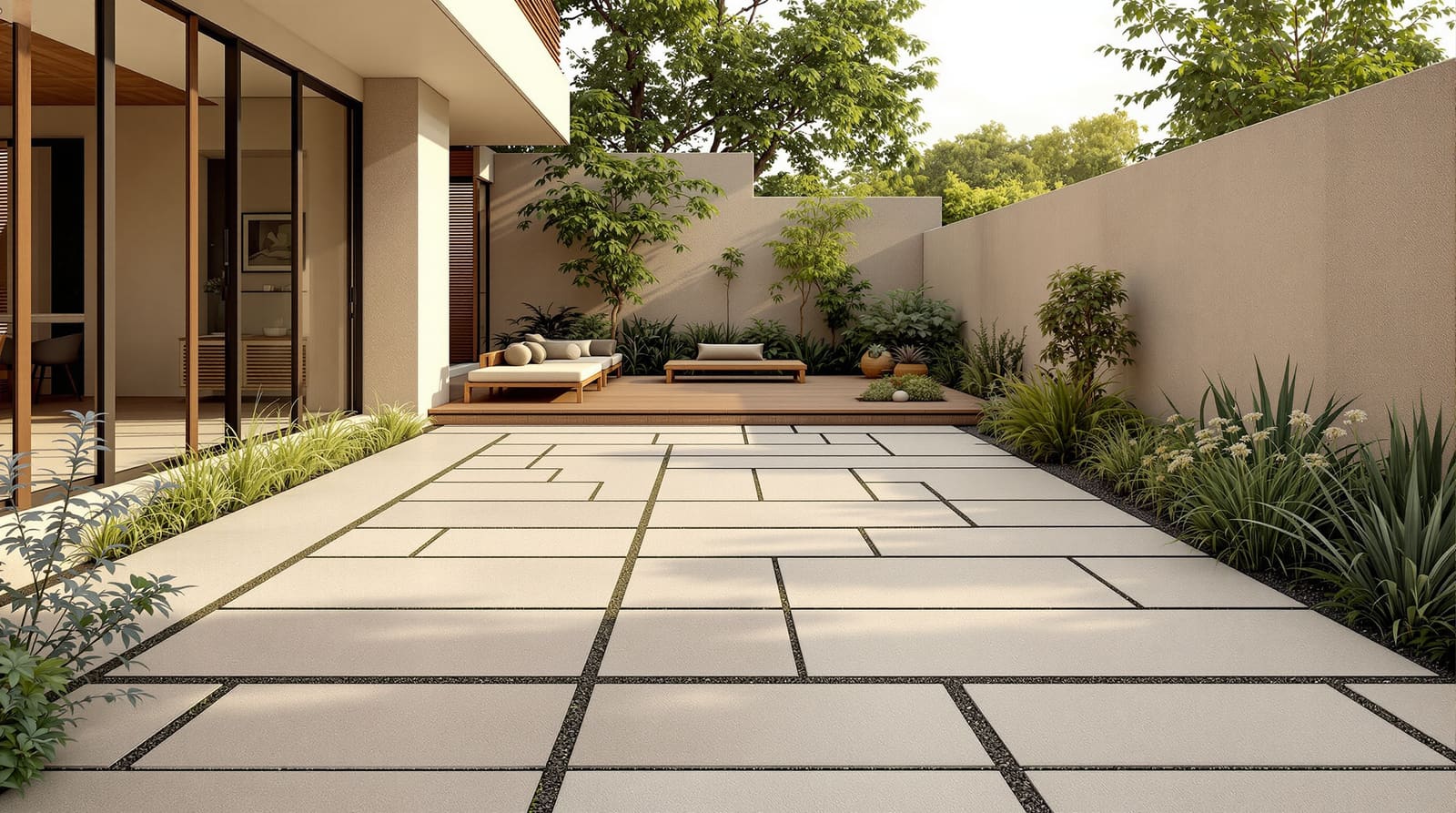
Outdoor Flooring Guide — Choosing the Right Surface
The broad chooser across every outdoor surface — natural stone, tile, deck, gravel, concrete and grass pavers — by slip, heat, drainage, upkeep and cost, and which suits which zone
Outdoor flooring is the one design decision your feet, your monsoon and your maintenance budget will all judge for the next twenty years — so choose the surface for the way each zone is actually used, not for how it looks in a showroom tile.
Picking what goes underfoot outside an Indian home is harder than picking indoor flooring, because the surface has to survive lashing monsoon rain, 45°C afternoon sun, red dust, foot traffic, parked cars and the occasional flooded driveway — often all in the same plot. This is the pillar guide to the whole family of outdoor surfaces: it walks you through the decision factors first, then gives you a quick survey of every realistic option, and finally tells you which surface belongs in which zone of your garden, terrace or compound. Where a topic deserves more room — natural stone, gravel-versus-pavers, timber decks — we keep it short here and send you to the dedicated deep-dive. This guide is about flooring and choosing; for how a path is actually built and detailed, see The Architecture of Pathways.
The nine decision factors
Before you fall in love with a finish, run it past these nine questions. Almost every outdoor flooring regret traces back to ignoring one of them.
- Use and traffic. A footpath walked twice a day is a different problem from a driveway carrying a 1,500 kg SUV. Vehicular zones need load-rated pavers or reinforced concrete; a quiet planted edge can take loose gravel.
- Slip resistance. This is the safety-critical one in India, where the surface is wet for four months. Specify a tested anti-slip rating — for wet, barefoot or poolside areas aim for class R11–R12 (DIN 51130) or "Group A/B" barefoot ratings. Polished granite by a pool is an accident waiting to happen.
- Heat underfoot. Dark, dense surfaces in full sun become unwalkable by 2 pm. Dark vitrified tile and black granite can cross 60°C surface temperature; light sandstone, timber and grass stay far cooler. Match dark, hot finishes only to shaded or evening-use zones.
- Drainage and permeability. Every outdoor floor must shed water — minimum 1 in 80 (about 1.2%) fall to a drain, more for paved courts. Permeable choices (gravel, grass pavers, open-jointed paving) let rain soak in and ease the load on your soak-pit and the municipal storm drain.
- Monsoon behaviour. Will it grow algae, stain, heave or wash out over a wet season? Riven stone and timber green up; loose gravel migrates; unsealed concrete darkens. Plan the finish and the falls together.
- Maintenance. Be honest about who sweeps, reseals and pressure-washes. Gravel needs topping up; timber needs annual oiling; vitrified tile is near zero-maintenance. Low effort almost always wins in the long run.
- Durability. A 20 mm stone slab on a proper bed lasts decades; a 8 mm tile cracks under a car. Buy the thickness the use demands.
- Cost — first and lifetime. A cheap finish that is relaid every five years is dearer than a premium one laid once. Weigh installed cost against reseal/replace cycles. For full landscape budgeting see the Landscape Cost Guide.
- Look and continuity. The outdoor floor frames the architecture. A coherent palette — ideally echoing an indoor material — makes a small plot feel larger and a villa feel resolved.
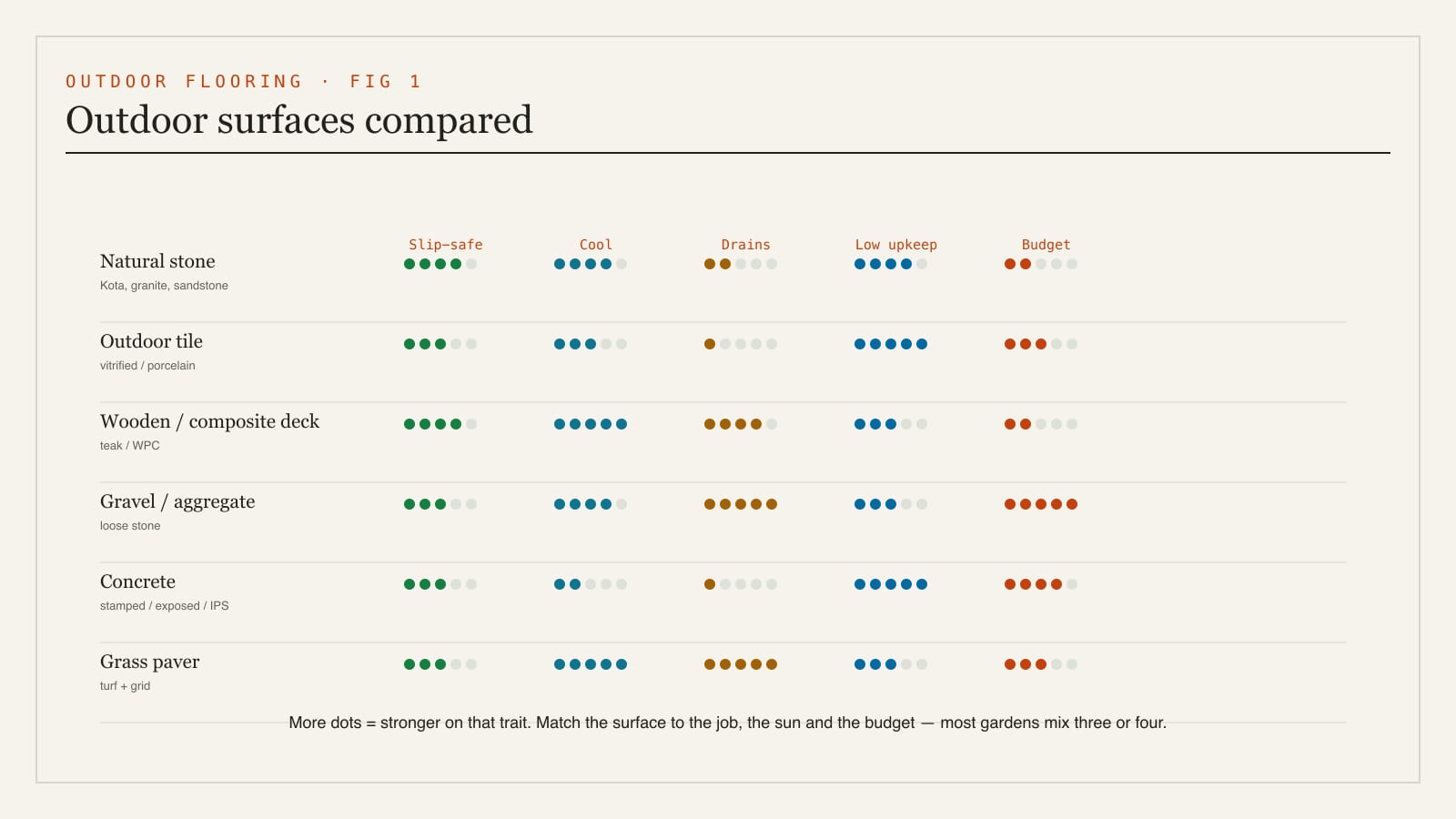
The options at a glance
| Surface | Slip (wet) | Heat underfoot | Drainage | Maintenance | Installed cost (₹/sqft) |
|---|---|---|---|---|---|
| Natural stone | Good if flamed/sawn | Medium–high (dark hot) | Low (sealed) | Medium | 120–450 |
| Vitrified / porcelain outdoor tile (20 mm) | Good (R11 grades) | High (dark), low (light) | Low | Very low | 90–300 |
| Timber / composite deck | Good | Low (cool) | High (open joints) | High (timber) | 250–700 |
| Gravel / aggregate | Good | Low | Very high | Medium (top-ups) | 40–110 |
| Concrete (plain/stamped/IPS) | Medium (broom/grit) | High | Low | Low | 70–220 |
| Grass pavers / reinforced turf | Good | Very low | Very high | Medium (mowing) | 90–180 |
| Brick / clay paver | Good | Medium | Medium (jointed) | Low–medium | 80–200 |
Costs are indicative installed rates (material plus laying) for 2026 and swing with region, base preparation and stone grade.
Natural stone — short version
India's workhorse: Kota, Tandur (Shahabad), Kadappa, sandstone (Dholpur, Mint, Raj green), and granite. It is the most contextual, long-lived outdoor floor available here, but the finish matters enormously — specify flamed, sawn or honed (never mirror-polished) outside, and seal porous stones against monsoon staining. This is a deep subject of its own; read Natural Stone in Landscape Design for species, finishes, sealing and detailing.
Vitrified and porcelain outdoor tile
Thick 20 mm porcelain pavers (Kajaria, Somany, Simpolo and others now make outdoor-rated ranges) are the low-maintenance modern choice: frost- and stain-proof, available in convincing stone and timber looks, and laid dry on pedestals over a terrace or wet on a screed. Insist on an R11/R12 wet-slip grade and a light colour for sunny zones — dark porcelain gets brutally hot. Excellent for terraces, balconies and shaded patios; not ideal as the sole driveway surface unless heavily bedded.
Wooden and composite decking
Timber gives the only genuinely cool, soft-underfoot, premium feel — ideal at poolsides, terrace lounges and over uneven ground. Indian-suited species include accoya, thermally-modified ash, Burma teak (costly) and ipe; WPC (wood-plastic composite) trades the warmth for near-zero maintenance and no annual oiling. Decks need ventilated joists, drainage gaps and discipline about water. Kept short here — see Wooden Decks for Indian Homes for species, sub-frame and monsoon care.
Gravel and aggregate
The cheapest, most permeable, most informal surface — pea gravel, crushed granite, river pebble. It drains instantly, suppresses dust when bound, and reads beautifully around planting and in low-traffic courtyards. It migrates without firm edging and is wheelchair- and heel-unfriendly. How it compares head-to-head with hard paving is its own decision — see Gravel vs Pavers.
Concrete — plain, stamped, exposed-aggregate, IPS
Concrete is the most versatile base finish. Options range from a broom-finished slab (cheapest, grippy) to stamped concrete (mimics stone at lower cost), exposed-aggregate (durable, decorative, grippy when washed), and IPS (Indian Patent Stone — a trowelled cement topping, common on Indian terraces and chajjas). Reinforce and provide control joints to manage cracking; a dark-pigmented slab in full sun runs hot. Strong for driveways, utility yards and contemporary patios.
Grass pavers and reinforced turf
Concrete or HDPE cellular grids filled with soil and grass carry car loads while staying green and permeable — the elegant answer to "I want parking that doesn't look like parking." They keep ground temperatures low and recharge groundwater. They need irrigation and mowing, and the grass thins under constant tyres, so they suit occasional-use parking and overflow drives.
Brick and clay pavers
Clay pavers and traditional brick-on-edge give warm, human-scaled, jointed paving that ages gracefully and stays cooler than dark stone. Laid on a sand bed with a herringbone bond they handle light vehicle loads and lift-and-relay repairs easily. Watch for moss in damp shade and efflorescence on cheap bricks.
Which surface for which zone
The single most useful move is to stop choosing one floor for the whole plot and instead match each surface to how that zone is used. The diagram below maps the logic.
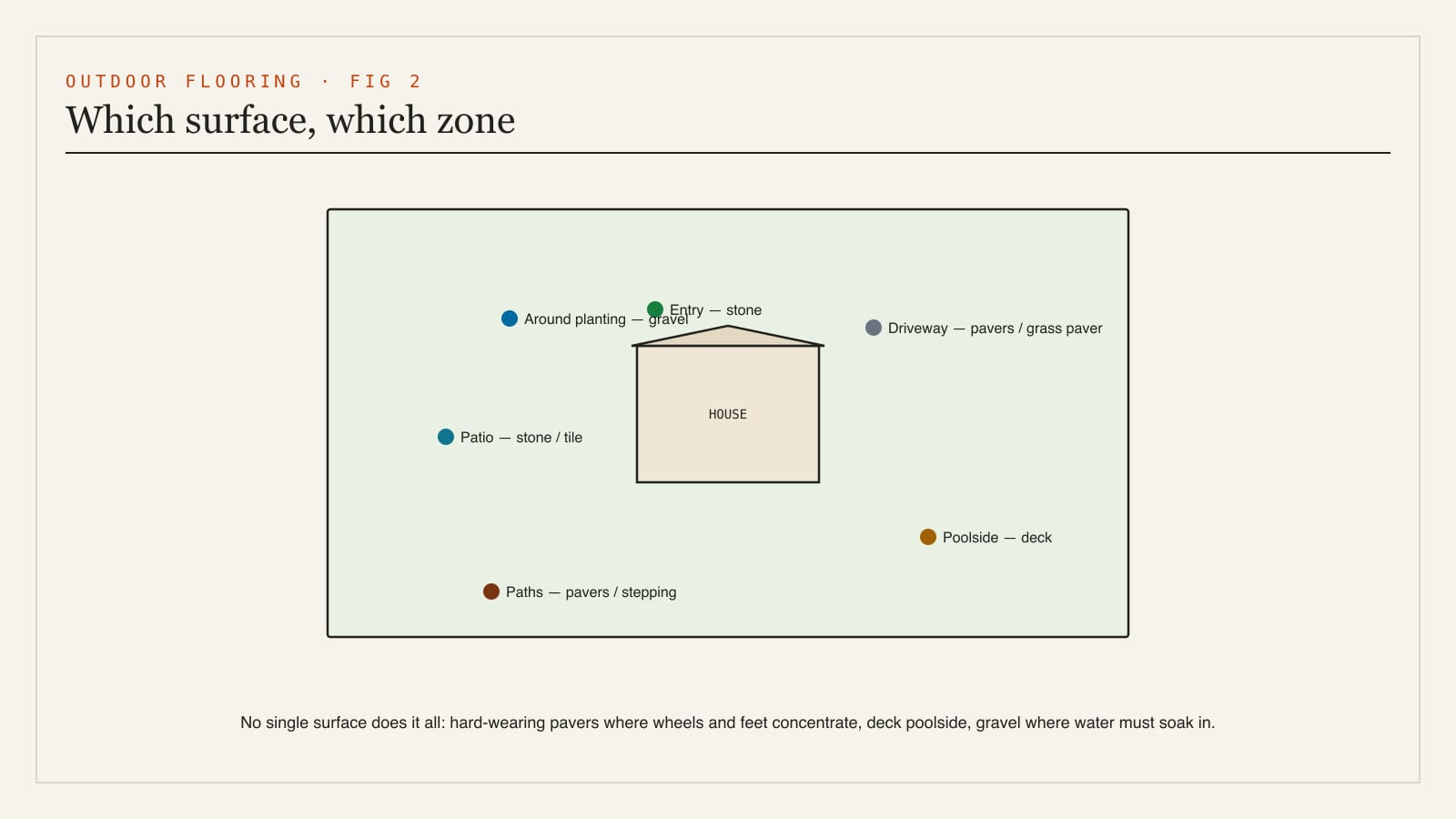
| Zone | Best-fit surfaces | Avoid | Why |
|---|---|---|---|
| Entry / forecourt | Flamed stone, large-format light porcelain | Polished granite, loose gravel | First impression, wheeled luggage, wet-grip |
| Patio / terrace | Light vitrified tile, sandstone, IPS | Dark dense stone in sun | Daytime use, low heat, low maintenance |
| Poolside | Timber/WPC deck, R12 anti-slip stone | Smooth tile, polished stone | Barefoot, always wet, cool underfoot |
| Garden paths | Stepping stone, clay paver, stabilised gravel | Continuous slab over roots | Drainage, gentle on planting |
| Driveway / parking | Interlocking concrete pavers, grass pavers, RCC | Thin tile, loose gravel | Point loads, turning tyres, oil |
| Around planting | Gravel, bark, permeable edging | Sealed concrete to the trunk | Root breathing, water to soil |
Entry and forecourt carry your home's first impression and wheeled bags, so use a dignified, grippy, large-format finish — flamed granite or a light porcelain — with a clear water fall away from the threshold.
Patio and terrace are about long, comfortable daytime sitting, so prioritise low heat and low maintenance: light vitrified tile, light sandstone or a clean IPS finish. This is where porcelain earns its keep.
Poolside is the strictest zone — always wet, always barefoot — so it is timber/WPC decking or a tested R12 anti-slip stone, never a smooth tile. The cool-underfoot quality of timber is why it dominates good pool surrounds.
Garden paths want to drain and tread lightly on roots and planting; stepping stones set in gravel or clay pavers do this gracefully. For the craft of detailing the path itself — widths, edges, bonds, ramps — go to The Architecture of Pathways.
Driveway and parking must take point loads and turning tyres: interlocking concrete pavers (60–80 mm), reinforced concrete, or grass pavers for occasional use. Never a thin tile.
Around planting, keep it permeable and breathable — gravel or bark up to a generous tree-pit, never sealed concrete poured to the trunk.
Putting it together for a typical Indian plot
A resolved scheme usually mixes three or four surfaces with a deliberate palette. A common villa logic: light flamed-stone forecourt and entry, light porcelain patio off the living room, a small timber deck at the pool or under a shade tree, interlocking pavers or grass pavers on the drive, and gravel-and-stepping-stone paths threading the planting. The palette is held together by repeating one or two colours and keeping joint widths consistent. For how this reads at villa scale see Villa Landscape Design; for smaller rear courts, Backyard Design Ideas; and where the brief is restorative outdoor rooms, Outdoor Wellness Spaces.
Three habits separate a floor that lasts from one that disappoints:
- Design the falls and drains first. Decide where every drop of monsoon water goes before you pick a tile. Minimum 1.2% fall, channel drains at the low edges, and never trap water against the house wall.
- Specify the finish, not just the material. "Granite" tells you nothing; "20 mm flamed grey granite, R11 wet-slip, light tone" tells the contractor everything.
- Buy the right base and edge. Most outdoor flooring failures are base failures — settlement, frost-free cracking, gravel migration. Compacted sub-base, proper bedding and firm edge restraint matter more than the surface itself.
Choose for climate, choose for use, and let look follow — see Climate-Responsive Landscape Design for how surface choice ties into shade, planting and water across India's zones, and Water Features in Landscape Design where paving meets pools and rills.
References & further reading
- Bureau of Indian Standards, IS 1237: Cement Concrete Flooring Tiles and IS 15658: Precast Concrete Blocks for Paving — specification and load classes for outdoor paving and concrete blocks.
- National Building Code of India 2016, Part 10: Landscape Development, Signs and Outdoor Display Structures — site grading, drainage falls and external surface guidance.
- DIN 51130 / DIN 51097 — internationally referenced slip-resistance (R-rating and barefoot A/B/C) test standards widely quoted by Indian tile and stone suppliers.
- Indian Bureau of Mines, Indian Minerals Yearbook (Dimension Stones) — authoritative reference on Indian building stones, finishes and uses.
- Centre for Science and Environment (CSE), publications on permeable surfaces and urban stormwater — rationale for permeable paving and groundwater recharge in Indian cities.
- Time-Saver Standards for Landscape Architecture (Harris & Dines) — recognised technical reference on hardscape construction, bedding and drainage detailing.
Export this guide
Related Guides — Deep-dive reading
Anti Slip Flooring for Bathroom and Wet Areas in India: R-Ratings, Finishes and Genuinely Safe Tile Choices
How to choose genuinely safe flooring for bathrooms, kitchens, balconies, pools, entrances and elderly- or child-friendly homes — the R-rating system, finishes that grip wet feet, anti-skid natural stone, slope to drains and the tiles to avoid.
Flooring & SurfacesPatio Flooring in India: Best Decks & Outdoor-Seating Floors for Weather, Grip & Looks
How to floor a patio, deck or outdoor lounge in India so it shrugs off UV and monsoon, grips wet feet, stays barefoot-friendly and still looks like a place you want to entertain.
Flooring & SurfacesGrass Pavers & Permeable Flooring in India: Green Driveways, Parking & Eco Paving at ₹40–150 per Sq Ft
Concrete and HDPE grass-paver grids that let grass grow through, plus open-jointed permeable paving — how green driveways, overflow parking and fire-lanes infiltrate rainwater, cut runoff, stay cooler than concrete and earn IGBC/GRIHA credits, with types, ₹40–150 per sq ft costs, the free-draining base build-up, load grades, laying and care.
Flooring & SurfacesRelated Tools — Try Free
Landscape Cost Calculator
Estimate a garden's cost — hardscape, softscape, lawn, irrigation, lighting and annual upkeep — by area, tier and city.
Budget CalculatorDoor Material Comparison Tool
Compare 2–4 door materials on cost, durability, maintenance, security and moisture resistance.
Comparison ToolCross-Ventilation Analyzer
Estimate airflow and air changes per hour (ACH) from room size, window areas, layout, and local wind — with NBC 2016 Part 8 compliance check.
Ventilation Calculator