

HVAC by Climate Zone: One Country, Five Very Different Problems
India spans five climate zones, and the right HVAC strategy is completely different in each — dry heat wants evaporative cooling, humid coasts want dehumidification, the north wants cooling and heating both. A map of India's climate zones and how HVAC changes across them.
"What's the best cooling?" has no single answer in India — because India isn't one climate, it's five. An air cooler that transforms a Jaipur summer is useless in Mumbai's monsoon; the dehumidification a Chennai home craves is beside the point in Jaisalmer; and Delhi needs to fight both a scorching summer and a cold winter. The single most important idea in Indian HVAC is that the right strategy depends entirely on your climate zone. This guide maps India's five zones and how the HVAC problem — and its best answer — changes across them.
It's the anchor of the regional thread in the HVAC Knowledge Hub, and builds on HVAC Fundamentals.
Scope. This is an orientation to climate-driven strategy. Actual system selection and design for a specific location are qualified MEP/HVAC work, tuned to local design conditions.
India's five climate zones
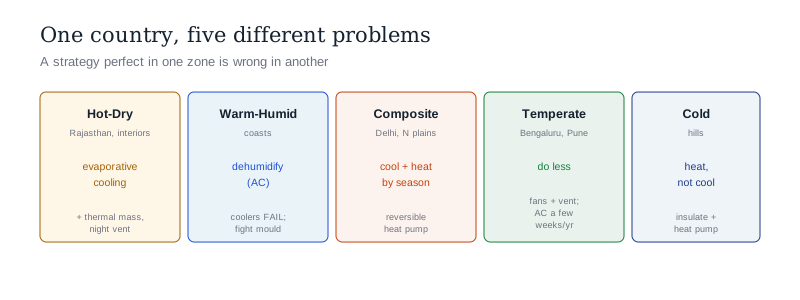
India's building codes (the National Building Code and Eco Niwas Samhita) classify the country into five climate zones, each defined by its temperature and humidity through the year:
- Hot-Dry — deserts and interiors (Rajasthan, parts of Gujarat): very hot, dry air, big day-night swings.
- Warm-Humid — the coasts (Mumbai, Chennai, Kolkata, Kerala, Goa): hot and sticky, high humidity year-round.
- Composite — the north-central plains (Delhi, Lucknow, Nagpur): all of it — hot summer, cold winter, humid monsoon.
- Temperate (moderate) — the southern plateau (Bengaluru, Pune): mild and pleasant much of the year.
- Cold — the hills and mountains (Shimla, Manali, the North-East heights): cold winters, cool summers.
Your zone sets your problem — and a strategy that's perfect in one is wrong in another.
How the HVAC problem changes by zone
The dominant challenge — and the best-fit answer — shifts completely across zones:
- Hot-Dry → make air moist and cool. With dry air, evaporative cooling (air coolers, passive downdraught) works beautifully and cheaply; thermal mass and night ventilation exploit the big temperature swing. AC is a top-up, not the whole answer (see hot-dry).
- Warm-Humid → remove moisture. Evaporative cooling fails (the air is already saturated); the job is dehumidification and sensible cooling — AC with good latent capacity, ventilation, and mould/corrosion defence (see warm-humid).
- Composite → do everything, by season. Cooling in summer, dehumidifying in monsoon, heating in winter — the most demanding all-rounder, best met with a reversible heat pump plus a good envelope (see composite).
- Temperate → mostly do less. Mild weather means fans and ventilation carry much of the year, with modest cooling for peak weeks — the easiest zone (see temperate).
- Cold → heat, don't cool. Heating dominates; insulation, heat pumps, solar gain and hot water matter, cooling barely (see cold climate).
Same country, five different briefs — which is why "best AC in India" is the wrong question; "best for your climate" is the right one.
The common principle: design to your climate
Whatever the zone, the same logic applies, tuned locally:
- Start with the envelope — Eco Niwas Samhita sets climate-zone-specific envelope limits precisely because the right wall, roof and glass differ by zone (see heat transfer).
- Exploit your climate's free resources — the dry air (evaporative), the night coolth (ventilation), the mild season (fans), the winter sun (passive heating).
- Match equipment to the dominant load — sensible vs latent, cooling vs heating (see psychrometrics and load calculation).
- Use local design conditions — Indian cities have published design temperatures and humidities; sizing must use yours, not a national average.
Climate-responsive design — using what your climate offers before spending on machinery — is the through-line of efficient Indian HVAC (see passive cooling and sustainable HVAC).
The one-line answer
India is five climate zones, not one, and the right HVAC strategy is completely different in each — so "the best cooling in India" is the wrong question; "the best for your zone" is the right one. The five zones set five different problems: Hot-Dry (deserts/interiors) wants evaporative cooling (air coolers, thermal mass, night ventilation), which the dry air makes cheap and effective; Warm-Humid (the coasts) wants dehumidification because evaporative cooling fails in saturated air; Composite (Delhi and the north plains) wants everything by season — cooling, dehumidifying and winter heating, best met by a reversible heat pump; Temperate (Bengaluru, Pune) wants mostly less — fans and ventilation carry the mild year; and Cold (the hills) wants heating, not cooling. Whatever the zone, the principle is the same, tuned locally: start with the envelope (Eco Niwas Samhita sets zone-specific limits), exploit your climate's free resources, match equipment to the dominant load (sensible vs latent, cooling vs heating), and size to local design conditions — climate-responsive design that uses what your climate offers before spending on machinery.
Where to go next
- Dry heat: Hot-Dry Climate HVAC.
- Humid coasts: Warm-Humid Climate HVAC.
- All-in-one north: Composite Climate HVAC.
- Mild & cold: Temperate Climate HVAC · Cold Climate HVAC.
References
- National Building Code of India / National Building Construction Standards, SP 7 : 2026 (climate classification for building design), Bureau of Indian Standards.
- Bureau of Energy Efficiency (BEE) — Eco Niwas Samhita (climate-zone-specific envelope limits): https://beeindia.gov.in/
- India Meteorological Department (IMD) — climatic data; ISHRAE weather data & climate-responsive design guidance.
An orientation to climate-driven strategy. System selection and design for a specific location are qualified MEP/HVAC work, tuned to local design conditions. Verify current climate-zone classifications and limits before relying on them.
Export this guide
Related Guides — Deep-dive reading
HVAC for Composite Climates: The All-Seasons Challenge
Delhi and the north-central plains get everything — scorching summers, cold winters and a humid monsoon — so their HVAC must cool, dehumidify and heat across the year. Why a reversible heat pump and a good envelope are the smart answer to India's most demanding climate.
HVAC & CoolingHVAC for Warm-Humid Climates: The Battle Is with Moisture
On India's coasts — Mumbai, Chennai, Kolkata, Kerala, Goa — the enemy isn't just heat, it's humidity. Why evaporative cooling fails, why dehumidification and latent capacity matter most, and how to fight mould, corrosion and that permanent stickiness.
HVAC & CoolingRoof Selection Guide for Indian Climates
India is not one climate but five — hot-dry Rajasthan, warm-humid Chennai, composite Delhi, cold Shimla and the monsoon coast of Kerala and the Konkan. Each demands a different roof shape, material, slope and detailing. A plain-language, zone-by-zone guide to matching the roof to the weather.
RoofingRelated Tools — Try Free
Cross-Ventilation Analyzer
Estimate airflow and air changes per hour (ACH) from room size, window areas, layout, and local wind — with NBC 2016 Part 8 compliance check.
Ventilation CalculatorBrise-Soleil Visualizer
Interactive horizontal-louvre cut-off angle calculator — sun altitude, louvre depth, and spacing inputs with a live shadow preview. Computes θ = arctan(spacing/depth) for façade shading, ECBC envelope compliance, hospital daylight design, and tropical sun-control detailing.
Sun Shading ToolProperty Tax Calculator — 10 Indian Cities
Estimate annual municipal property tax across BBMP / MCD / MCGM / GHMC / GCC / KMC / PMC / AMC / TMC / PCMC — with self-occupied, tenanted, and age-rebate adjustments.
Property Tax