
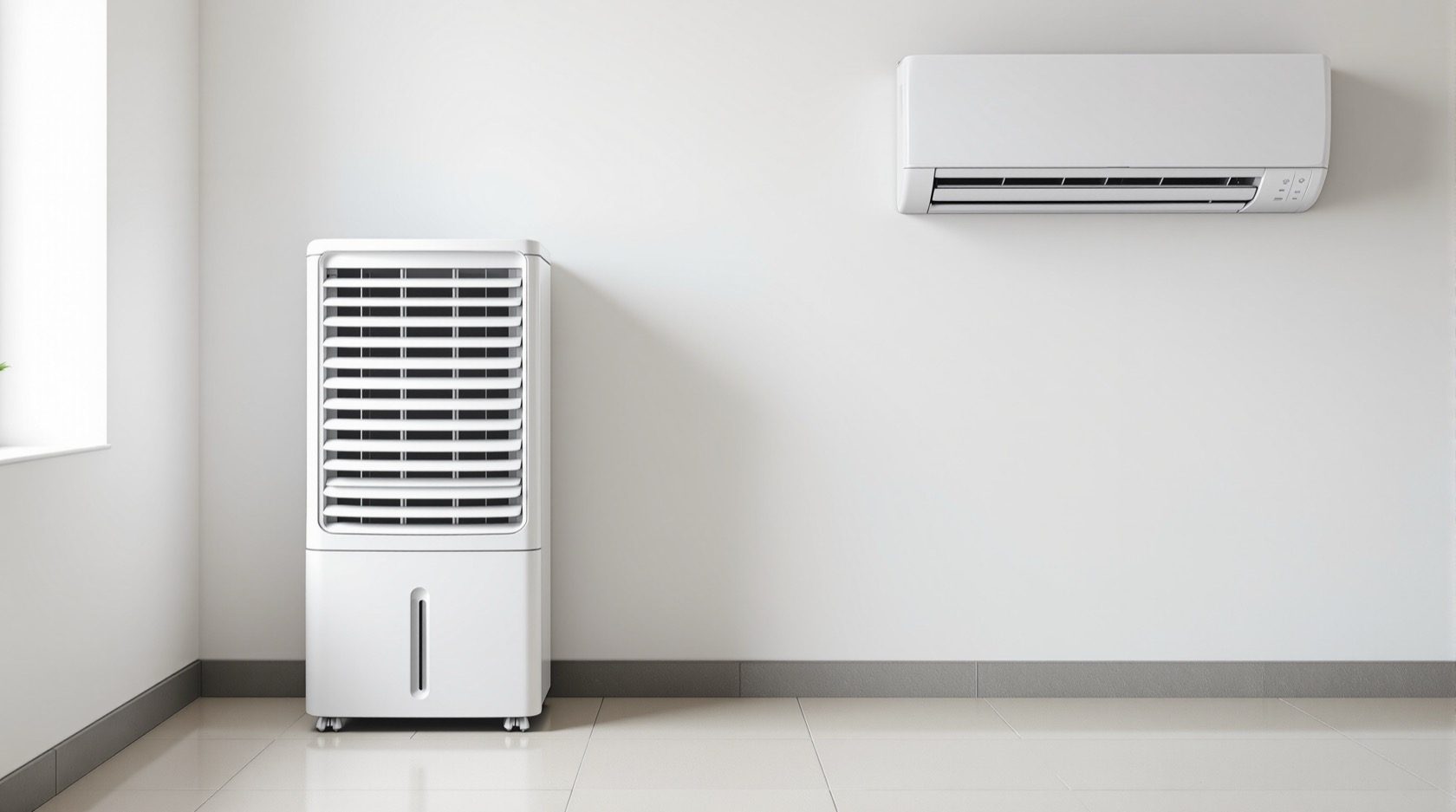
Air Cooler vs Air Conditioner: Which Is Right for Your Climate?
A very Indian dilemma — how an evaporative air cooler and an air conditioner actually differ, why the cooler is far cheaper to buy and run but only works in dry heat, why the AC wins in humidity, and how to choose for your city and budget.
Every Indian summer, millions face the same choice: the affordable air cooler (the "desert cooler") or the pricier air conditioner? They seem to do the same job, but they work on completely different principles — and that difference decides which is right for you. The short version: the cooler is far cheaper to buy and run but only cools well in dry heat, while the AC works everywhere, including humidity, but costs much more. This guide compares them honestly, so you can choose for your climate and budget.
It relates to Passive Cooling and Air Conditioning Basics, part of the HVAC Knowledge Hub.
The safety line & scope. Air coolers are simple plug-in appliances (keep water clean to avoid mould/mosquitoes). AC installation and refrigerant are a qualified technician's work.
How they work — the key difference
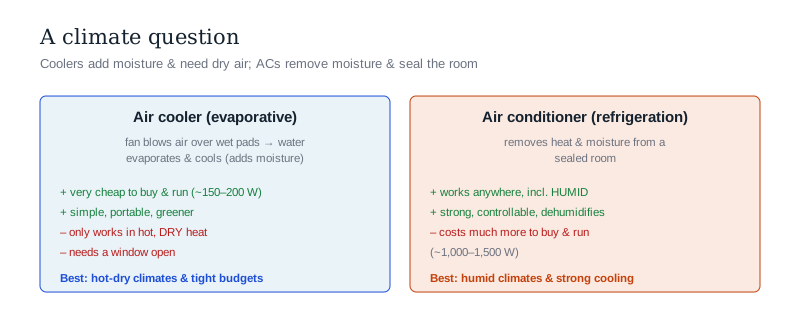
The whole comparison flows from how each cools:
- Air cooler (evaporative) — a fan blows air over water-soaked pads; the water evaporates, absorbing heat and cooling the air (the desert-cooler principle). It adds moisture to the air and needs fresh air flowing through (a window open).
- Air conditioner (refrigeration) — uses the refrigeration cycle to remove heat from the room and pump it outside, and removes moisture (dehumidifies) as it cools — working in a sealed room.
That difference — coolers add moisture and need dry air; ACs remove moisture and seal the room — decides everything else.
At a glance
| Air cooler | Air conditioner | |
|---|---|---|
| How it cools | Evaporating water | Refrigeration (removes heat) |
| Best climate | Hot & dry | Any, incl. humid |
| Effect on humidity | Adds moisture | Removes moisture |
| Buying cost | Low | High |
| Running cost | Very low (~fan + pump) | Higher |
| Needs | Fresh air (window open), water | Sealed room |
| Cooling power | Modest | Strong, controllable |
Why the cooler wins in dry heat
- Very cheap to buy and run — a cooler uses roughly the power of a fan plus a small pump (~150–200 W) versus an AC's ~1,000–1,500 W, so its electricity cost is a fraction (compare with the cooling cost comparison).
- Works beautifully in hot, dry climates — north/central India's dry summer heat, where evaporation is effective.
- Adds humidity — which is pleasant in bone-dry air.
- Simple, portable, no installation.
- Greener — a fraction of the energy and emissions.
Why the AC wins in humidity (and for strong cooling)
- Works in humid climates — coastal and monsoon India, where a cooler barely helps (you can't evaporate much into already-humid air) and would make the stickiness worse.
- Removes humidity — dehumidifying for real comfort.
- Strong, controllable cooling to any set temperature, in a sealed room.
- Consistent regardless of outdoor humidity.
How to choose — climate first
- Hot & dry climate (Delhi, Rajasthan, dry interior in summer) → an air cooler is a superb, cheap choice, especially on a budget; add an AC only for peak heat or specific rooms.
- Humid climate (Mumbai, Chennai, Kolkata, coasts, monsoon everywhere) → an AC — a cooler will disappoint and add stickiness.
- Composite climate (much of India) → often both — a cooler for the dry pre-monsoon heat, an AC for the humid monsoon and peak days.
- Budget-driven → a cooler is far cheaper to buy and run; an AC is the comfort upgrade where humidity or strong cooling demand it.
- Keep a cooler's water clean and the pads maintained to avoid mould and mosquitoes.
The one-line answer
Air cooler versus AC is really a climate question, because they cool on opposite principles: an evaporative air cooler blows air over wet pads so evaporating water cools and humidifies the air (needing dry air and an open window), while an air conditioner uses refrigeration to remove heat and moisture from a sealed room. So the cooler wins in hot, dry heat — it's far cheaper to buy and run (roughly a fan's power vs an AC's ~1,000–1,500 W), simple and green, and its added humidity feels pleasant in dry air — while the AC wins in humidity (coasts, monsoon), where a cooler barely helps and worsens the stickiness, and wherever you want strong, controllable, dehumidifying cooling. Choose by your climate: a cooler for dry heat and tight budgets, an AC for humid climates and strong cooling, and often both across India's composite seasons.
Where to go next
- Compare running costs: Cooling Cost Comparison Calculator.
- The AC side: Air Conditioning Basics Guide.
- Cut cooling need first: Passive Cooling Guide.
- Manage the humidity an AC removes: Humidity Control Guide.
References
- IS 1391 (Parts 1 & 2 : 2023) Room Air Conditioners; Bureau of Energy Efficiency (BEE) — Star Labelling: https://beeindia.gov.in/
- ISHRAE — evaporative cooling & climate-responsive design guidance; ASHRAE Standard 55 (comfort, including humidity).
Suitability depends on your local climate (dry vs humid); running-cost figures are indicative. Keep an air cooler's water clean; AC installation is a qualified technician's work. Verify the current BEE label and any standard's status via the BIS catalogue.
Export this guide
Related Guides — Deep-dive reading
HVAC by Climate Zone: One Country, Five Very Different Problems
India spans five climate zones, and the right HVAC strategy is completely different in each — dry heat wants evaporative cooling, humid coasts want dehumidification, the north wants cooling and heating both. A map of India's climate zones and how HVAC changes across them.
HVAC & CoolingHVAC for Composite Climates: The All-Seasons Challenge
Delhi and the north-central plains get everything — scorching summers, cold winters and a humid monsoon — so their HVAC must cool, dehumidify and heat across the year. Why a reversible heat pump and a good envelope are the smart answer to India's most demanding climate.
HVAC & CoolingHVAC & Air Conditioning Cost in India: Buy, Install, Run & Maintain
The whole cost picture, honestly — the four costs of cooling (buying, installation, running and maintenance), how they compare across window, split, VRF and ducted systems, why the cheapest AC is often the most expensive, and how to budget sensibly.
HVAC & CoolingRelated Tools — Try Free
Cross-Ventilation Analyzer
Estimate airflow and air changes per hour (ACH) from room size, window areas, layout, and local wind — with NBC 2016 Part 8 compliance check.
Ventilation CalculatorEvaporative Cooler Calculator
Whether an air cooler will actually cool your room — the wet-bulb temperature, the cooling it can achieve and a clear verdict, from your temperature and humidity.
HVACWindow Cost Calculator
Estimate window price plus installation by type, frame material, size, glass and quantity.
Window Calculator