
HVAC for Composite Climates: The All-Seasons Challenge
Delhi and the north-central plains get everything — scorching summers, cold winters and a humid monsoon — so their HVAC must cool, dehumidify and heat across the year. Why a reversible heat pump and a good envelope are the smart answer to India's most demanding climate.
The composite zone — Delhi, the north-central plains, and much of the interior (Lucknow, Kanpur, Nagpur, Bhopal) — has the hardest HVAC brief in India, because it doesn't have one problem, it has all of them across the year: brutal dry-then-humid summers touching 45°C, a sticky monsoon, and genuinely cold winters near freezing. A home here needs to cool, dehumidify and heat depending on the month — no single season dominates. Meeting that with one smart system, rather than a patchwork, is the art of composite-climate HVAC. This guide explains how.
It builds on the Climate Zone HVAC Guide, part of the HVAC Knowledge Hub. This is practical homeowner guidance for a north-plains home.
Scope. Practical seasonal strategy; system selection and sizing for the full range of conditions are qualified MEP/HVAC work.
The all-seasons problem
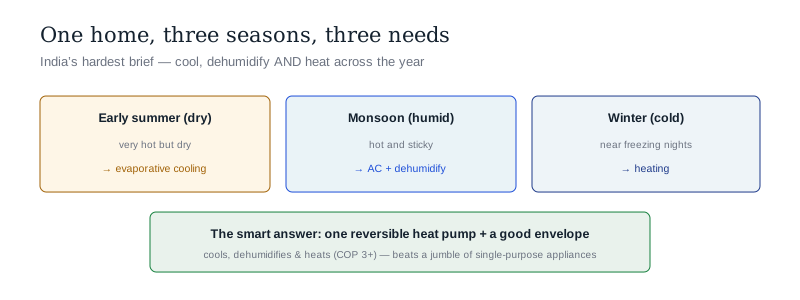
The defining feature of the composite zone is that the problem changes with the season:
- Early summer (hot-dry) — very hot but dry, so evaporative cooling works well before the monsoon arrives.
- Monsoon (warm-humid) — hot and humid, so evaporative cooling stops working and the job becomes AC with dehumidification (see warm-humid).
- Winter (cold) — genuinely cold nights near freezing, needing heating and hot water (see home heating).
- Shoulder months — mild and pleasant, needing little.
So a composite home must switch modes through the year — which is exactly why the equipment strategy differs from single-season zones.
The smart answer: reversible heat pump + good envelope
Because the composite zone needs both cooling and heating, the efficient solution is elegant:
- A reversible inverter AC (heat pump) — one machine that cools efficiently in summer and heats efficiently in winter, at COP 3+ for heating — far better than running a separate resistance room heater. This single choice covers the two big opposite loads, and it dehumidifies in the monsoon. For the composite zone, a reversible inverter split is close to the ideal all-rounder.
- A strong envelope — because the same walls and roof must keep summer heat out and winter warmth in, insulation and shading pay double here; Eco Niwas Samhita composite-zone limits reflect this (see heat transfer).
- Evaporative cooling for dry early summer — an air cooler is cheap and effective before the monsoon; many north-Indian homes sensibly use a cooler in the dry heat and the AC in the humid months.
- Winter sun — passive solar gain (south-facing glass, unshaded in winter) is a free heating asset in the composite winter.
The through-line: one efficient reversible system plus a good envelope beats a jumble of single-purpose appliances.
Season-by-season, in practice
- Peak dry summer — air cooler or AC; shade hard, ventilate at night (big day-night swing persists in the dry phase).
- Monsoon — switch to AC for dehumidification; watch for mould and damp; fans for air movement.
- Winter — reversible AC in heating mode (or targeted room heating); open south glass to the winter sun by day, insulate at night; a solar or heat-pump water heater for the higher winter hot-water demand.
- Year-round — the envelope and fans do quiet work in every season.
The one-line answer
The composite zone (Delhi and the north-central plains — Lucknow, Nagpur, Bhopal) has India's hardest HVAC brief because it has every problem across the year: a scorching dry early summer, a humid monsoon, and a genuinely cold winter near freezing — so a home must cool, dehumidify and heat by season, with none dominating. The smart answer is one efficient reversible inverter AC (heat pump) — it cools well in summer, dehumidifies in the monsoon, and heats efficiently in winter at COP 3+, far better than a separate resistance heater — paired with a strong envelope that keeps summer heat out and winter warmth in (so insulation and shading pay double, as Eco Niwas Samhita's composite limits reflect). Round it out with an air cooler for the dry pre-monsoon heat (cheap and effective before humidity arrives), winter solar gain through south glass as free heat, and a solar/heat-pump water heater for winter hot water. One reversible system plus a good envelope beats a jumble of single-purpose appliances — the art of the all-seasons climate.
Where to go next
- The zone map: Climate Zone HVAC Guide.
- The key equipment: Heat Pump Guide · Inverter vs Non-Inverter AC.
- The seasonal pieces: Hot-Dry · Warm-Humid · Home Heating.
- The envelope: Eco Niwas Samhita Guide.
References
- National Building Code of India, SP 7 : 2026 (composite climate design); Bureau of Energy Efficiency (BEE) — Eco Niwas Samhita composite envelope limits: https://beeindia.gov.in/
- ISHRAE — climate-responsive design for composite climates; India Meteorological Department (IMD) climatic data.
- BEE — reversible heat-pump/inverter AC efficiency (heating & cooling) guidance.
Practical seasonal guidance. System selection and sizing for the full range of conditions are qualified MEP/HVAC work tuned to local design conditions.
Export this guide
Related Guides — Deep-dive reading
Designing a Naturally Energy-Efficient Indian Home
Comfort first, gadgets last — passive design, orientation, insulation, ventilation and the climate wisdom that cuts Indian energy bills
SustainabilityHVAC by Climate Zone: One Country, Five Very Different Problems
India spans five climate zones, and the right HVAC strategy is completely different in each — dry heat wants evaporative cooling, humid coasts want dehumidification, the north wants cooling and heating both. A map of India's climate zones and how HVAC changes across them.
HVAC & CoolingHVAC for Cold Climates: India's Hills, Where Heating Rules
In Shimla, Manali, Leh, Gangtok and the Himalayan and hill belt, the HVAC problem flips — it's about staying warm, not cool. How insulation, heat pumps, solar gain and hot water keep a cold-climate Indian home comfortable through a real winter.
HVAC & CoolingRelated Tools — Try Free
Cross-Ventilation Analyzer
Estimate airflow and air changes per hour (ACH) from room size, window areas, layout, and local wind — with NBC 2016 Part 8 compliance check.
Ventilation CalculatorBrise-Soleil Visualizer
Interactive horizontal-louvre cut-off angle calculator — sun altitude, louvre depth, and spacing inputs with a live shadow preview. Computes θ = arctan(spacing/depth) for façade shading, ECBC envelope compliance, hospital daylight design, and tropical sun-control detailing.
Sun Shading ToolEvaporative Cooler Calculator
Whether an air cooler will actually cool your room — the wet-bulb temperature, the cooling it can achieve and a clear verdict, from your temperature and humidity.
HVAC