
HVAC Standards & Regulations in India: Who Sets the Rules
The codes and standards that govern HVAC in India — the National Building Code, ECBC and Eco Niwas Samhita energy codes, BEE star labelling, BIS/IS product standards, environmental refrigerant rules, and ISHRAE/ASHRAE practice — and who enforces which.
Behind every properly designed HVAC system in India sits a web of codes, standards and regulations — some legally mandatory, some best-practice, some product-level, some building-level. They decide how efficient your equipment must be, how a building's envelope must perform, which refrigerants are allowed, and what approvals a project needs. For anyone specifying, buying or approving HVAC, knowing this landscape is essential — and knowing who enforces what matters as much as the rules themselves. This guide maps the standards and regulations that govern HVAC in India.
It's the anchor of the standards thread in the HVAC Knowledge Hub, and builds on Building HVAC Design.
Scope. This is an orientation to the framework, not legal advice. Applicability and compliance for a specific project must be confirmed with the relevant authority and a qualified professional — codes are revised and adopted state-by-state.
The layers of the framework
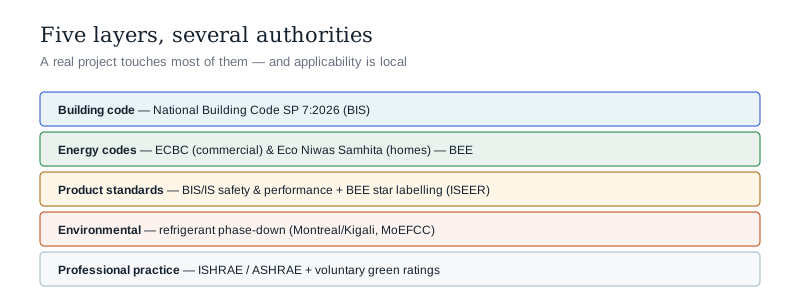
India's HVAC rules fall into distinct layers, each with its own author and purpose:
- Building codes — the National Building Code (SP 7) sets overall building-services provisions.
- Energy codes — ECBC (commercial) and Eco Niwas Samhita (residential) cap how much energy buildings and their HVAC may use.
- Product standards — BIS/IS standards define equipment safety and performance; BEE star labelling rates efficiency.
- Environmental regulations — refrigerant phase-down rules (Montreal/Kigali via MoEFCC) govern the gases HVAC may use.
- Professional practice — ISHRAE and ASHRAE standards guide how to design well, even where not legally mandated.
A real project touches several layers at once — a compliant AC (BEE-rated, safe to BIS, using an allowed refrigerant) installed in a building meeting the energy code and permitted by the local authority.
The building & energy codes
- National Building Code — SP 7 : 2026 (the current edition; SP 7 : 2016 is withdrawn) — the overarching reference for building services including HVAC and ventilation, published by BIS. Adopted into law by states/local bodies.
- ECBC — the Energy Conservation Building Code (BEE) for commercial buildings above a size/load threshold, setting minimum efficiency for HVAC, envelope, lighting and more; being updated toward the Energy Conservation & Sustainable Building Code (ECSBC).
- Eco Niwas Samhita — the residential energy code (BEE), focused on the envelope (RETV, roof, openings) so homes need less cooling in the first place.
- State adoption — energy codes become mandatory when a state notifies them, so local applicability varies — always check the state.
Product standards & labelling
- BEE Star Labelling — the familiar 1–5 star efficiency label on ACs and appliances, based on ISEER; mandatory for room ACs. More stars = more efficient.
- BIS / IS standards — product safety and performance: IS 1391 (room ACs), IS 8148 (ducted/packaged), IS 60335-2-40 (AC/heat-pump safety), IS 655 (ducts), IS 2082 (water heaters), and more.
- Testing & certification — equipment is tested to these standards; the BIS mark and BEE label are what a buyer actually sees.
Environmental & professional layers
- Refrigerant rules — India's HCFC phase-out and HFC phase-down (Montreal Protocol & Kigali Amendment, via the MoEFCC Ozone Cell) govern which refrigerants are permitted, pushing to low-GWP gases.
- Pollution & environmental clearances — CPCB/State Pollution Control Boards and environmental rules touch large plant, DG sets and emissions.
- ISHRAE & ASHRAE — the professional societies' standards (e.g. ASHRAE 55 comfort, 62.1 ventilation, 90.1 energy, 170 healthcare) are the how-to-design-well references widely used in India even where not statutory.
- Green rating systems — IGBC, GRIHA and LEED (voluntary) reward HVAC efficiency, commissioning and IAQ beyond code.
Who enforces what
- BIS — publishes the NBC and IS product standards; runs product certification.
- BEE (Ministry of Power) — owns ECBC, Eco Niwas Samhita and star labelling.
- State governments & local bodies — adopt and enforce the codes through building-plan approval; issue permits.
- MoEFCC — refrigerant/ozone regulation.
- Fire, pollution, electrical & health authorities — issue the approvals a project needs.
The practical takeaway: compliance is multi-authority, and applicability is local — the same project can face different mandatory codes in different states.
The one-line answer
HVAC in India is governed by a layered framework: the National Building Code (SP 7 : 2026, the current edition — SP 7 : 2016 is withdrawn) for building services; the energy codes — ECBC for commercial buildings and Eco Niwas Samhita for homes (both BEE, moving toward the sustainable-building code ECSBC) — capping how much energy buildings and HVAC may use; product standards (BIS/IS safety & performance like IS 1391, IS 60335-2-40, plus BEE star labelling rating efficiency by ISEER); environmental rules (the Montreal/Kigali refrigerant phase-down via MoEFCC); and professional practice (ISHRAE/ASHRAE standards and voluntary green ratings). Crucially, enforcement is multi-authority — BIS publishes standards, BEE owns the energy codes and labels, states adopt and enforce them through plan approval and permits, and MoEFCC governs refrigerants — and applicability is local, so the same project can face different mandatory codes in different states. Always confirm what applies with the relevant authority and a qualified professional.
Where to go next
- The commercial energy code: ECBC Compliance Guide.
- The residential energy code: Eco Niwas Samhita Guide.
- Reading the efficiency label: BEE Star Rating Guide.
- Getting a project approved: HVAC Approvals & Permits · Green Building HVAC.
References
- National Building Code of India / National Building Construction Standards, SP 7 : 2026 (current edition; SP 7 : 2016 withdrawn), Bureau of Indian Standards.
- Bureau of Energy Efficiency (BEE) — ECBC, Eco Niwas Samhita, Standards & Labelling: https://beeindia.gov.in/ ; MoEFCC Ozone Cell — refrigerant regulation.
- ISHRAE; ASHRAE Standards 55/62.1/90.1/170; IGBC/GRIHA green-building rating systems.
An orientation, not legal advice. Applicability and compliance for a specific project must be confirmed with the relevant authority and a qualified professional. Verify any standard's current status and state adoption before relying on it.
Export this guide
Related Guides — Deep-dive reading
The Future of Building Regulations in India
Where India's building rules are heading on energy, climate resilience, digital approvals and green construction, and what it means for the home you build next.
Building Regulations & ComplianceSolar Energy Mandates in Buildings: Where India Requires Solar
Solar water heating and rooftop PV requirements in building bye-laws and energy codes, and how they differ from subsidies
Building Regulations & ComplianceSecurity and Fire Regulations Guide for India (2026): Know the Rules and How to Navigate Them
There is no single national rulebook you can read off. This is the map of the whole regulatory landscape for home, housing-society and commercial security and fire systems in India, and a calm way to navigate it: who sets the rules, who approves what, and how to stay on the right side of them.
SecurityRelated Tools — Try Free
Cross-Ventilation Analyzer
Estimate airflow and air changes per hour (ACH) from room size, window areas, layout, and local wind — with NBC 2016 Part 8 compliance check.
Ventilation CalculatorGreen Building Water Score Calculator
Score a building's water efficiency 0–100 from treated-water reuse, rainwater harvesting, low-flow fixtures and metering, with an IGBC/GRIHA-style rating and your biggest improvement lever.
SustainabilityRoom Lighting Calculator
Estimate the target lux, total lumens and number of LED fixtures a room needs, from its type and size — a general-illumination planning guide.
Lighting