
HVAC Fundamentals: The Physics Behind Comfort
The ideas underneath every system — the four things HVAC actually controls (temperature, humidity, air movement and air quality), how heat moves, the difference between sensible and latent heat, and why a cooling load is more than just 'how hot it is', for the Indian climate.
Every air conditioner, chiller and ventilation fan is an application of a handful of physical ideas. Grasp those ideas — what HVAC actually controls, how heat moves, the difference between drying and cooling, and what really drives a cooling load — and the whole field stops being a catalogue of boxes and becomes a system you can reason about. This is the fundamentals guide: the physics behind comfort, grounded in the Indian climate.
It is the anchor of the fundamentals thread in the HVAC Knowledge Hub, and the "why" beneath the Ultimate HVAC Guide.
Scope. This is a conceptual literacy guide — the principles that inform planning and specification. Load calculation and system design are qualified MEP/HVAC engineering work.
What HVAC actually controls — four variables
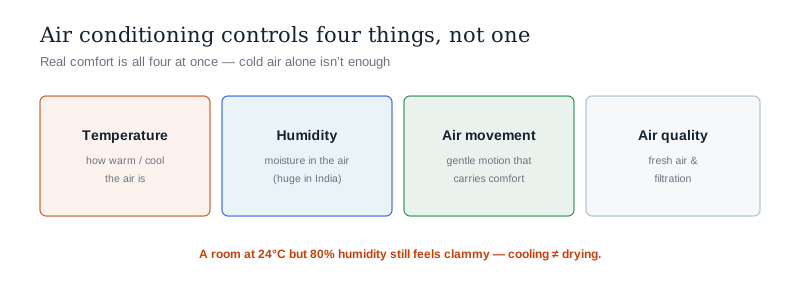
"Air conditioning" is often heard as "making air cold," but HVAC controls four things at once:
- Temperature — how warm or cool the air is.
- Humidity — how much moisture the air holds (huge in India; see humidity control).
- Air movement — the gentle motion that carries comfort and mixes the room.
- Air quality — fresh air and filtration (IAQ).
Real thermal comfort is all four together — which is why a room at 24°C but 80% humidity still feels clammy, and why cooling and drying are not the same job.
How heat moves — three modes
Cooling a space means removing heat, so you have to know how heat arrives. It travels three ways (detailed in heat transfer in buildings):
- Conduction — through solid materials (heat soaking through a wall or roof).
- Convection — carried by moving air or fluid (hot air, or a fan over a coil).
- Radiation — as infrared energy across space (the sun on a roof, a hot wall radiating to you).
In India, radiant heat gain through roofs and west walls, plus solar through glass, dominates the daytime cooling load — which is why shading and insulation matter before the AC is even chosen.
Sensible vs latent heat — the key distinction
The single idea that separates HVAC beginners from practitioners:
- Sensible heat — heat that changes temperature (what a thermometer reads). Cooling sensible heat makes air colder.
- Latent heat — heat stored in moisture (water vapour). Removing latent heat means condensing water out of the air — drying it, which shows up as the condensate dripping from an AC.
- Why it matters in India — humid coastal and monsoon air carries a huge latent load. An AC must spend energy both cooling (sensible) and dehumidifying (latent). A system sized only for temperature will feel cold-but-damp; comfort needs both handled. This is the heart of psychrometrics.
The total heat an AC removes = sensible + latent. The split between them (the "sensible heat ratio") is why humid-climate design differs from dry-climate design.
What drives a cooling load
A "cooling load" is the rate at which heat must be removed to hold a space comfortable — and it is much more than the outdoor temperature. It sums (see cooling load calculation):
- Envelope gains — conduction through walls, roof and glass.
- Solar gains — sunlight through windows and onto surfaces.
- Internal gains — people, lights, appliances, electronics (each person ≈ a small heater).
- Ventilation & infiltration — warm, humid outdoor air brought in or leaking in (a big latent load in India).
Because these vary by orientation, occupancy and hour, proper sizing is a calculation, not a rule of thumb — and both oversizing and undersizing hurt (see choosing an AC).
The units you'll meet
- Ton of refrigeration (TR) — a rate of cooling (1 TR ≈ 3.5 kW of heat removed). India sizes room ACs in tons.
- kW / BTU/hr — heat and cooling rates (1 TR = 12,000 BTU/hr).
- CFM / m³/hr — airflow (see air properties & airflow).
- ISEER / COP / EER — efficiency (cooling delivered per unit of energy; see efficiency).
The one-line answer
HVAC rests on a few physical ideas. It controls four variables at once — temperature, humidity, air movement and air quality — which is why a cold-but-humid room still feels clammy and why cooling ≠ drying. Heat arrives three ways — conduction (through solids), convection (via moving air) and radiation (infrared, e.g. sun on a roof) — and in India radiant and solar gains dominate the day. The decisive distinction is sensible heat (changes temperature) vs latent heat (stored in moisture — removing it dries the air by condensing water out); humid Indian air carries a large latent load, so an AC must both cool and dehumidify, and total heat removed = sensible + latent. A cooling load is the rate heat must be removed, summing envelope, solar, internal and ventilation/infiltration gains — so sizing is a calculation, not a guess. Master these and every system, from a split to a chiller, becomes reasoning rather than memorisation.
Where to go next
- What comfort really is: Thermal Comfort Guide.
- The moisture science: Psychrometrics Guide.
- What sizes the system: Cooling Load Calculation Guide.
- How heat gets in: Heat Transfer in Buildings · Air Properties & Airflow.
References
- ASHRAE Handbook — Fundamentals (psychrometrics, heat transfer, load calculation); ASHRAE Standard 55 — Thermal Comfort; ISHRAE — HVAC design guidance.
- Bureau of Energy Efficiency (BEE) — ECBC & Eco Niwas Samhita (envelope & load): https://beeindia.gov.in/
- National Building Code of India, SP 7 (Part 8 — Building Services; verify current edition), Bureau of Indian Standards.
This is a conceptual literacy guide. Cooling-load calculation and HVAC system design are qualified MEP/HVAC engineering work. Verify any standard's current status via the BIS catalogue before relying on it.
Export this guide
Related Guides — Deep-dive reading
Energy-Efficient Facades in India: How the Building Skin Cuts Your Cooling, Heating & Lighting Bills
How a building facade drives cooling, heating and lighting energy in India, the three levers of solar-heat-gain control, insulation and daylighting, U-value, SHGC, VLT and WWR in plain terms, ECBC and Eco-Niwas expectations, and real Indian green buildings.
Building FacadesDesigning a Naturally Energy-Efficient Indian Home
Comfort first, gadgets last — passive design, orientation, insulation, ventilation and the climate wisdom that cuts Indian energy bills
SustainabilityHeat Transfer in Buildings: How Heat Gets In (and How to Stop It)
The three ways heat moves through a building — conduction, convection and radiation — plus U-values and R-values, why the roof and west wall matter most in India, and why cutting heat gain at the envelope beats fighting it with a bigger air conditioner.
HVAC & CoolingRelated Tools — Try Free
Cross-Ventilation Analyzer
Estimate airflow and air changes per hour (ACH) from room size, window areas, layout, and local wind — with NBC 2016 Part 8 compliance check.
Ventilation CalculatorWindow Heat Gain Calculator
Estimate solar heat gain in watts, daily kWh and AC tonnage by window area, orientation, SHGC and shading.
Window CalculatorBrise-Soleil Visualizer
Interactive horizontal-louvre cut-off angle calculator — sun altitude, louvre depth, and spacing inputs with a live shadow preview. Computes θ = arctan(spacing/depth) for façade shading, ECBC envelope compliance, hospital daylight design, and tropical sun-control detailing.
Sun Shading Tool