

Eco Niwas Samhita: India's Energy Code for Homes
The residential energy code that quietly makes homes cooler and cheaper to run — what Eco Niwas Samhita requires, the RETV envelope metric, roof and window limits, natural ventilation and daylight, and why designing the cooling load down is the whole point.
Most conversations about efficient homes jump straight to the air conditioner. Eco Niwas Samhita (ENS) — India's residential energy code, from the Bureau of Energy Efficiency — takes the smarter view: get the building itself right, so it needs far less cooling in the first place. By setting limits on how much heat a home's envelope may admit, ENS quietly makes houses cooler, more comfortable, and cheaper to run — before any HVAC is chosen. For anyone designing or building a home, it's both a code to meet and a blueprint for a better house. This guide explains what ENS requires and why it matters.
It builds on the HVAC Standards & Regulations Guide, part of the HVAC Knowledge Hub.
Scope. This explains ENS to inform understanding and design intent. Compliance is a professional exercise against the version in force and the applicable state rules, confirmed by qualified professionals.
The philosophy: design the load down
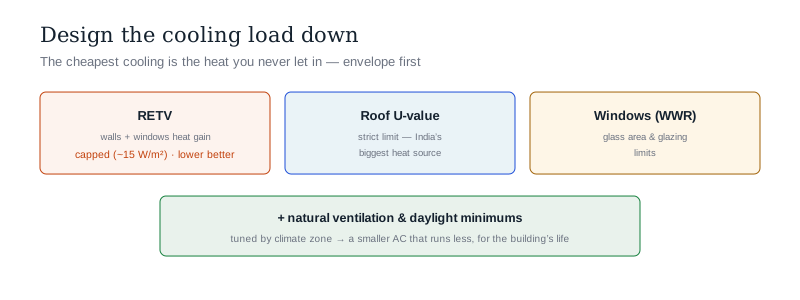
ENS is built on the envelope-first principle:
- The cheapest cooling is the heat you never let in. ENS caps how much heat the walls, roof and windows admit, so the cooling load is smaller by design.
- Comfort even without AC — a compliant home stays more comfortable naturally, and where AC is used, it's smaller, cheaper and runs less.
- Focus on the envelope — unlike ECBC (which also covers equipment), ENS for homes centres on the building fabric and passive design, the levers that matter most in residences.
The whole point: a well-designed home does most of the work, and the HVAC just tops it up.
What ENS requires
ENS sets performance limits on the parts of a home that admit heat and light:
- RETV (Residential Envelope Transmittance Value) — the headline metric: a single number capturing how much heat the walls and windows (the non-roof envelope) let in, per unit area. ENS caps RETV (a commonly cited limit is around 15 W/m² for most climate zones) — lower is better, achieved through insulation, shading, better glass and sensible window sizing.
- Roof thermal transmittance — a separate, strict U-value limit for the roof (the biggest heat source in India), pushing roof insulation and cool roofs.
- Window-to-Wall Ratio (WWR) & glazing — limits on glass area and its properties (U-value, solar heat gain), because glass is the weak point for heat gain.
- Natural ventilation & daylight — minimum openable area for cross-ventilation and adequate daylight, so homes can stay comfortable and lit passively (see passive cooling).
- Climate zones — limits vary across India's climate zones (hot-dry, warm-humid, composite, temperate, cold), tuned to each.
Meet these and the home is fundamentally cooler and cheaper to run — code as good design.
Why it matters — even beyond compliance
- Lower bills for life — a low-RETV, well-roofed home needs a smaller AC that runs less, saving every summer for the building's life.
- Comfort without dependence — better passive performance means more hours comfortable without the AC on.
- The right order of design — ENS enforces the correct sequence: envelope first, then HVAC (sizing follows), which is how efficient homes should be designed regardless of code.
- Scale impact — with India adding enormous housing stock, ENS locks in efficiency across millions of future homes.
- Adoption — like other codes, ENS becomes mandatory as states adopt it; even where voluntary, it's an excellent design brief.
The one-line answer
Eco Niwas Samhita (ENS) is India's residential energy code, from BEE, built on the envelope-first idea: rather than starting with the air conditioner, it limits how much heat a home's fabric admits so the cooling load is small by design — cheaper cooling, more natural comfort. Its headline metric is RETV (Residential Envelope Transmittance Value) — a single number for how much heat the walls and windows let in, capped (commonly around 15 W/m²) and lowered through insulation, shading, better glass and sensible window sizing — alongside a strict roof U-value limit (the roof being India's biggest heat source), window-to-wall-ratio and glazing limits, and minimums for natural ventilation and daylight, all tuned by climate zone. It matters beyond compliance because a low-RETV, well-roofed home needs a smaller AC that runs less, saving every summer for the building's life, and it enforces the right design order — envelope first, then HVAC. Becoming mandatory as states adopt it, ENS is both a code and a blueprint for cooler, cheaper Indian homes.
Where to go next
- The framework: HVAC Standards & Regulations Guide.
- The commercial equivalent: ECBC Compliance Guide.
- The physics behind it: Heat Transfer in Buildings · Passive Cooling Guide.
- Then size the HVAC: Cooling Load Calculation Guide.
References
- Bureau of Energy Efficiency (BEE) — Eco Niwas Samhita (Energy Conservation Building Code for Residential Buildings), including the RETV method: https://beeindia.gov.in/
- National Building Code of India, SP 7 : 2026 (current edition), Bureau of Indian Standards; state ENS notifications.
- ISHRAE & building-science references on residential envelope performance and passive design for Indian climates.
This guide informs understanding and design intent. ENS compliance is a professional exercise against the version in force and applicable state rules. Verify current applicability and limits before relying on them.
Export this guide
Related Guides — Deep-dive reading
Designing a Naturally Energy-Efficient Indian Home
Comfort first, gadgets last — passive design, orientation, insulation, ventilation and the climate wisdom that cuts Indian energy bills
SustainabilityEnergy-Efficient Facades in India: How the Building Skin Cuts Your Cooling, Heating & Lighting Bills
How a building facade drives cooling, heating and lighting energy in India, the three levers of solar-heat-gain control, insulation and daylighting, U-value, SHGC, VLT and WWR in plain terms, ECBC and Eco-Niwas expectations, and real Indian green buildings.
Building FacadesClimate-Responsive Facades for India: Designing Your Home's Skin for Your Weather
A homeowner's plain-language guide to the facade strategy for every Indian climate zone — what your walls, windows, shading, and colours should actually do where you live
Building FacadesRelated Tools — Try Free
Cross-Ventilation Analyzer
Estimate airflow and air changes per hour (ACH) from room size, window areas, layout, and local wind — with NBC 2016 Part 8 compliance check.
Ventilation CalculatorFuture Home Comfort Score
Score your home 0 to 100 on daylight, ventilation, thermal and acoustic comfort and find the weak link.
Window ToolWindow-to-Wall Ratio Calculator
Compute WWR percent and check it against Eco-Niwas Samhita VLT and RETV limits and climate.
Window Tool