

Psychrometrics: The Science of Air and Moisture, Made Readable
The one topic that unlocks humid-climate HVAC — dry-bulb, wet-bulb and dew point; relative humidity vs absolute; enthalpy; and how the psychrometric chart shows why cooling and dehumidifying are two different jobs in the Indian monsoon.
Psychrometrics — the study of air and the water vapour mixed into it — sounds forbidding, but it is the single topic that makes humid-climate air conditioning make sense. It explains why the AC drips water, why the monsoon feels unbearable at a temperature that would be fine in Delhi's dry heat, and why "just make it colder" doesn't fix a clammy room. Once the vocabulary clicks, the psychrometric chart becomes a map of everything HVAC does to air. This guide makes it readable.
It builds on HVAC Fundamentals, part of the HVAC Knowledge Hub.
Scope. A literacy guide to the concepts. Applying the psychrometric chart to system design is qualified MEP/HVAC engineering work.
The vocabulary of moist air
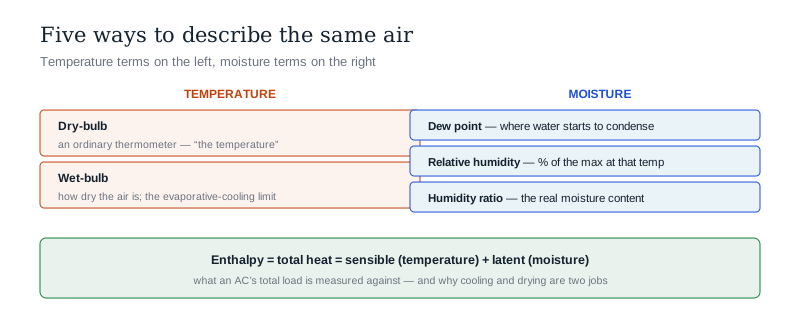
Air is a mixture of dry air and water vapour, and we describe it with a few linked properties:
- Dry-bulb temperature — what an ordinary thermometer reads; "the temperature."
- Wet-bulb temperature — the temperature a wet thermometer reads as water evaporates off it. The gap between dry-bulb and wet-bulb tells you how dry the air is (big gap = dry; no gap = saturated). It's also the limit of evaporative cooling.
- Dew point — the temperature at which air becomes saturated and water starts to condense. Any surface colder than the dew point will sweat (see the dew point calculator).
- Relative humidity (RH) — moisture as a percentage of the maximum the air can hold at that temperature. Because that maximum rises with temperature, RH changes as air heats or cools even with no moisture added.
- Humidity ratio (absolute humidity) — the actual mass of water per kg of dry air. This is the real moisture content, and it's what dehumidification reduces.
- Enthalpy — the total heat energy in the air: sensible (temperature) + latent (moisture) combined. It's what an AC's total load is measured against.
Relative vs absolute humidity — the classic confusion
The most common misunderstanding, and it matters:
- Relative humidity is relative to temperature. Cool a room and its RH rises even though no water was added — because cold air holds less moisture. That's why an over-cooled room can read 70% RH and feel damp.
- Absolute humidity (humidity ratio) is the real moisture. To actually dry the air, you must remove water — lower the humidity ratio — not just change the temperature.
- Practical consequence: raising the thermostat a touch and running a dehumidifier often feels better than blasting cold air, because it targets the moisture, not just the temperature.
Sensible and latent — read from the chart
The psychrometric chart plots dry-bulb (horizontal) against humidity ratio (vertical), with RH curves sweeping across it. On it, everything HVAC does is a line:
- Sensible cooling — a horizontal line left (temperature drops, moisture unchanged).
- Dehumidification — a downward line (moisture removed as the air hits a coil colder than its dew point and water condenses out).
- Real AC cooling — a diagonal down-and-left: it cools and dries at once, which is exactly what humid India needs.
- Evaporative cooling — a line along constant wet-bulb (adds moisture, drops temperature) — great in dry heat, useless in the monsoon.
The chart makes visible why the same AC behaves so differently in Rajasthan's dry summer and Mumbai's monsoon: same temperature, completely different moisture, completely different job.
Why this rules Indian HVAC
- The latent load is large. Coastal and monsoon air is heavy with moisture, so a big share of an AC's work is removing water, not lowering temperature — sizing and coil selection must account for it.
- Fresh air is a moisture penalty. Every litre of humid outdoor air brought in for ventilation carries latent load — which is why energy recovery (ERV), which pre-dries incoming air, pays off in India.
- Condensation is a design risk. Radiant cooling and cold pipes must stay above the dew point or they sweat — a psychrometric limit, not an optional caution.
The one-line answer
Psychrometrics is the science of air and its moisture, and it's the key to humid-climate HVAC. Air is described by linked properties: dry-bulb (ordinary temperature), wet-bulb (how dry the air is, and the evaporative-cooling limit), dew point (where water starts to condense — anything colder sweats), relative humidity (moisture as a percentage of the max at that temperature, so it rises as air cools), humidity ratio / absolute humidity (the real moisture content that dehumidification reduces), and enthalpy (total heat = sensible + latent). The classic trap is treating RH as absolute — cooling a room raises its RH without adding water, so to actually dry air you must remove moisture, not just lower temperature. On the psychrometric chart, sensible cooling is horizontal, dehumidification is downward, and real AC cooling is a diagonal that does both — which is why humid India's large latent load makes drying, ERV pre-drying of fresh air, and staying above the dew point central to good design.
Where to go next
- The physics context: HVAC Fundamentals Guide.
- Check condensation risk: Dew Point Calculator.
- Manage the moisture: Humidity Control Guide.
- Where the dew point bites: Radiant Cooling Guide · HRV / ERV Guide.
References
- ASHRAE Handbook — Fundamentals (Psychrometrics chapter; the psychrometric chart); ISHRAE — applied psychrometrics for the Indian climate.
- Bureau of Energy Efficiency (BEE) — Eco Niwas Samhita & ECBC (latent load & ventilation): https://beeindia.gov.in/
- National Building Code of India, SP 7 (Part 8 — Building Services; verify current edition), Bureau of Indian Standards.
A conceptual literacy guide. Applying psychrometrics to HVAC system design is qualified MEP/HVAC engineering work. Verify any standard's current status via the BIS catalogue before relying on it.
Export this guide
Related Guides — Deep-dive reading
HVAC Fundamentals: The Physics Behind Comfort
The ideas underneath every system — the four things HVAC actually controls (temperature, humidity, air movement and air quality), how heat moves, the difference between sensible and latent heat, and why a cooling load is more than just 'how hot it is', for the Indian climate.
HVAC & CoolingFlooring Thermal Comfort in India: How Your Floor Affects Heat, Cold and Energy Bills
The physics of why stone and tile feel cool while wood, cork and carpet feel warm, and how to match the floor to your climate zone so the surface under your feet works with the weather instead of against it.
Flooring & SurfacesDesigning a Naturally Energy-Efficient Indian Home
Comfort first, gadgets last — passive design, orientation, insulation, ventilation and the climate wisdom that cuts Indian energy bills
SustainabilityRelated Tools — Try Free
Brise-Soleil Visualizer
Interactive horizontal-louvre cut-off angle calculator — sun altitude, louvre depth, and spacing inputs with a live shadow preview. Computes θ = arctan(spacing/depth) for façade shading, ECBC envelope compliance, hospital daylight design, and tropical sun-control detailing.
Sun Shading ToolDew Point Calculator
The dew point from air temperature and humidity, plus which cold surfaces will sweat — a condensation-risk estimate for AC coils, chilled-water pipes, radiant panels and windows.
HVACBathroom Humidity Calculator
Gauge condensation and mould risk in a bathroom and the ventilation needed to control it — a 0-100 risk score with drivers and fixes.
Bathroom Calculator