

Weekly STP Maintenance Tasks: The Operator's Checklist
The seven jobs that keep a building STP healthy week after week — settleability testing, sludge wasting, diffuser checks, backwash review, chemical stock, calibration and cleaning — laid out as a practical routine for facility managers and operators.
A sewage treatment plant does not fail on a Tuesday afternoon out of nowhere. It fails because something small went unwatched for a fortnight — the sludge got too thick, a diffuser choked, the chlorine ran out, a probe drifted out of calibration. The daily STP checklist catches the obvious things: is it running, is it stinking, are the pumps hot. But the slower, sneakier problems only show up when you look once a week, with a bucket, a stopwatch and a notebook.
This guide is that weekly routine. Seven tasks, an hour or two of an operator's time, that keep a building STP producing compliant effluent instead of drifting quietly towards a plant reset.
Weekly maintenance is where you stop reacting to the plant and start reading it. The SV30 cone and the calibration check tell you what the plant will do next week — long before the outlet turns cloudy.
The weekly task list at a glance
| # | Task | What it protects | Typical time |
|---|---|---|---|
| 1 | SV30 settleability test | Biology health, clarifier performance | 40 min |
| 2 | Sludge wasting to holding tank | Correct MLSS, effluent clarity | 30 min |
| 3 | Diffuser & aeration check | Oxygen transfer, blower load | 20 min |
| 4 | Filter backwash review | Tertiary polishing, reuse quality | 15 min |
| 5 | Chemical stock & dosing check | Disinfection, pH correction | 15 min |
| 6 | Instrument calibration check | Trustworthy readings | 20 min |
| 7 | Cleaning & housekeeping | Everything above | 30 min |
Pick a fixed day. A plant that gets its weekly attention every Wednesday morning is far healthier than one that gets it "whenever there's time."
1. Run the SV30 settleability test
This is the single most useful thing an operator does all week. Fill a one-litre measuring cone with mixed liquor straight from the aeration tank, let it stand undisturbed for 30 minutes, and read the level the settled sludge occupies. That figure — millilitres of sludge per litre — is your SV30.
What it tells you:
- Healthy settling parks the sludge blanket somewhere around 250–350 ml/l for a typical extended-aeration plant, with a clear, straw-coloured liquid on top.
- Sludge that barely settles (a high, cloudy blanket) usually means too much sludge in the system, or filamentous bulking.
- Sludge that settles too fast and clumps, leaving pin-floc in the water above, often means the biology is over-aged and needs wasting.
Log the SV30 every week in the same book. The trend matters more than any single reading. Pair it with your MLSS figure to get the Sludge Volume Index — the number that tells you exactly how well your activated sludge is behaving.
2. Waste sludge to the holding tank
Micro-organisms multiply. Every week your aeration tank makes more biomass than it needs, and if you never remove any, the MLSS climbs, the clarifier overloads, and solids start washing over into the treated water. Sludge wasting is the deliberate removal of that surplus, pumped from the system into the sludge holding tank.
- Use the SV30 and MLSS trend to decide how much to waste — do not guess blindly.
- Waste little and often. A steady weekly draw holds the plant far better than a panicked bulk removal once solids are already carrying over.
- Note the run-time or volume you wasted, so next week's decision has a baseline.
- Watch the holding tank level so you can plan the tanker for sludge removal before it overflows.
If you want a sense of how much sludge your plant should be generating, the Sludge Generation Calculator converts your load into an expected weekly quantity — handy for spotting when wasting is off.
3. Check the diffusers and aeration pattern
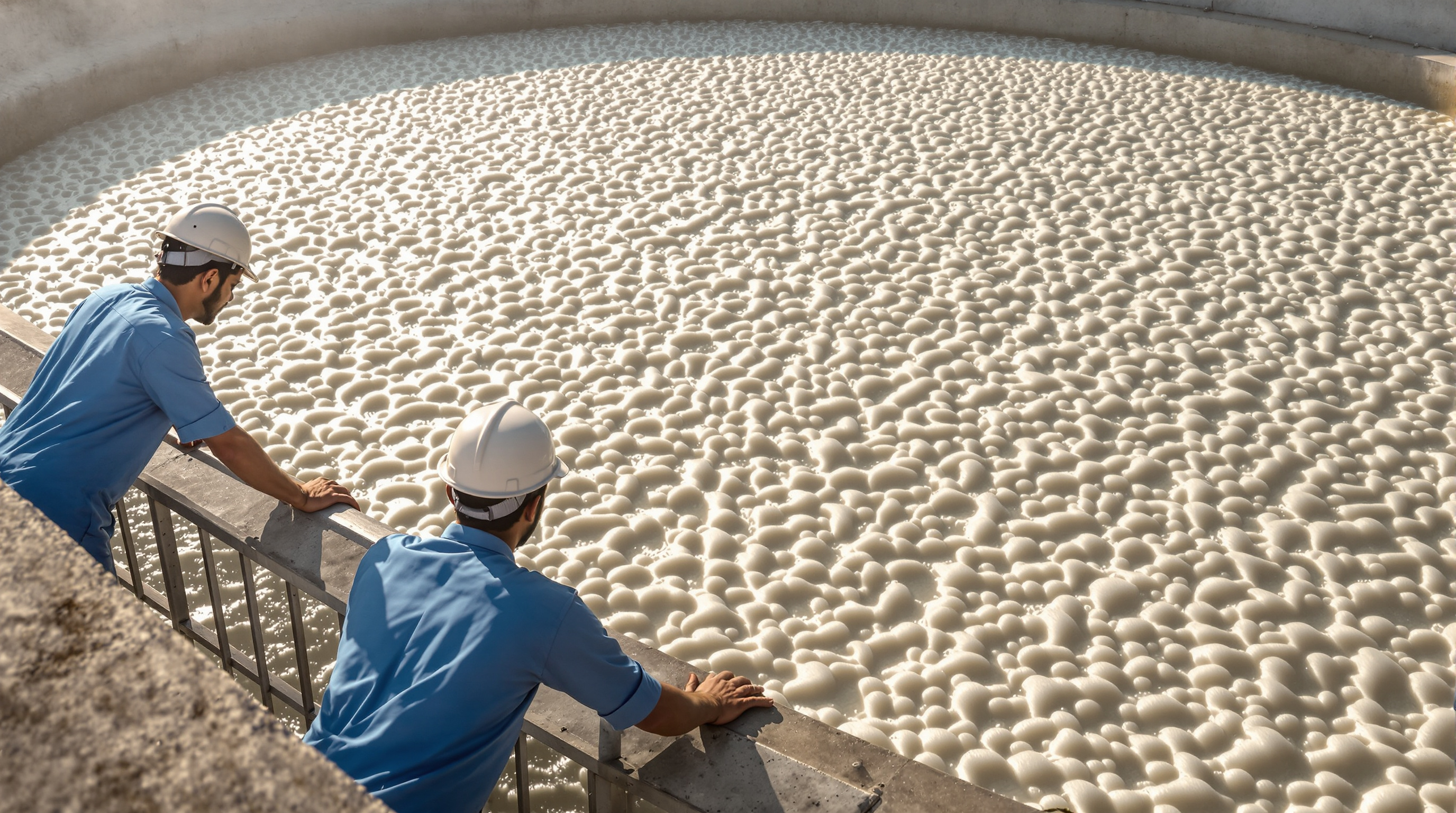
Stand over the aeration tank and look at the surface. A healthy tank boils evenly across its whole area with a fine, uniform froth. Weekly, check for:
- Dead patches — flat, un-bubbling zones that mean a choked or cracked diffuser below. Choked diffusers force the blower to work harder for less oxygen, quietly inflating your power bill.
- Coarse, violent boils in one spot — usually a detached or split diffuser membrane.
- Rising blower pressure on the gauge week to week, the clearest early sign that diffusers are fouling and heading for a diffuser cleaning.
You cannot fix diffusers weekly — they sit under a full tank — but weekly observation is how you schedule the cleaning before oxygen transfer collapses. Log the blower discharge pressure each week; a steady climb is your warning.
4. Review the filter backwash
Your pressure sand filter and any carbon filter do the final polishing before reuse. They are usually on an automatic or daily backwash, but weekly you confirm it is actually working:
- Check the pressure differential across the pressure sand filter. A large or growing gap between inlet and outlet pressure means the bed is clogging and needs a longer or more frequent backwash.
- Watch one backwash cycle end to end — confirm good turbulence, dirty water clearing to clean, and a clean return to service.
- If your plant polishes through a UF membrane, review the transmembrane pressure trend and confirm the clean-in-place schedule is being kept.
The full method sits in the filter backwashing guide — weekly, you are just verifying it happened and worked.
5. Check chemical stock and dosing

Running out of chemical is one of the most common — and most avoidable — causes of a non-compliant plant. Once a week:
- Measure what's left in the sodium hypochlorite / chlorine tank and the pH-correction chemicals, and compare against your consumption. Order before you hit the last drum, never after.
- Verify the dosing pump is actually dosing — check stroke, prime and that the chemical level is visibly dropping week to week.
- Confirm the residual. A quick chlorine residual test on the final outlet tells you the chlorination system is doing its job. If it reads low, fix the dose before the water goes out.
The Chlorine Dose Calculator helps you set the right dose for your flow, and the wider chemical dosing guide covers storage and safety.
6. Verify instrument calibration
Every decision above rests on your instruments telling the truth. Probes drift. A weekly spot-check keeps them honest:
- pH meter — check against a fresh buffer solution; a probe reading a full unit off will send you correcting a problem that isn't there.
- DO (dissolved oxygen) probe, if fitted — verify it against a simple reference and clean the membrane.
- Flow meter — sanity-check the totaliser against your pump run-times; a wildly off reading flags a fault.
You are not doing a full laboratory calibration weekly — that belongs in the monthly STP maintenance routine — but a weekly reality-check catches a drifting sensor before it misleads a week of decisions. The pumps and instrumentation guide covers the sensor set in detail.
7. Clean and keep house
Finally, the unglamorous half-hour that makes everything else possible:
- Clear the bar screen and oil-and-grease trap of accumulated rag and scum.
- Hose down froth, scum and spatter off tank walls, walkways and the clarifier weir — a clean weir gives an even overflow and better settling.
- Wipe down panels, check for oil leaks under pumps and blowers, and confirm the plant room is dry and ventilated.
- Update the logbook: SV30, MLSS, blower pressure, chemical stock, calibration notes. A filled logbook is what turns weekly readings into a trend you can act on.
Fitting it into the bigger routine
Weekly maintenance is the middle layer. Below it, the daily checklist keeps the plant alive day to day; above it, monthly and annual tasks handle deep cleaning, overhauls and statutory testing. When a weekly check throws up something you cannot explain — sludge that won't settle, an outlet that won't clear — the STP troubleshooting guide is the next stop.
Do these seven tasks on the same day every week, write down what you see, and you will spend far less time firefighting — and far less money on emergency repairs and tanker runs — than the plant next door that only looks when the water turns cloudy.
Export this guide
Related Guides — Deep-dive reading
STP Troubleshooting: Common Problems & Fixes (Operator's Guide)
Odour, cloudy effluent, high BOD, sludge bulking, foaming, choked diffusers, pump trips and rising power bills — a practical symptom-to-cause-to-fix guide for facility managers running an Indian building STP.
Sewage Treatment PlantsAnnual STP Maintenance & Overhaul: The Complete Yearly Shutdown Checklist
Once a year your STP needs a full stop, a drain-down, and an honest look at everything the daily rounds never reach — tanks, blowers, membranes, instruments, concrete and the AMC. Here is the complete annual overhaul, in the right order.
Sewage Treatment PlantsBiological Culture Management in an STP: The Heart of Good O&M
The microbes in your aeration tank do the actual work of cleaning sewage. Keep them healthy — the right MLSS, food, oxygen and nutrients — and everything else falls into place. Here is how operators manage the living culture, diagnose bulking and foaming, and recover after a crash.
Sewage Treatment PlantsRelated Tools — Try Free
Chlorine Dose Calculator
Compute chlorine demand for water and sewage disinfection from daily flow and dose, returning chlorine consumption in kg/day and kg/month.
STP CalculatorSTP Desludging Interval Calculator
Estimate how often your STP's sludge holding tank must be desludged, in days and weeks, from dry sludge produced, tank volume, solids concentration and fill target.
STP CalculatorDaily STP O&M Checklist Tool
An interactive daily operator round for a sewage treatment plant — tick off biology, flows, equipment and output checks and see a live completion score, per-section progress and shift readiness.
Checklist