
STP Sludge Removal & Disposal: A Practical O&M Guide for Operators
How to waste sludge on schedule, dewater it on drying beds or a filter press, dispose of or reuse it safely, and keep the compliance records that inspectors ask for — written for the people who actually run building STPs in India.
Every sewage treatment plant makes sludge. It is not a fault or a sign of a badly run plant — it is the whole point. The microbes in your aeration tank eat the pollution in the sewage and, in doing so, grow and multiply. That growing mass of bacteria is the sludge. Left alone it keeps building until it chokes the tanks, thickens the water, and pushes solids straight out into your treated effluent.
So the single most important thing to understand about sludge is this: an STP that never removes sludge will eventually fail. Not slowly — often suddenly, on the day an inspector visits or the day the clarifier finally washes out. This guide is the practical, checklist-friendly walk-through of getting sludge out of your plant, drying it, disposing of it, and proving on paper that you did.
Rule of thumb for operators: you are not running a water plant that happens to make sludge — you are running a sludge factory that happens to clean water. Manage the sludge and the water looks after itself.
Why sludge has to be removed on schedule
Inside the biological process, the bacteria population must be held roughly constant. Engineers track this as MLSS (mixed liquor suspended solids) — the concentration of biomass in the aeration tank, usually held around 3,000–4,000 mg/L in a conventional activated sludge plant. When the microbes grow, MLSS climbs above the target band, and the excess must be wasted — pumped out of the system on purpose.
Skip the wasting and three things go wrong fast:
- The clarifier overloads. Too much biomass means the clarifier can no longer settle it all. Solids carry over into the final water and your TSS shoots up.
- The sludge goes old and bulky. An ageing, over-grown culture settles poorly (a high Sludge Volume Index) and can turn the tank into a floating, foaming mess.
- Oxygen demand rockets. More biomass needs more air, so your blowers work harder and your power bill climbs for no benefit.
Wasting sludge is therefore a routine control action, not an emergency clean-up. In most compact building STPs the excess sludge is pumped from the clarifier underflow (or the return-sludge line) into a sludge holding tank, where it thickens before dewatering.
How often to waste — and how much
There is no single number that fits every plant, because wasting depends on your incoming load, your MLSS target and your chosen SRT (sludge retention time). But the operator's job is to convert those into a practical rhythm. As a starting framework for a typical domestic STP:
| Plant load / type | Typical wasting rhythm | What to watch |
|---|---|---|
| Small STP (up to ~100 KLD) | A short waste daily to alternate days | MLSS drifting above target; sludge blanket rising in clarifier |
| Medium STP (100–500 KLD) | Daily timed wasting to holding tank | Clarifier blanket depth, SV30 settleability test |
| MBBR / SBR plants | Per the cycle / as biofilm sloughs | Excess solids in the settling phase |
| MBR plants | Frequent, small wastes to keep MLSS in band | High MLSS is normal (8,000–12,000) but must still be controlled |
The disciplined way to set your rate is to measure, not guess. Run a simple SV30 test (settle a litre of mixed liquor for 30 minutes and read the sludge volume), track MLSS weekly, and waste enough to hold the target band. To size the expected daily solids your plant produces — the number that tells you how big a holding tank and how frequent a disposal cycle you need — run your figures through the Sludge Generation Calculator. It converts your BOD load and flow into kilograms of dry solids per day, which is the foundation of any real disposal plan.
Dewatering: turning wet sludge into a cake you can carry
Wasted sludge is mostly water — often 98–99% water when it leaves the tank. You cannot cart that away economically, and it is illegal to just let it drain off. Dewatering removes the bulk of that water so what remains is a spadeable "cake" of perhaps 20–30% solids. Two methods dominate Indian building STPs.
Sludge drying beds
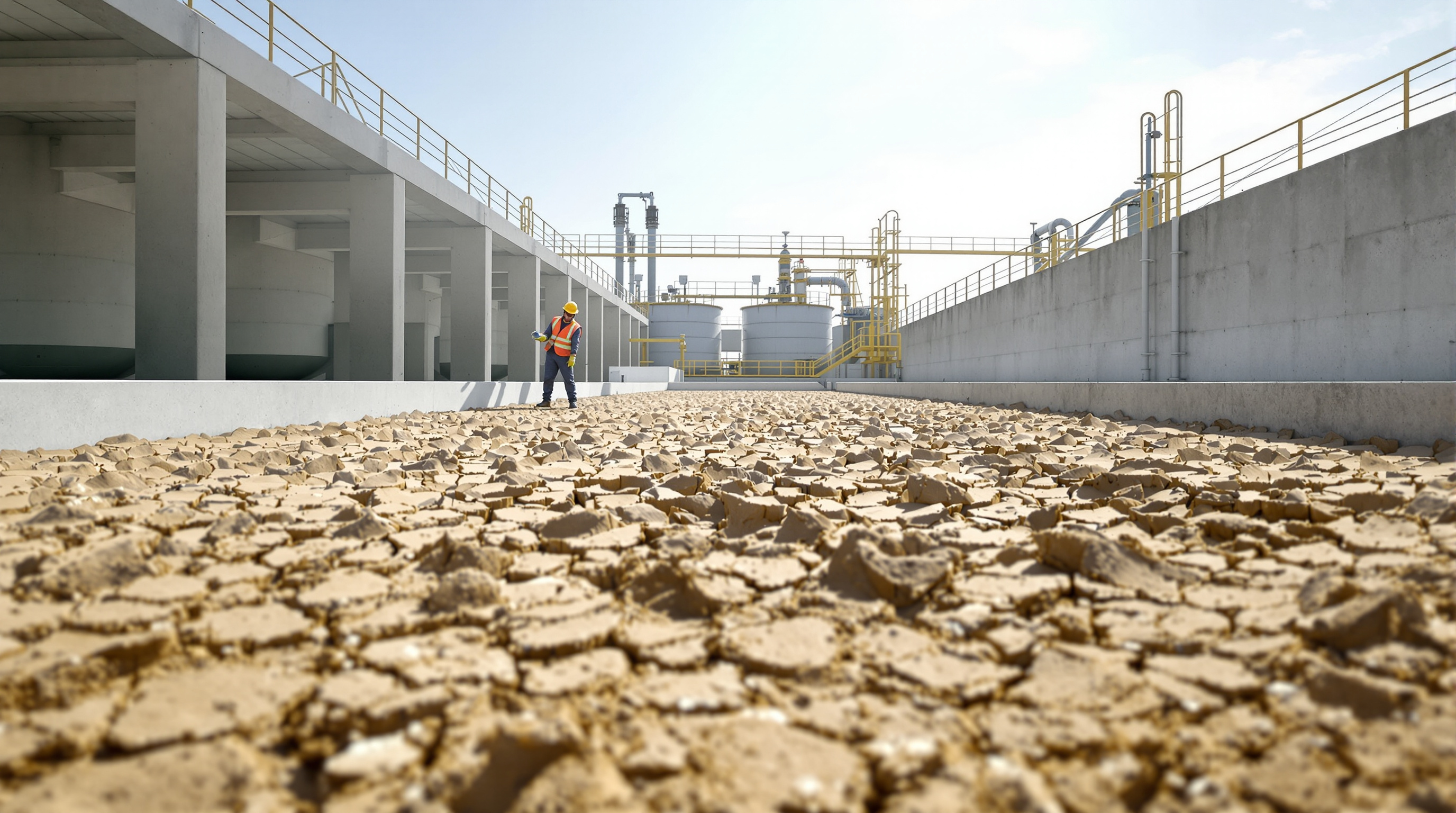
The low-cost, low-maintenance workhorse. Thickened sludge is spread over open beds of sand and gravel; water drains down through the media (and is returned to the plant inlet) while the sun and air evaporate the rest. After a few days to a couple of weeks — depending on weather — the sludge cracks into a dry cake that is lifted off manually.
Drying beds are cheap and need no power, but they need space, sunshine and patience, and they struggle through the monsoon. See the dedicated sludge drying beds guide for bed sizing and operation. Operator checklist for beds:
- Load beds evenly to a sensible depth (roughly 200–300 mm); do not overfill.
- Keep the underdrain clear so filtrate returns to the plant, not to the ground.
- Lift the cake once it cracks and pulls from the sand — do not let it re-wet.
- Rake and top up the sand between cycles; replace fouled top-sand periodically.
Mechanical dewatering — filter press / centrifuge
Where land is tight or output is high, a filter press (or a screw press / centrifuge) squeezes the water out mechanically in hours instead of days, producing a consistent dry cake regardless of weather. It costs more, uses power, and usually needs a polymer dose to make the sludge release its water, but it is compact and predictable. Filter-press checklist:
- Dose and mix polymer correctly — under-dosing gives a wet, sloppy cake.
- Watch the cycle pressure; blinded (clogged) cloths give poor cakes and must be washed.
- Route the pressate (squeezed-out water) back to the plant inlet.
- Log cake output per run so you can track disposal volumes.
Safe disposal — and when sludge becomes manure
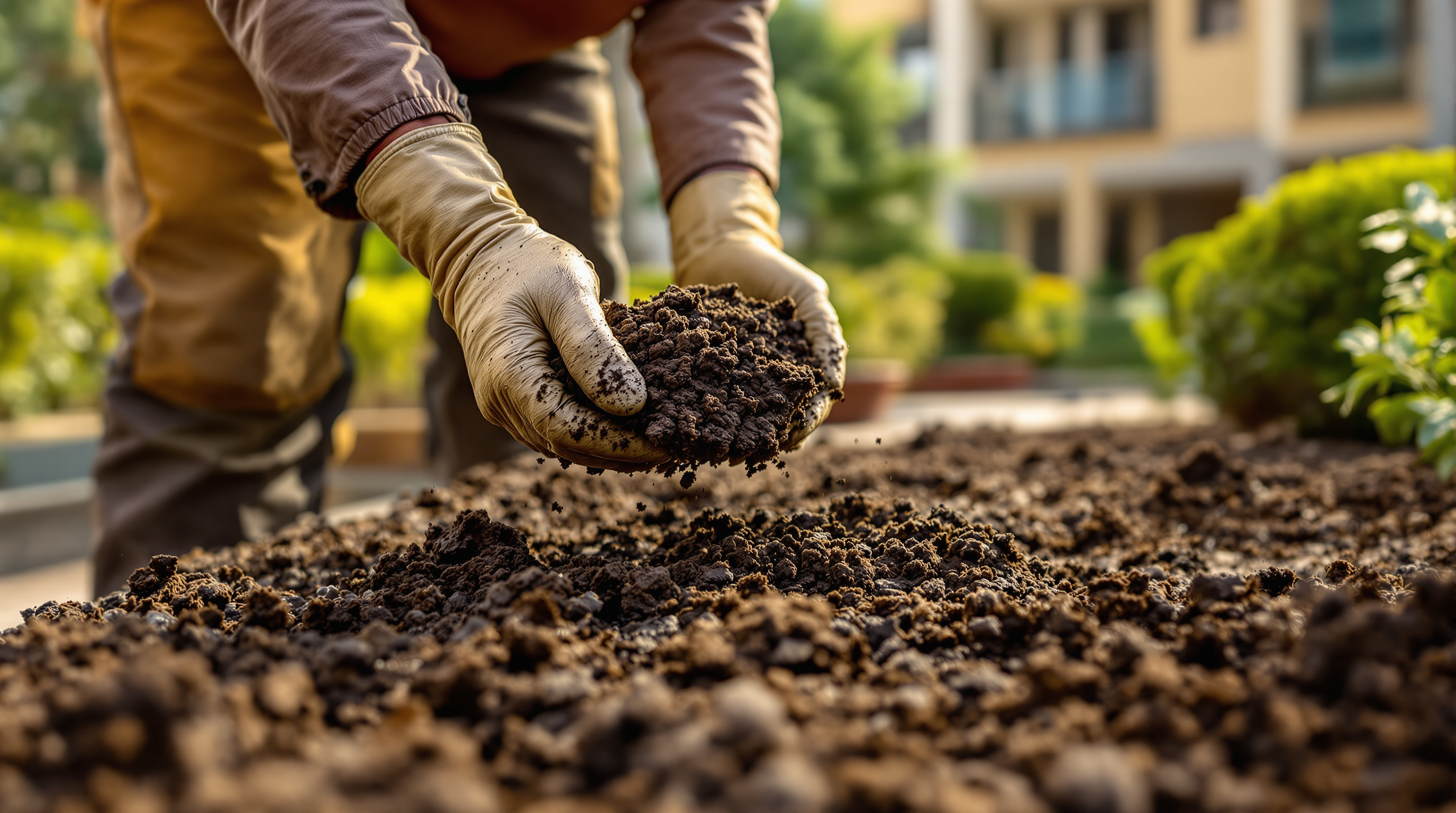
Once you have a dry cake, it still has to leave the site responsibly. Domestic STP sludge, properly dried and stabilised, is largely organic and can be a genuine resource — but only when it is safe.
- Landscaping / manure use. Well-digested, fully dried domestic sludge is commonly used on site as a soil conditioner for gardens and non-edible landscaping. This is the ideal outcome: zero disposal cost and a use for the material. Caution: use it only on ornamental/landscape areas, never on food crops, and only when the sludge is genuinely stabilised and dry — fresh or partly-dried sludge still carries pathogens and odour.
- Authorised disposal. Surplus cake that you cannot use on site should go to an authorised facility — a municipal/landfill route or a licensed contractor — as your local pollution-control board directs. Keep it dewatered and covered while stored.
- Never dump wet sludge into drains, storm-water lines, open land or a waterbody. That single act can undo an otherwise compliant plant and attract penalties.
Because sludge from a purely domestic STP is not industrial effluent sludge, the rules are more forgiving than for an ETP — but "domestic" is not the same as "do whatever you like." Follow your consent conditions and CPCB/state-board directions for the disposal route.
Record-keeping: the paperwork that keeps you compliant

At an inspection, the sludge you have already disposed of is invisible — the records are what prove you managed it. Keep a simple Sludge Register, and keep it current:
- Date and volume wasted to the holding tank, and MLSS at the time.
- Dewatering runs — bed loaded / press cycle, and the cake produced.
- Disposal events — date, quantity, destination (on-site landscaping or contractor), and the contractor's docket/receipt where applicable.
- Polymer and consumables used, for mechanical dewatering.
Fold these into your routine logs rather than treating them as a separate chore — the daily STP checklist and monthly maintenance routines are the natural home for the settleability test, MLSS reading and disposal entries.
The operator's bottom line
Sludge management is not the glamorous end of running an STP, but it is the part that most often decides whether a plant passes or fails. Get four habits right and you rarely have trouble:
1. Waste on a schedule, guided by MLSS and a daily settleability test — not only when the tank looks full.
2. Dewater properly on drying beds or a press so what leaves the site is a dry cake, not a slurry.
3. Dispose safely — reuse stabilised, dried sludge on landscaping where you can; send the rest to an authorised route.
4. Write it all down as you go, so compliance is a by-product of good operation, not a scramble before an audit.
To go deeper on the plant behind the sludge, start from the Sewage Treatment Plants guide library. And before you finalise a disposal cycle, put your load and flow through the Sludge Generation Calculator — knowing your kilograms-per-day of dry solids is what turns sludge from a nasty surprise into a scheduled routine.
Export this guide
Related Guides — Deep-dive reading
Biological Culture Management in an STP: The Heart of Good O&M
The microbes in your aeration tank do the actual work of cleaning sewage. Keep them healthy — the right MLSS, food, oxygen and nutrients — and everything else falls into place. Here is how operators manage the living culture, diagnose bulking and foaming, and recover after a crash.
Sewage Treatment PlantsSludge Drying Beds: How STP Sludge Is Dewatered for Disposal
Every STP produces wet sludge that has to be dried before it can leave the site. This guide explains how sand-and-gravel drying beds use drainage and evaporation to do it, how much area they need, and when a filter press or centrifuge makes more sense.
Sewage Treatment PlantsWeekly STP Maintenance Tasks: The Operator's Checklist
The seven jobs that keep a building STP healthy week after week — settleability testing, sludge wasting, diffuser checks, backwash review, chemical stock, calibration and cleaning — laid out as a practical routine for facility managers and operators.
Sewage Treatment PlantsRelated Tools — Try Free
Monsoon-Readiness Checklist
Pre-rain home audit across 9 categories — terrace, drains, waterproofing, electrical, HVAC, pest, vehicles, documents.
Seasonal AuditSTP Compliance Checklist Tool
Interactive self-audit that ticks off STP consents, discharge norms, reuse metering, online monitoring and O&M records to give a live compliance readiness score.
ChecklistCPCB Compliance Checklist for STPs
Tick off CPCB/SPCB outlet standards, monitoring duties and record-keeping to score your sewage treatment plant's compliance readiness.
Checklist