

Diffuser Cleaning & Maintenance in STPs: Keeping Oxygen Transfer Efficient
Why fine-bubble diffusers foul, how to read the warning signs of uneven bubbling and rising back-pressure, and the acid-wash, air-bumping and replacement routines that keep your aeration tank transferring oxygen the way it was designed to.
Deep at the bottom of your aeration tank, under a metre or two of churning mixed liquor, sits the hardest-working and least-seen component in the whole STP: the diffuser grid. These rows of perforated membranes are what turn a blower's raw airflow into the fine curtain of bubbles that feeds oxygen to the biological culture. When they are clean, they do their job invisibly. When they foul — and they always foul — the first thing you lose is oxygen transfer efficiency, and the first thing you pay for is electricity.
This guide is the practical operator's playbook for keeping fine-bubble diffusers alive: why they clog, the symptoms that tell you they are clogging, and the cleaning and replacement routines that restore them before the aeration tank starts to starve.
A fouled diffuser does not usually fail loudly. It fails as a slow tax — the blower works harder for less oxygen every week, and the electricity bill climbs long before the effluent numbers slip.
Why fine-bubble diffusers matter so much
The whole economics of the secondary stage rests on oxygen transfer efficiency (OTE) — how much of the oxygen you pump actually dissolves into the water. Fine-bubble diffusers win because small bubbles have far more surface area per litre of air and rise slowly, giving oxygen more time to cross into the liquid. A healthy fine-bubble grid can transfer two to three times the oxygen of a coarse-bubble system for the same air, which is exactly why nearly every modern activated sludge process and MBBR plant uses them.
That advantage is fragile. The same fine pores that make small bubbles are also easy to block. As they foul, bubbles grow larger and fewer, OTE collapses, and the air blowers have to push against a rising back-pressure to deliver the same air. You lose on both sides at once.
Why diffusers foul
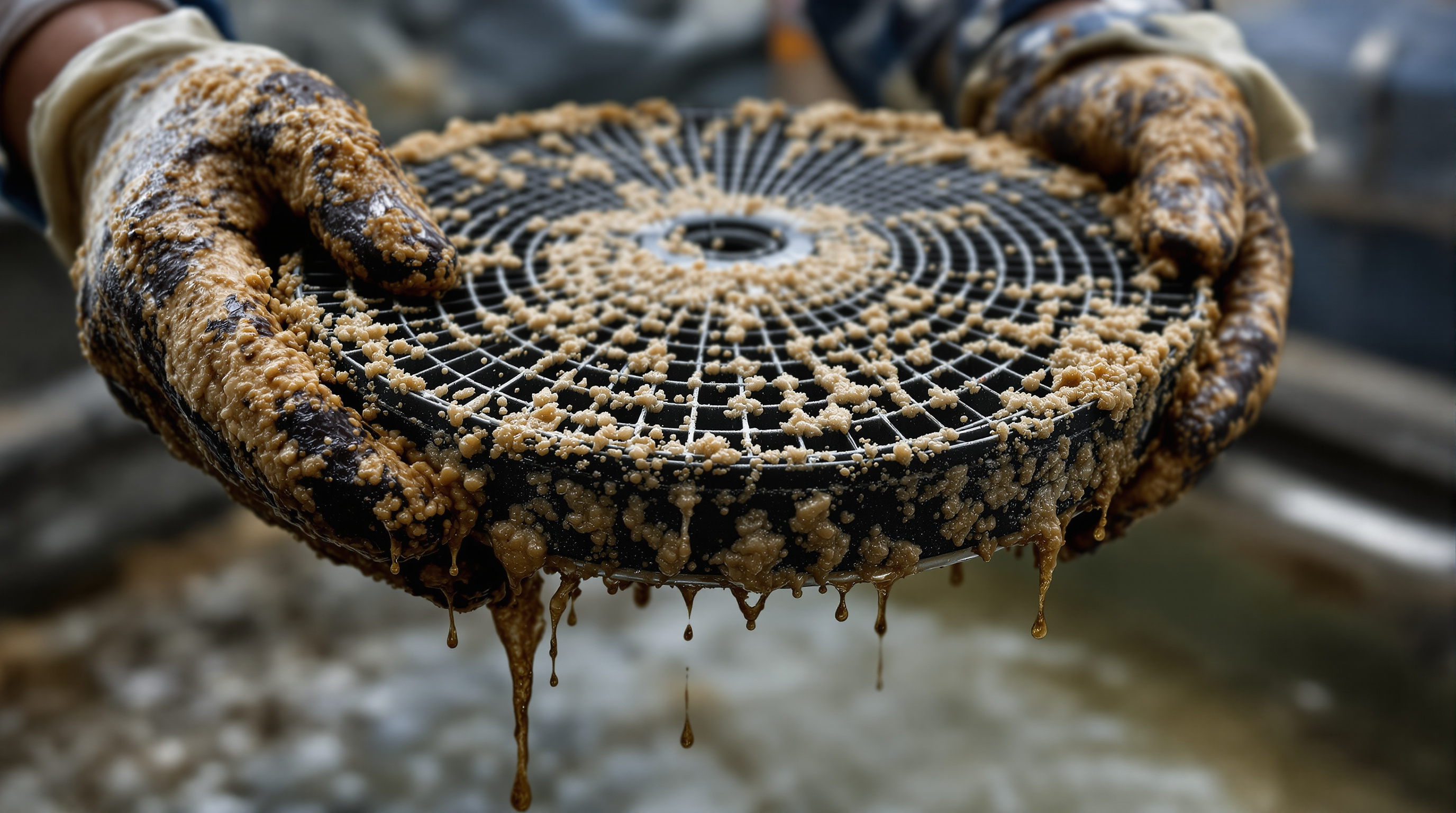
Fouling comes from three directions, usually at the same time:
- Biological (biofilm) fouling — a slime layer of the very microbes you are cultivating grows over and into the membrane pores, especially during low-load or intermittent-aeration periods when air is off and liquid can weep back through the slits.
- Inorganic scaling — calcium and magnesium carbonate, iron and other minerals in Indian hard water precipitate on and inside the pores, hardening into a scale that a scrub cannot shift.
- Mechanical clogging and stiffening — grit that slipped past the preliminary stage, sludge intrusion during blower trips, and the natural stiffening and shrinkage of EPDM or silicone membranes as they age.
The result is the same however it happens: pores narrow or block, air is forced through the remaining open pores at higher pressure, and the bubble pattern goes patchy.
Reading the symptoms
You rarely see the diffusers, so you diagnose them from the tank surface and the blower gauge. Learn to read these signs on your daily rounds and log them in the daily STP checklist.
| Symptom | Likely cause | What to do |
|---|---|---|
| Uneven "boiling" — vigorous patches next to dead calm zones | Partial fouling or a cracked/detached diffuser sending air to easy pores | Map the dead zones; schedule an air-bump, then inspect on next drain-down |
| Large, coarse, rolling bubbles instead of a fine even carpet | Membrane pores enlarged by ageing or torn membrane | Plan cleaning; if bubbles stay coarse after cleaning, replace |
| Blower discharge pressure creeping up over weeks | Scaling/biofilm raising back-pressure across the grid | Trend the pressure; clean when it rises ~15–20% above the clean baseline |
| Dissolved oxygen (DO) hard to hold despite blower at full | OTE lost to fouling; blower straining | Check DO probe first, then treat as fouling |
| Rising blower power (kW/amps) for the same air output | System back-pressure climbing | Benchmark energy; clean grid before assuming blower wear |
| One header or drop-leg dead while others bubble | Airline blockage, closed valve, or broken drop-pipe | Isolate and inspect that leg mechanically |
The single most useful number is blower discharge back-pressure. Record the pressure when the grid is new or freshly cleaned — that is your clean baseline. When operating pressure climbs roughly 15–20% above it (with the same submergence and airflow), the grid is telling you it is time to clean. Pair this with the energy benchmark calculator to see the cost of leaving it.
Cleaning method 1 — in-situ air bumping
The gentlest first response needs no drain-down and no chemicals. Air bumping briefly runs the blowers at maximum airflow to over-inflate the membranes, flexing them so the slits open wider and crack off soft biofilm and loose deposits, which then slough away in the turbulence.
- Do it with the tank in service, typically for a few minutes.
- Best against fresh biological fouling; it does little against hardened mineral scale.
- Cheap and quick enough to run on a routine basis in plants prone to slime growth.
If air bumping restores an even bubble pattern and drops the back-pressure back toward baseline, you have bought months before a deeper clean.
Cleaning method 2 — in-situ acid gas / liquid cleaning
For inorganic scale, acid is the answer. Many membrane diffuser systems are designed for formic or hydrochloric acid cleaning without emptying the tank: metered acid (as a gas injected into the air line, or as a dilute liquid) is carried through the diffusers with the process air, where it dissolves the carbonate and iron scale inside the pores. This is closely related to how membranes are chemically cleaned elsewhere in the plant.
- Always follow the diffuser manufacturer's dosing and contact-time instructions — over-dosing acid attacks the membrane and its supports.
- Acid handling is a safety job: goggles, gloves, apron, ventilation, and a neutralising agent on hand. Never mix acids with chlorine dosing lines.
- Watch the effect on the biological culture and pH — dose conservatively and monitor DO recovery afterwards.
Acid cleaning typically restores back-pressure and the fine-bubble pattern far better than air bumping alone when scale is the culprit.
Cleaning method 3 — drain-down and manual cleaning
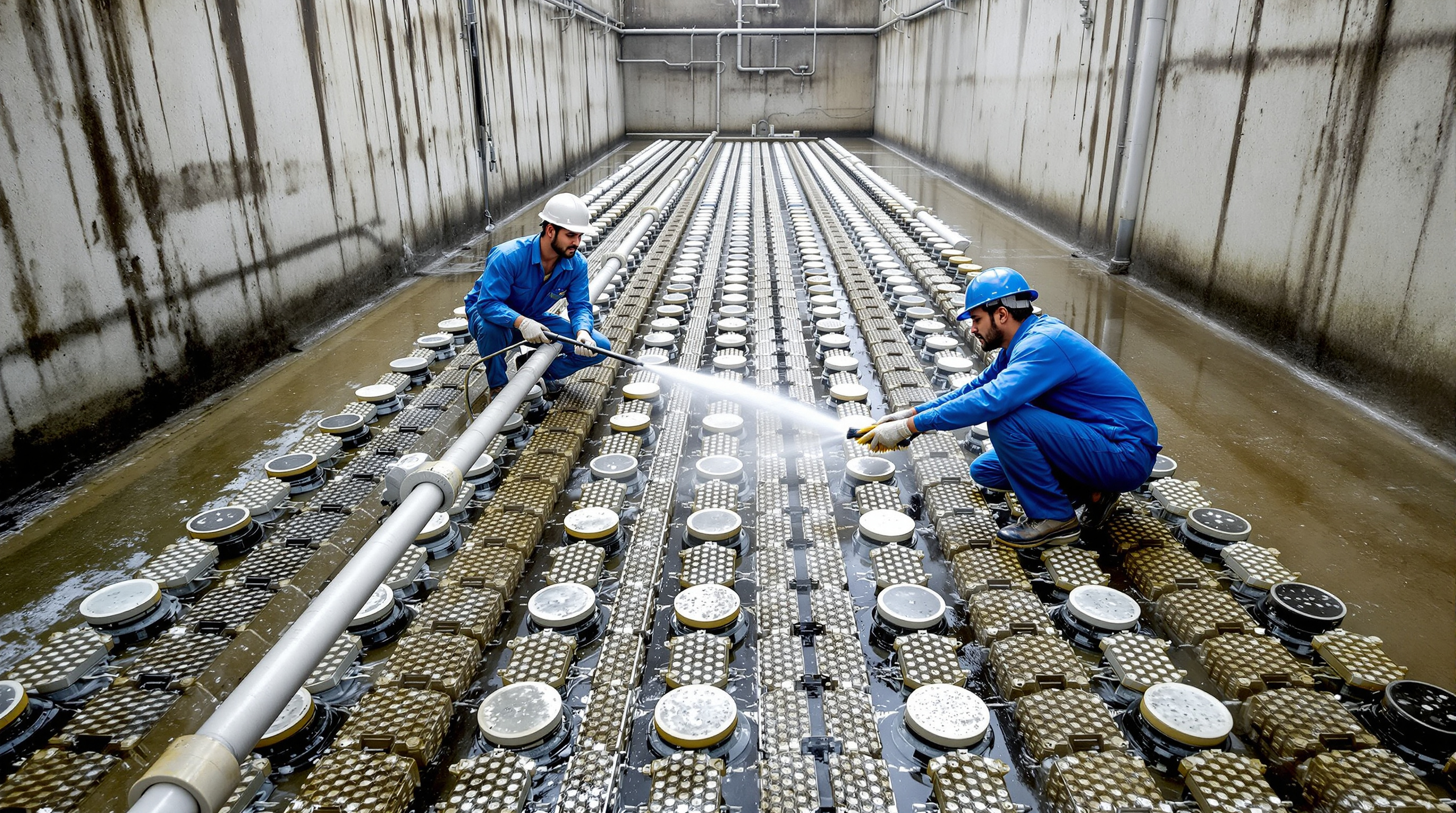
When in-situ methods stop working, or when you suspect torn membranes and broken fittings, there is no substitute for taking the tank offline, draining it, and getting down to the grid. This is planned outage work, best folded into annual STP maintenance.
- Isolate and drain the aeration tank; if you run a single tank, arrange bypass or temporary aeration so the culture survives.
- Hose down the grid, then gently brush or use a low-pressure wash — never a high-pressure jet that can rupture membranes.
- Spot-treat stubborn scale with a manufacturer-approved dilute acid and rinse thoroughly.
- Inspect every diffuser: look for tears, ballooning, detached membranes, cracked bodies, loose retaining rings and leaking saddles/couplings.
- Check the grid is level and that all drop-legs and headers are clear and firmly supported.
When to replace rather than clean
Membranes are consumables. EPDM and silicone stiffen, shrink and lose elasticity over years of service; once a membrane will no longer flex, no cleaning restores a fine bubble. Replace when you see:
- Coarse bubbles that persist immediately after a thorough clean.
- Visible tears, holes, ballooning or membranes detaching from the base.
- Cracked diffuser bodies or perished retaining rings.
- Back-pressure that stays high after acid cleaning, indicating irreversible pore scaling.
As a rule of thumb, fine-bubble membranes give a serviceable life of several years; plan a full grid replacement as a capital line item rather than a surprise. When you do open the tank, replace the whole grid's membranes together — mixing old stiff diffusers with new supple ones creates the very uneven airflow you are trying to cure.
A practical maintenance rhythm
| Interval | Diffuser task |
|---|---|
| Daily | Observe bubble pattern from the surface; log blower discharge pressure and DO |
| Weekly | Trend back-pressure against clean baseline; note any growing dead zones (weekly maintenance) |
| Monthly / as needed | Air-bump the grid if biofilm fouling is suspected |
| 6–12 months | In-situ acid clean when back-pressure is ~15–20% over baseline |
| Annual | Drain-down inspection: check membranes, fittings, grid level, headers |
| 4–7 years (typical) | Full membrane/grid replacement when cleaning no longer restores performance |
The bottom line
Diffuser maintenance is the cheapest oxygen you will ever buy. A grid that is bumped, acid-cleaned on a back-pressure trigger, inspected annually and replaced before it goes coarse keeps oxygen transfer efficient, keeps your blowers off their strain limit, and keeps the electricity bill flat. Ignore it and the plant does not fail overnight — it quietly gets more expensive and less capable every month.
Pair this routine with disciplined blower maintenance and a broader look at reducing STP electricity consumption, and the aeration tank — the single biggest energy consumer in the plant — stays lean. For the wider O&M picture, start from the Sewage Treatment Plants guide library.
Export this guide
Related Guides — Deep-dive reading
Aeration Tank: The Biological Heart of an STP
The tank where blowers push oxygen into billions of microbes that eat the sewage's organic load — how it works, what DO, MLSS, F/M and HRT mean, and why it quietly runs up the biggest electricity bill in the plant.
Sewage Treatment PlantsAir Blowers & Diffusers in an STP: How Aeration Actually Works
The blowers that push air and the diffusers that turn it into bubbles are the lungs of your sewage treatment plant. Here is how they work, how they are sized, and why they decide most of your electricity bill.
Sewage Treatment PlantsReducing STP Electricity Consumption: The O&M Guide to Cutting Your Biggest Running Cost
Aeration eats 50–70% of an STP's power bill. This practical guide shows facility managers and operators how to right-size air, add DO control and VFDs, fix leaks, run off-peak, and cut the monthly electricity spend without ever breaking discharge norms.
Sewage Treatment PlantsRelated Tools — Try Free
Cross-Ventilation Analyzer
Estimate airflow and air changes per hour (ACH) from room size, window areas, layout, and local wind — with NBC 2016 Part 8 compliance check.
Ventilation CalculatorDaily STP O&M Checklist Tool
An interactive daily operator round for a sewage treatment plant — tick off biology, flows, equipment and output checks and see a live completion score, per-section progress and shift readiness.
ChecklistPool Water Calculator
Chlorine, shock and salt doses plus top-up water for your pool — an indicative balancing guide.
Pool Calculator