
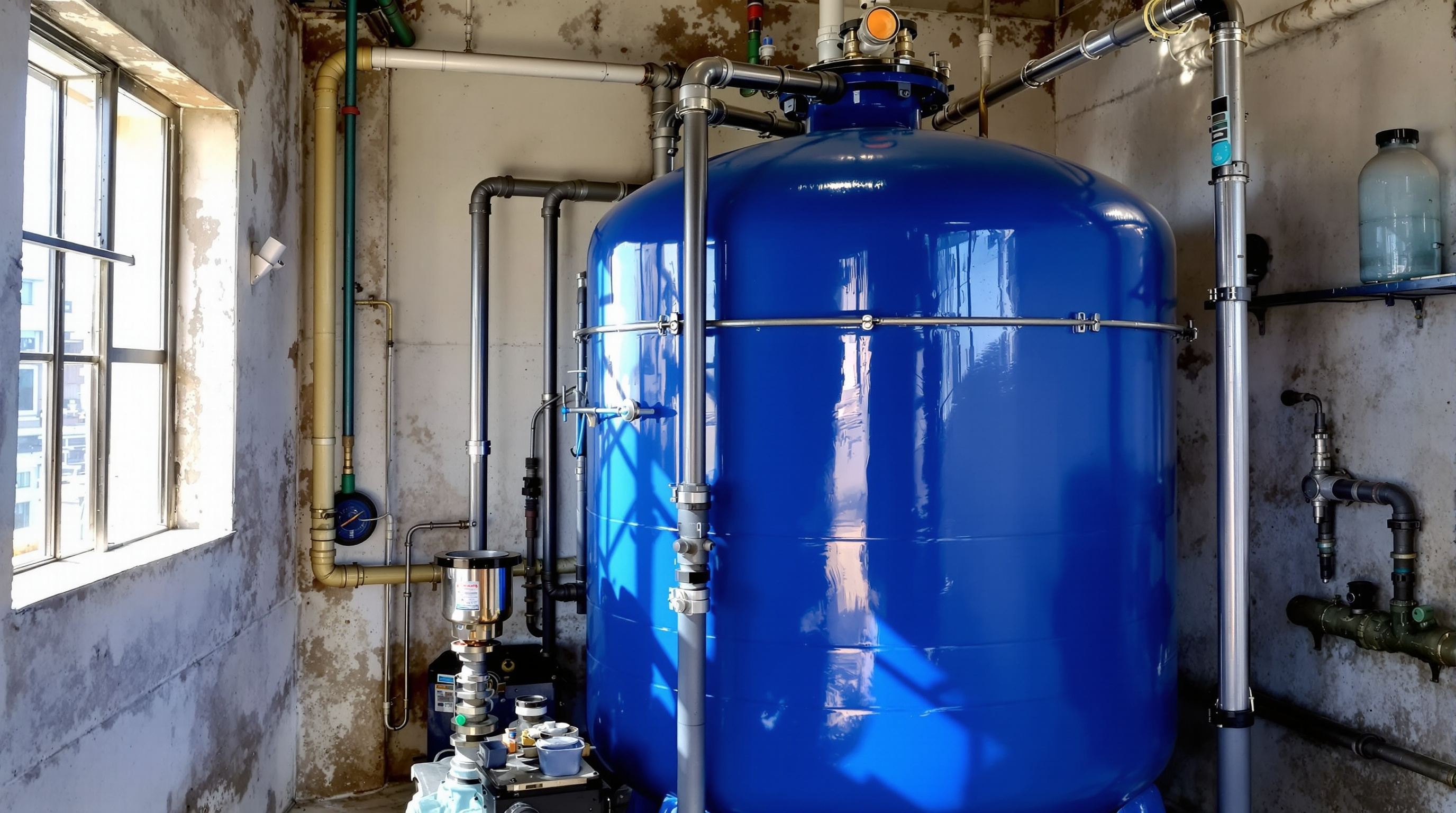
Pressure Sand Filter (PSF) in an STP: How Tertiary Sand Filtration Works
The tertiary filter that catches the fine suspended solids clarifier settling leaves behind — how multigrade media filtration works, its filtration rate, backwashing, and why it sits just before carbon and disinfection.
By the time water reaches the end of a sewage treatment plant, the hard work is done. The microbes have eaten the organic waste, and the clarifier has settled out the heavy sludge. What comes off the top of that clarifier looks clean — but "looks clean" and "reuse-grade" are not the same thing. A faint haze of fine particles is still drifting in that water, too light to have settled. Removing that last haze is the job of the pressure sand filter, or PSF — the workhorse of tertiary treatment.
A clarifier settles what gravity can pull down in a few hours. A pressure sand filter catches what gravity never will — the fine suspended solids that would otherwise cloud your treated water and clog everything downstream.
What a pressure sand filter actually is
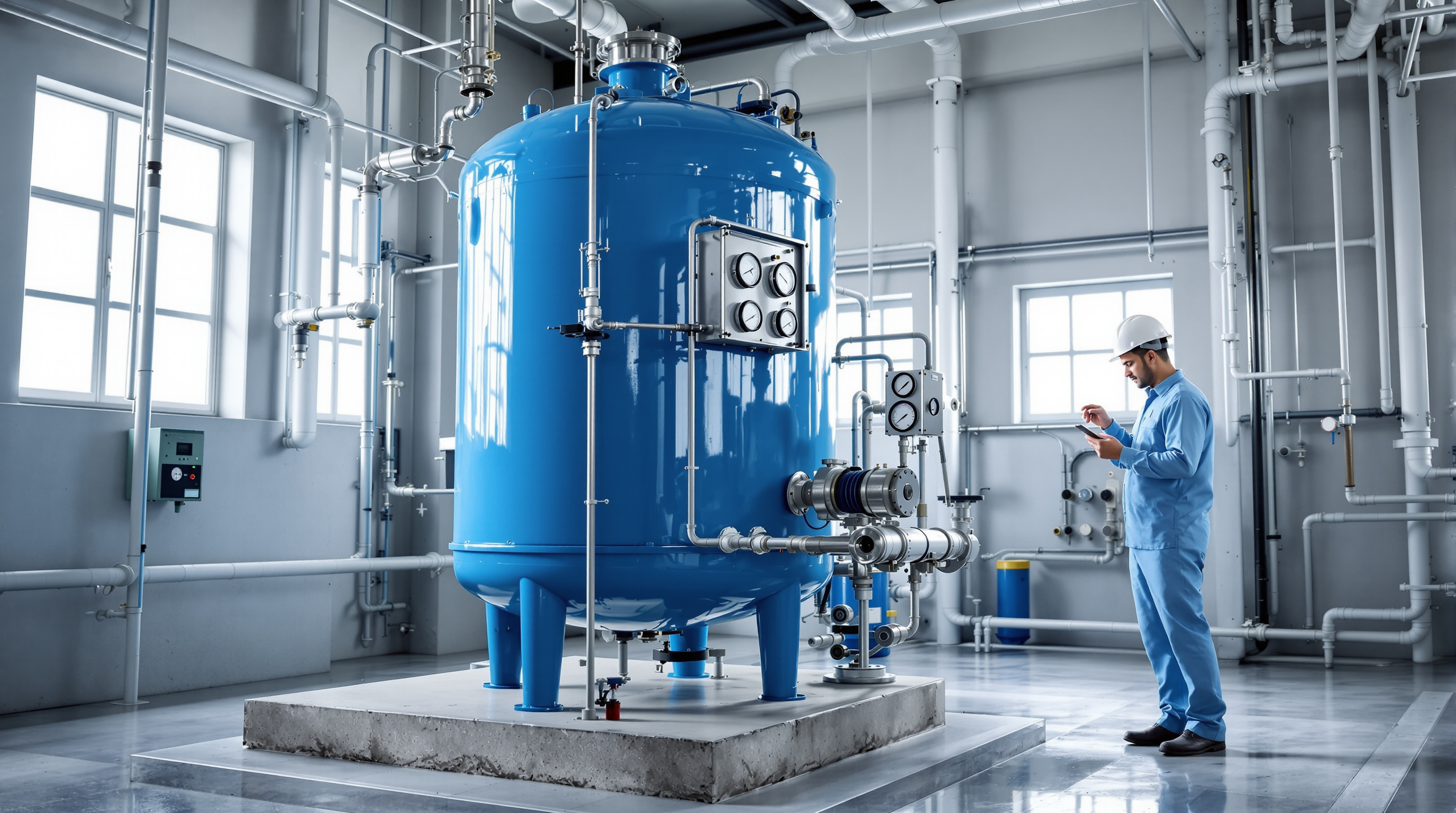
A pressure sand filter is a closed steel or FRP vessel packed with layers of sand and gravel. Water is pushed through it under pressure — hence the name — from top to bottom. The suspended particles get trapped in the media bed while clean water passes through and exits the bottom. That is the whole principle: force cloudy water through a deep bed of graded sand, and the sand strains out the fines.
It sits in the tertiary (polishing) stage of the treatment flow, after the biological and settling stages are complete. In the standard Indian STP train it is almost always the first filter the clarified water meets, followed by an activated carbon filter and then a disinfection step. You can trace its exact position in our sewage treatment process flow guide.
Two things make it "pressure" rather than the old gravity sand filters you might picture at a municipal waterworks:
- It is sealed and pressurised. A pump (or the head from a treated-water tank) drives water through the bed, so the vessel can be compact and mounted anywhere — even on a basement slab or rooftop.
- It backwashes in place. When the bed clogs, the flow is reversed to flush the trapped dirt out, and the filter is back in service in minutes. No digging up sand.
Why "multigrade"? How the media is layered
The best pressure sand filters are multigrade filters (MGF) — the media is not one uniform sand but several layers of different particle sizes, coarse at the top and fine at the bottom. Water enters at the top, hits the coarse layer first, and meets progressively finer media as it descends.
This grading matters. If you used only fine sand, the very top millimetre would clog instantly and the rest of the bed would sit idle. By putting coarse media on top, the large particles are caught high up and the fine particles deeper down, so the whole depth of the bed does useful work. This is called depth filtration, and it is why an MGF runs far longer between backwashes than a single-grade bed.
A typical layered bed looks like this:
| Layer (top to bottom) | Media | Rough size | What it does |
|---|---|---|---|
| Top | Coarse sand / anthracite | 1.5–2.5 mm | Catches the largest floc and haze first |
| Middle | Fine silica sand | 0.5–1.2 mm | The main straining layer — traps most fines |
| Support | Fine gravel | 3–6 mm | Holds the sand, spreads the flow |
| Bottom | Coarse gravel / pebbles | 6–20 mm | Supports the bed above the underdrain |
The exact grades and depths vary by manufacturer, but the coarse-to-fine logic is universal.
How it fits in the treatment flow
It helps to see where the PSF sits relative to everything else. After secondary treatment — whether that is a classic activated sludge process, an MBBR, or an SBR — the water passes through a settling stage, then:
1. Pressure sand filter — removes fine suspended solids, dropping the water's cloudiness (turbidity) and its TSS.
2. Activated carbon filter — strips residual colour, odour and dissolved organics.
3. Disinfection — chlorination or UV kills the remaining bacteria.
The order is deliberate. The sand filter goes first because it removes the bulk suspended load. If you sent cloudy water straight to the carbon filter, the carbon bed would blind over with silt and lose its adsorption capacity fast. And disinfection only works properly on already-clear water — suspended particles shield bacteria from both chlorine and UV. The PSF protects everything downstream of it.
Sizing basics: it comes down to filtration rate
You do not size a pressure sand filter by volume — you size it by filtration rate, the speed at which water passes through the bed, measured in cubic metres per square metre of bed area per hour (m³/m²/hr), which conveniently just works out to metres per hour.
For domestic STP tertiary duty, designers typically aim for a filtration rate in the range of 10–20 m³/m²/hr. Push the rate too high and particles are dragged straight through instead of being caught; run it too slow and the filter is needlessly oversized. From the design flow and a chosen rate, you back-calculate the bed area, and from area the vessel diameter.
The directional logic:
- Bigger diameter → more bed area → lower rate → better filtration (but more cost and footprint).
- The flow rate it must handle comes straight from your plant's treated-water throughput, which starts from your building's sewage generation and overall plant capacity.
- Bed depth (commonly around 0.8–1.2 m of media) sets how much dirt it can hold before it needs backwashing.
A quick worked feel: a plant polishing about 10 m³/hr at a filtration rate of ~15 m³/m²/hr needs roughly 0.7 m² of bed — a vessel around 900 mm in diameter. Treat these as directional; a designer will confirm the media grading, freeboard for bed expansion, and pump head against manufacturer curves.
Backwashing: the routine that keeps it alive

Every filter clogs — that is the point of a filter. As the sand bed fills with trapped solids, resistance rises and the pressure drop across the filter climbs. When that pressure difference between inlet and outlet crosses a set threshold (or simply on a daily timer), it is time to backwash.
Backwashing reverses the process:
- Backwash: Water (and often air, in an air-scour cycle) is pumped upward through the bed. This lifts and fluidises the sand, scrubbing the trapped dirt loose. The filthy backwash water carries the solids out the top and back to the head of the plant — usually the equalization tank or collection sump.
- Rinse (settle down): Clean water is passed downward briefly to re-settle the graded bed into its proper coarse-to-fine layering before returning to service.
On most compact STPs this is done through a multiport valve — a single handle (or an automated actuator) that switches the vessel between Filter, Backwash, Rinse and Service positions. Backwash frequency depends on the incoming load, but daily is common for a busy plant.
Common problems and O&M
A pressure sand filter is one of the more forgiving pieces of an STP, but it is not maintenance-free.
- Channelling / mud-balling. If backwashing is skipped or done too gently, trapped solids clump into hard "mud balls" and water carves channels straight through, bypassing the media. The fix is disciplined, vigorous backwashing — and occasionally manually breaking up or replacing the top sand.
- Rising pressure drop that won't clear. If a backwash no longer restores the pressure, the media is fouled or worn and it is time to top up or replace the sand (typically every few years).
- Media loss. Backwashing too hard, or with too much freeboard, can carry sand out with the backwash water. The bed slowly shrinks and filtration quality falls — check the media level periodically.
- Poor upstream settling. A PSF is a polisher, not a primary settler. If the clarifier or tube settler ahead of it is overloaded and passing heavy solids, the sand filter clogs almost immediately. The real fix is always upstream.
Good practice: log the inlet/outlet pressure daily, backwash on schedule, and check media depth every few months.
The bottom line
A pressure sand filter is the quiet polishing step that turns "settled" water into "clear" water. It uses a deep, graded bed of sand to strain out the fine suspended solids that no settling tank can remove, it is sized by filtration rate rather than volume, and it is kept healthy by regular backwashing. Positioned just before the carbon filter and disinfection, it protects everything downstream and is the reason your treated water comes out genuinely clear.
To see how the PSF connects to every other tank and filter, walk through the full sewage treatment process flow, or browse the complete STP guide library.
Export this guide
Related Guides — Deep-dive reading
Filter Backwashing in STPs (PSF & ACF): When and How to Do It Right
The pressure-drop triggers, the correct air-scour-and-backwash sequence, and the media top-up routine that keep your pressure sand and activated carbon filters delivering clear, reuse-grade water — a practical guide for STP operators.
Sewage Treatment PlantsHow Does an STP Work? A Step-by-Step Explanation
Follow a single drop of sewage from the building drain to reusable water — through screening, settling, the living microbial heart of the plant, and final polishing — with every stage explained in plain language and no engineering background assumed.
Sewage Treatment PlantsThe Sewage Treatment Process Flow, Explained: Every Stage From Inlet to Reuse
Follow a drop of sewage through a typical STP — inlet, screening, aeration, clarifier, filtration, disinfection and reuse — as one connected flow, with a block diagram and a unit-by-unit table, in plain language.
Sewage Treatment PlantsRelated Tools — Try Free
Rainwater Tank Sizer
How big should your rainwater tank be? Computes annual harvest, recommended tank capacity in litres, water-bill savings, and payback — for 10 Indian cities.
RWH CalculatorFilter Sizing Calculator (PSF/ACF)
Size a pressure sand or activated carbon filter from flow and filtration rate to get vessel diameter, filter area and hourly design flow.
STP CalculatorChlorine Dose Calculator
Compute chlorine demand for water and sewage disinfection from daily flow and dose, returning chlorine consumption in kg/day and kg/month.
STP Calculator