

STP Troubleshooting: Common Problems & Fixes (Operator's Guide)
Odour, cloudy effluent, high BOD, sludge bulking, foaming, choked diffusers, pump trips and rising power bills — a practical symptom-to-cause-to-fix guide for facility managers running an Indian building STP.
An STP is a living machine. Most of the real work is done by billions of microbes, and like anything alive, the plant tells you when something is wrong — long before the effluent report from the lab does. A whiff of sewage in the basement, water that will not clear, a blower that runs hot, a pump that trips at 2 a.m.: each is a symptom pointing at a specific, fixable cause.
The mistake operators make is treating symptoms in isolation — adding chlorine to kill a smell, or bleeding a pump instead of asking why it airlocked. This guide is built the other way round: symptom to likely cause to fix, the way an experienced operator actually reasons on the plant floor. Keep it near the control panel.
Nine out of ten STP faults trace back to one of four things: not enough air, the wrong amount of sludge, a pump or level problem, or a dosing/power fault. Learn to read those four, and most "mystery" problems stop being mysteries.
The quick-reference troubleshooting table
Start here. Find your symptom, read across to the usual causes, then act on the fix. The detailed sections below explain the reasoning.
| Symptom | Likely cause | First fixes to try |
|---|---|---|
| Sewage odour / rotten-egg smell | Low dissolved oxygen (DO); septic sewage sitting in tanks; anaerobic sludge | Check DO in aeration tank (target 1.5–2.5 mg/L); increase blower run/output; empty and clean the collection/equalisation tank; check diffusers |
| Cloudy / poor effluent, high BOD & TSS | Under-aeration; too little or too much sludge (MLSS out of range); overloaded plant; short-circuiting clarifier | Verify DO and MLSS; adjust sludge wasting; check clarifier for carry-over; confirm inflow is not above design |
| Sludge bulking (sludge floats/won't settle) | Filamentous bacteria; low DO; low F/M (over-aged sludge) or nutrient imbalance | Run a settleability (SV30) test; raise DO; correct sludge age by wasting; check nutrient balance |
| Thick foam on aeration tank | White foam = young sludge/startup or detergents; brown/greasy foam = old sludge or Nocardia; oil ingress | Adjust MLSS/sludge age; skim and remove foam; trap oil & grease upstream; avoid over-dosing chemicals |
| Blocked / uneven diffusers | Bio-fouling, scaling, or grit; torn membranes | Observe rolling pattern on surface; run air-bump/acid cleaning; replace torn diffuser membranes |
| Pump tripping or not lifting | Choke (rags/cloth); airlock; overload; level-sensor / float fault; dry run | Clear the choke; check float switches; reset overload once and watch amps; verify NRV & suction |
| High power bill | Blower running 24×7 at full output; oversized/old motors; air leaks; poor scheduling | Match blower output to load; fix air leaks; use timers/VFD; benchmark energy per KL treated |
Odour: almost always an oxygen problem
A working aerobic STP should smell earthy and musty, not of sewage. A strong septic or rotten-egg (hydrogen sulphide) smell means part of the plant has gone anaerobic — the good, air-loving microbes have been starved of oxygen and the bad ones have taken over.
Walk it back in this order:
- Check dissolved oxygen in the aeration tank with a DO meter. Below ~1 mg/L and the biology is suffocating. Raise blower output or run time until you hold 1.5–2.5 mg/L.
- Check the raw sewage tanks. Sewage that sits stagnant in the collection or equalisation tank for hours turns septic. Keep transfer pumps cycling; clean out settled sludge and grit.
- Check the diffusers (see below). If air is going in but not distributing, the tank has dead zones that go anaerobic.
If the biology has crashed, odour comes back within hours of masking it. For rebuilding a healthy culture, see biological culture management.
Poor effluent and high BOD: read DO and MLSS together
Cloudy effluent that fails BOD/TSS is the single most reported STP problem — and the diagnosis nearly always lives in two numbers: dissolved oxygen and MLSS (the concentration of microbes in the aeration tank). One tells you if the bugs can breathe; the other tells you if you have the right number of them.
- DO too low → microbes can't fully digest the load → BOD passes through untreated. Fix the air first.
- MLSS too low (over-wasting, or a young/recovering plant) → not enough biomass to eat the incoming load.
- MLSS too high (under-wasting) → the clarifier is overloaded, sludge carries over the weir, and TSS spikes.
- Hydraulic overload → if the building is discharging more than the plant's design KLD, water simply doesn't get enough contact time. Compare inflow against your rated capacity; the STP capacity calculator gives you the design number to check against.
Also inspect the clarifier: rising sludge, short-circuiting, or a broken scraper all send solids into the final water. See clarifier and the underlying activated sludge process for the mechanics.
Sludge bulking and foaming: the sludge-age problems
These two are cousins — both usually mean your sludge age is wrong or DO is low, which lets stringy filamentous bacteria dominate.
Bulking is sludge that won't compact in the clarifier — it floats and washes out. Confirm it with a simple SV30 test: fill a one-litre cone with mixed liquor and let it settle 30 minutes. Healthy sludge settles to roughly a third; bulking sludge barely settles at all. Fixes: raise DO, correct sludge age by wasting the right amount, and check the nutrient balance (a starved N:P ratio breeds filaments).
Foaming is diagnosed by colour. Thick white foam usually means young sludge (startup) or detergent/surfactant ingress. Brown, greasy, stable foam points to old sludge or Nocardia filaments, often fed by oil and grease slipping past the trap. Skim and physically remove foam — don't just hose it back in — fix the oil trap upstream, and bring MLSS back into range. Correct sludge wasting rates come from your sludge holding tank routine and the sludge generation calculator.
Blocked diffusers: watch the surface
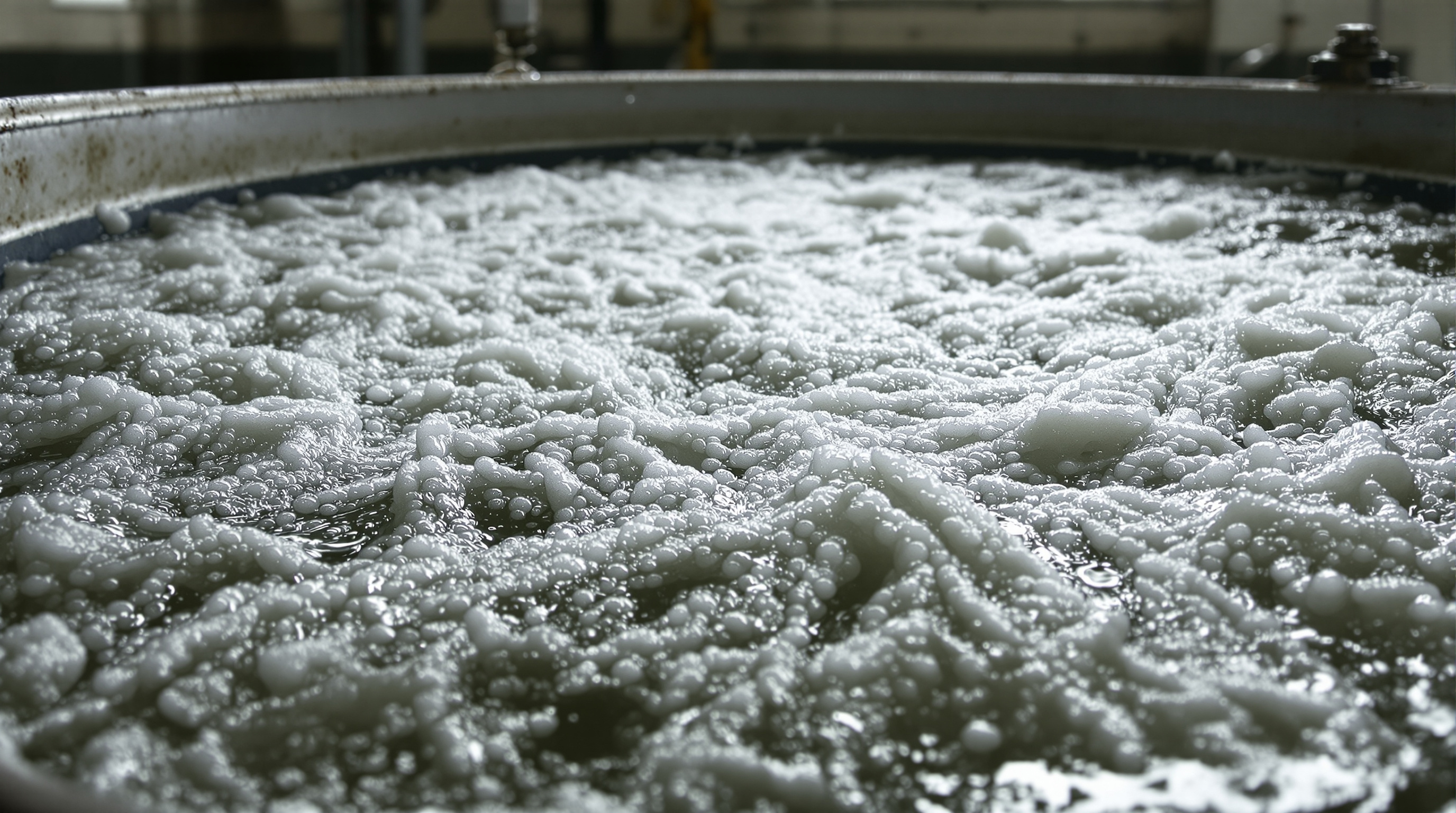
Your diffusers are invisible at the bottom of the tank, but they announce their condition on the surface. A healthy tank shows an even, gentle rolling boil across the whole area. Look for:
- Dead patches with no bubbles → blocked or disconnected diffusers, or a broken air line.
- Large, violent, lopsided bubbles in one spot → a torn membrane dumping air.
- Rising back-pressure on the blower gauge for the same airflow → bio-fouling or scaling.
Most fouling clears with a periodic air-bump or acid clean; torn EPDM membranes must be replaced. Full method in diffuser cleaning and air blowers and diffusers. Sizing air correctly in the first place: blower size calculator.
Pump trips: choke, airlock, or overload

When a transfer or recirculation pump trips or runs dry, work through the usual suspects before touching the motor:
- Choke — rags, sanitary cloth and wipes are the number-one killer of STP pumps. Isolate, open, and clear the impeller.
- Airlock — common on suction-lift pumps; prime it and check the non-return valve is holding.
- Level/float fault — a stuck or waterlogged float switch tells the pump to run dry or never start. Clean and test the floats.
- Overload / high amps — reset the overload relay once and watch the current. If it climbs again, you have a mechanical bind, a seized bearing, or a supply-phase problem — stop and investigate, don't keep resetting.
Detailed procedure in pump maintenance and STP pumps and instrumentation. Confirm the duty point with the pump size calculator.
High power bills: the blower is the culprit
The blower is the biggest energy consumer in almost every STP — often 60% or more of the bill. If your power cost is climbing:
- Match air to load. Running blowers flat-out 24×7 when night flows are a fraction of daytime is pure waste. Use timers, DO-based control, or a VFD to throttle back off-peak.
- Fix air leaks in headers, valves and joints — leaking air is money pumped into a wall.
- Benchmark it. Track energy per kilolitre treated so you can spot creep. The energy benchmark calculator gives you a yardstick, and reducing STP electricity consumption covers the levers in depth.
Build the habit, not just the fix
Every problem above is cheaper to prevent than to chase. A five-minute DO and SV30 check, a glance at the surface roll, and a note of blower pressure and pump amps each morning will catch most faults while they're still small. Fold them into your daily STP checklist and the weekly and monthly maintenance routines. A plant that's read every day rarely surprises you — and that is the whole art of running an STP well.
Export this guide
Related Guides — Deep-dive reading
Biological Culture Management in an STP: The Heart of Good O&M
The microbes in your aeration tank do the actual work of cleaning sewage. Keep them healthy — the right MLSS, food, oxygen and nutrients — and everything else falls into place. Here is how operators manage the living culture, diagnose bulking and foaming, and recover after a crash.
Sewage Treatment PlantsAeration Tank: The Biological Heart of an STP
The tank where blowers push oxygen into billions of microbes that eat the sewage's organic load — how it works, what DO, MLSS, F/M and HRT mean, and why it quietly runs up the biggest electricity bill in the plant.
Sewage Treatment PlantsDaily STP Checklist: What Operators Must Check Every Day
The exact round an STP operator should walk every single day — dissolved oxygen, blowers, MLSS colour and smell, flow, chlorine residual, screens, pumps and the logbook — laid out as a practical checklist a facility manager can actually follow.
Sewage Treatment PlantsRelated Tools — Try Free
Sewage Generation Calculator
Estimate the daily sewage a building generates and its peak flow in KLD from occupancy, LPCD, sewage return factor and peak factor.
STP CalculatorApartment STP Planner
Plan an apartment complex sewage treatment plant from flats and occupancy — get population load, sewage flow, recommended STP capacity in KLD, treatment technology and approximate space.
PlannerDaily STP O&M Checklist Tool
An interactive daily operator round for a sewage treatment plant — tick off biology, flows, equipment and output checks and see a live completion score, per-section progress and shift readiness.
Checklist