
Stilt Parking in India — What It Is, Why Buildings Use It, and What to Check
The open, column-supported ground floor explained: FSI rules, the illegal-conversion trap, who owns the parking, and stilt vs basement vs podium.
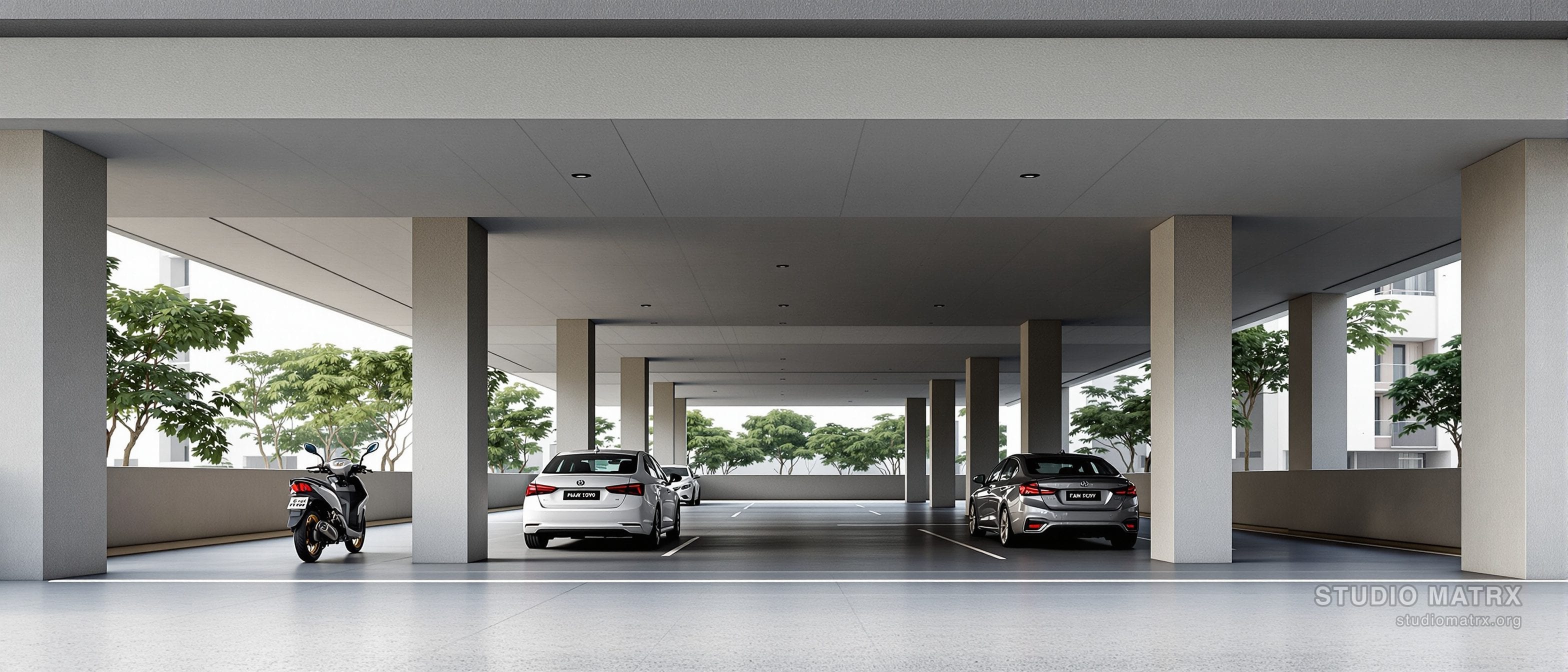
Walk up to most new apartment buildings and houses in urban India and the ground floor is missing — there are no rooms, just columns, cars and air. That open ground level is stilt parking, and it has quietly become the default way Indian buildings make room for vehicles. Here is what it is, why builders love it, and what every buyer must check.
What stilt parking is
Stilt parking (from pilotis — columns) is a building where the ground level is left open on columns and used for parking, with the habitable floors stacked above. You will see it written as "Stilt + 4" or "S+4" — a stilt parking level plus four residential floors.
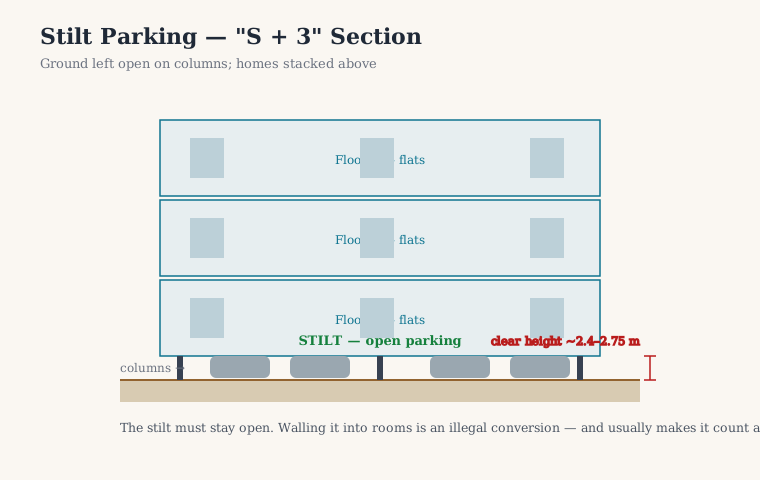
The stilt level is open on the sides — no walls, just columns and the structural core (the staircase and lift). Its clear height is deliberately limited, typically 2.4–2.75 m (and capped by bye-laws at around 2.8 m in many cities), precisely so it can only ever be parking, not a habitable floor.
Why builders — and cities — favour it
Stilt parking spread for solid reasons:
- It usually doesn't count against FSI. Most municipal bye-laws exempt stilt parking from the Floor Space Index — it is an incentive to provide parking. That means a builder gets the parking without sacrificing saleable floor area. (How permissible floor area is computed is covered in FSI / FAR computation.)
- It satisfies the parking requirement that sanction plans demand, in a compact footprint.
- It is cheap and dry. No digging, no waterproofing, no pumps — unlike a basement. Cars stay shaded and dry.
- It is naturally ventilated, so no mechanical exhaust is needed.
- It lifts the homes a floor above street level — useful for privacy, flood splash and views.
The rules that keep it legal
Because the FSI exemption is generous, the rules around stilt parking are strict, and breaking them is one of the most common building violations in India:
| Rule | Why it exists |
|---|---|
| Clear height capped (~2.4–2.8 m) | So it can't become a habitable floor |
| Must stay open on the sides | Ventilation, and to prevent enclosure into rooms |
| No habitable rooms in the stilt | It is parking, not living space |
| Parking bay + aisle dimensions | A usable bay is ~2.5 × 5 m, aisle ~5.5 m |
| Ramp gradient limits | Safe vehicle access |
The big trap: illegal conversion. Walling up the stilt to make shops, a room, a store or extra flats is illegal almost everywhere. It removes mandated parking, adds unsanctioned floor area, and can stall your occupancy certificate — see OC / CC and plinth verification and building plan approval. If you are buying a flat in such a building, an enclosed stilt is a red flag for a regularisation problem you may inherit.
How the stilt is laid out
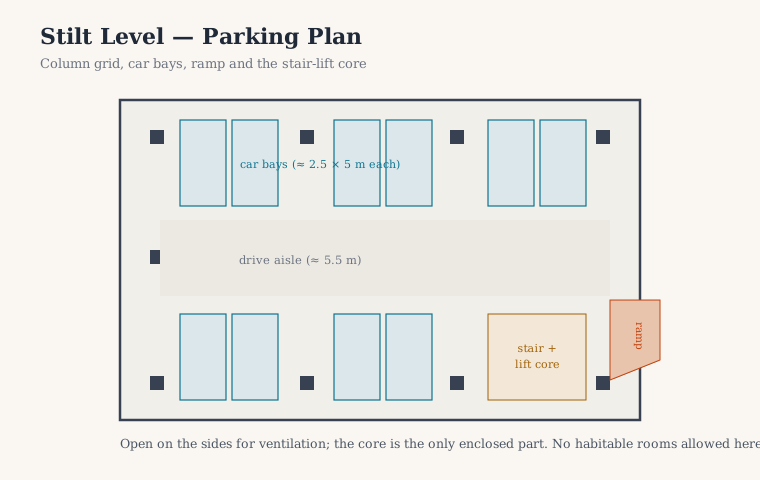
A good stilt level is a column grid sized so cars park between columns without games of Tetris, a drive aisle wide enough to reverse out in one shot, a ramp if the stilt is half a level up, and the stair-lift core as the only enclosed element. Open edges keep it ventilated and naturally lit.
Stilt vs basement vs podium
Stilt is one of three ways to park a building. The choice is about cost, land and what sits on top.
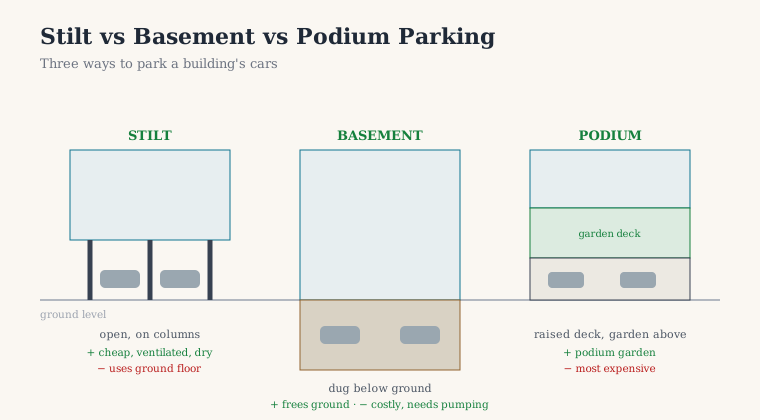
- Stilt — cheapest, dry, ventilated; but it consumes the ground floor and offers limited capacity.
- Basement — frees the ground for landscaping or a lobby, holds more cars; but it is expensive, needs waterproofing, ventilation and sump pumps, and floods if drainage fails.
- Podium — a raised parking deck (one or two levels) with a garden or the building above; common in large gated projects, gives a green podium amenity, but is the costliest.
Many projects combine them — stilt plus basement, or a podium over stilt — to hit the parking count. Whichever it is, the cost flows into your price; sanity-check the per-sq-ft maths with the cost calculator.
What a buyer must check
1. Is the stilt open and unconverted? Walled-up stilts signal an unauthorised conversion and possible OC trouble.
2. Who owns the parking? Open stilt/parking spaces are generally treated as common areas under RERA and several court rulings, and cannot be sold to you as a separate saleable area. They are allotted, not sold. Confirm how your space is documented — see the RERA homebuyer guide.
3. Is your bay usable? Check the real dimensions and the turning space, not just a number on paper.
4. Does the sanctioned plan match reality? The number of parking spaces in the approved plan should match what's built.
5. Flood line. In low-lying areas, confirm the stilt is high enough that monsoon water won't reach parked cars.
A quick Vastu note: an open, well-ventilated stilt is generally considered neutral-to-good; keep the north-east light and unobstructed where you can, per Vastu for modern homes.
The takeaway
Stilt parking is the open, column-supported ground floor that lets a building park its cars without spending FSI — cheap, dry and ventilated, which is why it is everywhere. Keep three things front of mind: it must stay open (an enclosed stilt is usually illegal), the parking is allotted as common area, not sold to you, and a basement or podium is the costlier alternative when the ground floor is too precious to give up.
Disclaimer: Stilt height limits, FSI treatment and parking norms are set by each city's building bye-laws and state RERA rules, and they vary. Verify the sanctioned plan, the parking allotment in your agreement, and the legality of any enclosure with a licensed architect and a property lawyer.
Export this guide
Related Guides — Deep-dive reading
Basement Parking Design in India: Levels, Ramps, Ventilation and Drainage (2026)
How below-grade car parking is planned in Indian homes, societies and commercial buildings — when a basement makes sense over stilt or podium, the level grid and clear headroom under services, the entry ramp footprint, engineered carbon-monoxide and smoke-extract ventilation, waterproofing and the sump-and-pump drainage, fire safety and egress, lighting, and the real structural cost.
ParkingBuilding By-laws & Your Roof: Height, Setbacks, Terrace & Mumty Rules (India)
The municipal layer that shapes what you can build on top of your home — how local by-laws treat building height, setbacks and roof projections, open versus enclosed terraces and FSI, the mumty, lift machine-room and overhead tank above the height line, and parapet height for a usable roof. India-grounded, and always “confirm with your local authority.”
RoofingWhy Parking Rules Matter: How India's Off-Street Parking Norms Work
Why building rules force your home to provide its own parking, how the numbers are set, and what a buyer or self-builder should check before committing
Building Regulations & ComplianceRelated Tools — Try Free
Cross-Ventilation Analyzer
Estimate airflow and air changes per hour (ACH) from room size, window areas, layout, and local wind — with NBC 2016 Part 8 compliance check.
Ventilation CalculatorMonsoon-Readiness Checklist
Pre-rain home audit across 9 categories — terrace, drains, waterproofing, electrical, HVAC, pest, vehicles, documents.
Seasonal AuditBuilding Plan Approval Roadmap
Step-by-step building plan approval process by city with documents, timelines, and fees.
ArchitectAI