
Vastu Compass
Point your phone to detect room directions, then get instant Vaastu Shastra recommendations — ideal placements, colors, elements, and remedies.
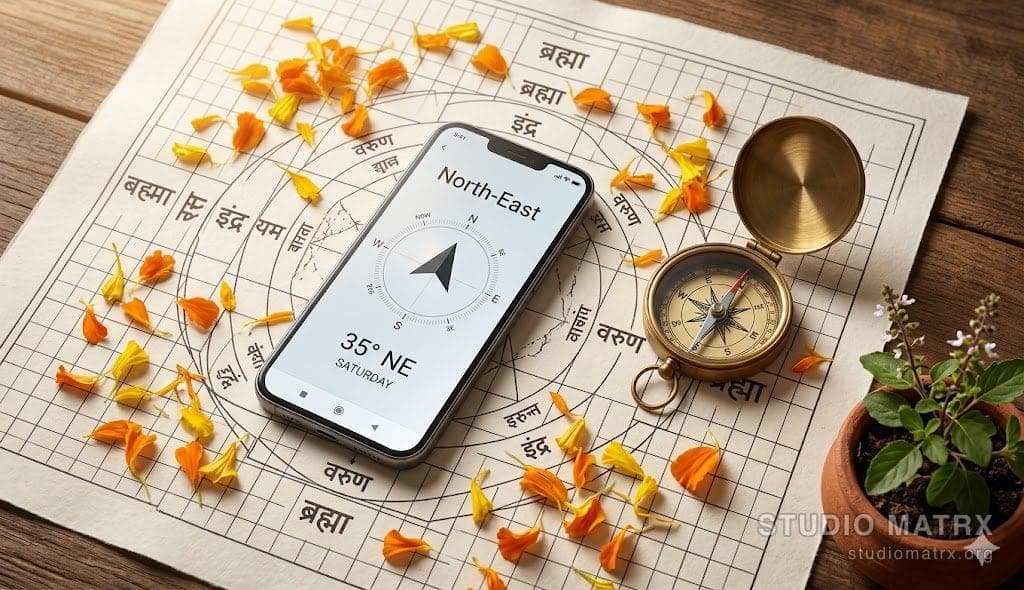
Vastu Compass — A Working Reference
Vastu Shastra is a 5,000-year-old Indian system that links a building's orientation to a set of symbolic, climatic, and energy-flow logics. The compass tool above translates a phone's magnetometer reading into one of eight Vastu zones — North, Northeast, East, Southeast, South, Southwest, West, Northwest — and returns the traditional verdict for the room you're standing in. This page documents how the bearing-to-zone mapping works, which placements are auspicious for which rooms, and how to remedy the defects that almost every existing Indian home carries.
How Compass Bearings Become Vastu Directions
Each Vastu direction occupies a 45° sector centred on its cardinal axis. North spans from 337.5° to 22.5° (passing through 0°). Northeast spans 22.5° to 67.5°, centred on 45°. The boundary lines fall every 22.5°. This matters in practice: a room measured at 18° is in the North; the same room at 25° is in the Northeast. The verdict can change because the symbolic associations shift.
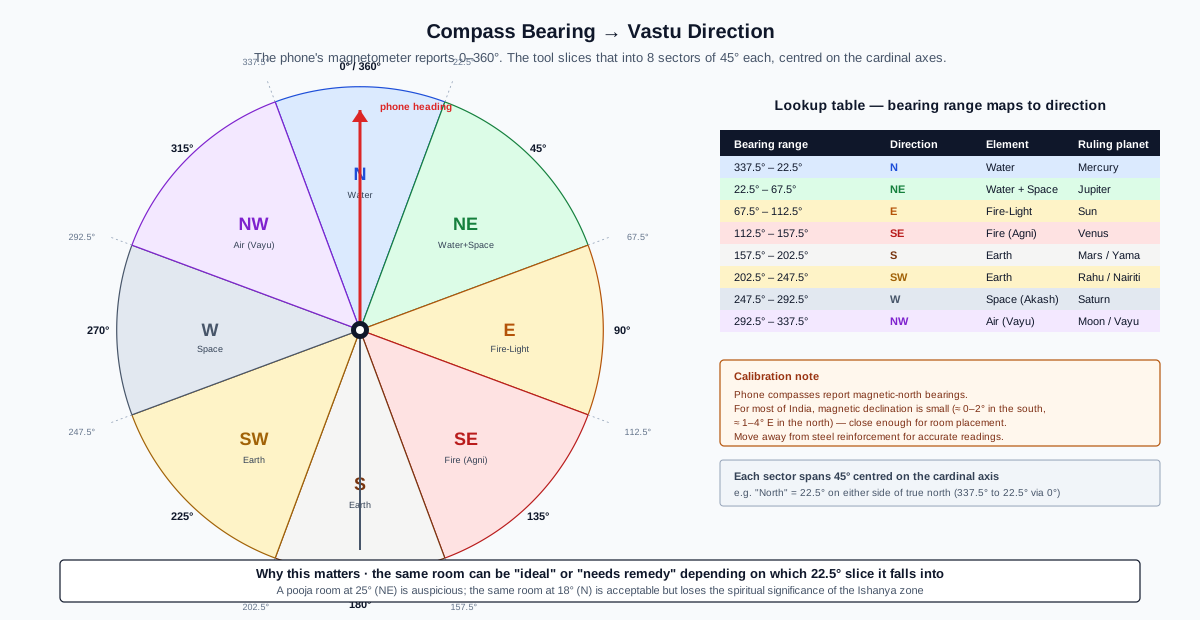
Calibration matters. Phone compasses occasionally drift, especially after travel or near magnetic interference (steel reinforcement, AC ducts, electrical panels). Move the phone in a slow figure-8 motion before reading; stand at least one metre away from large metal objects.
The Room × Direction Lookup
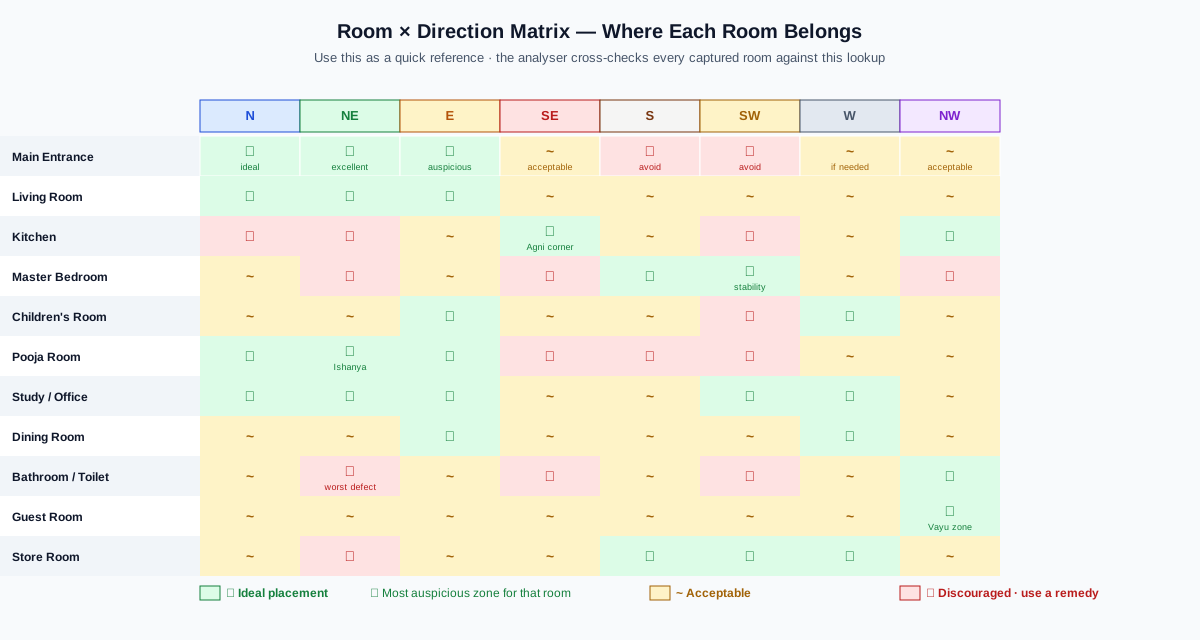
Different rooms suit different zones because Vastu assigns each direction an element and a ruling deity. The kitchen (Fire / Agni) belongs in the Southeast. The pooja room (Water + Space / Ishanya) belongs in the Northeast. The master bedroom (Earth / stability) belongs in the Southwest. The compass tool runs every captured room against the table below; the matrix is your reference for what the verdict is doing.
Common Defects & Their Remedies
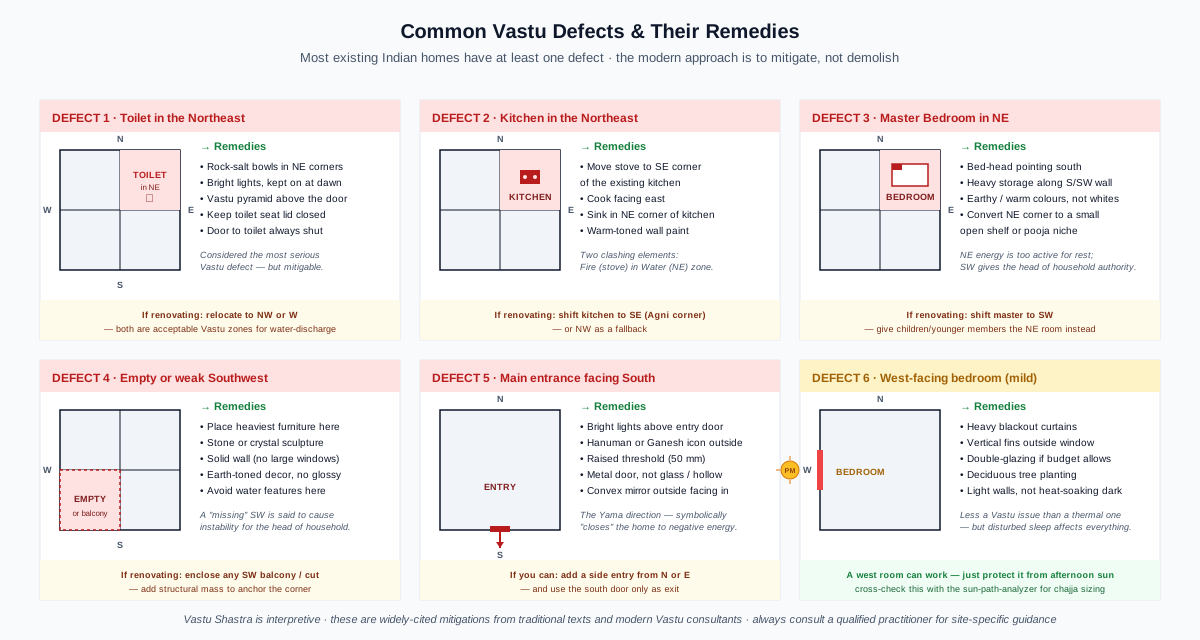
Most existing Indian homes — particularly apartments — carry at least one Vastu defect. The mainstream modern approach is mitigation, not demolition. Each of the six most common defects has a structural alternative (if you're renovating) and a symbolic remedy (if you're renting or cannot rebuild). The six panels below cover the recurring offenders: toilet in the Northeast, kitchen in the Northeast, master bedroom in the Northeast, an empty or weak Southwest, a south-facing main entrance, and the thermal problem of a west-facing bedroom.
A Note on Interpretation
Some Vastu rules have clear climatic basis. NE openings catch soft morning sun without harsh afternoon heat. The Southwest's solid mass anchors a home against monsoon winds. The Southeast kitchen catches morning sun and naturally exhausts heat away from sleeping zones. Other Vastu rules are symbolic — drawn from texts that map directions to deities, planets, and elemental forces. The compass returns the traditional verdict; you decide which lenses to act on. A modern Indian home benefits when Vastu is treated as one input among several (climate, code, structure, budget) rather than the single design driver.
Cross-References
- Vastu in Modern Homes (Guide) — the longer treatment with the 9-zone Vastu Purusha Mandala and room-by-room layouts
- Full 21-point Vastu Compliance Checker — broader audit beyond direction
- Sun Path Analyzer — verify Vastu orientation against actual solar geometry
- Cross-Ventilation Analyzer — check that Vastu-correct rooms also breathe well
Disclaimer: This Vastu Compass tool is provided by Studio Matrx for educational and informational purposes only. Vastu Shastra is a traditional Indian architectural philosophy and its application is subjective. Compass readings depend on device sensor accuracy and may be affected by magnetic interference. Always consult qualified Vastu consultants and licensed architects for project-specific guidance.
Related Guides — Deep-dive reading
Vastu House Plan — Complete Indian Layout Reference
The 9-Zone Mandala, 20-Room Direction Matrix, Plot Rules, Four Cardinal Reference Plans & Myth-vs-Rule Field Guide
Room PlanningVastu Shastra for Modern Homes
A Scientific Approach — Directions, Room Planning, Colours & Architect's Guide
Design StylesEast-Facing House Plan — Complete Guide for India
Vastu Logic, Sun-Path, Room-Direction Matrix & Reference Plans for the Most-Asked Orientation in Indian Homes
Room PlanningRelated Tools — You may also find these useful
Vaastu + Orientation Advisor
Vaastu room placement by direction, sorted honestly by building science — climate-sound, contingent, or convention. Pick your entrance orientation.
OrientationVastu Shastra Compliance Checker
Score your home across 21 Vastu criteria with a weighted score, compliance band, and remedial guidance.
Vastu ScoringCross-Ventilation Analyzer
Estimate airflow and air changes per hour (ACH) from room size, window areas, layout, and local wind — with NBC 2016 Part 8 compliance check.
Ventilation Calculator