
Treated Water for Landscape Irrigation: Distribution, Storage, Quality & Salinity
How to irrigate large lawns, planted podiums and campus landscapes with STP-treated water — the distribution network, storage sizing, the quality numbers that keep plants alive, and how to manage salt build-up in the soil over the years.
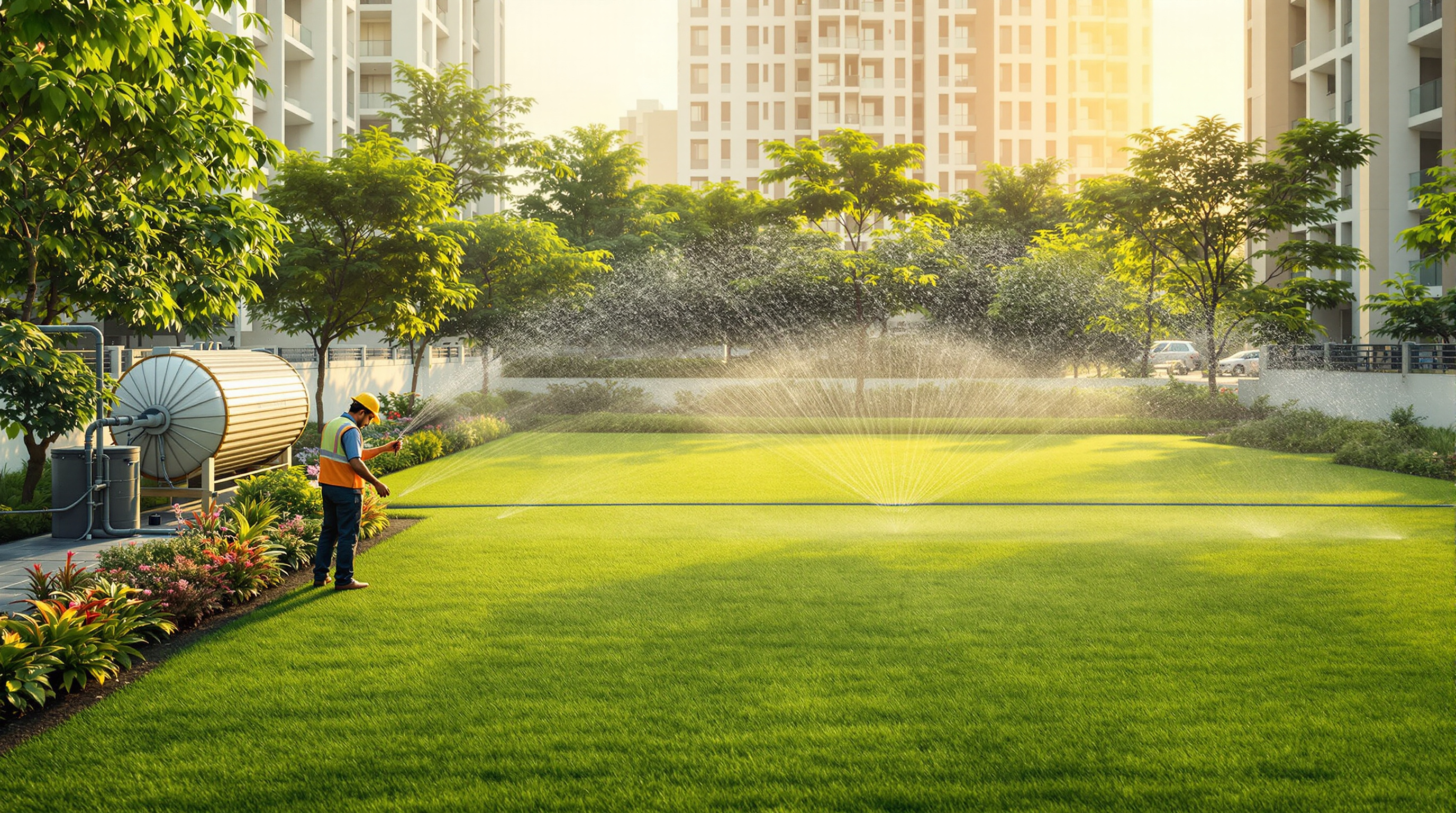
A large building's landscape is thirsty. A hectare of lawn in an Indian summer can want 40,000–60,000 litres a day; add podium planters, avenue trees and flowering beds and the garden becomes one of the biggest water consumers on the plot. Buying that water — from the mains or, worse, from tankers — is expensive and, in many cities, simply not allowed for gardening. Meanwhile the building's own sewage treatment plant is producing hundreds of kilolitres of clean water every day and looking for somewhere to send it.
Landscape irrigation is the most natural marriage of the two. But treated water is not tanker water, and a garden is not a discharge drain. Do it casually and you get soggy patches, blocked drippers, white crusts on the soil and slowly dying shrubs. Do it deliberately — with the right network, storage and quality control — and you irrigate a campus for years at almost no marginal cost.
Treated water is the cheapest irrigation source your building will ever have. The catch is that plants are living customers with standards of their own — they care about salt, sodium and chlorine in ways a flush cistern never will.
Why landscape is the anchor reuse
Every reuse channel — toilet flushing, cooling towers, car washing — competes for the same treated output. Landscape irrigation earns its place at the front of the queue for three reasons:
- Volume. Gardens absorb large, steady quantities, especially in the dry months when the STP is producing at full tilt and flushing demand alone cannot soak it up.
- Tolerance. Soil and plants are more forgiving of the odd off-spec batch than a cooling tower or a dual-plumbed flushing line — within limits, which this guide is about.
- Visibility. A green, well-kept landscape is the most visible proof that the reuse system works, which keeps residents and management behind it.
Getting the plant to reliably produce that water is the subject of the rest of this library — start with how an STP works and the full treatment process flow. This guide picks up at the point where clean water leaves the plant and asks: how do we get it into the soil, safely, forever?
The quality the garden actually needs
For irrigation, the parameters that matter are not the same headline numbers you watch for discharge. BOD and TSS still matter — they clog emitters and can smell — but the ones that quietly decide whether your landscape thrives or dies over years are the salt parameters.
| Parameter | Comfortable range for irrigation | What goes wrong if ignored |
|---|---|---|
| BOD | Below 10 mg/l | Higher values feed slime that blocks drip emitters and smells in the sun |
| TSS | Below 10 mg/l | Fine solids clog drippers and filters; forces frequent flushing |
| pH | 6.5 – 8.0 | Extremes lock up nutrients and corrode fittings |
| EC / TDS (salinity) | EC below ~2.0 dS/m; TDS below ~1200 mg/l | High salt stunts growth, browns leaf tips, kills sensitive species |
| SAR (Sodium Adsorption Ratio) | Below ~6–9 | High sodium destroys soil structure — it seals up and stops draining |
| Residual chlorine | Below ~1 mg/l at the root zone | Over-chlorinated water scorches roots and foliage |
The last three are where treated sewage differs from fresh water. Sewage arrives already carrying the salts of everything that was washed, cooked and cleaned with it, and treatment does not remove dissolved salt — biological processes eat organics, not sodium chloride. So treated water almost always has a higher TDS and SAR than the freshwater the building started with. That is the single fact around which good landscape reuse is designed.
Because tertiary steps like chlorination and activated carbon shape these numbers, coordinate the plant's disinfection dosing with the garden's needs — a flushing line wants a chlorine residual the root zone does not.
Distribution: getting water to the plants
A landscape network is a separate, clearly identified system — never cross-connected to potable lines, and marked at every valve and outlet.
- Dedicated non-potable mains. Run irrigation supply in its own pipework, conventionally colour-coded and labelled, with backflow prevention where it could ever meet a potable line. This is a code expectation, not a nicety.
- Drip over spray for beds and shrubs. Drip and subsurface lines put water at the root and keep it off foliage and paths — which matters more with treated water, because it avoids leaf scorch, aerosol drift and human contact. Reserve sprinklers and pop-ups for open lawn, ideally scheduled for early morning or night when nobody is on the grass.
- Filtration at the head. A screen or disc filter (and often a sand filter) at the irrigation pump set is non-negotiable for drip systems — it is the difference between emitters that last years and emitters that block in a season.
- Podium and terrace gardens need their own attention: planters over occupied space demand reliable waterproofing-grade detailing, positive drainage, and lighter, more frequent dosing because the soil volume is shallow and dries fast. Pressure-compensating drip is the standard answer on a podium where head varies across levels.
The STP pumps and instrumentation guide covers the transfer and pressure sets that push water from the plant to the far corners of the site.
Storage: buffering supply against demand
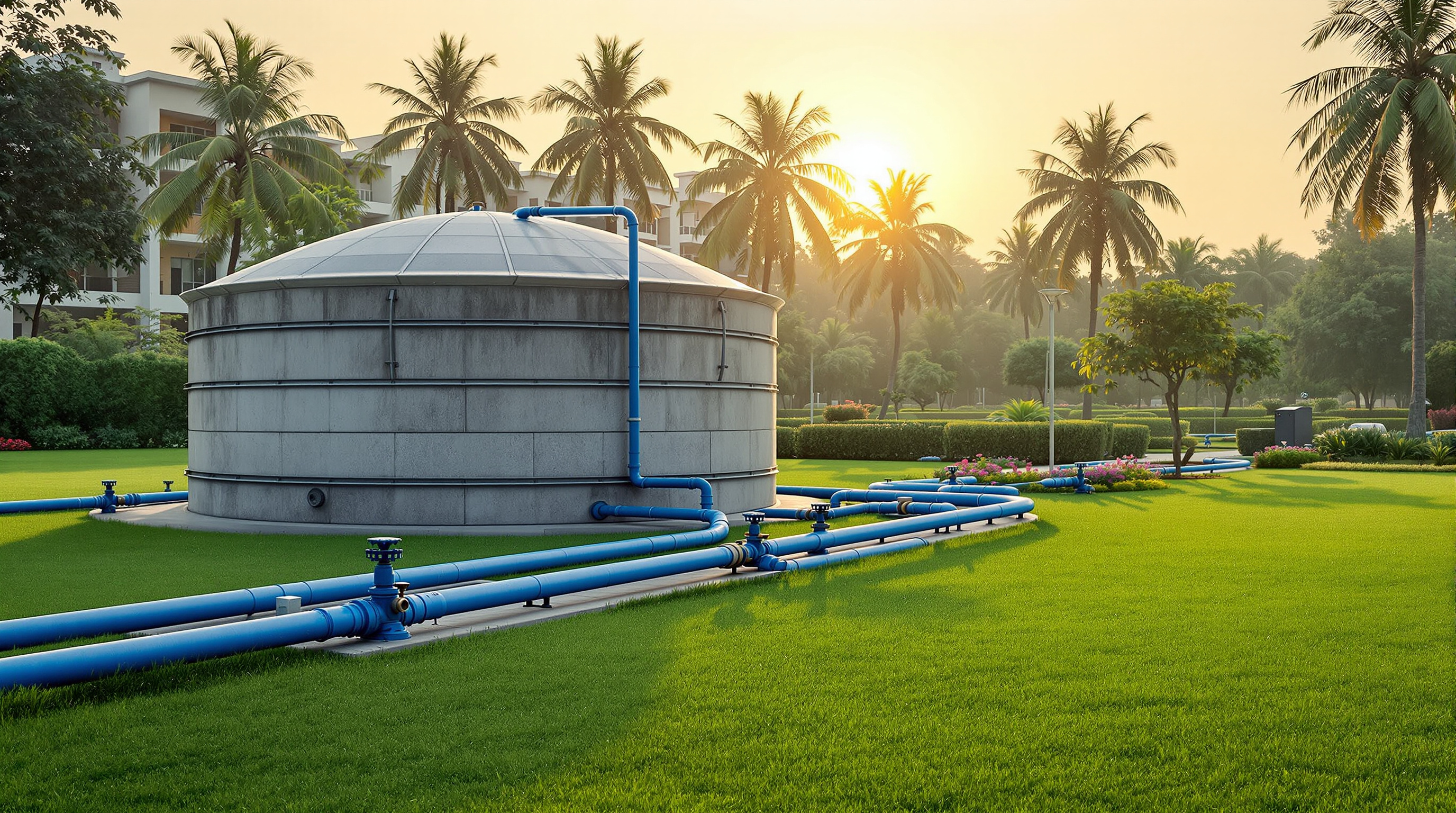
The STP produces treated water evenly, around the clock. The garden drinks in bursts — heavily at dawn, almost nothing at midday, seasonally huge in April and nearly zero in the monsoon. Storage bridges that gap.
- Size the treated-water tank to hold at least a full irrigation cycle plus a buffer — commonly half to one full day of peak landscape demand — so a short plant stoppage never browns the lawn. Work the numbers with the water balance calculator, which lines up production against flushing, irrigation and other demands across the day.
- Cover the tank. Treated water left open re-grows algae and bacteria and loses its disinfection residual. A covered, vented tank keeps it irrigation-ready.
- Keep a top-up and an overflow path. When the garden sleeps through the monsoon and flushing cannot absorb the surplus, the excess needs a compliant home — groundwater recharge or, where permitted, discharge. When the garden's peak exceeds what the STP makes, a metered freshwater or borewell top-up keeps it alive.
Managing salinity over the years

This is the part most projects miss, and it plays out slowly. Every irrigation adds a little salt to the soil; the water evaporates and the plant transpires, but the salt stays behind and concentrates. Over seasons, a soil irrigated only with moderately saline treated water can build up to levels that stunt or kill sensitive plants — and if sodium (SAR) is high, the clay particles disperse and the soil literally seals shut, so water ponds instead of soaking in.
The good news is that salinity is manageable with routine, boring discipline:
- Leach deliberately. Periodically apply extra water — often the monsoon does this for free — to push accumulated salts below the root zone. This "leaching fraction" is a designed part of the schedule, not an accident. It only works if the soil drains, which is why podium and heavy-clay beds need engineered sub-drainage.
- Choose salt-tolerant planting. Match the palette to the water. Many hardy Indian landscape species — several grasses, bougainvillea, oleander, casuarina, coconut and date palms — shrug off salinity that would kill lawns of fine turf or acid-loving ornamentals. Put the sensitive species on freshwater or the least-saline blend.
- Amend high-sodium soils. Where SAR is high, gypsum (calcium) displaces sodium and restores soil structure. This is a standard, inexpensive agronomic fix repeated as needed.
- Monitor, don't guess. Test the treated water and the soil at least seasonally for EC and SAR. Rising numbers are an early warning you can act on long before plants show damage.
- Blend when you can. Mixing treated water with rainwater or freshwater dilutes the salt load and buys tolerance across a wider plant palette — a small freshwater fraction goes a long way.
The same salinity logic, at larger scale, governs treated water in agriculture; the landscape version is simply more controlled and more visible.
The bottom line
Irrigating a large landscape with treated water is the highest-value, most forgiving reuse a building has — provided you treat the garden as a customer with real requirements. Give it a dedicated, filtered, drip-first distribution network; a covered storage tank sized to bridge production against bursty demand; and, above all, an ongoing salinity plan — leaching, salt-tolerant planting, gypsum and seasonal testing — so the soil stays alive for decades, not seasons.
Do that, and the maths is unarguable: a green campus watered essentially for free from water you were going to produce anyway. Put your own numbers to it with the water reuse savings calculator, and see the wider picture of reuse in the urban water circular economy and across the full Sewage Treatment Plants guide library.
Export this guide
Related Guides — Deep-dive reading
Using Treated STP Water for Gardening: A Safe Reuse Guide
How to safely put treated STP water on home and apartment-complex gardens — the quality you actually need, why drip beats sprinklers, the salt and chlorine traps that quietly kill plants, and the dual-plumbing basics that make it all work.
Sewage Treatment PlantsTreated Water for Toilet Flushing: The Complete STP Reuse Guide
How dual plumbing, a dedicated flush tank and pump, colour-coded lines, and residual chlorine turn STP effluent into the single biggest water saving a building can make — done safely, without a single cross-connection.
Sewage Treatment PlantsDual Water Supply for Indian Buildings: Dual Plumbing, Colour-Coded Networks & Cross-Connection Control
How a dual water supply splits a building into two independent lines — fresh potable water for drinking and bathing, treated/recycled water for WC flushing, gardening and washdown — with colour-coded piping, separate storage, and the backflow protection that keeps the two from ever mixing.
PlumbingRelated Tools — Try Free
Monsoon-Readiness Checklist
Pre-rain home audit across 9 categories — terrace, drains, waterproofing, electrical, HVAC, pest, vehicles, documents.
Seasonal AuditWater Reuse Savings Calculator
Estimate the money you save by reusing STP-treated water instead of buying fresh supply, with daily, monthly and annual savings.
STP CalculatorLandscape Cost Calculator
Estimate a garden's cost — hardscape, softscape, lawn, irrigation, lighting and annual upkeep — by area, tier and city.
Budget Calculator