
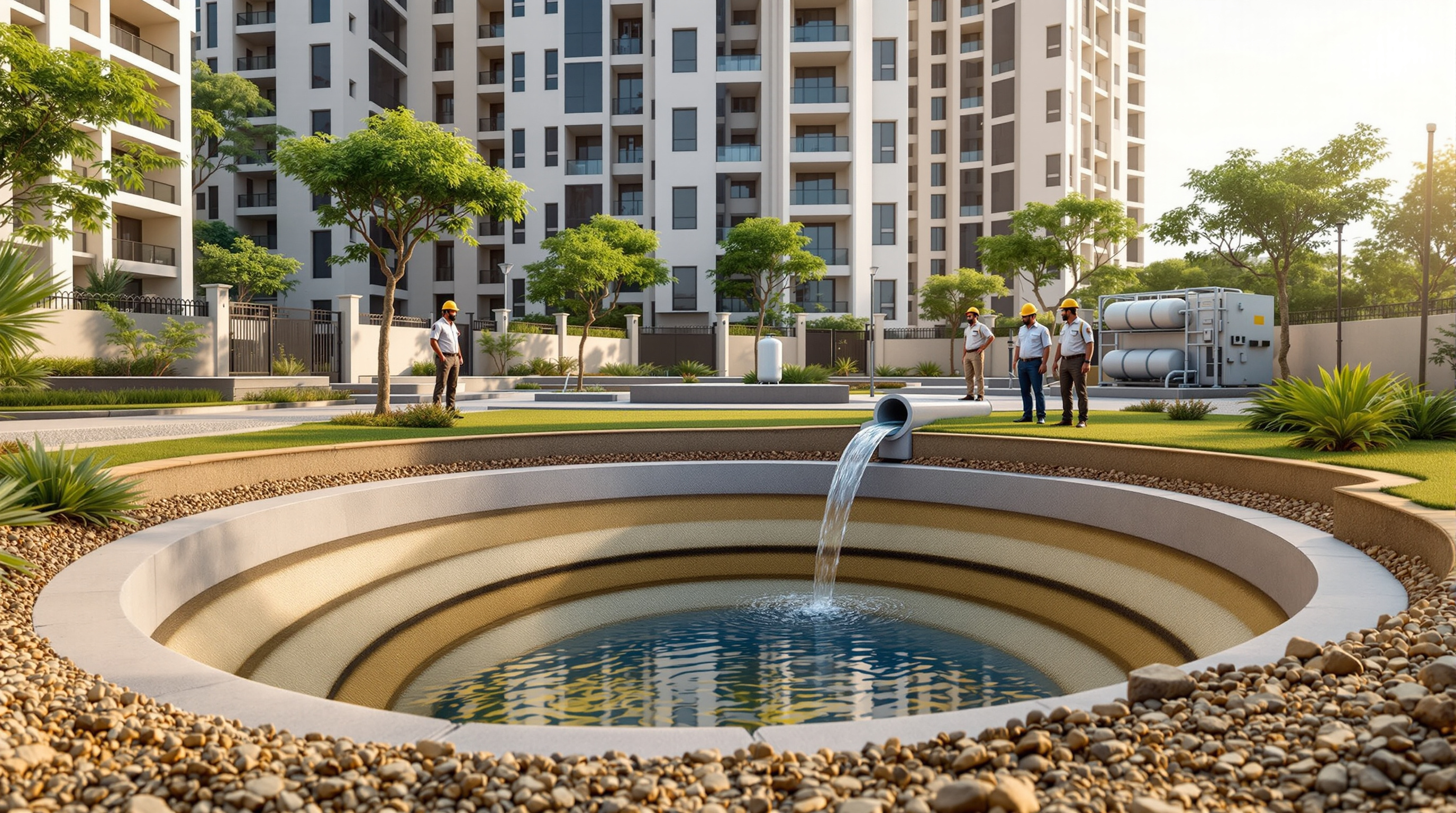
Groundwater Recharge with Treated Water: Recharge Pits, the Quality Bar, and the Rules
How to safely put surplus STP-treated water back into the aquifer — the recharge structures, the near-potable quality standard it demands, the CPCB and state rules, and the cautions that keep you from poisoning your own borewell.
Most treated-water reuse forgives a little. If the water going to the garden or the flush cistern is slightly off-spec one afternoon, the consequence is a faint odour and a quick correction. Groundwater recharge forgives nothing. Water that soaks into the ground does not come back for inspection — it joins an aquifer that may feed your own borewells, your neighbours', and drinking-water sources you will never see. Whatever you put in, you and everyone downgradient will eventually drink some version of it.
That is why recharging the aquifer with treated water is both one of the most valuable things an STP can do and the one reuse that carries the highest quality bar of all. Done well, it turns surplus effluent into a slow, free deposit into a depleting resource. Done carelessly, it is a direct injection of pollution into the very water table you depend on.
Recharge is the only reuse where a mistake is effectively permanent. You cannot un-inject water into an aquifer. Treat the quality standard for recharge not as "good enough for gardens" but as "safe enough to drink" — because someone, somewhere, eventually will.
This guide is for the surplus. It assumes you already reuse treated water for toilet flushing and landscape irrigation, and that even after those, your water balance shows more treated water than the site can absorb. Recharge is where that genuine surplus should go — carefully.
Why recharge treated water at all

India's urban aquifers are falling. In Bengaluru, Chennai, Hyderabad and much of the Deccan, borewells that hit water at 200 feet a decade ago now go dry at 800 or 1000. A building that recharges its treated surplus does three useful things at once:
- Banks water for itself. Recharge near your own borewells raises the local water table you draw from — a slow return on the water you clean.
- Reduces discharge. Surplus that would otherwise go to a drain or sewer instead stays on site, easing your compliance and your discharge volume.
- Earns credit. Many state and municipal approvals treat on-site recharge as part of the mandated rainwater-harvesting and water-conservation obligation.
The economics are modest but real — the Water Reuse Savings Calculator will show recharge as avoided tanker purchases over a season. But the primary case for recharge is stewardship, not the meter.
The quality bar: near-potable, non-negotiable
Here is the hard rule that separates recharge from every other reuse. Water for gardens can be secondary-quality. Water for the ground must be close to drinking-water quality. The soil and unsaturated zone give some natural polishing, but you cannot rely on it to fix bad water — and once the water reaches the saturated aquifer, there is no filtration left at all.
Treated water destined for recharge should clear a full tertiary train and be tested against a near-potable bar:
| Parameter | Typical reuse (flush/garden) | Recharge target |
|---|---|---|
| BOD | < 10 mg/l | < 5 mg/l |
| COD | < 50 mg/l | < 30 mg/l |
| TSS | < 10 mg/l | Near 0 (clog-free) |
| Faecal coliform | < 100 MPN/100ml | Undetectable / < 10 |
| Nitrate (as N) | Monitored | < 10 mg/l (drinking limit) |
| TDS | Site-dependent | Below ambient groundwater TDS |
| pH | 6.5–8.5 | 6.5–8.5 |
Two parameters deserve special respect. Nitrate passes straight through soil and is the classic contaminant of recharge schemes — a partially nitrified effluent can push aquifer nitrate past the 10 mg/l drinking limit and cause real harm. Faecal coliform must be genuinely absent, not merely low: recharge water needs robust, verified disinfection with a real residual or dose margin.
Practically, this means recharge-grade water comes off an ultrafiltration membrane or a well-run MBR, polished through an activated carbon filter, and disinfected hard by UV or chlorination with the residual managed down before it enters the ground. If your STP cannot consistently and provably hit this bar, the water is not fit to recharge — send it to irrigation instead and recharge only rainwater.
Recharge structures: pits and wells
Getting clean water into the ground is a civil problem, and the structure you choose depends on your soil and the depth of the water table.
Recharge pits (shallow, permeable ground)
A recharge pit is a lined excavation — often 1.5–2 m square and 2–3 m deep — backfilled with graded media: coarse boulders at the bottom, then gravel, then coarse sand at the top. Treated water enters through a desilting / settling chamber first, then percolates down through the media into the unsaturated zone. Pits suit sites with permeable soil and a reasonably shallow water table. They are cheap, easy to inspect, and easy to clean — but they need permeable ground to actually infiltrate.
Recharge wells / shafts (deep water table, clayey top soil)
Where the top soil is clayey or the water table is deep, a shallow pit will simply pond. Here you use a recharge well or bore — a cased shaft, sometimes drilled down toward a permeable strata, fitted with a slotted pipe and a gravel pack, again fed through a silt trap. This is closer to managed aquifer recharge and delivers water nearer the saturated zone, which raises the contamination stakes further — the natural soil-filtration buffer is short or absent, so the inflow quality bar is even more critical.
Design essentials for either structure:
- Always a settling/silt chamber upstream. TSS is the enemy of recharge — solids blind the media and choke the pit within months.
- Size to a percolation test, not a guess. Match inflow rate to the soil's measured infiltration rate so water does not pond and stagnate.
- Keep it inspectable and cleanable. Recharge structures silt up; build in access to desilt them.
- Separate from the borewell. Maintain sensible horizontal distance between the recharge point and any abstraction borewell so there is travel time and soil contact.
The rules
Recharge sits inside a stack of regulation, and you should treat all of it as directional and locally verifiable rather than a single national number:
- CPCB / SPCB. The Central and State Pollution Control Boards set treated-water standards and, importantly, are cautious about recharging treated sewage into aquifers. Some jurisdictions restrict or prohibit direct injection of treated sewage into groundwater. Confirm with your SPCB before you design for recharge — the permission, not the pipe, is the constraint.
- CGWA (Central Ground Water Authority). Groundwater abstraction and artificial recharge are regulated; recharge structures and any borewell interaction fall under CGWA / state groundwater rules.
- Local building bylaws. Many municipal bylaws mandate rainwater harvesting and recharge as a condition of occupancy — but rainwater and treated sewage are treated very differently. Do not assume a rainwater-recharge sanction covers treated-sewage recharge.
- IS codes. Indian Standards on artificial recharge and rainwater harvesting (directionally, the IS 15797-series work on roof-top recharge) inform structure design; follow current codes and your consultant's specification.
The safe default posture: recharge rainwater freely; recharge treated sewage only with explicit local sanction and only at near-potable quality, continuously monitored.
Cautions: how recharge goes wrong

Every recharge failure traces back to the same root — water that was not as clean as assumed, entering ground that could not fix it. Guard against:
- Trusting the design, not the effluent. An STP that meets its numbers on a good day still fails on the day the blower trips. Recharge should be interlocked to online quality — if BOD/turbidity/coliform drift, the water diverts away from the recharge structure automatically. Never hard-plumb the STP outlet straight into a recharge pit.
- Nitrate and TDS creep. Even "clean-looking" effluent can carry nitrate and dissolved salts that accumulate in a slow-moving aquifer. Test the groundwater itself, periodically, not just the inflow.
- Silt blinding. Skip the settling chamber and the pit clogs, water ponds, mosquitoes breed, and someone quietly reroutes the raw-ish overflow somewhere worse.
- Pathogen breakthrough. Under-dosed disinfection plus a short soil path in a recharge well equals live pathogens in the water table. Disinfection for recharge needs margin and monitoring, not a nominal dose.
- No monitoring at all. The unforgivable one. If you recharge treated water, you must sample both the inflow and a nearby monitoring/borewell on a schedule, and keep the records.
The bottom line
Groundwater recharge is the most generous thing you can do with surplus treated water and the least forgiving. The engineering — a silt trap, graded media, a pit or a well matched to your soil — is the easy half. The hard half is discipline: holding the water to a near-potable standard every hour, interlocking recharge to real-time quality, respecting a regulatory regime that is deliberately wary of putting sewage-origin water underground, and monitoring the aquifer you are feeding. Get that discipline right and you are banking clean water for your own borewells and the city's. Get it wrong and you have contaminated the one water source no filter can reach.
Start by confirming there is genuine surplus after higher-value reuse — run your water balance — then read the wider treated-water reuse picture and the full Sewage Treatment Plants guide library for the tertiary-treatment depth that recharge-grade water demands.
Export this guide
Related Guides — Deep-dive reading
How Does an STP Work? A Step-by-Step Explanation
Follow a single drop of sewage from the building drain to reusable water — through screening, settling, the living microbial heart of the plant, and final polishing — with every stage explained in plain language and no engineering background assumed.
Sewage Treatment PlantsCPCB Guidelines for STPs Explained: Discharge Standards & the 2017/2019 History
What the Central Pollution Control Board actually prescribes for sewage treatment plants — the effluent parameters, the contested 2015–2017–2019 notification history, the NGT interventions, and which numbers your plant is really held to today.
Sewage Treatment PlantsSmart City Wastewater Guidelines: Urban Reuse Rules Developers Must Know
How the Smart Cities Mission, AMRUT 2.0 and India's reuse framework are turning treated sewage into a mandated resource — and what the shift to decentralised treatment and reuse targets means for developers, RWAs and facility managers.
Sewage Treatment PlantsRelated Tools — Try Free
Water Reuse Savings Calculator
Estimate the money you save by reusing STP-treated water instead of buying fresh supply, with daily, monthly and annual savings.
STP CalculatorCPCB Compliance Checklist for STPs
Tick off CPCB/SPCB outlet standards, monitoring duties and record-keeping to score your sewage treatment plant's compliance readiness.
ChecklistRainwater Tank Sizer
How big should your rainwater tank be? Computes annual harvest, recommended tank capacity in litres, water-bill savings, and payback — for 10 Indian cities.
RWH Calculator