
Treated Water for Toilet Flushing: The Complete STP Reuse Guide
How dual plumbing, a dedicated flush tank and pump, colour-coded lines, and residual chlorine turn STP effluent into the single biggest water saving a building can make — done safely, without a single cross-connection.
Ask any STP operator where the treated water goes, and the first answer is almost always the same: back up to the toilets. In a typical Indian residential or commercial building, flushing is the single largest reuse of treated sewage — bigger than gardening, bigger than cooling towers, bigger than car washing. It is also the reuse that pays for itself fastest, because every litre flushed with treated water is a litre of expensive freshwater you did not have to buy, pump or store.
But "send the treated water to the flush tanks" is a one-line idea that hides a serious piece of engineering. Get the plumbing, the quality and the safeguards right and flushing reuse runs invisibly for decades. Get them wrong — one careless cross-connection, one under-chlorinated tank — and you have a health hazard piped into every bathroom in the building.
Toilet flushing typically accounts for 30–40% of a building's total water demand. Meet that demand with STP effluent and you cut freshwater purchase by roughly a third — the biggest single lever in any building's water balance.
Why flushing is the reuse everyone starts with
Flushing is the ideal first home for treated water for three practical reasons.
- The demand is huge and constant. People flush all day, every day, in numbers that closely track the sewage the building generates in the first place. Supply and demand are naturally matched.
- The quality bar is reasonable. Flush water never touches skin for long and is never drunk, so it does not need to be potable — it needs to be clear, odour-free, and disinfected. A well-run STP already produces exactly that.
- The saving is immediate and measurable. Because flushing is such a large share of demand, diverting it to treated water shows up on the very next freshwater bill. The Water Reuse Savings Calculator puts a monthly rupee figure on it for your own occupancy.
If you are still sizing the plant that will feed all this, start with the STP Capacity Calculator; to see how flushing fits against gardening, cooling and discharge, the Water Balance Calculator maps the whole loop.
Dual plumbing: two water systems in one building
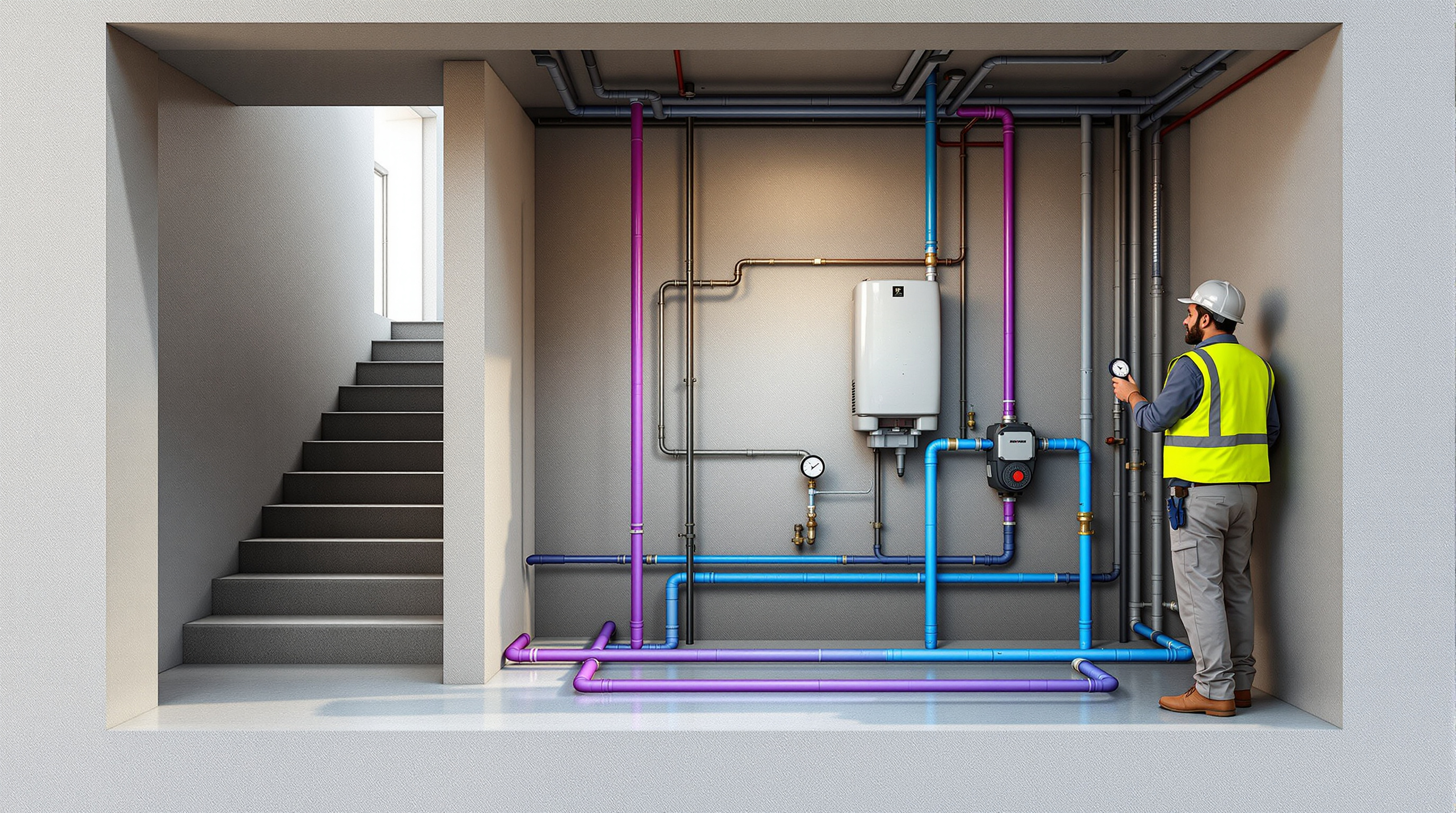
The heart of flushing reuse is dual plumbing — the building carries two entirely separate water networks that never touch:
1. A potable line (fresh municipal or borewell water, treated to drinking standard) that feeds kitchen taps, drinking points, wash basins and bathroom showers.
2. A non-potable, treated-water line that feeds only the toilet cisterns and urinals.
This has to be designed in from the very first plumbing drawing. Retrofitting a second riser into an occupied building means opening shafts, chasing walls and re-routing branches — hugely more expensive than running the extra pipe at construction stage. This is why flushing reuse is a core decision in apartment STP planning, not an afterthought bolted on at commissioning.
The two systems are kept physically apart end to end: separate tanks, separate pumps, separate risers, separate branch lines to each fixture. There is no valve, no bypass, no "emergency link" between them. The moment a link exists, treated water can back-flow into the drinking supply — the exact failure the whole design exists to prevent.
The dedicated flush tank and pump
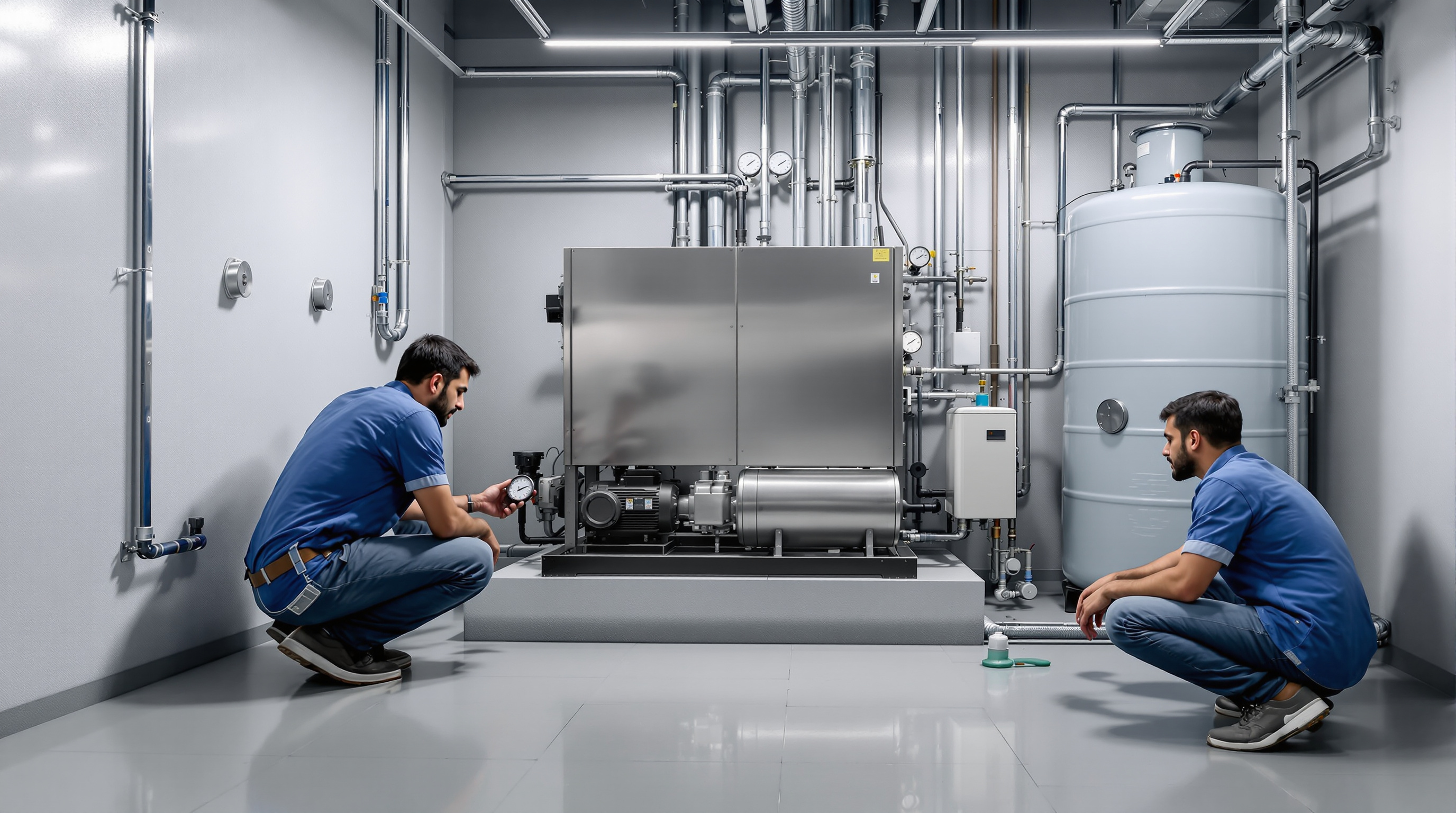
Treated water leaves the STP and is stored in a dedicated treated-water tank (often called the flush water tank or reuse tank) — never in the potable underground or overhead tanks. From there it is lifted to the toilets by its own dedicated flush pump set, sized for the building's flushing demand and peak factor, quite separate from the domestic water pumps.
A typical arrangement looks like this:
| Element | Potable system | Treated-water flushing system |
|---|---|---|
| Source | Municipal / borewell + softening | STP tertiary outlet |
| Storage | Potable UG + overhead tank | Separate treated-water / flush tank |
| Pump | Domestic hydro-pneumatic set | Dedicated flush pump / hydro set |
| Riser & branches | Blue-coded lines | Colour-coded non-potable lines |
| Serves | Taps, showers, kitchen, drinking | Toilet cisterns, urinals only |
In most buildings the flush pump is a hydro-pneumatic set that holds constant pressure at the cisterns, or the treated water is lifted to a small overhead flush tank on the terrace that then gravity-feeds the stacks. Either way, the pumps and instrumentation for flushing are a distinct sub-system with their own level controls, so a treated-water shortage never draws on drinking water and vice versa.
A practical detail worth designing for: the flush tank needs a top-up strategy for days the STP is down for maintenance or the building runs at low occupancy. The correct solution is a potable make-up via an air gap — water falls freely into the flush tank through an open gap, so there is no physical pipe connection that could ever siphon backwards. Never top up with a direct threaded connection.
Colour-coded lines: making the second system visible
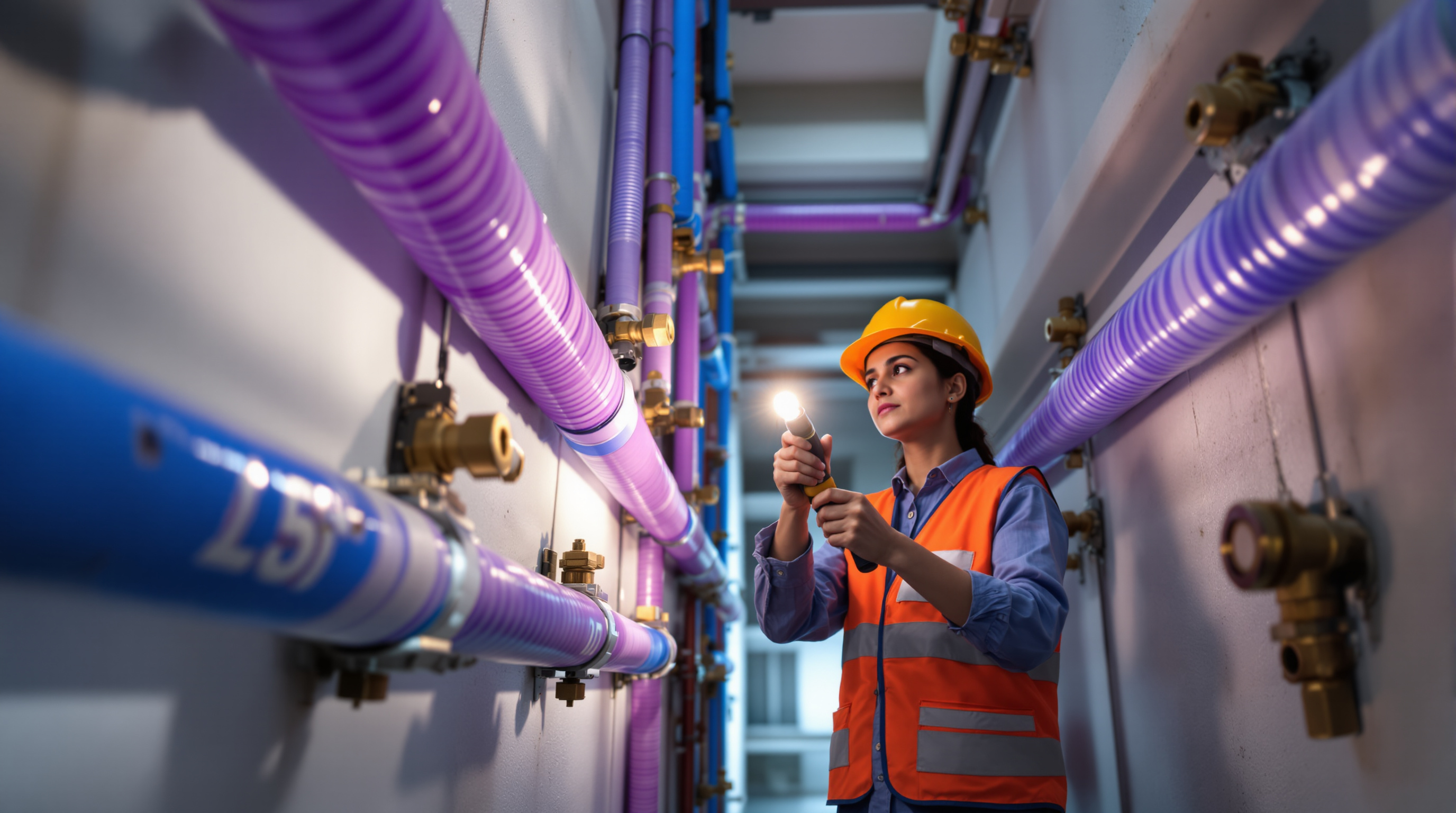
Because two water systems now run through the same building, every plumber, every AMC technician and every future renovator must be able to tell them apart at a glance. The universal convention is colour-coding the non-potable line and clearly labelling it as treated / non-potable / "not for drinking."
Good practice on Indian projects:
- Run treated-water pipes in a distinct colour (lilac/purple is the international non-potable convention; many Indian sites also use clearly marked green or a printed "TREATED WATER — DO NOT DRINK" band).
- Label at every junction, valve, tank and pump — in the shaft, at the cistern branch, wherever someone might work on the line.
- Keep the marking legible in the local language plus a symbol, so it survives a change of maintenance contractor years later.
Colour-coding is not decoration. It is the standing instruction that stops a well-meaning plumber, five years from now, from tapping the nearest pipe to fix a leak and unknowingly joining the two systems.
Quality and residual chlorine: what flush water must actually be
Flush water does not need to be potable, but it cannot be raw secondary effluent either. Two problems have to be solved: clarity/odour and biological safety.
- Clarity and odour come from good tertiary treatment. Water that has been through a pressure sand and activated carbon filter — or better still a UF membrane on an MBR system — is clear and odour-free, so it will not stain cisterns, leave a smell in the bathroom, or slime up the ballcock and flush valve.
- Biological safety and shelf-life come from disinfection with a maintained chlorine residual. This is the point most often missed. UV disinfection kills organisms as the water passes the lamp, but leaves no residual — so the moment treated water sits in a warm flush tank for a few hours, bacteria and biofilm regrow. For stored flush water you want a small free chlorine residual (roughly 0.5–1.0 mg/l at the far cistern) carried by the chlorination system so the water stays disinfected all the way through the tank, the pump and the riser to the last toilet on the top floor.
In practice many plants run UV for the primary kill plus a light chlorine dose for the residual — belt and braces. The target is water that is visually clear, free of odour, low in suspended solids and BOD, and carrying enough residual chlorine to stay safe in storage, comfortably within CPCB reuse expectations for non-potable applications. It should not smell strongly of chlorine at the cistern — that means over-dosing.
Cross-connection: the one failure you must engineer out
Everything above exists to prevent one specific accident: a cross-connection, where non-potable treated water finds a path into the potable drinking supply. It is the single most serious risk in any dual-plumbed building, because the consequence is contaminated drinking water.
The defences are layered, and you want all of them:
- Physical separation — no interconnecting pipe or valve between the two systems, anywhere, ever.
- Air-gapped make-up — any potable top-up to the flush tank falls through an open air gap, not a connected pipe. Where an air gap is impossible, a tested backflow preventer is the fallback, never a plain check valve.
- Colour-coding and labelling — so no future technician joins the systems by mistake.
- Fixture discipline — treated water goes to cisterns and urinals only; it never feeds a health-faucet, a hand-spray, a bidet, or any point a person might use to rinse.
- Commissioning verification — at handover, the plumbing is pressure-tested system by system and physically walked to confirm no accidental link exists. Make this an explicit line on the STP handover checklist and part of commissioning, not an assumption.
A cross-connection is almost never a design error on paper — it is a field mistake made during a hurried repair years later. That is precisely why the colour-coding and labelling matter as much as the drawings.
The bottom line
Toilet flushing is where STP reuse earns its keep. It absorbs the largest, steadiest slice of a building's water demand, it accepts water that a competent tertiary stage already produces, and it pays back on the very next freshwater bill. The engineering that makes it safe is not exotic — two fully separate water systems, a dedicated flush tank and pump, colour-coded and labelled non-potable lines, a maintained chlorine residual, and an air-gapped top-up so the two supplies can never meet. Design all of that in from the first plumbing drawing and flushing reuse becomes the quiet, reliable foundation of the building's water strategy.
From here, see how flushing sits alongside the other reuse routes in the Sewage Treatment Plants guide library, compare it with treated water for gardening and cooling towers, or put a number on the saving with the Water Reuse Savings Calculator.
Export this guide
Related Guides — Deep-dive reading
Dual Water Supply for Indian Buildings: Dual Plumbing, Colour-Coded Networks & Cross-Connection Control
How a dual water supply splits a building into two independent lines — fresh potable water for drinking and bathing, treated/recycled water for WC flushing, gardening and washdown — with colour-coded piping, separate storage, and the backflow protection that keeps the two from ever mixing.
PlumbingSTP Layout Planning: Arranging Tanks, Plant Room and Pipe Runs the Right Way
How to lay out an STP so sewage flows downhill by gravity, every tank can be reached for maintenance, and the plant can grow later — compared against real compact and linear arrangements used in Indian buildings.
Sewage Treatment PlantsApartment STP Planning Guide: Sizing, Space & Compliance
How to plan a sewage treatment plant for an apartment complex — sizing it from occupancy, choosing the right technology, finding space for it, plumbing it for reuse, and keeping it compliant and running for years.
Sewage Treatment PlantsRelated Tools — Try Free
Water Reuse Savings Calculator
Estimate the money you save by reusing STP-treated water instead of buying fresh supply, with daily, monthly and annual savings.
STP CalculatorRainwater Tank Sizer
How big should your rainwater tank be? Computes annual harvest, recommended tank capacity in litres, water-bill savings, and payback — for 10 Indian cities.
RWH CalculatorWater Carbon Savings Calculator
Estimate the CO2 emissions you avoid each year by reusing treated water instead of fresh supply, with annual tonnes saved and a tree-equivalent.
Sustainability