
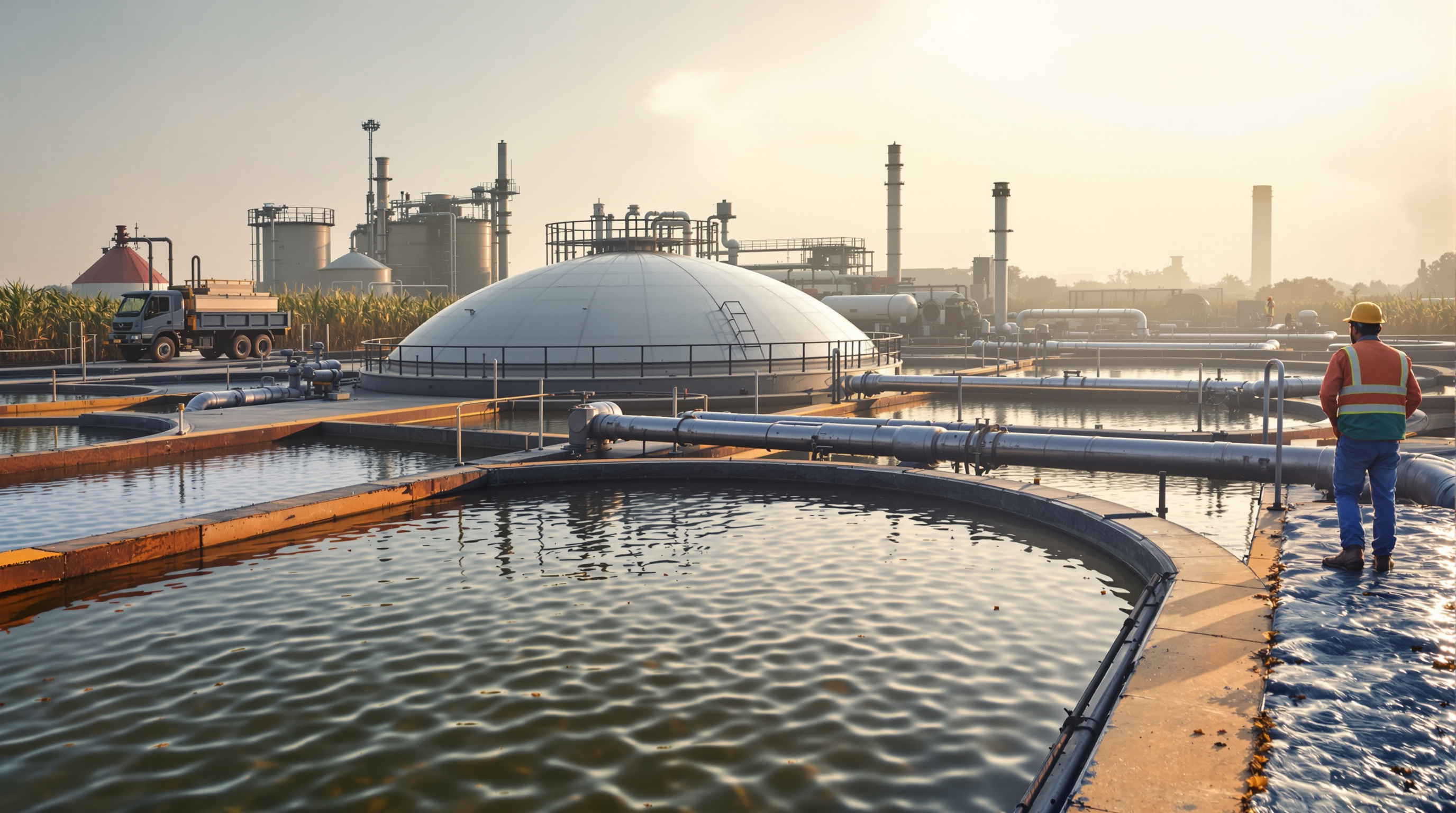
Sugar Factory Wastewater Treatment: ETP Design for High-BOD Mill Effluent
Why sugar-mill effluent is one of the highest-strength wastewaters in India, and how anaerobic biogas digestion, aerobic polishing and spray irrigation are combined to treat it — including how to survive the crushing-season load surge.
A sugar factory is, from a water engineer's point of view, a seasonal flood of high-strength organic wastewater. For four or five months of the year — the crushing campaign — cane pours in around the clock, and with it comes a torrent of effluent loaded with dissolved sugars, molasses residue and washings. Then the mill falls silent, the cane runs out, and the treatment plant sits nearly idle until the next season. Few industries stress an effluent system the way sugar does: enormous organic load, sharp seasonality, and a legacy of by-products — molasses, press-mud, and (if there is an attached distillery) spentwash — that each need their own answer.
This guide explains what makes sugar-factory wastewater so difficult, and how a well-designed treatment train — anaerobic digestion for biogas, aerobic polishing, and controlled land application — brings it under control. This is firmly industrial territory: a sugar mill needs an Effluent Treatment Plant (ETP), not a domestic STP. If the difference is new to you, read STPs vs ETPs first.
A sugar mill's raw effluent can carry a BOD ten to thirty times stronger than ordinary sewage — and deliver almost all of it inside a four-month window. The design problem is not just strength; it is strength concentrated in a season.
Where the wastewater comes from
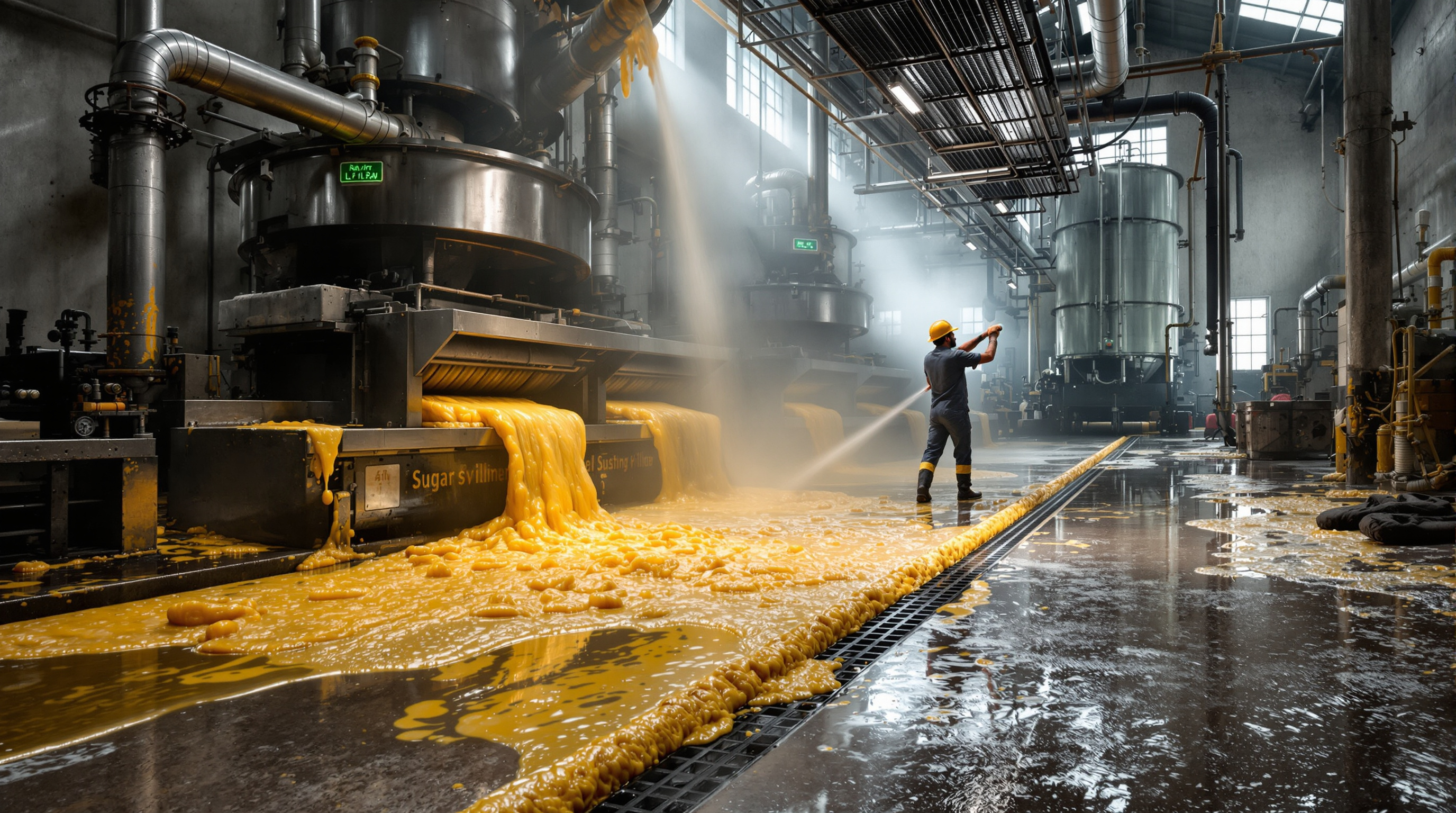
Not all sugar-factory water is equally dirty. Understanding the streams is the first step, because the cleanest ones can be segregated, cooled and recycled instead of being sent to treatment.
- Mill house and floor washings — spillage of cane juice and syrup, the highest-BOD process stream.
- Condenser and cooling water — large volume but lightly polluted; mainly a thermal (heat) problem, ideal for segregation and recirculation through a cooling tower.
- Boiler and spray-pond blowdown — moderate volume, salts and some suspended solids.
- Filter / press-mud washings and molasses spillage — small in volume, extreme in strength.
- Distillery spentwash — if a distillery is attached, this is a separate beast entirely: dark, acidic, with COD in the range of tens of thousands, and it deserves its own dedicated treatment rather than dilution into the sugar ETP.
The single most valuable design move is stream segregation: keep the large, clean cooling-water flow away from the small, filthy process streams. Mixing them just creates a huge volume of moderately dirty water that is expensive to treat. Recirculate the cooling water; concentrate treatment on the strong stuff.
Why it is so hard to treat
Sugar effluent's defining feature is its organic strength. Because it is essentially dissolved sugar and organic acids, it is highly biodegradable — which is good news for biological treatment — but the sheer load is punishing. Typical raw-effluent characteristics (combined, before segregation) look roughly like this:
| Parameter | Raw sugar-mill effluent (typical) | Domestic sewage (for comparison) |
|---|---|---|
| BOD | 1,000–3,000 mg/L | 250–350 mg/L |
| COD | 2,000–6,000 mg/L | 400–600 mg/L |
| TSS | 500–1,500 mg/L | 200–400 mg/L |
| pH | 4.5–7 (often acidic) | 6.5–8 |
| Temperature | 40–50 °C (condensers) | Ambient |
Treat these as directional planning figures, not guarantees — actual values swing with cane quality, housekeeping and how well streams are segregated. The parameters themselves are explained in Wastewater characteristics: BOD, COD, TSS, pH.
Three properties make sugar effluent tricky beyond the raw numbers:
- It is warm and acidic. Condenser water arrives hot; process streams can turn acidic as sugars ferment. Both must be corrected before biology can work.
- It goes septic fast. Left standing, dissolved sugar ferments within hours, dropping pH and generating foul odour. Effluent cannot be allowed to sit untreated.
- It is seasonal. The organic load that biology must handle appears and vanishes with the campaign, which makes stable biomass hard to maintain.
The treatment train
Because the effluent is strong but biodegradable, the workhorse strategy is anaerobic treatment first, aerobic polishing second — the same logic used across dairy, brewery and food-processing effluent, only at larger scale.
Stage 1 — Screening, cooling and equalisation
Coarse screens catch bagasse fibre and cane trash. Hot streams pass through a cooling arrangement to drop below about 38 °C so microbes are not cooked. Everything then collects in a large equalisation tank that buffers the flow and, crucially, blends the acidic slugs so pH and load reach the biology evenly. On a seasonal plant the equalisation tank is oversized deliberately — it is your shock absorber against campaign surges. Lime or caustic dosing here lifts pH into the neutral band the microbes need.
Stage 2 — Anaerobic digestion (and free biogas)
This is the heart of a sugar ETP. High-strength, warm, biodegradable effluent is exactly what anaerobic bacteria love. In an anaerobic reactor — most often a UASB (Upflow Anaerobic Sludge Blanket) or an anaerobic lagoon/digester — bacteria break down the organic load without oxygen and remove the bulk of the COD, typically 70–85%. Two things make this stage attractive:
- It needs no aeration energy for the heavy lifting, unlike an aerobic tank.
- It produces biogas — methane-rich gas that the mill can burn in the boiler, offsetting fuel. A high-load sugar effluent turns a treatment cost into an energy recovery.
Because so much load is destroyed here cheaply, anaerobic-first is almost always the right economic call for sugar. The trade-off is that anaerobic biomass is slow to grow and sensitive to pH and temperature swings — which is why Stage 1 buffering matters so much.
Stage 3 — Aerobic polishing
Anaerobic effluent is much weaker but still well above discharge limits. An aerobic stage — an extended-aeration activated sludge process, an MBBR, or aerated lagoons — finishes the job, using oxygen-fed microbes in an aeration tank to pull BOD down to compliance. A clarifier then settles the biomass, and the sludge is recirculated or wasted. For a seasonal plant, robust, forgiving technologies (aerated lagoons, MBBR) are often preferred over higher-maintenance options because the plant must restart cleanly every campaign.
Stage 4 — Final polishing and reuse
Filtration and, where needed, tertiary steps bring the water to reuse or discharge quality. Treated effluent is commonly used for spray/flood irrigation of the mill's own cane fields or nearby farmland — a genuinely useful outlet, since the treated water still carries nutrients cane can use. Land application must be controlled: apply only at agronomic rates, avoid waterlogging and monitor groundwater, so treatment does not simply move pollution into the soil.
Handling the by-products
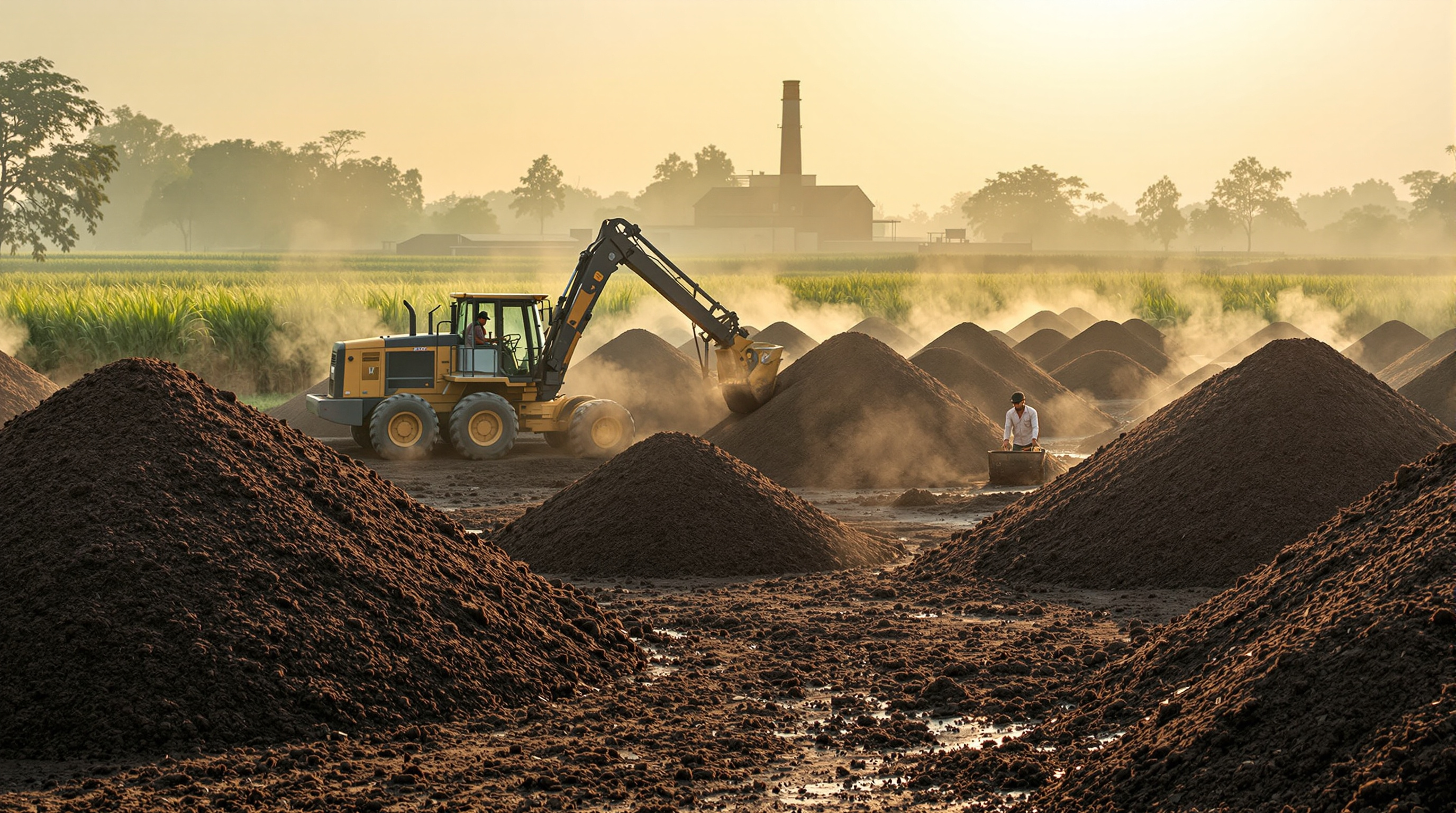
Sugar wastewater cannot be separated from its solids problem:
- Press-mud (filter cake) — the fibrous residue from juice clarification. It is not sent to the ETP; it is composted, often with distillery spentwash, into bio-compost and returned to the fields. A well-run mill treats press-mud as a product, not a waste.
- ETP sludge — the biomass wasted from the biological stages. Estimate it early with the sludge-generation approach so drying beds and disposal are sized correctly.
- Spentwash (distillery) — the hardest stream of all, usually routed to a dedicated concentration/incineration or bio-methanation train aiming at Zero Liquid Discharge (ZLD), which many SPCBs now expect of molasses-based distilleries.
Designing for the campaign season
The seasonality is the design theme that never goes away. A few principles:
- Size on peak campaign load, not the annual average. Averaging across the idle months will badly undersize the plant. Work from organic loading and hydraulic retention time at full crush.
- Keep the biology alive off-season. Anaerobic granules and aerobic biomass die without feed. Recirculation, minimal feeding or protected seed sludge helps the plant restart fast next campaign.
- Buffer generously. Oversized equalisation and anaerobic volumes absorb the daily and start-up surges that would otherwise wash out the biomass.
- Segregate and recycle water to shrink the volume the ETP must handle, cutting both capital and running cost.
Sizing an industrial plant like this starts, as always, from load — use the organic loading calculator to convert flow and COD into the kilograms of BOD per day your biology must digest.
The bottom line
Sugar-factory wastewater treatment is a problem of strength, seasonality and by-products, solved by playing to the effluent's own nature: it is filthy but biodegradable, so let anaerobic bacteria eat most of it for free (and hand you biogas), polish the rest aerobically, and put the nutrient-rich treated water back on the land. Segregate the clean streams, buffer hard against the campaign surge, keep the biomass alive between seasons, and treat press-mud and spentwash as the separate problems they are. Do that, and one of India's toughest effluents becomes a manageable — even resource-positive — part of running a mill.
To go deeper on the underlying processes, browse the Sewage Treatment Plants guide library, and to translate your crushing-season flow into a design load, start with the organic loading calculator.
Export this guide
Related Guides — Deep-dive reading
Upflow Anaerobic Sludge Blanket (UASB): Anaerobic Sewage Treatment Explained
The no-oxygen reactor where sewage flows up through a blanket of granular sludge, destroying pollution while producing biogas and using almost no energy — how the sludge blanket and gas-solid separator work, why Indian municipal STPs favour it, and why it always needs an aerobic polishing step.
Sewage Treatment PlantsSludge Generation Estimation in STPs: How Much Sludge Will Your Plant Produce?
Every STP that cleans water also makes sludge — and the biosolids you forget to plan for become the operating headache you cannot ignore. Here is how to estimate sludge generation, understand the yield concept, and size dewatering before you build.
Sewage Treatment PlantsFood Processing Industry Wastewater Treatment: A Practical Engineering Guide
Why food and beverage effluent is so hard to treat — its punishing organic load, seasonal batch flows, fats and solids — and how a well-designed ETP tames it with screening, DAF, anaerobic and aerobic biology, and water reuse.
Sewage Treatment PlantsRelated Tools — Try Free
Hydraulic Retention Time (HRT) Calculator
Compute a reactor or tank's hydraulic retention time from its volume and daily flow, and benchmark it against recommended ASP, MBBR and SBR ranges.
STP CalculatorIndustrial Wastewater Treatment Planner
Pick your dominant industrial wastewater and daily flow to see whether you need an STP or ETP, a 1–5 treatment complexity rating, and how rough capex scales.
PlannerPopulation Equivalent (PE) Calculator
Convert an organic pollution load into Population Equivalent from flow and BOD concentration — the BOD load in kg/day and equivalent number of people.
STP Calculator