
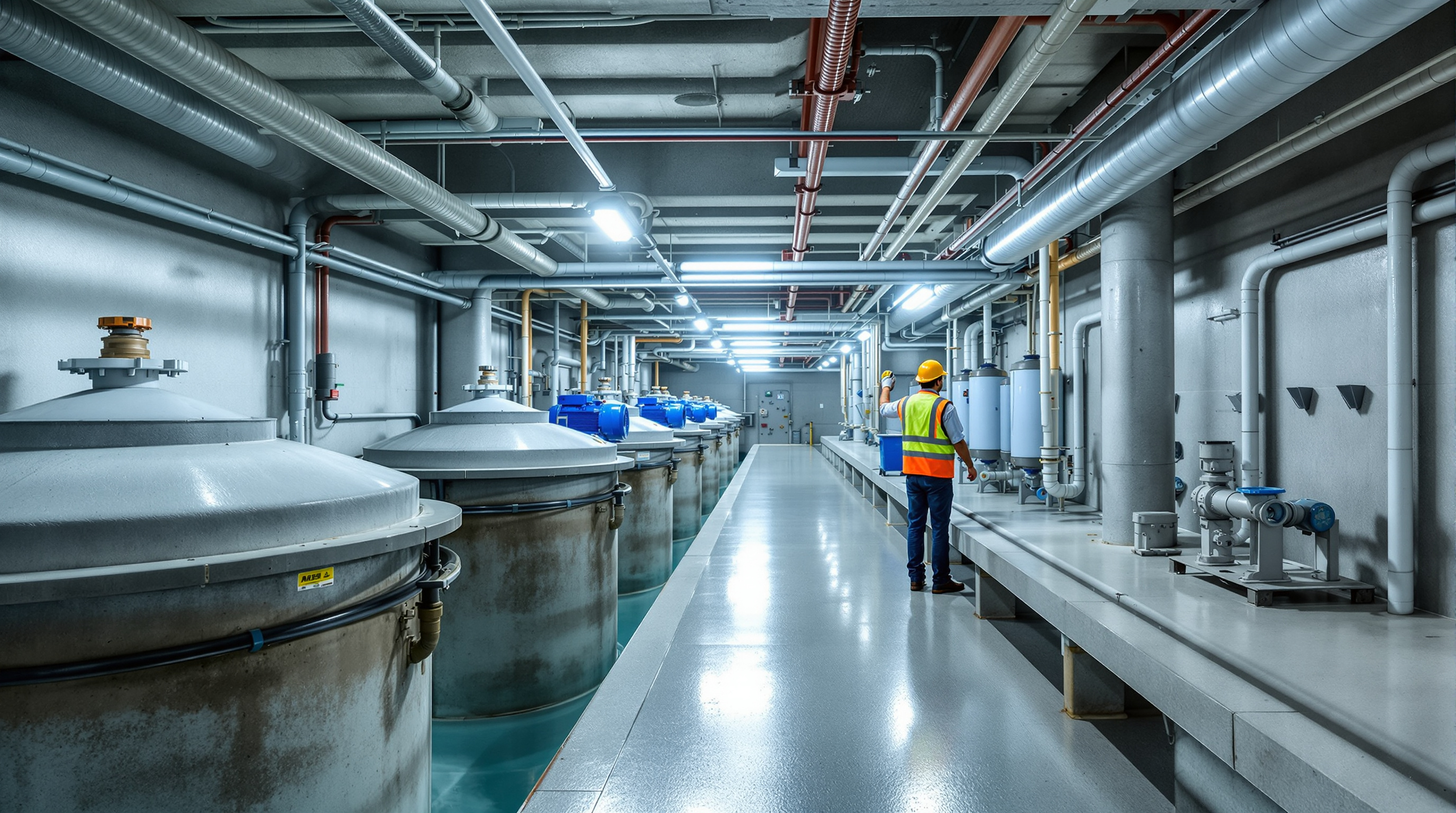
STP Layout Planning: Arranging Tanks, Plant Room and Pipe Runs the Right Way
How to lay out an STP so sewage flows downhill by gravity, every tank can be reached for maintenance, and the plant can grow later — compared against real compact and linear arrangements used in Indian buildings.
Two STPs can use the exact same technology, treat the exact same volume of sewage, and cost wildly different amounts to run — because one was laid out well and the other was squeezed into whatever corner of the basement was left over after the car park was drawn. Layout is the part of STP design that gets the least attention and causes the most regret. A cramped, badly-arranged plant fights the operator every day: pumps that should never have been needed, tanks that cannot be desludged, filters that cannot be lifted out. A good layout, by contrast, is almost invisible — it just quietly works, year after year, on gravity and common sense.
This guide is about STP layout planning: how to arrange the tanks, the plant room and the pipe runs so the plant flows through efficiently, stays accessible for maintenance, and leaves room to grow. It assumes you already know roughly what an STP is and how big yours needs to be — if not, start with what an STP is and the STP Capacity Calculator, because you cannot lay out a plant whose capacity you have not fixed.
Design the layout around the flow of water, not the shape of the leftover space. Water should enter high, fall through every stage by gravity, and be lifted only once. Every extra lift is a pump you will pay for, forever.
The one principle that governs everything: flow-through by gravity
Trace a drop of sewage from the moment it arrives to the moment it leaves as clean water. That path — screen, oil trap, equalisation, aeration, clarifier, filters, disinfection, treated-water tank — is the sewage treatment process flow, and it should ideally run downhill the entire way. Each tank's outlet sits a little lower than the last one's, so water spills forward on its own.
The single unavoidable lift is at the equalisation tank: raw sewage collects at the lowest point (it arrives by gravity from the building drains), and from there it is pumped up to the highest process tank. After that one lift, everything cascades. A layout that respects this needs one set of pumps; a layout drawn without it ends up pumping between every stage, tripling the energy bill. Getting this right is the biggest single lever on STP electricity consumption.
Practical consequences for the plan:
- Order the tanks in process sequence, physically. The clarifier should sit next to the aeration tank it draws from, not across the room. Adjacent stages mean short pipes, fewer bends, less head loss.
- Set tank top-water levels in a descending staircase. Fix the hydraulic profile first, then lay out in plan. Many drawings get the plan right and the levels wrong.
- Keep the return-sludge path short. Sludge is pumped from the clarifier back to aeration constantly — if those two tanks are far apart, that pump works harder every second of every day.
Maintenance access: the thing everyone forgets
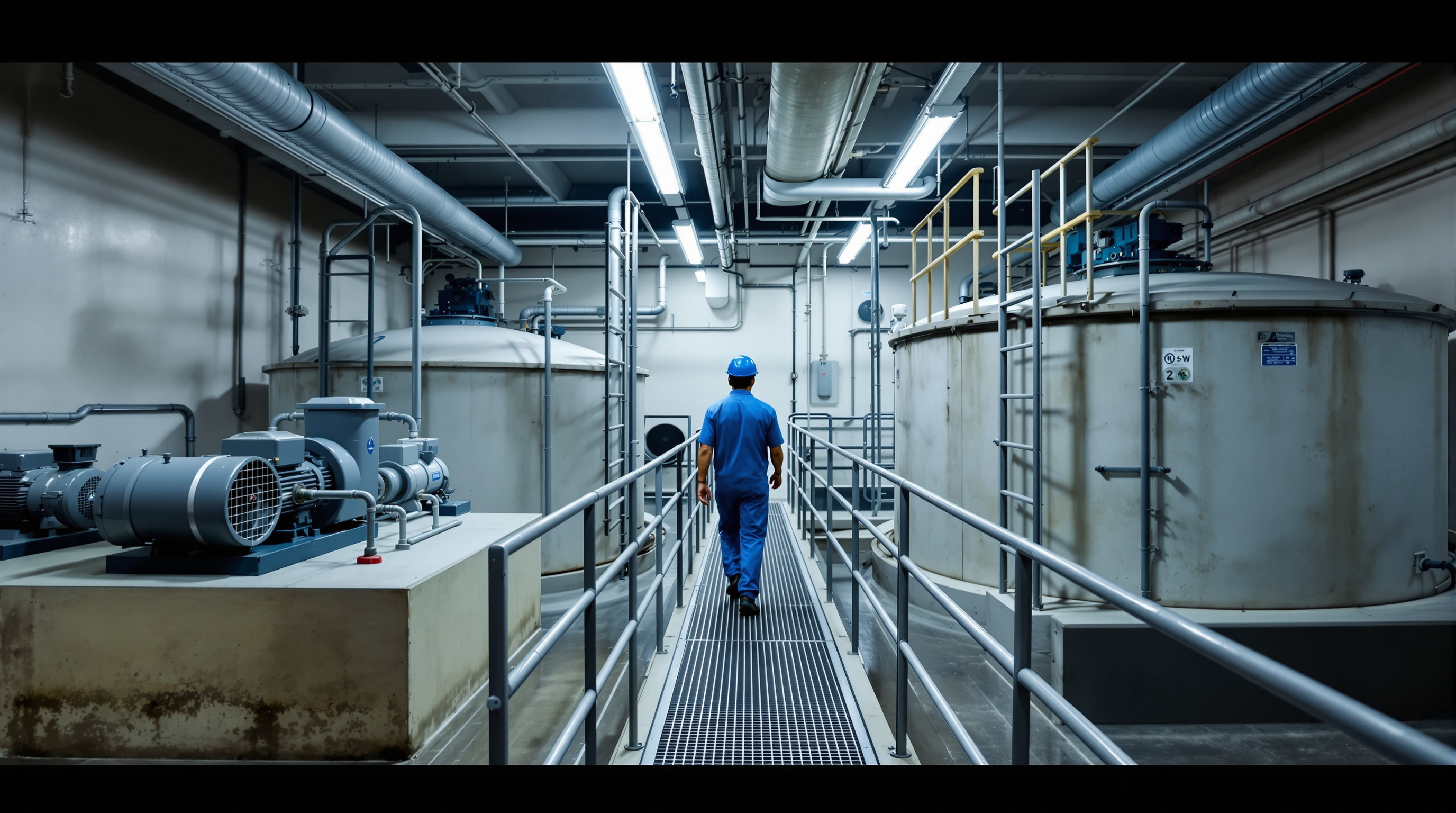
An STP is not a monument; it is a workshop that runs 24×7 and needs a person in it every day. The commonest layout failure in Indian basements is tanks and equipment packed wall-to-wall with no room to actually service them.
Build these clearances into the layout from the start:
- Walk-around access. Leave a clear walkway — treat roughly a metre as a working minimum — along at least one side of every tank so an operator can reach valves, weirs and level sensors.
- Equipment removal space. Blowers, feed pumps, filter-press and the UF membrane modules all wear out and must come out whole. Plan a clear pull-out path and a lifting arrangement above the heavy items. A pump you cannot lift out is a pump you cannot repair.
- Desludging and de-scumming. Every tank needs a way to be emptied and cleaned. Position drain valves and provide tanker-hose access to the equalisation and sludge tanks.
- Plant-room breathing room. The blowers, pumps and instrumentation and the control panel belong in a dedicated, ventilated, reasonably dry plant room — not perched on a tank slab where splash and humidity kill electricals early.
- Safe entry. Deep underground tanks are confined spaces. Provide proper covers, fixed ladders and ventilation so cleaning does not become a rescue operation.
If the plant is going underground — as most urban Indian STPs now do — access planning gets harder and more important; weigh it early with the underground vs above-ground STP comparator and the deeper trade-offs in underground vs above-ground STPs.
Compact vs linear: two ways to arrange the same plant
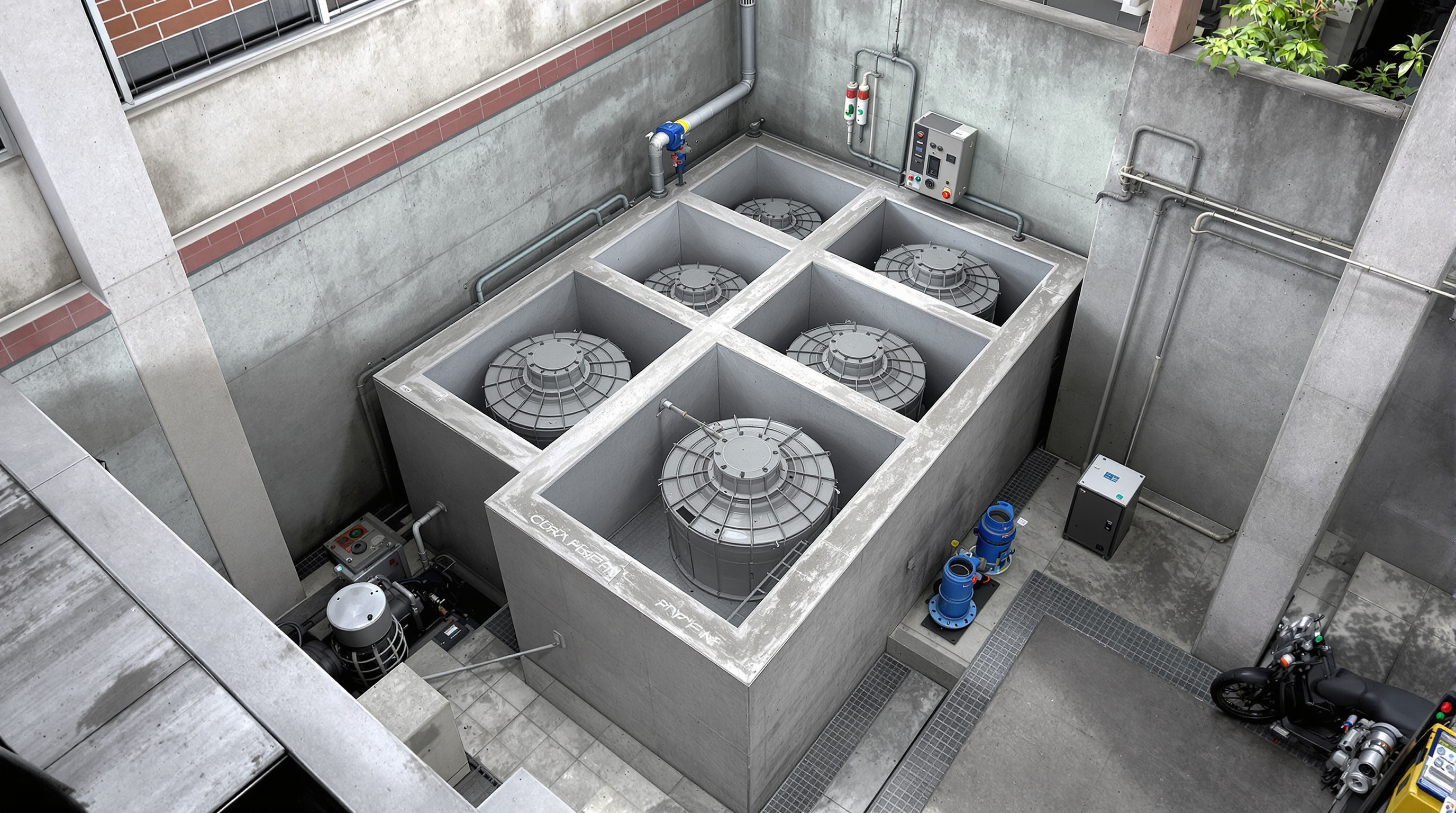
Given the same tanks, you can pack them into a tight block or string them out in a line. The choice is usually forced by the shape of the available land, but each arrangement has real consequences.
| Factor | Compact (clustered) layout | Linear (in-line) layout |
|---|---|---|
| Footprint | Smallest plan area; tanks share common walls | Longer, narrower; needs a strip of land |
| Pipe runs | Very short between stages | Longer runs, more head loss |
| Maintenance access | Tight — access must be deliberately protected | Naturally good; every tank has an open side |
| Flow-through | Needs careful level design to cascade in a small area | Follows the flow path intuitively, stage by stage |
| Expansion | Hard — surrounded on all sides | Easy — extend the line at the outlet end |
| Best suited to | Basements, small plots, packaged/MBR plants | Independent plots, larger capacities, phased builds |
A compact layout — often a single reinforced-concrete block with shared internal walls, the norm for a packaged plant in an apartment basement — wins on footprint and pipe length but must design in the access it does not get for free. A linear layout spreads the same stages along a walkway; it costs land but repays it with easy access and, crucially, easy expansion.
Technology choice interacts with this. Space-efficient processes like MBBR and MBR suit compact blocks; a conventional activated sludge or SBR plant is bulkier and often laid out more linearly.
Planning for the plant you don't need yet
Buildings fill up in phases, and occupancy rises over years. An STP sized for full design load runs badly under-loaded on day one, so many projects build in stages — and a layout that ignored expansion makes that impossible.
- Leave the expansion bay. If the plant will grow, reserve the adjacent space now and detail how the second module ties in — ideally at the outlet end so new tanks extend the flow line without re-plumbing the existing plant.
- Size the shared elements for the future, the process tanks for today. The inlet chamber, screen channel and equalisation tank are cheap to build large once and painful to enlarge later; biological and filter trains can be added in modules.
- Provide isolation valves and blanked tees on the main headers so a future module can be cut in without shutting the running plant down.
A sensible layout checklist
Before freezing an STP layout, walk the drawing against these questions:
- Does water flow from inlet to outlet by gravity, with only one lift after equalisation?
- Are the tanks in process order, with the clarifier beside the aeration tank and a short return-sludge path?
- Can an operator walk around every tank and lift out every pump, blower and membrane module?
- Is the plant room dry, ventilated and separate from the wet tanks?
- Are deep tanks treated as confined spaces, with covers, ladders and ventilation?
- Is odour contained near the inlet and away from occupied areas, and are noisy blowers acoustically boxed?
- Is there a reserved bay and tie-in detail for the next phase?
Get those seven right and the arrangement will serve the building for decades. To place the plant well on the site in the first place, pair this with STP site selection; to get the pipes themselves right, see STP pipe sizing; and to browse the full library, return to the Sewage Treatment Plants hub.
Export this guide
Related Guides — Deep-dive reading
STP for High-Rise Buildings: Solving the Vertical Challenges
Why an STP in a tower is a different animal from one in a low-rise block — sharp peak flows, a basement site starved of air and light, treated water that has to be pumped forty floors up, and odour and fire clearances that decide whether the plant gets signed off at all.
Sewage Treatment PlantsAnnual STP Maintenance & Overhaul: The Complete Yearly Shutdown Checklist
Once a year your STP needs a full stop, a drain-down, and an honest look at everything the daily rounds never reach — tanks, blowers, membranes, instruments, concrete and the AMC. Here is the complete annual overhaul, in the right order.
Sewage Treatment PlantsThe Sewage Treatment Process Flow, Explained: Every Stage From Inlet to Reuse
Follow a drop of sewage through a typical STP — inlet, screening, aeration, clarifier, filtration, disinfection and reuse — as one connected flow, with a block diagram and a unit-by-unit table, in plain language.
Sewage Treatment PlantsRelated Tools — Try Free
Rainwater Tank Sizer
How big should your rainwater tank be? Computes annual harvest, recommended tank capacity in litres, water-bill savings, and payback — for 10 Indian cities.
RWH CalculatorAcoustic Privacy (STC) Visualizer
Indian healthcare acoustic visualizer — compare wall assemblies and noise sources, see received SPL after STC attenuation, and check FGI 2018 / IS 1950 / NABH speech-privacy compliance with live dual-canvas waveform.
Acoustic ToolUnderground vs Above-Ground STP Comparator
Weight seven site factors — space, cost, maintenance, odour, aesthetics, ventilation and flood safety — to get an instant recommendation on whether to build your sewage treatment plant underground or above grade.
Comparator