
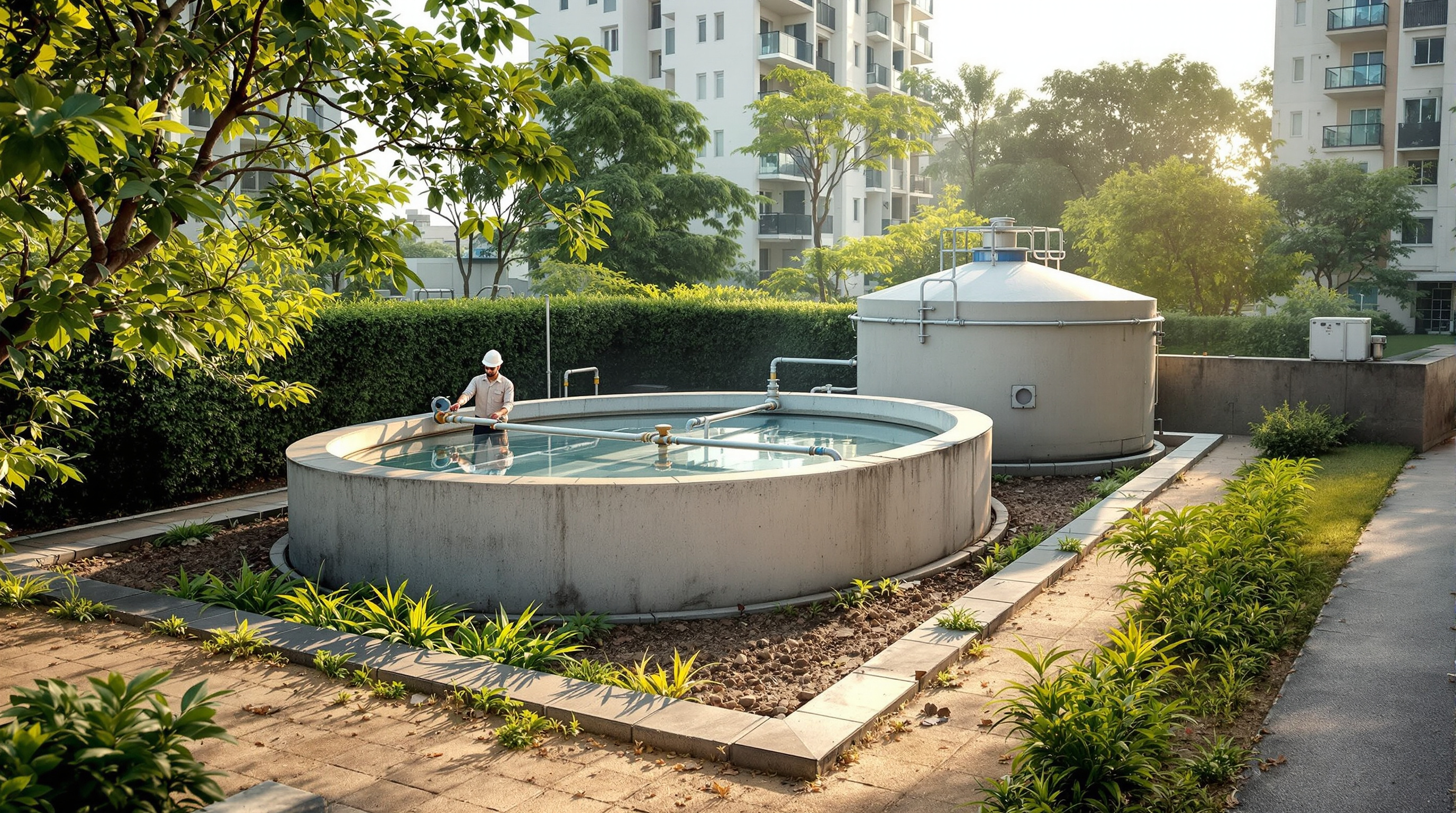
STP Site Selection Guidelines: How to Choose the Right Location for a Sewage Treatment Plant
Where you put an STP decides how well it runs for the next twenty years. This guide walks through the seven factors that make or break a location — habitation distance, access, ventilation, groundwater, drainage, expandability and byelaw setbacks — for Indian sites.
Every other decision about a sewage treatment plant — the technology, the tank sizes, the pumps, the pipework — can be revised on paper before construction. Where the plant sits cannot. Once the excavation is dug and the tanks are cast, the location is permanent, and a badly placed STP haunts a building for its entire life: complaints about smell, tankers that cannot reach the sludge beds, effluent that will not drain, and no room to expand when occupancy grows. Good stp site selection is therefore one of the highest-leverage decisions in the whole project, and it is made early — usually at the master-planning stage, alongside parking and the water tanks.
This guide sets out the seven factors that decide a good location, in the order a designer should weigh them, for Indian sites governed by CPCB norms and local development-authority byelaws.
An STP placed for the convenience of the drawing is punished every day it operates. An STP placed for the convenience of the operator, the neighbours and the drainage runs quietly for twenty years. Site it for the operating life, not for the plan.
Start with the non-negotiables: byelaw setbacks
Before any judgement about the "best" spot, find out where you are not allowed to build. Most municipal and development-authority byelaws in India prescribe minimum setbacks for an STP from the plot boundary, from habitable buildings, and from any water source such as a well or borewell. These vary by city and by plant capacity, so the first step is always to pull the specific development-control regulations for your jurisdiction rather than assume a number.
As a working orientation only — confirm against your local rules — designers commonly plan for:
- A buffer between the STP and the nearest habitable room or window, so that odour and noise do not reach living spaces.
- A minimum distance from any drinking-water well or borewell, protecting groundwater from contamination.
- A setback from the plot boundary, so the plant and its access do not encroach on the neighbour.
These setbacks are hard constraints. Sketch them onto the site plan as no-go zones first; what remains is your actual search area. Trying to argue a plant into a non-compliant location almost always fails at the sanction stage and forces an expensive redesign.
Factor 1 — Distance from habitation
The single most common complaint against an STP is smell drifting into homes. Distance is the cheapest defence. Place the plant as far from bedrooms, balconies, dining areas and children's play zones as the plot allows, and downwind of the prevailing breeze where you can establish the wind direction. A well-run plant with proper odour control should not stink — but process upsets happen, blowers trip, and a plant that is close to habitation converts every minor upset into a resident WhatsApp storm.
Corners of the plot, service yards, and zones already dedicated to utilities and parking are natural homes for an STP. Avoid siting it under or immediately beside a clubhouse, gym, or any amenity where people gather and linger.
Factor 2 — Access for operation and desludging
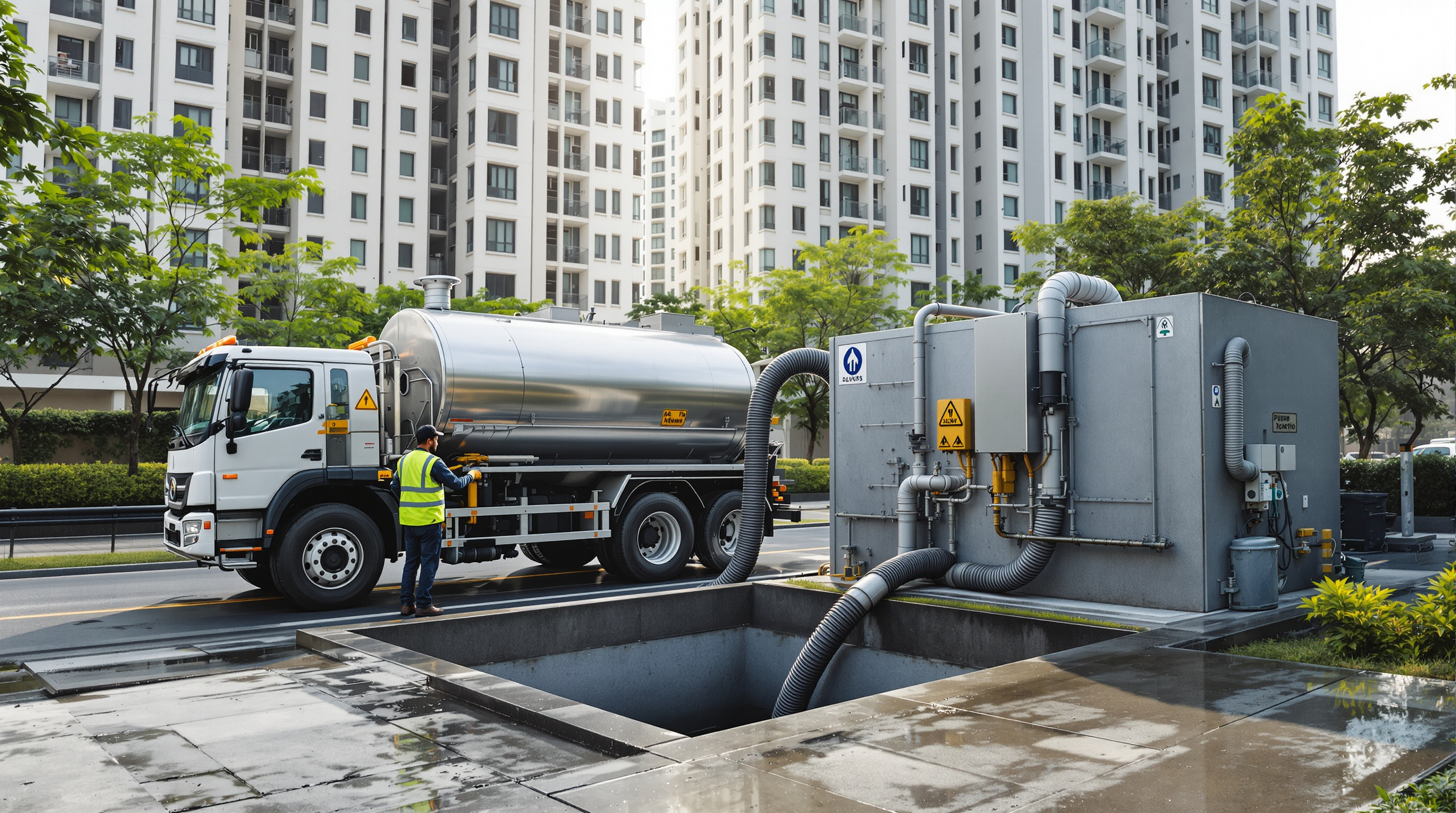
An STP is not a set-and-forget box. It needs an operator daily, chemical deliveries periodically, and — critically — a desludging tanker every few months to pump out accumulated sludge. If a suction tanker cannot physically reach the plant, sludge removal becomes a manual nightmare and the plant will be neglected.
Check that:
- A tanker can drive to within hose reach of the sludge sump or drying beds.
- There is room to lower and lift pumps, blowers and other equipment for maintenance and eventual replacement.
- Equipment routes exist for the biggest single component — an MBBR media load or an MBR membrane module — not just a person.
Factor 3 — Ventilation
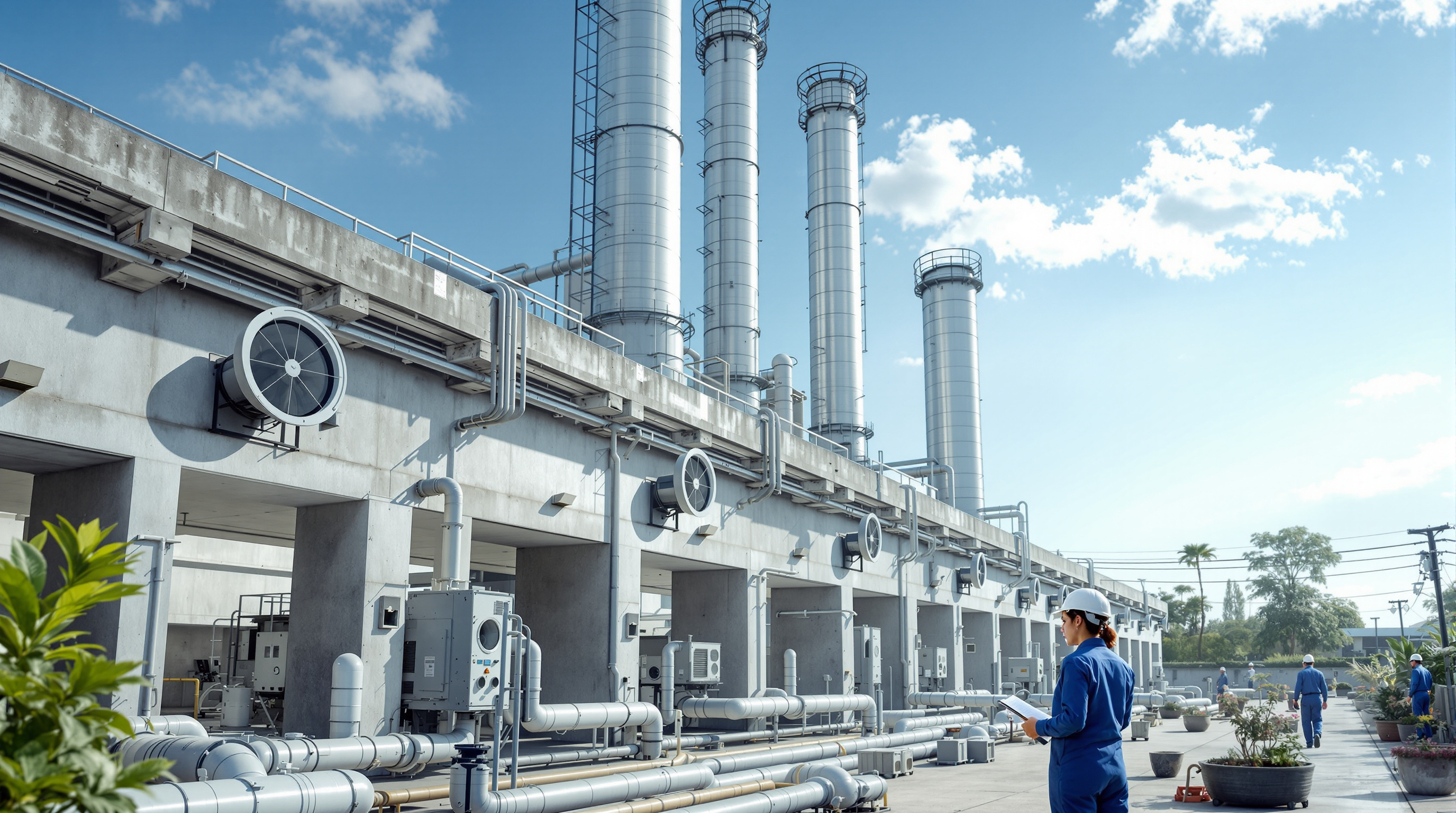
Biological treatment is an aerobic process, and the plant breathes. Aeration tanks release humid, sometimes odorous air; sludge zones generate gas. A location with natural cross-ventilation disperses this; a sealed, cramped basement corner concentrates it and accelerates corrosion of electricals and steelwork.
This is where the underground-versus-above-ground question becomes a siting question, not just a cost one. An above-ground plant ventilates itself for free. An underground or basement plant must be given engineered ventilation — supply and exhaust fans, ducted stacks that carry foul air well above occupied levels, and generous headroom. If the only available site is below grade, budget for that ventilation from the start and weigh the trade-off with the underground vs above-ground comparison and the underground vs above-ground STPs guide.
Factor 4 — Groundwater and soil
Two groundwater issues govern the choice:
- Contamination risk. Tanks placed near a well or in a high water-table zone risk leaking raw sewage into the aquifer. Keep the required distance from any water source, and specify watertight, well-detailed tank construction.
- Buoyancy and construction. In a high water table, an empty underground tank can literally float — uplift is a real failure mode — and excavation needs continuous dewatering. A high water table pushes the decision toward an above-ground plant or demands anti-flotation design.
A quick geotechnical and water-table check at candidate locations, early, saves a great deal of grief.
Factor 5 — Drainage and gravity
Sewage flows downhill for free; pumping it costs money and adds a failure point. The ideal site sits at a low point relative to the building's sewer outfalls, so raw sewage arrives by gravity into the inlet chamber. Equally, the treated-water outfall — to the reuse tank, the storm drain, or the recharge point — should be able to drain away without a second lift pump wherever possible.
Map the invert levels before fixing the location. A plant placed at a natural low point simplifies the whole hydraulic design covered in STP layout planning and keeps the pumping and instrumentation — and the energy bill — to a minimum.
Factor 6 — Room to expand
Occupancy grows, and norms tighten. A plant sized exactly for today, boxed in on all four sides, cannot be enlarged without demolition. Reserve a modest expansion footprint beside the plant, or design the civil works so a future module can be bolted on. This is far cheaper as a line on a plan today than as a retrofit in five years.
Weighing it up: the location trade-off
No plot offers a perfect spot; site selection is the art of the least-bad compromise. The table below shows how the common candidate locations score against the factors that matter.
| Candidate location | Habitation distance | Ventilation | Gravity drainage | Expandability | Typical verdict |
|---|---|---|---|---|---|
| Plot corner / service yard (above ground) | Good — far from homes | Excellent — natural air | Depends on levels | Good if space reserved | Usually the best choice |
| Basement below building | Poor — under occupants | Poor — needs forced ventilation | Often good (low point) | Very limited | Only if no surface land exists |
| Below driveway / lawn (underground) | Good — buffered by cover | Moderate — engineered venting | Good — naturally low | Limited | Workable with proper detailing |
| Beside amenity / clubhouse | Poor — people gather nearby | Varies | Varies | Varies | Avoid |
Bringing it together
Good STP site selection is a sequence, not a single guess: strike out the byelaw no-go zones first, then push the plant as far from habitation as the plot allows, at a natural low point, with tanker access, real ventilation, safe distance from groundwater, and a reserved corner to grow into. Get those in place and the plant almost sites itself — usually a ventilated, above-ground corner of the service zone, downwind of the homes.
From here, size the plant that has to fit the site with the STP Capacity Calculator and the how to size an STP guide, match the technology to the space you have using the STP Technology Selector, and browse the full Sewage Treatment Plants guide library for the design decisions that follow.
Export this guide
Related Guides — Deep-dive reading
STP Layout Planning: Arranging Tanks, Plant Room and Pipe Runs the Right Way
How to lay out an STP so sewage flows downhill by gravity, every tank can be reached for maintenance, and the plant can grow later — compared against real compact and linear arrangements used in Indian buildings.
Sewage Treatment PlantsUnderground vs Above-Ground STPs: The Complete Comparison Guide
Space, cost, maintenance, odour, aesthetics, ventilation and flood risk — a plain, honest comparison of underground and above-ground sewage treatment plants, and how to choose the right one for your Indian project.
Sewage Treatment PlantsUnderground STP Cost: The Premium Explained (India 2026 Guide)
Building a sewage treatment plant below ground buys you a silent basement and a free courtyard — but it costs more. Here is exactly where the money goes in excavation, waterproofing, structure and ventilation, in realistic 2026 Indian ranges, and when that premium is worth paying.
Sewage Treatment PlantsRelated Tools — Try Free
Cross-Ventilation Analyzer
Estimate airflow and air changes per hour (ACH) from room size, window areas, layout, and local wind — with NBC 2016 Part 8 compliance check.
Ventilation CalculatorUnderground vs Above-Ground STP Comparator
Weight seven site factors — space, cost, maintenance, odour, aesthetics, ventilation and flood safety — to get an instant recommendation on whether to build your sewage treatment plant underground or above grade.
ComparatorLandscape Cost Calculator
Estimate a garden's cost — hardscape, softscape, lawn, irrigation, lighting and annual upkeep — by area, tier and city.
Budget Calculator