

STP for Luxury Villas: Discreet, High-Reuse Systems That Stay Invisible
How to treat wastewater in a high-end villa without the smell, the noise or the eyesore — underground MBR systems, automation and reuse-grade water for landscaping, water features and pool top-up.
A luxury villa sells a feeling: quiet, clean air, manicured lawns, a fountain that catches the evening light, a pool that never seems to run low. Nothing about that experience should ever remind the owner that the house also produces sewage. Yet every villa does — bathrooms, kitchens, a service block, guest suites — and by law and by good sense that wastewater has to be treated on the plot. The engineering challenge in a premium home is therefore unusual: the sewage treatment plant must do a demanding job while being effectively invisible, inaudible and odourless, and it must produce water good enough to circulate through the very features that define the property.
This guide is about getting that balance right. If you are new to the technology itself, start with what an STP is and how an STP works; here we assume the basics and focus on what makes the stp for luxury villas a distinct design problem.
In a luxury villa the STP is not judged on how well it treats water alone — it is judged on whether anyone ever notices it exists. Odour, noise or a visible tank in the wrong place will be read as a defect in a crore-plus home, no matter how clean the effluent.
The wastewater profile of a luxury villa
A villa is not a small apartment. Its flow pattern and load have their own signature, and the design has to respect it.
- Low but spiky flow. A single household — even a large one with staff and guests — generates far less sewage than an apartment block, but it arrives in sharp bursts: morning bathrooms, a dinner party, a weekend full of guests, then long quiet stretches when the family travels. A plant sized for the peak will sit half-starved most of the week.
- Long idle periods. Second homes and farmhouse-style villas may be empty for days. Biological treatment depends on a living microbe culture that needs feeding; starvation during vacancy is one of the biggest technical risks, and one apartment or hotel plants rarely face.
- Strong kitchen load. Premium villas cook a lot, often with a service kitchen. That means high oils, grease and organic strength (BOD) unless the grease trap is generously sized.
- Landscape and pool chemistry. Backwash from pool filters and softener regeneration can find its way into the drainage and shock the biology with chlorine or salt if the plumbing is not separated.
If you want to put numbers to this, the water consumption calculator and the sewage generation calculator will convert your bedroom count and occupancy into realistic litres-per-day figures before you size anything.
Why MBR is usually the right technology
The two constraints that dominate a villa — smallest possible footprint and highest possible water quality — point strongly to one technology: the Membrane Bioreactor (MBR). It combines biological treatment and membrane filtration in a single compact tank, doing away with the large secondary clarifier that older processes need.
Here is how the main options compare for this specific use case:
| Technology | Footprint | Effluent quality | Fit for a luxury villa |
|---|---|---|---|
| MBR | Smallest | Excellent — clear, near-turbidity-free | Best choice: fits underground, water good enough for features & pool top-up |
| MBBR | Compact | Good, tolerant of load swings | Solid alternative where budget is tighter and reuse is only irrigation |
| SBR | Moderate | Very good | Handles intermittent flow well, but batch cycles and tank depth suit larger plots |
| ASP | Largest | Good | Rarely justified — too big and too visible for a single villa |
MBR's membrane barrier produces water so consistently clear that it is the natural feed for water features and pool top-up, where any cloudiness would be immediately obvious. Its tight footprint is what makes a fully underground, buried installation practical, and its enclosed nature makes odour control far easier. The trade-offs — higher capital cost, membranes that need periodic cleaning, and a plant that dislikes being starved — are all manageable in a well-run villa, and the premium is small relative to the overall build. For the broader comparison of technologies, the guide on how an STP works and the treatment process flow walk through each stage.
Making it discreet: underground, odourless, silent
This is where villa STP design earns its fee. Three problems have to be solved together.
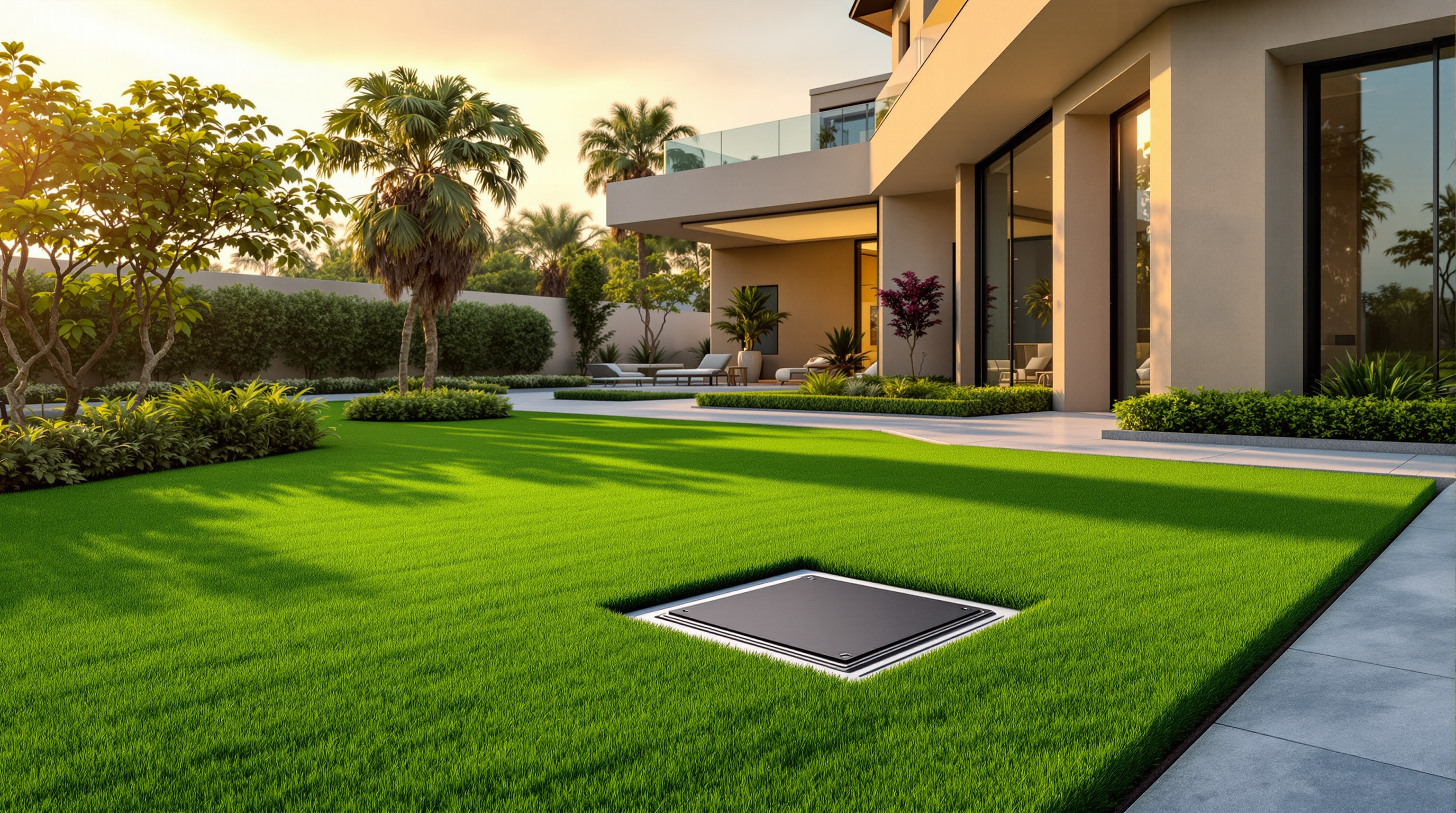
Hide it. The whole plant — tanks, blowers, controls — is typically installed underground, beneath a driveway, a lawn or a landscaped corner, with only flush access covers at grade. A compact packaged MBR unit makes this feasible where a sprawling conventional plant would not. Plan the location early with the landscape architect; retrofitting a buried tank under a finished garden is painful.
Kill the smell. Odour is the single complaint that will get an owner to condemn a plant. The defences are: a well-sized, regularly cleaned grease trap; keeping the biology healthy and aerated (a well-oxygenated plant does not stink); sealed tank covers; and an activated-carbon or bio-filter on the vent so the little air that escapes is scrubbed. A properly run MBR is essentially odourless at the surface.
Silence it. The blower and pumps are the noise source. House them in an acoustically lined underground chamber, choose low-noise blowers, and mount everything on anti-vibration pads. Nobody dining on the terrace should hear a hum from the lawn.
Automation: a plant that runs itself
A villa does not have a full-time STP operator the way an apartment complex or hotel does. The plant therefore has to be near-autonomous. Good practice includes PLC-based automatic operation, level sensors that modulate the blower so the biology is not over- or under-aerated during idle periods, automatic dosing of chlorine or a UV lamp for disinfection, and remote monitoring with SMS or app alerts so the AMC vendor sees a fault before the owner smells one. Automation is also the practical answer to the long-vacancy problem: a recirculation and minimum-aeration mode keeps the microbes alive while the family is away.
Sizing: build for reality, not the brochure peak
Villa plants are easy to oversize, and an oversized biological plant treats poorly because there is not enough food to sustain the culture. Work from honest occupancy — permanent residents plus realistic guest and staff loads — not the theoretical maximum of every bedroom filled every night.
- Estimate sewage at roughly 80–85% of freshwater consumption, using the calculators above rather than a rule of thumb.
- Add a modest buffer for entertaining, but resist the urge to double it — use the STP capacity calculator to land on a defensible KLD figure.
- Provide a generous equalisation tank so the morning and dinner-party spikes are smoothed into a steady feed — this matters more in a villa than almost anywhere else because the peaks are so sharp.
- Specify the plant for the reuse quality you actually need (pool top-up and water features demand the highest grade; irrigation is more forgiving).
Where the clean water goes: the high-reuse payoff
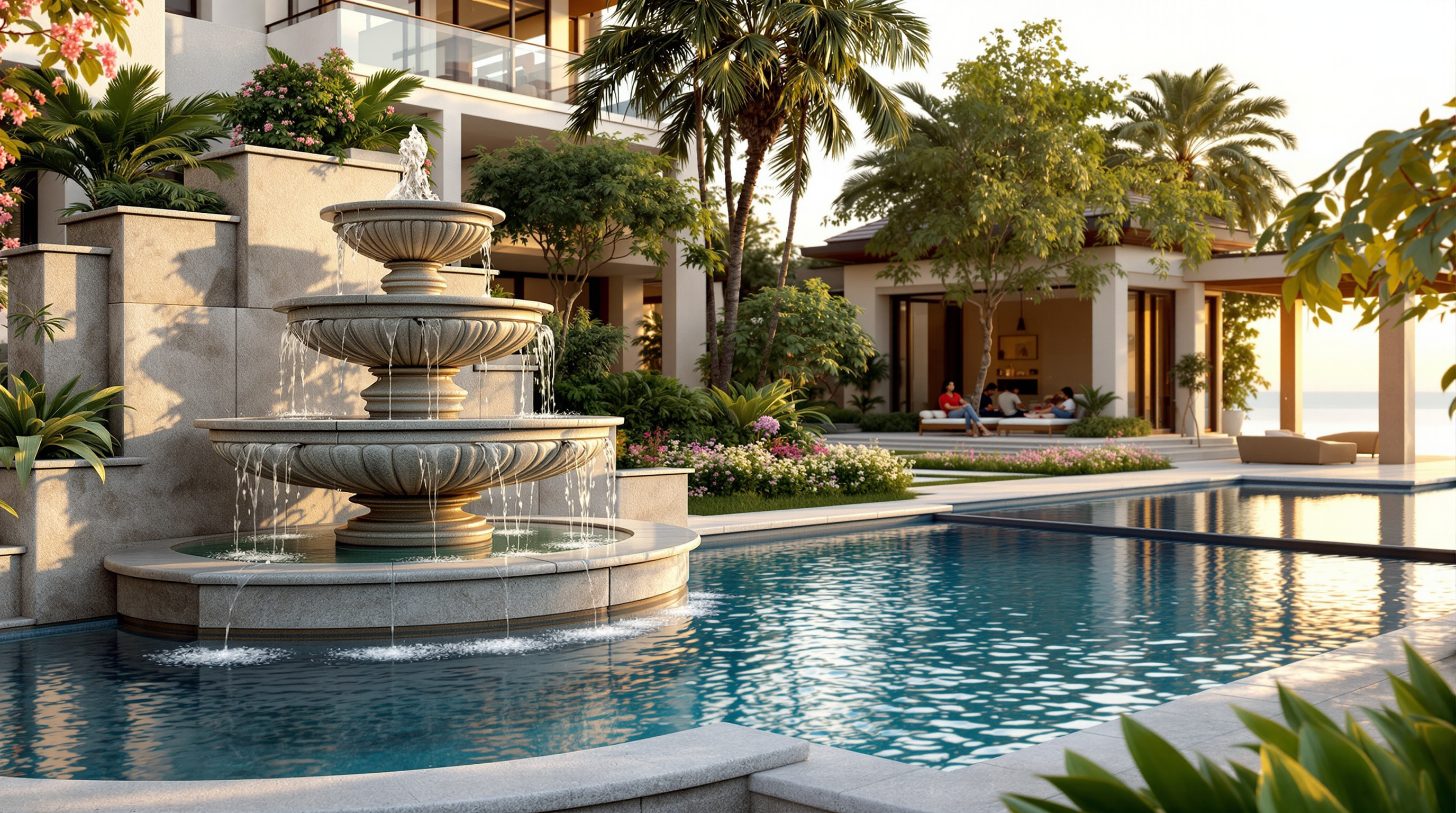
The reward for all this effort is water — a lot of it — reclaimed inside the property line. In a well-designed villa the MBR effluent, polished and disinfected, is reused for:
- Landscape irrigation — lawns, hedges and ornamental beds, the single largest demand in most villas.
- Water features — fountains, cascades and reflecting pools, where MBR-grade clarity is essential.
- Swimming pool top-up — making up evaporation losses (as top-up feeding the balancing tank, not as a substitute for proper pool sanitation).
- Toilet flushing via a separate dual-plumbing line.
- Washing of driveways, cars and common areas, and groundwater recharge of the surplus.
For homes that want to push recovery even further, pair the STP with greywater recycling and rooftop water-recycling integration so bathing and rainwater are captured too. In a large villa this can mean tens of thousands of litres a month that never have to arrive by tanker.
Compliance, and the common mistakes
Directionally, on-site treatment is expected under CPCB direction and NBC-aligned local by-laws for developments of any significant size, and the treated water must meet the applicable discharge and reuse standards. Where a single villa sits below a mandated threshold, a plant is still the right call — because the reuse economics and the water-scarcity reality make it worthwhile regardless. If your villa is part of a cluster, the guides on gated communities and housing layouts cover shared-plant options; for the standalone case see the companion guide on STP for villas and, for weekend homes, STP for farmhouses.
The mistakes that spoil premium villa projects are predictable:
- Locating the plant as an afterthought — buried under a finished garden or, worse, left above ground beside the boundary wall in full view.
- Undersizing the grease trap — guaranteeing odour and clogging from a cooking-heavy household.
- Ignoring the vacancy problem — no idle mode, so the biology dies during travel and the plant reeks on the family's return.
- No acoustic treatment on the blower chamber.
- No AMC and no automation — a sophisticated MBR left to a gardener will fail; budget for a proper annual maintenance contract from day one.
Get those right and the STP disappears exactly as it should. To go deeper on the technology and the numbers, browse the sewage treatment plants guide library and run your villa's figures through the STP capacity calculator — the litres-per-day it returns is where every good villa design begins.
Export this guide
Related Guides — Deep-dive reading
STP for Hotels: High Per-Guest Loads, FOG & Water Reuse Explained
Why hotel wastewater is heavier and swingier than an apartment's, which STP technology (MBBR vs MBR) actually fits, how to size for peak occupancy, and where the treated water pays for itself — in laundry, cooling and landscape.
Sewage Treatment PlantsSTP for Farmhouses: Off-Grid Wastewater Treatment & Reuse Guide
Farmhouses sit on big plots far from any municipal sewer, are used in bursts, and often run on weak or intermittent power. This guide covers the low-maintenance STP options that actually suit that reality — and how to reuse every drop for irrigation.
Sewage Treatment PlantsSTP for High-Rise Buildings: Solving the Vertical Challenges
Why an STP in a tower is a different animal from one in a low-rise block — sharp peak flows, a basement site starved of air and light, treated water that has to be pumped forty floors up, and odour and fire clearances that decide whether the plant gets signed off at all.
Sewage Treatment PlantsRelated Tools — Try Free
Rainwater Tank Sizer
How big should your rainwater tank be? Computes annual harvest, recommended tank capacity in litres, water-bill savings, and payback — for 10 Indian cities.
RWH CalculatorLandscape Cost Calculator
Estimate a garden's cost — hardscape, softscape, lawn, irrigation, lighting and annual upkeep — by area, tier and city.
Budget CalculatorPool Water Calculator
Chlorine, shock and salt doses plus top-up water for your pool — an indicative balancing guide.
Pool Calculator