
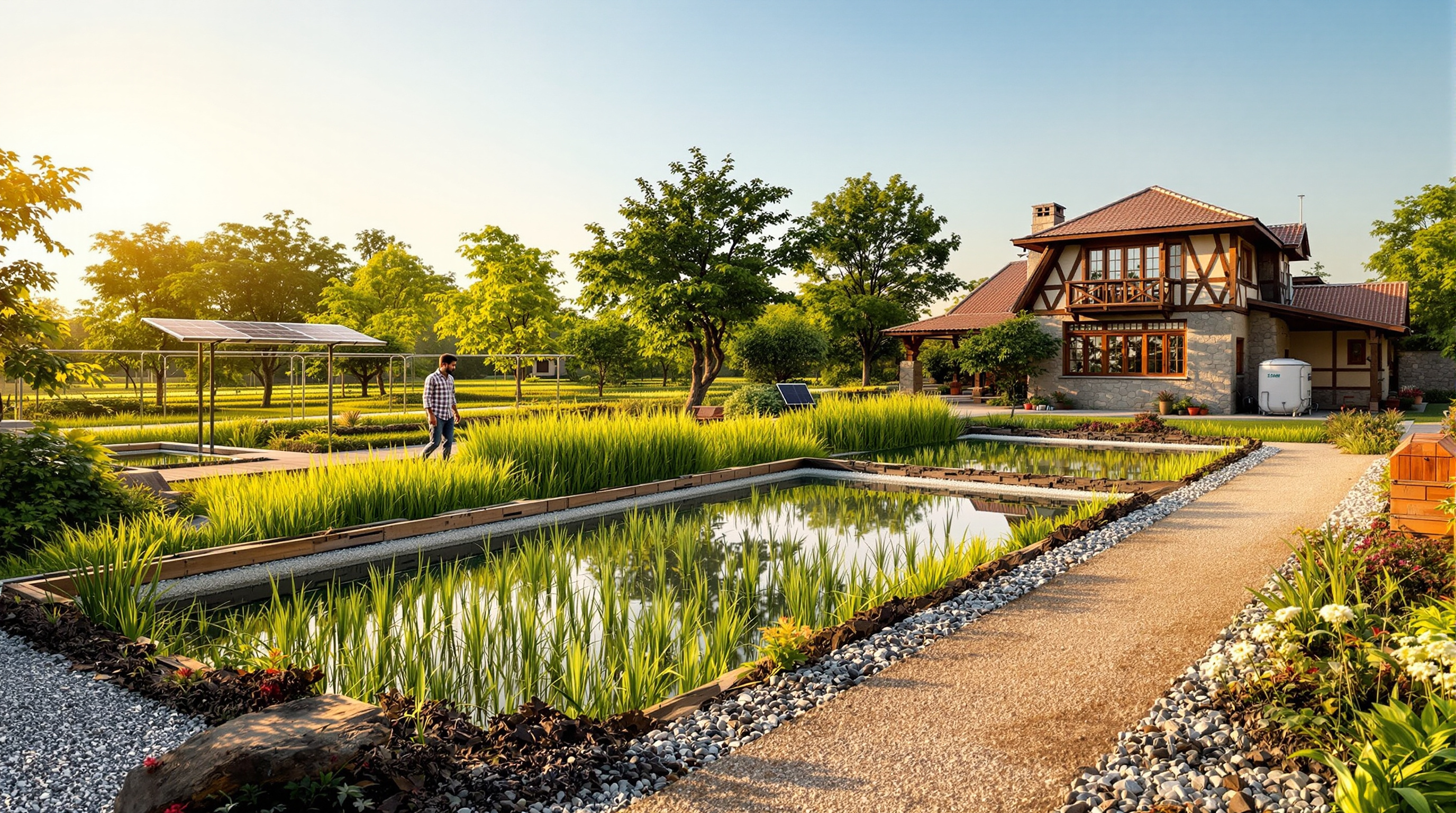
STP for Farmhouses: Off-Grid Wastewater Treatment & Reuse Guide
Farmhouses sit on big plots far from any municipal sewer, are used in bursts, and often run on weak or intermittent power. This guide covers the low-maintenance STP options that actually suit that reality — and how to reuse every drop for irrigation.
A farmhouse is a strange animal for a wastewater engineer. It has the plumbing load of a small hotel packed into a weekend, sits on land measured in acres, and almost never has a municipal sewer within reach. It may run for one loud weekend of twenty guests, then sit empty and silent for three weeks. And the grid power feeding it is often the weakest, most load-shedding-prone connection in the whole design.
Get the treatment choice wrong and you get the classic farmhouse failure: a fancy aeration plant whose bacterial culture starves and dies during the empty weeks, then can't cope when everyone arrives at once. Get it right and the farmhouse becomes what it should be — a nearly closed loop, where the water that flushed the toilets on Sunday is watering the mango trees by Wednesday.
A farmhouse STP is not a shrunken apartment plant. It is a different design problem: high peak load, long idle gaps, weak power, and an entire estate of thirsty landscape waiting to drink the treated water. Design for the gaps, not just the crowd.
This guide walks through the wastewater profile of a farmhouse, which technologies survive the intermittent-occupancy problem, how to size for feast-and-famine flow, and how to turn every litre into irrigation.
Why a farmhouse can't just use a septic tank
The default rural answer has always been a septic tank plus soak pit. For a caretaker's cottage that is genuinely fine. But a modern farmhouse — multiple bathrooms, a kitchen that cooks for parties, a swimming pool shower block, occasional overnight crowds — pushes far more organic load than a soak pit can absorb, and the goal has changed. You no longer just want the sewage to disappear into the ground; you want to reuse it on land that is often water-starved for half the year.
The distinction matters, and we cover it in depth in STP vs Septic Tank. In short: a septic tank stores and partially settles; an STP treats to a reusable standard. On a large plot where irrigation water is precious, that difference is the whole point.
The farmhouse wastewater profile
Before choosing a technology, understand what you are treating. Farmhouse sewage has three defining quirks:
- Feast-and-famine flow. Occupancy swings from zero to full in an evening. Flow is not the smooth daily curve of an apartment; it is a spike followed by a flat line of nothing. Any biological process must tolerate long starvation periods.
- Concentrated, kitchen-heavy load. Party cooking means high oil and grease and a punchy organic load (BOD) in short bursts. A good grease trap ahead of the plant is non-negotiable. For the underlying parameters, see Wastewater Characteristics: BOD, COD, TSS, pH.
- Weak or intermittent power. Continuous high-power aeration — the heart of a conventional plant — is exactly what a farmhouse cannot reliably feed. Power-hungry designs either trip out or burn diesel.
Add the low-caretaker-attention reality — nobody with a lab coat is checking the plant on a Tuesday — and the brief writes itself: low power, low maintenance, tolerant of idle gaps.
Which technology actually suits a farmhouse
There is no single answer, but the field narrows fast once you weight it for resilience during the empty weeks rather than raw efficiency.
| Option | How it copes with idle gaps | Power need | Maintenance | Best when |
|---|---|---|---|---|
| Constructed wetland (reed bed) | Excellent — plants survive dormancy, bounce back | Near zero (gravity/tiny pump) | Very low — occasional harvest | Land is available, load moderate |
| Packaged MBBR | Good — biofilm on carriers survives better than suspended sludge | Moderate (blower) | Low–moderate | Compact footprint, party peaks |
| SBR | Fair — batch cycles, but culture can starve | Moderate–high | Moderate | Steadier occupancy, skilled operator |
| Conventional ASP | Poor — suspended sludge dies when starved | High, continuous | High | Rarely right for a farmhouse |
| MBR | Fair, but membranes hate neglect/fouling | High | High (skilled) | Only if reuse quality must be very high |
Two winners emerge for most farmhouses.
Constructed wetlands — the low-maintenance champion
A constructed wetland is an engineered gravel bed planted with reeds (canna, phragmites, typha) through which pre-settled sewage flows horizontally or vertically. Microbes on the roots and gravel do the treatment; the plants keep the bed alive. It is close to the ideal farmhouse system: almost no moving parts, near-zero running power, and a biology that tolerates weeks of idleness because the plants simply wait. It also looks like landscaping rather than a plant.
The catch is land and load. A wetland needs area — very roughly a few square metres per person of design load — and prefers a moderate, not violently spiky, organic load. On a multi-acre farmhouse, land is the one resource you have, which is why wetlands fit so naturally here. Pair a septic/settling tank + grease trap upstream (primary treatment) with the wetland as the biological stage and you have a genuinely off-grid-friendly line.
Packaged MBBR — when footprint or peaks demand it
Where the crowd is large, the plot is landscaped tightly, or you want a compact skid-mounted unit, a packaged MBBR is the pragmatic choice. In a Moving Bed Biofilm Reactor, the bacteria grow as a biofilm on free-floating plastic carriers. That biofilm clings to the carriers and rides out starvation far better than the free-floating sludge of a conventional Activated Sludge Process or the delicate membranes of an MBR — which is precisely why MBBR suits intermittent occupancy. It still needs a blower, so pair it with solar or a reliable inverter, and it recovers quickly after a quiet fortnight. To see how it slots into the wider treatment train, How Does an STP Work and the Sewage Treatment Process Flow lay out the full stage-by-stage journey.
A common, robust farmhouse answer is a hybrid: a compact packaged unit (MBBR) handling the peaks, discharging to a constructed wetland or planted polishing bed that buffers the gaps and delivers irrigation-grade water — belt and braces, both low-power.
Sizing for feast and famine
Sizing a farmhouse plant is where engineers most often go wrong, because the textbook method assumes steady occupancy.
- Design for peak occupancy, not average. Size the biological capacity for a full house — the party weekend — using roughly 90–135 litres per person per day for a residential-style load. The Water Consumption Calculator and Sewage Generation Calculator turn a headcount into a design flow; the STP Capacity Calculator converts that into a plant capacity in KLD.
- Add generous equalisation buffering. A larger-than-usual equalisation tank smooths the party spike into a flow the plant can chew through over the following days, so you can size the biological stage for the averaged-out load rather than the instantaneous surge.
- Round up, then keep it simple. Most farmhouses land in the 2–10 KLD range. Resist the temptation to over-engineer with high-tech kit that needs a full-time operator.
- Plan the reuse storage. The treated water arrives in bursts too; a lined storage tank or pond lets you hold it and irrigate steadily through the dry idle weeks.
Power-light and off-grid choices

The farmhouse's weak power connection should shape the whole design:
- Favour gravity flow across the treatment train wherever the site's contours allow — every pump you delete is a failure point removed.
- Solar-power the blower and pumps. A modest PV array with battery backup comfortably runs an MBBR blower or a wetland's small circulation pump, cutting the plant loose from load-shedding and diesel.
- Choose blowers and pumps rated for stop-start life, and specify a control panel that ramps aeration down (not off) during idle periods to keep the culture just alive without wasting energy.
Reuse: closing the loop on the land

This is where a farmhouse STP pays for itself. The estate is one enormous irrigation demand, and treated water is a genuine asset:
- Drip and sub-surface irrigation of orchards, ornamental landscape and non-edible crops is the primary reuse — steady, low-evaporation, and safe if the water is treated and disinfected.
- Pond top-up and groundwater recharge for aquifer-starved plots.
- Toilet flushing and washdown back in the building, via a dual-plumbing line, as in home greywater recycling systems.
A word of caution on reuse standards: treated water used for unrestricted or edible-crop irrigation should be properly disinfected (UV or chlorination) and meet the relevant CPCB reuse expectations — do not spray under-treated water onto anything that reaches the kitchen. For most farmhouses, drip-feeding the ornamental and orchard landscape is the safe, high-value sweet spot.
Common farmhouse mistakes to avoid
- Buying an apartment-style ASP plant whose sludge culture dies during the empty weeks, then smells and underperforms when reoccupied. Choose biofilm or wetland processes that survive starvation.
- Skipping the grease trap. Party-kitchen fats will blind a wetland and foul carriers fast.
- Sizing on average occupancy and then drowning the plant on the first big weekend.
- Ignoring the power reality — specifying continuous high-kW aeration on a connection that load-sheds daily.
- No reuse plan. Treating the water and then soaking it away wastes the entire advantage of being on a large, thirsty plot.
The bottom line
A farmhouse rewards the engineer who designs for its rhythm rather than fighting it. Match the intermittent, party-peak, weak-power reality with a low-maintenance, starvation-tolerant process — a constructed wetland, a packaged MBBR, or a hybrid of the two — size it for the peak with a big equalisation buffer, run it light on solar, and pipe every treated litre back into the land. Done well, the farmhouse stops importing tanker water and starts irrigating itself.
To go deeper on the fundamentals, start with What is a Sewage Treatment Plant and browse the full Sewage Treatment Plants guide library; to put numbers on your own plot, the STP Capacity Calculator is the fastest first step.
Export this guide
Related Guides — Deep-dive reading
STP for Hotels: High Per-Guest Loads, FOG & Water Reuse Explained
Why hotel wastewater is heavier and swingier than an apartment's, which STP technology (MBBR vs MBR) actually fits, how to size for peak occupancy, and where the treated water pays for itself — in laundry, cooling and landscape.
Sewage Treatment PlantsSTP for Schools, Colleges & Universities: A Campus Design Guide
Why educational-campus sewage swings hard between packed term-time days and empty vacations, which STP technology handles that rhythm, how to size for peaky daytime flow, and how to reuse treated water on grounds — with O&M simple enough for a campus caretaker.
Sewage Treatment PlantsConstructed Wetlands & Root Zone Systems: Natural STPs Explained
How engineered gravel beds planted with reeds and canna clean sewage using roots and microbes instead of blowers and motors — the low-energy, low-maintenance natural STP, and exactly where it fits in India.
Sewage Treatment PlantsRelated Tools — Try Free
Rainwater Tank Sizer
How big should your rainwater tank be? Computes annual harvest, recommended tank capacity in litres, water-bill savings, and payback — for 10 Indian cities.
RWH CalculatorApartment STP Planner
Plan an apartment complex sewage treatment plant from flats and occupancy — get population load, sewage flow, recommended STP capacity in KLD, treatment technology and approximate space.
PlannerSewage Generation Calculator
Estimate the daily sewage a building generates and its peak flow in KLD from occupancy, LPCD, sewage return factor and peak factor.
STP Calculator